 Jan 24, 2026
Table of Contents
Outsourced IT for small businesses has become less of a cost-cutting tactic and more of a growth strategy. From what we’ve seen working with small teams across different industries, technology quickly becomes a bottleneck once the business starts moving faster than its internal IT capacity. Hiring is slow, expertise is fragmented, and founders often end up wearing the “temporary IT manager” hat—usually longer than they should.
This guide is written from hands-on experience supporting small businesses through that transition. We’ll walk through what IT outsourcing really means in practice, when it makes sense, what services bring the most value, and how to choose the right partner—without overcomplicating things or pushing enterprise-level solutions where they don’t belong.
Understanding IT Outsourcing
IT outsourcing means partnering with an external technology provider to handle part or all of your IT work—so your business can focus on growth instead of managing technical complexity. From our experience working with small businesses, outsourcing is rarely about “cutting costs only.” It’s more often about gaining capability, speed, and reliability that would be hard to build in-house.
In practical terms, IT outsourcing can cover many things: software development, system maintenance, cloud management, cybersecurity, helpdesk support, or even a full remote development team. Instead of hiring, training, and retaining full-time IT staff, you work with a partner that already has the skills, processes, and tools in place. For a small business, this reduces operational burden and shortens the time it takes to turn ideas into working systems.
A simple example from real projects:
We once worked with a small retail company that wanted to launch an online ordering system. Hiring an internal IT team would have taken months and stretched their budget. By outsourcing the development and infrastructure setup, they launched in a few weeks, paid only for the skills they needed, and scaled the system as demand grew. Their internal team stayed focused on sales and operations, while we handled the technical side. That’s the core value of IT outsourcing when it’s done right.
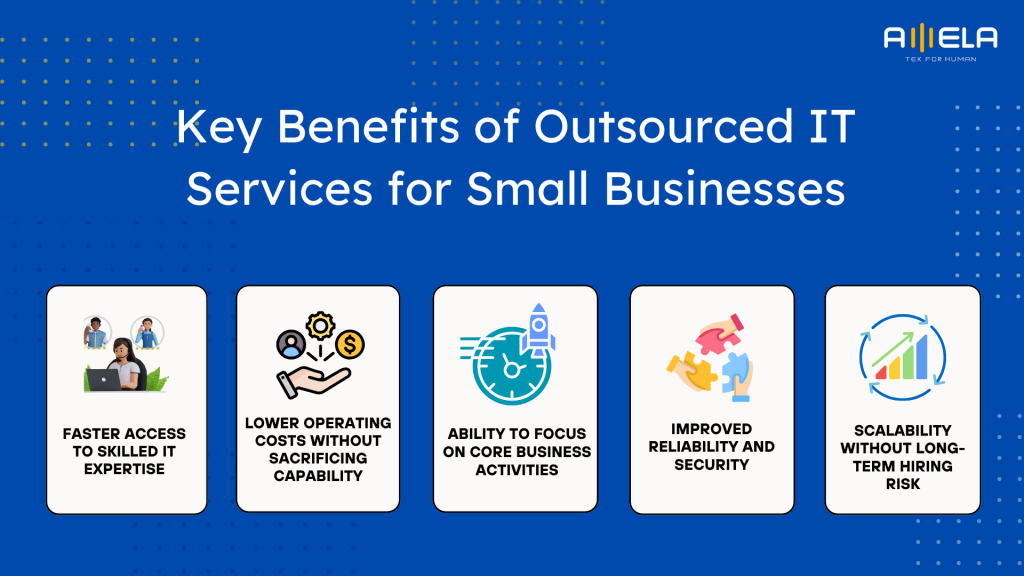
Key Benefits of Outsourced IT Services for Small Businesses
From our experience working with small and growing businesses, outsourced IT is less about “doing IT cheaper” and more about removing bottlenecks that slow the business down. Below are the benefits we see most consistently in real projects, backed by reliable data.
- Lower operating costs without sacrificing capability
Small businesses often can’t justify the cost of hiring full-time specialists across development, infrastructure, and security. Outsourcing allows you to access the same skill sets on a pay-for-what-you-use basis. According to Deloitte’s Global Outsourcing Survey, cost reduction remains the top driver for IT outsourcing, with many organizations reporting savings of 20–30% compared to in-house setups.
- Faster access to skilled IT expertise
Hiring experienced developers, cloud engineers, or security specialists can take months—if you can find them at all. With outsourced IT services, small businesses gain immediate access to ready-to-work teams. The U.S. Bureau of Labor Statistics projects that demand for software developers will grow much faster than average, making competition for talent even tougher for small firms.
- Ability to focus on core business activities
When IT issues pile up, founders and managers often become accidental IT coordinators. Outsourcing shifts that responsibility away from internal teams, allowing them to focus on sales, operations, and customer experience. In our projects, this focus shift alone often delivers more value than the technical work itself.
- Scalability without long-term hiring risk
Small businesses rarely grow in a straight line. Outsourced IT services make it easier to scale up during growth periods and scale down during quieter phases—without layoffs or idle staff. Gartner highlights that flexible sourcing models help organizations adapt faster to changing business conditions, especially during uncertain economic cycles.
- Improved reliability and security
Many small businesses struggle to keep systems secure and up to date due to limited internal expertise. Outsourcing to experienced IT providers brings established security practices, monitoring, and maintenance processes. IBM’s Cost of a Data Breach report shows that organizations with mature security practices reduce breach costs significantly, underscoring the value of professional IT management.
- Predictable IT spending and fewer surprises
Instead of unpredictable expenses caused by system failures or rushed hiring, outsourcing converts IT into a more predictable operating cost. From experience, this predictability helps small businesses plan better and avoid reactive, last-minute decisions.
From the field: The biggest benefit of outsourced IT for small businesses we see is confidence. Small businesses that outsource IT stop worrying about whether their systems will hold up—and start using technology as a growth tool rather than a constant source of stress.
Top 15 Outsourced IT Services for Small Businesses
From our experience working closely with small businesses across different stages, outsourced IT services for SMEs are most valuable when they directly solve day-to-day operational pain, reduce risk, and unlock growth capacity. Below is a deeper look at how each service actually supports small businesses in real-life scenarios.
1. Managed IT Services
Managed IT services act as an external IT department. They continuously monitor systems, apply updates, manage infrastructure, and prevent incidents before they impact operations. For small businesses, this removes the constant fear of “something breaking” and eliminates reactive firefighting, allowing leadership to focus on running the business.
2. IT Support & Maintenance
Outsourced IT support ensures employees receive fast help for technical issues such as system errors, access problems, or device failures. This reduces downtime, improves employee productivity, and prevents small technical issues from escalating into business disruptions.
3. Custom Software Development
Many small businesses rely on spreadsheets or disconnected tools. Outsourcing custom software development helps replace manual workflows with tailored systems—such as internal dashboards, order management tools, or automation scripts—that reduce errors and scale with business growth.
4. Dedicated IT Development Team
An outsourced development team provides consistent, long-term development capacity. Small businesses benefit from predictable costs, stable knowledge retention, and faster iteration compared to repeatedly hiring freelancers or contractors who lack long-term context.
5. Web Application Development
Outsourced web application development services supports customer portals, booking systems, admin dashboards, or partner platforms. These applications improve customer experience, centralize operations, and enable small businesses to offer digital services without building internal engineering teams.
6. Mobile App Development
Mobile apps often become key customer touchpoints. Outsourcing mobile development allows small businesses to launch and maintain iOS and Android apps quickly, without the overhead of hiring specialized mobile engineers or managing multiple platforms internally.
7. Cloud Infrastructure & DevOps Services
Cloud and DevOps outsourcing helps small businesses set up scalable, secure infrastructure from the start. This includes cloud migration, deployment automation, monitoring, and cost optimization—preventing performance bottlenecks and unexpected cloud expenses as usage grows.
8. Cybersecurity Services
Small businesses are frequent targets for cyberattacks due to limited internal defenses. Outsourced cybersecurity services provide vulnerability assessments, monitoring, incident response, and compliance support—protecting customer data and business reputation without internal security teams.
9. Data Analytics & Business Intelligence
Outsourced analytics services help small businesses make sense of operational and customer data. Dashboards, reporting systems, and basic predictive analysis support better decisions around sales, marketing, inventory, and resource allocation.
10. IT Consulting & Technology Strategy
IT consulting helps small businesses avoid costly technology mistakes. External experts provide guidance on platform selection, system architecture, digital transformation, and long-term IT roadmaps—ensuring technology decisions align with business goals.
11. ERP & CRM Implementation
ERP and CRM systems can dramatically improve efficiency, but poor implementation often causes disruption. Outsourcing these implementations ensures systems are configured around real workflows, improving sales tracking, customer management, and operational visibility.
12. System Integration Services
As businesses grow, disconnected systems create data silos and manual work. Outsourced integration services connect accounting, inventory, sales, and logistics platforms, enabling seamless data flow and reducing operational friction.
13. QA & Software Testing
Outsourced QA teams help maintain software quality by identifying bugs, performance issues, and usability problems early. For small businesses, this protects customer trust and reduces the risk of costly production failures.
14. Legacy System Modernization
Many small businesses rely on outdated systems that limit scalability. Outsourced modernization services gradually refactor or migrate legacy applications, improving performance and security without interrupting daily operations.
15. IT Staffing & Staff Augmentation
When immediate or specialized expertise is required, IT staff augmentation services provides flexibility. Small businesses can quickly access skilled developers, cloud engineers, or security specialists without long-term hiring commitments or recruitment overhead.
The most successful small businesses use outsourced IT services as a strategic extension of their team, not a last-resort cost-saving tactic. When chosen carefully, outsourcing turns IT from a constant operational burden into a stable foundation for sustainable growth.
When to Outsource IT for Small Businesses?
From our experience working with small businesses, the decision to outsource IT usually doesn’t start with a grand strategy—it starts with a quiet realization that IT is getting in the way instead of helping. We’ve seen this pattern many times, and the signals are surprisingly consistent.
- When IT keeps pulling you away from the business
The moment founders or managers start acting as part-time IT coordinators, something’s off. We’ve worked with teams where leadership spent hours chasing bugs, managing freelancers, or fixing system issues. Outsourcing at this point is honestly a lifesaver—it puts IT back where it belongs and lets the business focus on growth.
- When hiring internally just doesn’t make sense anymore
Small businesses often reach a stage where they need real technical depth, but hiring full-time developers, DevOps, or security specialists feels heavy and risky. We see outsourcing work best here because you get immediate access to skills without committing to long-term payroll. It’s a practical move, not a shortcut.
- When growth starts exposing technical cracks
Growth is great—until systems can’t keep up. We’ve seen order systems slow down, integrations break, and manual processes spiral out of control as volume increases. Outsourcing at this stage helps stabilize things fast, before tech debt turns into a serious headache.
- When projects stop being “one-off”
Freelancers are fine for small tasks, but once development becomes ongoing—new features, updates, integrations—it’s a different game. From our side, a dedicated outsourced team brings continuity and accountability that ad-hoc setups just can’t match. It’s smoother, cleaner, and way less stressful.
- When security and uptime become non-negotiable
As soon as customer data, online payments, or internal systems become business-critical, there’s no room for guesswork. We’ve seen small businesses outsource security and infrastructure simply because the risk of getting it wrong is too high. That peace of mind is worth it.
- When IT spending feels unpredictable and reactive
Emergency fixes, rushed hires, and last-minute changes are a money drain. Outsourcing helps turn chaos into a predictable operating cost. From experience, that predictability alone makes planning and decision-making a lot saner.
- When speed matters more than perfection
Sometimes you just need to move fast—launch a product, test a market, or digitize operations. Outsourcing removes internal bottlenecks and gets things moving. It’s not about cutting corners; it’s about momentum. Pretty clutch, honestly.
The best time to outsource IT is before things break. Small businesses that act early use outsourcing as a growth lever. Those that wait usually outsource under pressure—and that’s never the chill way to do it.
Tips for Choosing the Right IT Outsourcing Partner for Small Businesses
From our experience working with small businesses—and also seeing projects that went sideways—the partner you choose matters just as much as what you outsource. A good outsourcing partner feels like an extension of your team. A bad one creates more work than they remove. Here are the tips we usually share, based on what actually works in practice.
- Look for business understanding, not just technical skills
Strong technical skills are table stakes. What really separates good partners is their ability to understand your business model, constraints, and priorities. We’ve seen projects succeed simply because the partner asked the right “why” questions early. If a vendor jumps straight into solutions without understanding your business, that’s a red flag.
- Check for experience with small businesses, not only big logos
Enterprise experience sounds impressive, but small businesses operate differently. Budgets are tighter, decisions move faster, and priorities shift quickly. From experience, partners who have worked with small businesses understand how to balance speed, cost, and pragmatism without overengineering. That fit matters a lot.
- Evaluate communication style early
Communication issues rarely improve over time. We always recommend paying attention to how clearly and proactively a partner communicates during early discussions. If explanations are vague or responses are slow at the start, things usually don’t get better later. Clear communication upfront is a huge green flag.
- Ask how they handle change and uncertainty
Small businesses evolve fast—roadmaps change, priorities shift, and assumptions break. A solid outsourcing partner is comfortable with that and has processes to manage change without constant friction. If a vendor seems rigid or defensive about changes, it’s probably going to be painful down the line.
- Understand their delivery and quality process
Don’t be shy about asking how work is planned, reviewed, tested, and delivered. From our side, the best partnerships are built when both sides understand how quality is maintained. You don’t need heavy process, but you do need consistency and accountability.
- Start small before going all in
One of the safest moves we’ve seen is starting with a pilot project or a small scope. This gives you a real feel for how the partner works—communication, reliability, problem-solving—before committing long-term. Think of it as a low-risk test drive. Pretty smart, honestly.
- Be clear about ownership and long-term expectations
Small businesses often plan to scale. Make sure the partner is comfortable growing with you—more scope, more users, more complexity. Clarifying ownership, documentation, and knowledge transfer early avoids painful transitions later.
Practical takeaway from experience:
The right IT outsourcing partner doesn’t just deliver tasks—they reduce uncertainty. When communication feels easy, decisions move faster, and problems get solved without drama, you’re probably working with the right team.
Conclusion
Outsourced IT for small businesses works best when it’s treated as a long-term capability decision, not a last-minute fix. The teams that get the most value are the ones that outsource early enough to stay focused, move faster, and avoid technical debt piling up quietly in the background. When IT is stable, scalable, and handled by the right partner, small businesses gain room to grow without constantly worrying about what might break next.
From our experience supporting global clients, a good outsourcing setup isn’t about handing things off blindly—it’s about building a reliable extension of your team. If you’re looking to strengthen your IT foundation, scale development, or simply reduce day-to-day technical friction, working with an experienced outsourcing partner can make that path a lot smoother. A small move in the right direction here can unlock much bigger wins down the line.
FAQs About Outsourced IT Services for Small Businesses
Below are the questions we hear most often from small business owners when they’re considering IT outsourcing. These answers come directly from real conversations and project experience—not theory.
How much does IT outsourcing cost for a small business?
It depends on the scope and model. In practice, small businesses usually spend less than hiring in-house, especially when multiple skill sets are needed. IT Outsourcing Costs can range from a few thousand dollars per month for managed IT support to higher budgets for dedicated development teams. The key advantage is paying only for what you need, when you need it—without long-term hiring commitments.
Is IT outsourcing only about cost savings?
Not really. Cost is part of it, but speed, access to expertise, and reduced risk matter more. From our experience, businesses that outsource purely to cut costs often struggle. Those that outsource to move faster and stay focused usually get much better results.
What IT services should a small business outsource first?
Most small businesses start with IT support, managed IT services, or software development. These areas remove daily operational friction quickly. Over time, as the business grows, services like cloud management, security, or data analytics often follow naturally.
What are the biggest challenges of IT outsourcing?
The biggest challenges are usually communication gaps, unclear expectations, and poor partner selection. Technology problems are rarely the main issue. When roles, goals, and decision-making aren’t clear, friction builds up. Choosing the right partner and setting expectations early makes a huge difference.
Is IT outsourcing safe for sensitive data?
Yes, but only if security is taken seriously. A reliable outsourcing partner should follow security best practices, access controls, and compliance requirements. From experience, professional IT providers often have stronger security processes than small businesses running IT on their own.
Should startups and very small businesses outsource IT?
In many cases, yes. For startups and very small teams, outsourcing avoids early hiring mistakes and preserves cash flow. The key is keeping scope focused and choosing a partner who understands early-stage constraints.