
 Jan 29, 2026
Table of Contents
To outsource web development is no longer a tactical cost move—it is a strategic decision to build faster, scale smarter, and reduce delivery risk. From our experience working with global clients, companies that outsource effectively gain access to proven expertise while keeping internal teams focused on growth and product direction.
What is Outsourcing Web Development?
Outsourcing web development means partnering with an external team to design, build, maintain, or scale your website instead of relying entirely on in-house developers. From our experience, it’s less about “sending work away” and more about extending your technical capability fast and safely.
A Growing Market Driven by Digital Demand
Outsourcing isn’t a niche anymore — it’s a central part of how modern software gets built:
- The enterprise web development outsourcing services market is forecast to grow from USD 1.4 billion in 2025 to USD 2.6 billion by 2035 at a 6.5 % CAGR, reflecting steady expansion in tailored web solutions across regulated industries like finance, retail, and telecom.
- More broadly, the global web development services market — which encompasses both in-house and outsourced work — was valued at USD 80.6 billion in 2025 and is expected to grow by nearly 9 % annually through 2031, largely due to ongoing digital transformation, cloud adoption, and rising AI integration demands.
- The wider IT outsourcing landscape — of which web development is a key component — projects continued robust growth through the decade, with overall outsourcing revenues climbing significantly through 2034.
These growth figures resonate with what we see in client demand: more companies want specialized skills, faster turnaround, and flexible resourcing, all without locking themselves into long-term internal hiring cycles.
Why Businesses Outsource Web Development?
Outsourcing web development helps companies build faster, access proven expertise, and control delivery risk. These benefits compound when outsourcing is treated as a long-term capability, not a one-off shortcut.
Faster Time to Market
The biggest win we see is speed with structure. Outsourced teams come pre-trained, tool-ready, and process-aligned. There’s no long hiring ramp or internal reshuffle.
From real projects we’ve delivered, outsourcing typically:
- Cuts initial delivery time by 30–50% compared to an in-house team setup
- Enables parallel development (frontend, backend, QA running together)
- Reduces rework thanks to teams that have solved similar problems before
When deadlines are real, and the market won’t wait, this speed matters. A lot.
Access to Specialized Web Expertise
Outsourcing gives you immediate access to:
- Senior frontend engineers (React, Next.js, Vue)
- Backend specialists (Node.js, Java, .NET, scalable APIs)
- DevOps, cloud, security, and performance optimization skills
We’ve seen clients struggle for months to hire niche skills internally. With outsourcing, those skills are available in weeks or days. No drama.
>>> Related: Outsourcing NET Development: A Complete Guide
Predictable and Lower Total Cost of Ownership
Cost saving is real, but predictability is the hidden benefit. Instead of variable internal costs (recruitment, attrition, idle time), outsourcing offers:
- Clear rate cards and delivery estimates
- Lower overhead (no hiring, HR, training, bench cost)
- Better cost-to-output ratio for non-core engineering work
From experience, companies often save 25–60% in total web development cost, especially for long-running or multi-phase platforms. That’s not “cheap labor”—that’s operational efficiency.
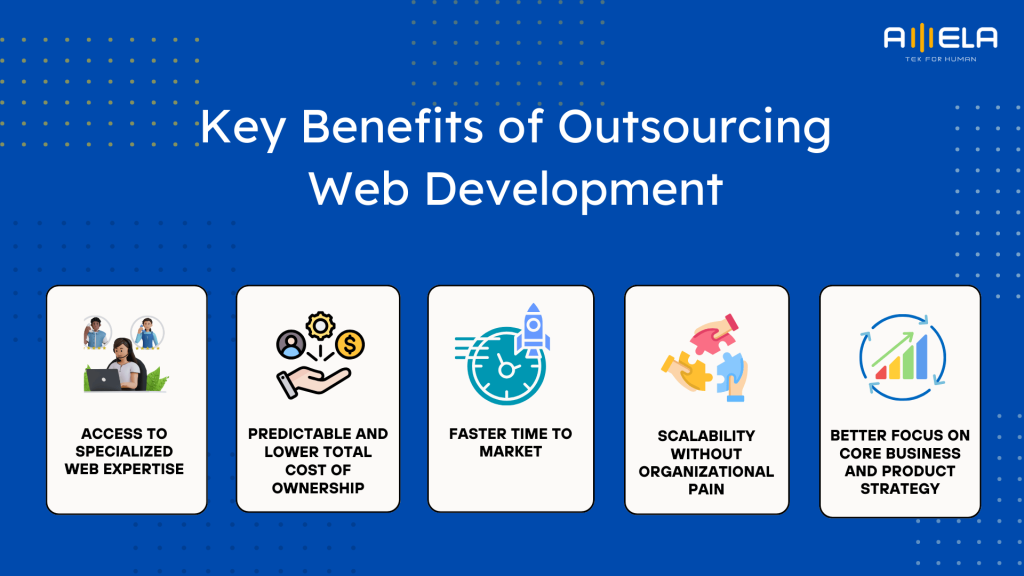
Scalability Without Organizational Pain
Scaling an internal team is slow. Scaling an outsourced team is… easy. That’s the truth.
Outsourcing allows you to:
- Scale up during feature-heavy phases
- Scale down after launch or stabilization
- Adjust team composition as the product evolves
We’ve supported clients who doubled their development capacity in under a month—something that would be nearly impossible internally without burning people out.
Better Focus on Core Business and Product Strategy
Your internal team should think, not just code.
When web development execution is outsourced:
- Founders focus on growth and customers
- Product leaders focus on the roadmap and outcomes
- Internal tech leads focus on architecture and governance
This separation of concerns improves decision quality. We’ve seen teams make sharper product calls once they’re no longer buried in day-to-day delivery noise.
Reduced Delivery and Technical Risk
Here’s a counterintuitive one: outsourcing can actually lower risk.
Why?
- Mature vendors bring battle-tested processes
- QA, security, and code review are built in
- Early risk signals are identified faster
From our side, projects fail less when expectations, ownership, and communication are explicit from day one. Outsourcing doesn’t remove responsibility—it clarifies it.
Flexibility in Engagement Models
Outsourcing web development is not one-size-fits-all. You can choose:
- Project-based delivery for fixed scope launches
- Offshore Dedicated teams for long-term products
- Staff augmentation for skill gaps
That flexibility lets companies adapt their delivery model as the business evolves—without rewriting org charts every six months.
Bottom line: outsourcing web development is not about “doing it cheaper somewhere else.” It’s about building with leverage—using experienced teams, proven processes, and flexible capacity to move faster and smarter. Done right, it’s a growth accelerator, not a compromise.
Outsourcing Web Development Process
A high-performing outsourcing web development process turns uncertainty into controlled execution by locking down goals, governance, and quality gates before serious coding starts.
1. Define Requirements as Outcomes, Not Features
Most outsourcing problems begin when requirements describe pages and functions but skip the business outcome. When I run discovery, I start with measurable goals: conversion targets, onboarding completion, content publishing speed, checkout drop-off, or internal workflow time saved. Then I map those goals to user journeys and only after that do we translate needs into features. This approach prevents a common trap where teams build a “complete” website that still fails to move business metrics.
Deep requirement definition includes the non-obvious constraints: compliance rules, SEO requirements, expected traffic spikes, latency targets by region, integration boundaries, and the “must not break” list for existing systems. If a website depends on CRM, payment gateways, ERP, or SSO, I treat those as first-class requirements because integration complexity can quietly dominate timeline and website development cost. The best requirements are not long; they are precise, prioritized, and testable.
2. Decide What to Outsource by Mapping Ownership and Risk
Outsourcing is not a binary decision. In practice, we decide what to outsource based on risk concentration and internal capability. If a client has strong product ownership but limited engineering bandwidth, outsourcing execution makes sense while keeping decision-making internal. If a client lacks web architecture leadership, outsourcing can cover architecture and implementation, but governance must be tighter because architectural mistakes are expensive to reverse.
I often suggest a RACI-style ownership map early: who is Responsible, Accountable, Consulted, and Informed for product decisions, code quality, releases, security, and incident response. Without that map, clients unintentionally outsource responsibility while expecting control, and the vendor unintentionally takes control without owning outcomes. That mismatch becomes the real issue, not distance or timezone.
3. Choose the Outsourcing Model Based on Change Rate
The best outsourcing model depends on how fast requirements will change. If scope is stable and the website is a defined launch, project-based outsourcing works because it optimizes predictability. If scope will evolve through feedback cycles, a dedicated team model is safer because it keeps context and reduces re-onboarding costs. If the client already has a mature product team but needs extra hands or niche skills, staff augmentation is the most efficient because it preserves internal delivery structure.
4. Select a Partner Using Engineering Signals, Not Sales Signals
When it comes to IT vendor selection criteria, most buyers focus on portfolio screenshots and hourly rates. I look for engineering signals that predict delivery quality: how they estimate, how they handle unknowns, how they test, and how they communicate bad news. A good partner will ask uncomfortable questions early: unclear requirements, missing data sources, unrealistic launch dates, or inconsistent stakeholder inputs. If a vendor agrees too easily, that’s usually a warning sign.
I also recommend checking for operational maturity: version control discipline, code review standards, CI/CD practices, environment management, and how they document decisions. A strong partner can explain how they prevent regressions, how they manage releases, and how they handle security fixes. That is what determines whether outsourcing becomes leverage or chaos.
5. Align Governance: Scope Control, Quality Gates, and Decision Rights
This step is where outsourcing becomes predictable. Before build, I align three things explicitly: how scope changes are proposed and approved, what quality gates must be passed before anything is “done,” and who has final decision rights. Without these, outsourcing creates accidental scope creep and delayed approvals that look like “vendor slowness” but are actually process gaps.
Quality gates should be concrete. Examples include acceptance criteria per user story, performance budgets, accessibility baseline, security checks, and test coverage expectations for critical flows. For web development, I also push for SEO and analytics gates: correct indexing rules, structured data where needed, tracking plan validation, and consent management compliance if relevant. These gates protect business outcomes, not just code correctness.
6. Execute with Tight Feedback Loops and Visible Progress
Outsourcing fails when feedback arrives late and progress is invisible. In delivery, I prefer weekly demos because they force alignment around real working software. We combine that with shared tracking, clear sprint goals, and decision logs so the team doesn’t relitigate the same discussions. This keeps momentum and reduces “lost in translation” issues that people wrongly blame on outsourcing.
This phase also needs operational discipline: branching strategy, code reviews, staging environments, and release cadence. The goal is to make progress measurable and reversible. If every release feels scary, the process is broken. If releases become routine, outsourcing becomes scalable.
7. Launch with a Stability Plan and a Maintenance Contract, Not a Handover Document
A website launch is a systems event, not a file transfer. The process must include release readiness: load testing for expected traffic, rollback planning, monitoring dashboards, and an incident workflow with response times. From experience, many “successful” launches become painful because no one defined who fixes what in the first two weeks after go-live.
Post-launch planning should cover warranty, bug triage rules, and a maintenance rhythm. If the website is tied to marketing campaigns, content updates, or new features, then maintenance is not optional. A clean process treats launch as the start of an operating cycle, not the end of a project.
>>> Related: IT Outsourcing Guide
Top Outsourced Web Development Companies
Choosing an outsourced web development partner becomes much easier when you compare delivery focus, engagement style, and best-fit use cases side by side. Here’s the top 5 list:
| Company | Delivery Focus | Engagement Models | Best For | Key Strengths | Typical Limitations |
| AMELA Technology | End-to-end web development & long-term product delivery | Project-based, Dedicated Team, Staff Augmentation | Startups, SMEs, and enterprises needing reliable execution | Strong modern web stack, clear governance, Japan & global market experience, cost-efficient | Not positioned as a pure consulting firm |
| Toptal | Individual expert developers | Freelance staffing | Companies with strong internal tech leadership | Fast access to senior engineers, flexible hiring | No full project ownership, limited delivery governance |
| BairesDev | Large-scale development capacity | Dedicated teams, Staff Augmentation | US-focused companies needing scale | Large talent pool, broad tech coverage | Less flexible for highly customized processes |
| EPAM Systems | Enterprise digital platforms | Long-term enterprise engagements | Large enterprises with complex ecosystems | Deep engineering maturity, strong enterprise governance | High cost, slower decision cycles |
| Thoughtworks | Consulting-led software delivery | Consulting + Delivery | Organizations undergoing transformation | Strong architecture, product thinking, engineering culture | Premium pricing, not execution-only focused |
Web Development Services You Can Outsource
Below is a practical breakdown of the most commonly outsourced web development services, explained from real project usage—not theory.
Frontend Development
Frontend development is one of the most frequently outsourced services because it requires deep expertise in modern web frameworks and performance optimization. External teams typically handle UI implementation using technologies like React, Next.js, Vue, or Angular, translating design systems into fast, accessible, and SEO-friendly interfaces. In practice, outsourcing frontend work helps teams avoid long ramp-up time and ensures consistent quality across devices and browsers.
Backend Development
Backend development is often outsourced when systems require scalability, security, or complex integrations. This includes building APIs, business logic, authentication layers, and data processing workflows using Node.js, Java, .NET, PHP or similar stacks. From experience, outsourcing backend work is especially effective when internal teams lack exposure to high-load systems or cloud-native architectures.
>>> Related: Outsourcing PHP Website Development Guide
Full-Stack Web Development
Many companies choose to outsource full-stack development to a single partner to reduce coordination overhead. In this model, one team handles frontend, backend, database design, and basic DevOps. This works well for startups and SMEs launching new products, where speed and accountability matter more than splitting responsibilities across multiple vendors.
UI/UX Design and Design Systems
UI/UX design is frequently outsourced alongside development to ensure alignment between design intent and technical execution. External design teams typically cover user research, wireframes, prototypes, usability testing, and design systems. From real projects, we’ve seen better results when design and development teams collaborate closely instead of operating in silos.
CMS Development and Content Platforms
CMS development is commonly outsourced for marketing-driven websites and content-heavy platforms. This includes building and customizing systems based on WordPress, headless CMSs, or enterprise platforms. Outsourcing CMS work helps teams move faster on content updates, localization, and SEO optimization without heavy internal engineering involvement.
Web Application Development
Beyond marketing sites, many companies outsource full web applications such as dashboards, internal tools, SaaS platforms, and customer portals. These projects usually involve role-based access, data visualization, integrations, and ongoing iteration. From experience, outsourcing web app development services works best with dedicated teams and long-term engagement models.
API Development and System Integration
API development and third-party integration are often outsourced because they require careful handling of data flows and edge cases. This includes payment gateways, CRM systems, ERP platforms, analytics tools, and external services. Outsourcing this layer reduces integration risk and speeds up system interoperability when done by experienced engineers.
DevOps, Cloud Setup, and Deployment
Many companies outsource DevOps and cloud services to avoid building specialized internal roles. These services include cloud infrastructure setup, CI/CD pipelines, environment management, monitoring, and performance tuning. In practice, outsourcing DevOps early prevents deployment bottlenecks and improves long-term system stability.
Quality Assurance and Testing
QA and testing are commonly outsourced to ensure objectivity and coverage. External QA teams typically handle functional testing, regression testing, performance testing, and security checks. From delivery experience, independent QA significantly reduces post-launch issues and protects business reputation—especially under tight timelines.
Website Maintenance and Ongoing Support
Post-launch maintenance is one of the most overlooked but most valuable services to outsource. This includes bug fixes, performance optimization, security updates, content support, and incremental improvements. Outsourcing maintenance allows internal teams to stay focused on growth while ensuring the website remains stable and secure.
From experience, the decision is less about what can be outsourced and more about where outsourcing creates the most leverage. Execution-heavy, specialized, or time-sensitive services are usually the best candidates, while strategic ownership often stays in-house.
Ways of Outsourcing Web Development
Onshore, nearshore, and offshore outsourcing differ mainly in cost, communication style, and scalability. A side-by-side comparison makes it easier to see which model fits your delivery reality and risk tolerance.
| Outsourcing Model | Definition | Cost Level | Communication & Time Zone | Talent Scalability | Best Fit Scenarios | Key Trade-offs |
| Onshore | Development team located in the same country as the client | High | Same language, same working hours | Limited | Discovery phases, regulated industries, high stakeholder interaction | Highest cost, limited talent pool, slower scaling |
| Nearshore | Team located in a nearby or neighboring country | Medium–High | Partial time zone overlap, cultural similarity | Moderate | Projects needing frequent collaboration with some cost control | Higher cost than offshore, smaller talent pools |
| Offshore | Team located in a distant region (e.g., Asia, Eastern Europe) | Low–Medium | Limited overlap, structured communication needed | High | Long-term delivery, scalable platforms, cost-sensitive projects | Requires strong process and governance |
Many teams succeed with a hybrid setup, using onshore or nearshore roles for product ownership and offshore teams for execution. This approach keeps control close while maximizing delivery efficiency.
Web Development Team Structure in Outsourcing Projects
A well-structured outsourced web development team balances speed, quality, and accountability by clearly separating roles while keeping collaboration tight. Below is how an effective outsourced development team is typically structured, and why each role matters in real projects.
- Product Owner / Business Representative
In successful outsourcing engagements, the client always retains a clear product owner or business representative. This role defines priorities, clarifies business logic, and makes final decisions when trade-offs arise. From experience, projects slow down dramatically when this role is missing or shared across too many stakeholders. A single, empowered decision-maker keeps momentum and prevents conflicting instructions.
- Project Manager or Delivery Manager
The project manager acts as the operational backbone of the outsourced team. This role plans timelines, manages scope, tracks risks, and ensures communication stays consistent. In practice, a strong PM translates business goals into executable plans and shields developers from noise, while keeping clients informed with clear, honest progress updates. When this role is weak, issues surface late and trust erodes fast.
- Technical Lead / Solution Architect
The technical lead is responsible for architecture decisions, code quality standards, and long-term maintainability. From experience, this role is critical in outsourcing because it prevents short-term delivery pressure from creating long-term technical debt. A good tech lead reviews designs, guides developers, and ensures the system can scale, integrate, and evolve without costly rewrites.
- Frontend Developers
Frontend developers focus on building user-facing interfaces that are fast, accessible, and consistent with design intent. In outsourced teams, frontend engineers typically work closely with designers and backend developers to implement responsive layouts, client-side logic, and SEO-friendly rendering. Strong frontend talent reduces UI bugs and improves user experience, which directly impacts business results.
- Backend Developers
Backend developers handle business logic, APIs, databases, authentication, and integrations. In real projects, they are responsible for performance, security, and data integrity—areas where mistakes are expensive. Outsourcing backend work is effective when developers have experience with scalable systems and understand how to design for future growth, not just current requirements.
- UI/UX Designers
Not all projects include dedicated designers, but when they do, results improve noticeably. UI/UX designers translate user needs into clear flows, wireframes, and design systems. From experience, involving designers early reduces rework, shortens development cycles, and aligns stakeholder expectations before code is written.
- Quality Assurance (QA) Engineers
QA engineers provide an independent check on functionality, usability, and stability. In outsourcing, QA is especially valuable because it catches issues that developers may overlook due to familiarity with the codebase. Effective QA reduces post-launch defects and protects the client’s brand—especially under tight deadlines.
- DevOps / Cloud Engineers
DevOps engineers support deployment, infrastructure, monitoring, and automation. While not always full-time, this role becomes critical for scalable or high-traffic websites. From experience, early DevOps involvement prevents last-minute deployment surprises and ensures the system is reliable after launch, not just during demos.
In outsourced web development, adding more people rarely fixes process issues. Clear roles, ownership, and communication paths matter far more than team size. When each role understands its responsibility and decision rights, outsourcing becomes predictable, scalable, and low-friction.
Outsourcing Web Development Cost
Web development outsourcing costs vary widely by region, project complexity, and team composition. Reliable research shows that location and expertise are the biggest drivers of pricing, and low hourly rates don’t always mean lower total cost. The figures below reflect aggregated industry data and market research from current outsourcing cost studies.
Estimated Outsourcing Cost by Project Phase & Complexity
| Project Phase | Simple Website (CMS/Basic) | Mid Complexity (Custom Site, Integrations) | High Complexity (Web App/SaaS) |
| Discovery & Requirements | $800 – $3,000 | $3,000 – $7,000 | $7,000 – $15,000 |
| UI/UX Design | $1,500 – $5,000 | $5,000 – $12,000 | $12,000 – $25,000 |
| Frontend Development | $3,000 – $8,000 | $8,000 – $20,000 | $20,000 – $45,000 |
| Backend Development | $2,500 – $6,000 | $10,000 – $30,000 | $30,000 – $80,000 |
| Integrations & APIs | Minimal | $3,000 – $10,000 | $10,000 – $30,000 |
| Testing & QA | $1,000 – $3,500 | $3,000 – $8,000 | $8,000 – $18,000 |
| Deployment & DevOps | $500 – $2,500 | $2,000 – $6,000 | $6,000 – $12,000 |
| Total Estimated Range | $10,000 – $30,000 | $35,000 – $90,000 | $100,000 – $225,000+ |
These ranges combine practical benchmarks and current market research. Many clients budgeting for complex outsourced web apps today use ranges similar to the mid and high complexity bands shown.
Typical Regional Web Developer Hourly Rates
| Region | Junior Dev | Mid-Level Dev | Senior Dev |
| North America / Western Europe | $80 – $120 | $100 – $150 | $120 – $250+ |
| Eastern Europe | $30 – $45 | $40 – $65 | $50 – $90 |
| Latin America (Nearshore) | $30 – $45 | $40 – $60 | $50 – $85 |
| Asia (South / Southeast Asia) | $15 – $30 | $25 – $45 | $35 – $70 |
Based on multiple outsourcing cost studies and regional rate comparisons.
Notes:
- Asia (Vietnam, India, Philippines) generally offers the lowest hourly rates with high cost efficiency for execution-oriented work.
- Eastern Europe balances quality and cost with strong engineering skills.
- Nearshore (Latin America) provides time-zone alignment with reasonable rates.
- Onshore (US/Western Europe) is the highest cost but often best for high-governance or regulated projects.
Factors That Significantly Affect Outsourcing Cost
Many variables influence the total cost of outsourcing web development beyond hourly rates. Understanding these helps you plan more accurately:
- Region & Location: Location affects basic rates due to living costs and local wage levels. For example, senior developers in the US/UK can cost multiple times more than their counterparts in Asia or Eastern Europe.
- Project Complexity & Feature Set: Simple brochure sites cost far less than custom platforms with integrations, role-based access, search, payments, real-time features, or admin dashboards. Complexity drives hours exponentially, not linearly.
- Technology Stack Modern frontend frameworks (e.g., React, Next.js), microservices, custom APIs, or cloud-native builds require more specialized skills and often higher rates.
- Team Composition & Seniority: Projects with more senior engineers, architects, or DevOps specialists cost more per hour but often reduce total hours by improving design and reducing rework.
- Engagement Model & Risk Buffer: Fixed-price contracts provide predictability but often include buffers for unknowns. Dedicated teams or time & materials contracts allow flexibility but require stronger governance.
- Hidden & Support Costs: Communication overhead, project management tools, testing, and integration efforts typically add 15–30% on top of base development estimates if not budgeted upfront.
Challenges of Outsourcing Web Development
Outsourcing web development introduces risks around communication, control, and execution quality—but these IT outsourcing challenges are predictable and manageable with the right structure.
Communication Gaps and Misaligned Expectations
One of the most cited challenges is communication breakdown. This usually happens when requirements are ambiguous, feedback cycles are slow, or decision ownership is unclear. Time zone differences can amplify the issue, but they are rarely the root cause. In practice, teams struggle when assumptions replace explicit documentation and when feedback is given late or indirectly.
Unclear communication leads to rework, frustration, and the false perception that the outsourced team “doesn’t understand the business,” when in reality the business context was never fully transferred.
Loss of Control and Visibility
Many companies fear losing control once development is outsourced. This concern becomes real when progress is not visible or when reporting focuses on effort instead of outcomes. Without shared tracking tools, regular demos, and clear milestones, stakeholders feel disconnected from delivery—even if work is progressing.
Inconsistent Code Quality and Technical Debt
Quality issues often arise when delivery pressure outweighs architectural discipline. Some outsourcing teams focus on “making it work” instead of “making it maintainable,” especially under fixed-price or aggressive timelines. This results in fragile codebases that become expensive to scale or modify later.
We’ve seen projects where short-term speed created long-term pain—not because outsourcing was wrong, but because quality standards and review processes were never clearly defined.
Cultural and Working-Style Differences
Cultural differences can affect how teams communicate problems, estimate effort, or respond to uncertainty. In some cultures, teams may avoid challenging unclear requirements or unrealistic deadlines, leading to silent risks that surface too late.
This challenge is less about national culture and more about psychological safety. When teams feel safe to ask questions and raise concerns early, cultural differences become strengths rather than obstacles.
Scope Creep and Change Management Issues
Outsourced projects often struggle with uncontrolled scope changes. When requirements evolve without a clear change process, teams absorb extra work informally, timelines slip, and budgets quietly inflate. This creates tension, even when both sides are acting in good faith.
The core issue is not change itself—change is expected—but the absence of a shared mechanism to evaluate impact and reprioritize accordingly.
Security, Compliance, and IP Concerns
For data-sensitive or regulated industries, outsourcing raises concerns about security, compliance, and intellectual property protection. These risks increase when access controls, data handling rules, and contractual safeguards are vague or inconsistent.
From delivery experience, most security issues stem from process gaps rather than malicious intent. Clear policies, audits, and access governance reduce this risk significantly.
Dependency on External Teams
Over-reliance on an outsourced team can become a challenge when internal knowledge is not retained. If documentation is weak or ownership is unclear, companies may struggle to transition, scale internally, or switch vendors later.
Across projects of different sizes and regions, one pattern is consistent: outsourcing challenges are systemic, not accidental. They arise when governance, communication, and quality controls are weak—not because teams are remote.
When companies address these challenges upfront with clear roles, structured processes, and shared accountability, outsourcing becomes stable and predictable instead of risky.
FAQs About Outsourcing Web Development
How long does an outsourced web development project usually take?
Most outsourced web projects take 2–6 months, depending on scope and complexity. A simple marketing website may take 6–10 weeks, while a custom platform or web application typically runs 3–6 months. From experience, unclear requirements—not coding—are the biggest cause of delays.
Is outsourcing web development actually cheaper than in-house?
Yes, in most cases—but the real benefit is predictable cost, not just lower rates.
Outsourcing often reduces total cost by avoiding hiring, onboarding, and idle time. However, savings only materialize when scope and governance are well defined. Cheap rates with weak processes usually backfire.
What questions should I ask a web development outsourcing vendor?
The right questions reveal delivery maturity, not sales polish. From experience, these are the most important ones:
- How do you handle unclear or changing requirements?
- What quality checks happen before code is considered “done”?
- Who owns architecture and technical decisions?
- How do you communicate risks or delays?
- What does post-launch support look like?
- If a vendor can’t answer these clearly, that’s a red flag.
How do I protect my intellectual property when outsourcing?
IP protection comes from contracts, access control, and process—not trust alone. Best practice includes clear IP clauses, role-based access to systems, version control ownership, and documented handover. In real projects, these controls matter far more than geography.
Conclusion
When done right, to outsource web development is about leverage, not delegation. The companies that succeed are those that define clear goals, choose the right outsourcing model, and treat external teams as long-term partners rather than task executors. From real delivery experience, structure, communication, and governance matter far more than location or hourly rates.
If you’re considering how to outsource web development in a way that delivers predictable results, the AMELA team is always open to sharing practical insights, real case experience, and honest recommendations—before you commit to anything.