 Mar 2, 2026
Table of Contents
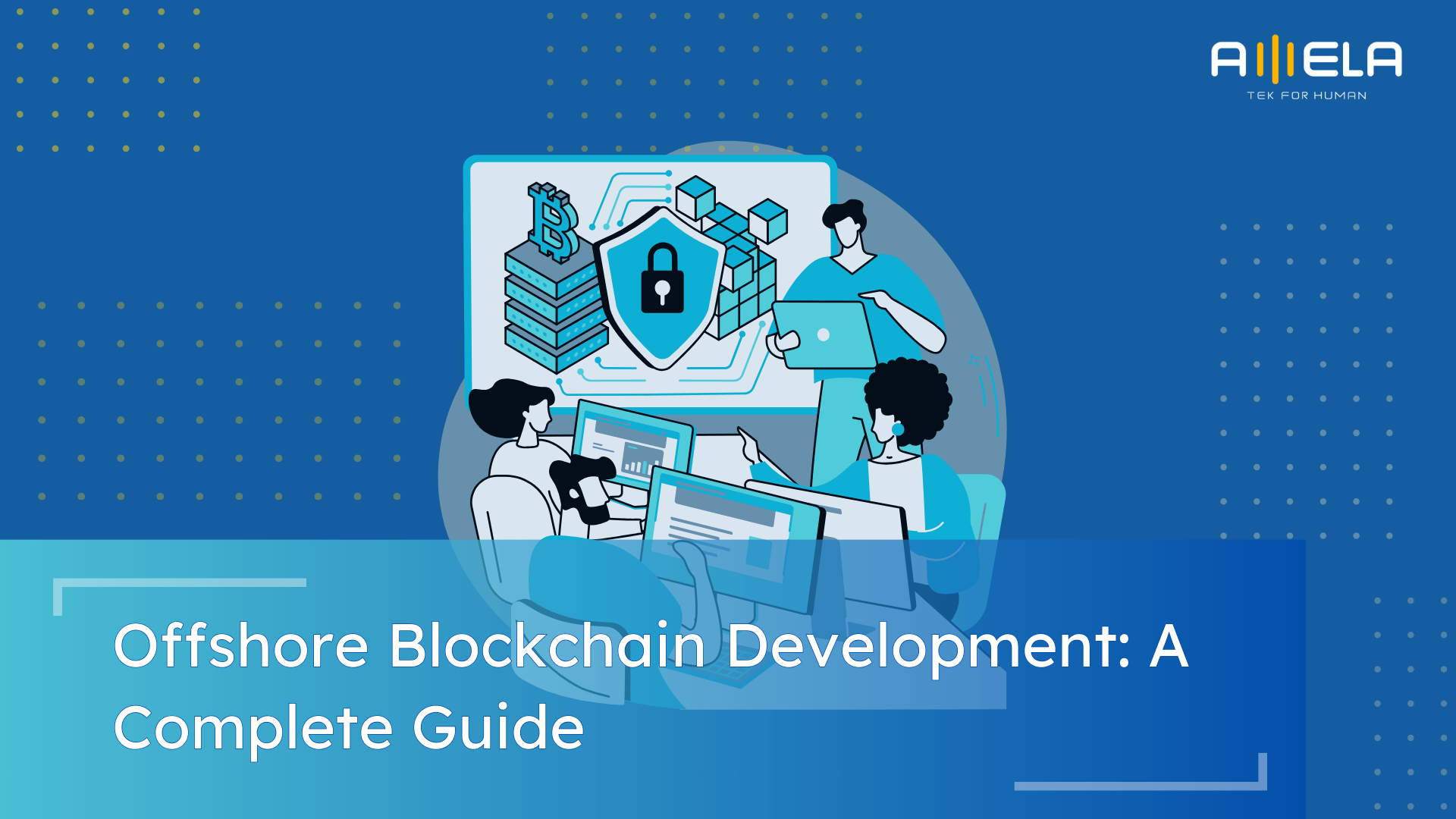
Offshore blockchain development is the fastest way to build a production-ready blockchain layer—smart contracts plus integrations—without waiting months to hire niche specialists locally.
Most teams discover quickly that blockchain work is not just “write contracts.” It’s also APIs, event handling, key security, indexing, and the operating model that keeps a distributed system stable across time zones. If you’re exploring offshore delivery options for your blockchain projects, AMELA’s blockchain development services provide a clear view of engagement models and how offshore teams plug into real product roadmaps.
What Is Offshore Blockchain Development?
Offshore blockchain development is hiring a remote team in another country to build blockchain-based software—smart contracts, backend services, and the integration layer—while you keep product direction and ownership.
In practice, offshore blockchain development is not “outsourcing the blockchain part.” It’s outsourcing a delivery team that can work across the full stack needed for blockchain to function in the real world: contract logic, APIs, identity, monitoring, and the boring-but-critical glue that connects the ledger to your business systems.
Here’s how it usually looks when it’s done well.
You have a product or internal platform that needs a trust layer across multiple parties—traceability, trade docs, digital assets, approvals, or settlement. Your in-house team can handle product decisions and domain knowledge, but blockchain introduces new workloads: contract security review, key management, event processing, off-chain storage design, and sometimes a new runtime (EVM, Fabric/Corda-style networks). Hiring all of that locally can take ages. Offshore lets you assemble a balanced team faster—often with people who’ve already shipped similar patterns and learned the sharp edges the hard way.
Why Companies Choose Offshore Blockchain Development
Companies choose offshore blockchain development to get a production-ready team faster—covering smart contracts, integrations, and security—without long hiring cycles.
- Faster access to niche talent: Blockchain engineers, smart contract specialists, and Web3-savvy QA are hard to hire locally, so offshore helps teams start now, not “next quarter.
- A complete delivery squad, not just coders: Offshore teams can cover smart contracts + backend APIs + event processing + testing, which is what makes blockchain work in real products.
- Battle-tested implementation patterns: Teams that have shipped before know the common traps—pending/confirmed states, retries, key handling, upgrade planning, and partner integration friction.
- Better cost-to-skill efficiency: Offshore often lets you afford senior-level specialists at a sustainable burn, so you can build carefully instead of rushing and paying later.
- Easier scaling after the pilot: When the concept proves value, you can add QA automation, DevOps, or a second squad without restarting the hiring loop.
- Keeps your core team focused: Your in-house team stays on product direction, stakeholder decisions, and compliance, while execution moves forward without bottlenecks.
Offshore vs Nearshore vs Onshore vs Inhouse in Blockchain Outsourcing
If you still wonder what type of IT Outsourcing you should choose, check out our Outsourcing IT Projects Guide:
| Criteria | In-House | Onshore Outsourcing | Nearshore Outsourcing | Offshore Outsourcing |
| Team location | Same company, same country | External vendor, same country | External vendor, nearby country / close time zone | External vendor, distant country / different time zone |
| Speed to start | Slow if hiring is needed | Medium (vendor ready, but onboarding still needed) | Fast–medium | Fast (quick access to ready teams) |
| Cost | Highest fixed cost (salary + overhead) | High | Medium | Lowest / best cost-to-skill in many cases |
| Talent pool | Limited to local hiring | Wider than in-house, but still local | Wider regional pool | Largest global pool, strong scalability |
| Time-zone overlap | Full | Full | High | Low–medium (depends on region) |
| Communication friction | Lowest | Low | Medium–low | Medium (needs strong async habits) |
| Control over priorities | Highest | Medium–high | Medium | Medium (clear governance required) |
| Quality consistency | Depends on internal maturity | Strong if vendor is mature | Strong if vendor is mature | Strong with good vendor + governance; variable otherwise |
| Security & compliance control | Easiest to enforce internally | Easier than cross-border | Medium | Highest need for strict controls (access, data handling, IP) |
| Scalability | Slow (hire/layoff cycles) | Medium | High | Highest (ramp up/down fastest) |
| Best fit | Core IP, long-term platform ownership, deep domain knowledge | Regulated work, heavy stakeholder alignment, discovery | Agile builds needing frequent collaboration with cost balance | Fast builds, scaling delivery, specialist skills, sustained execution |
Offshore Engagement Models for Blockchain Development
Pick the model based on scope clarity and control: project-based for fixed outcomes, dedicated teams for ongoing roadmaps, and hiring developers for targeted skill gaps.
Project-Based
Best for clear scope + fixed deliverables. Use this when you can define acceptance criteria upfront (e.g., MVP module, smart contract package, chain integration). It’s efficient, but change requests can slow things down if requirements evolve.
Dedicated Offshore Development Team
Best for evolving products and continuous delivery. A stable squad works like your remote product team (contracts + backend + QA + DevOps). You own priorities; the team ships sprint by sprint. This is often the smoothest model for blockchain because integration and hardening are iterative.
Hiring Offshore Developers (Staff Augmentation)
Best when you need to add specific roles to your team fast. Add a Solidity engineer, backend dev, QA automation, or DevOps to your existing team. You keep full control, but you need strong internal leadership or output gets messy.
If you’re weighing these models, AMELA can support all three—project-based delivery, Vietnam offshore dedicated teams, or IT staff augmentation—so you can start with the setup that fits your roadmap today and adjust later. Learn more at amela.tech.
Offshore Blockchain Development Process
A solid offshore process keeps work moving 24/7 without losing control: clear ownership, tight async communication, security-first smart contracts, and an integration layer built for real-world delays.
1. Offshore kickoff and working agreement (Day 1–3)
Before specs, we lock how the team will work: overlap hours, response SLAs, escalation path, and a single source of truth (tickets + docs). This prevents the classic offshore trap where small questions take a full day to resolve.
2. Scope the “one workflow” and define success (Week 1)
Offshore teams move fastest when the target is unambiguous. We pick one multi-party workflow, define states and transitions, and agree on one measurable success metric (cycle time, dispute rate, audit effort). No metric, no momentum.
3. Architecture split: on-chain vs off-chain (Week 1)
We decide early what is on-chain (state changes, signatures, hashes, references) and what stays off-chain (PII, documents, heavy payloads, analytics). Offshore delivery stays stable when this boundary is written down, not debated mid-sprint.
Check out our Blockchain Development Guide to learn all the architecture in blockchain.
4. Platform and environment setup with “remote-ready” controls (Week 1–2)
Repos, CI/CD, dev/staging/prod, secrets handling, access rules, and logging standards are set up up front. Offshore success depends on clean permissions and traceability—no shared accounts, no “temporary” credentials that never get removed.
5. Smart contract implementation (Week 2+)
Contracts are built like strict state machines: explicit permissions, predictable events, and tests for edge cases. Offshore teams do best when contracts are kept intentionally simple—less cleverness, fewer future headaches.
6. Integration layer build (runs in parallel)
This is where offshore teams prove value. We implement APIs and event handlers that handle retries, idempotency, and “pending → confirmed” behavior. If this layer is weak, the product feels flaky even when the chain is fine.
7. Offshore-friendly QA and security hardening (every sprint)
Instead of a big-bang QA phase, we bake in: code reviews, automated tests, negative tests (duplicates, delayed confirmations), and a lightweight security review for keys, signing flows, and access boundaries. This avoids the “it worked in demo” moment.
8. Release rehearsal, go-live, and handover (pre-launch → launch)
We do a dry run: deployment steps, rollback, incident playbook, and upgrade approach. Then we ship with monitoring that matters (tx lifecycle, event backlogs, failure reasons). Finally, we document the system so you’re not dependent on one offshore engineer to explain everything later.
How to Hire a Blockchain Development Team
Hire and manage an offshore blockchain development team by validating real delivery behavior (contracts + integration + security), locking a clear operating rhythm, and measuring outcomes—not hours—so offshore speed doesn’t turn into offshore chaos.
Define the “blockchain scope” properly (before you hire anyone)
Most teams hire “blockchain devs” and later realize they actually needed a full delivery slice:
- smart contracts (state machine + permissions + events)
- backend/API service (transaction orchestration, retries, idempotency)
- off-chain data + indexing (search/reporting)
- security controls (keys, access, audit logs)
If you only staff one piece, the project stalls in integration hell. Been there, seen that.
Choose the team shape that matches your roadmap
You don’t need a huge team—just the right spine.
- For an MVP with real integrations: 1 contract engineer, 1 backend engineer, 1 QA (automation-friendly), part-time DevOps.
- For production + multi-party workflows: add a tech lead who owns architecture decisions and a security reviewer cadence (even if lightweight).
If you’re not sure, default to a small squad with clear ownership rather than a pile of “resources.”
Screen for production thinking, not “blockchain vocabulary”
A strong offshore blockchain engineer talks about failure modes like it’s normal life. Ask candidates to walk through:
- How they handle “pending → confirmed” and avoid double-processing
- How they design contracts as state machines (and keep upgrades sane)
- How they store sensitive data off-chain while anchoring integrity on-chain
If the answers are fluffy, you’ll feel it later—no cap.
Run a proof sprint that forces end-to-end delivery
Skip long trials. Do 1–2 weeks with a narrow slice that proves real capability:
- One contract workflow (states + events + tests)
- One API endpoint that writes to chain
- One event consumer that updates an off-chain store
- A tiny dashboard/query view (even basic) to show the data is usable
This exposes the truth: communication, quality gates, documentation habits, and how they react when things break.
Lock an offshore working agreement (this is where teams win or bleed time)
Offshore success is mostly operations. Set these rules on day one:
- Overlap window: even 1–2 hours daily is enough if decisions happen there.
- Response SLAs: how quickly blockers get answered (same day vs next day).
- Escalation path: who decides when priorities conflict.
- Single source of truth: tickets + docs + decision log (no scattered chats).
This prevents the “one small question = one-day delay” loop.
Make quality non-negotiable, but keep it lightweight
Blockchain projects don’t survive on “we’ll fix it later.” Require a simple Definition of Done:
- Code review completed
- Tests passing (contract + backend)
- Events documented (schema + meaning)
- Basic monitoring hooks added (logs/metrics)
When teams do this consistently, offshore velocity stays stable instead of collapsing after month two.
Treat key management and access like a security product
This is the part teams underestimate the most. Set clear controls:
- Least-privilege repo and environment access
- No shared accounts, no “temporary” credentials
- Defined signing flow (who can sign what, where keys live)
- Rotation and offboarding process (vendors change, people leave)
If you’re loose here, you’re building on sand.
Manage by outcomes with a small set of metrics
Keep it simple and visible:
- Sprint goal completion (features that meet acceptance criteria)
- Defect trend (new vs reopened)
- Lead time from ticket → merged → deployed
- Confirmation/retry health (how often tx fail, how often retries happen)
- Documentation completeness (architecture notes, runbooks, decision log)
If metrics aren’t moving, add clarity—not headcount.
Protect yourself from vendor lock-in by designing handover as you go
The easiest time to document is while building, not at the end. Ask for:
- Architecture diagram + key decisions
- Deployment steps + rollback plan
- How to debug” runbook (common failures and where to look)
- Onboarding guide for a new engineer
When this exists, you’re in control—offshore becomes an advantage, not a dependency.
Red flags to watch early (so you can correct fast)
Progress reports feel busy but don’t show product changes. They avoid writing acceptance criteria back to you in their own words.
- Contracts are complex “because blockchain,” not because the workflow needs it.
- Bugs repeat in the same area (signals missing tests or weak reviews).
- Documentation is always “later.”
>>> Related: How to Integrate Blockchain in Software Development?
Use Cases for Offshore Blockchain Teams
Offshore blockchain teams shine when you need to ship a blockchain-enabled workflow fast—smart contracts plus the integration layer—without waiting months to hire niche talent locally.
- Smart contract development + security-focused testing
Ideal for teams building token logic, escrow/release rules, staking/rewards, or multi-step approval flows. Offshore works well when the contracts are treated as strict state machines with clear events and strong test coverage.
- Blockchain integration for existing business systems
Common in traceability, trade docs, warranties, and partner approvals—where blockchain is only the trust layer. Offshore teams build APIs, transaction orchestration, event consumers, and off-chain indexing so ERP/CRM/WMS systems can actually use the ledger.
- Tokenization of real-world business objects
Turning licenses, credits, loyalty points, inventory units, or access rights into programmable assets. Offshore teams can build the token model, transfer rules, allowlists, and admin tooling while keeping sensitive data off-chain.
- Supply chain provenance and compliance audit trails
When multiple parties must agree on custody events and evidence. Offshore teams implement event schemas, mobile/scan ingestion, immutable proofs, and reporting views that auditors and ops teams can read without pain.
- DeFi and payment rails (carefully scoped)
Offshore teams can help build or integrate lending, swapping, staking, or stablecoin settlement flows—especially the surrounding backend services, monitoring, and risk controls. This is best when requirements are explicit and security review is not optional.
- Private/consortium networks for B2B workflows
Useful for regulated industries or partner ecosystems that need controlled access and shared governance. Offshore teams handle node setup (if needed), permission rules, contract deployment pipelines, and change management processes.
- Web3 product MVPs with a “real” path to production
Offshore teams help founders move beyond demos by building the parts that usually get skipped: confirmation-state UX, retries, indexing, admin dashboards, and operational tooling.
Factors Affecting Offshore Blockchain Development
Offshore blockchain success depends on delivery conditions—integration scope, security, governance, and decision speed—more than on “blockchain coding” itself.
- Scope depth: Contracts-only is simpler; full integration adds APIs, event processing, indexing, and off-chain storage—often the real workload.
- Network model: Public chains add fees and confirmation timing; permissioned networks add governance, access rules, and onboarding.
- Security posture: Key custody, access control, and environment separation can make or break the project faster than most bugs.
- Contract complexity: Simple state machines scale; “clever” contracts raise audit risk and make upgrades painful.
- Team stability: You need a balanced squad (contracts + backend + QA + DevOps); high turnover quietly kills quality.
- Time-zone execution: The biggest drag is slow decisions—overlap hours and escalation paths prevent day-long blocker loops.
- Client-side ownership: A clear product owner and technical decision-maker on your side keeps delivery crisp.
- Region & ecosystem: Location affects cost-to-skill, hiring speed, and outsourcing maturity—Vietnam is often shortlisted for strong engineering depth and scalable delivery capacity. And cost is only one of the many reasons businesses choose Vietnam for IT Outsourcing.
If you’re exploring Vietnam-based teams, AMELA supports offshore blockchain delivery from Vietnam via project-based work, dedicated teams, or staff augmentation.
How to Choose the Right Offshore Blockchain Development Company
Pick an offshore blockchain development company that can ship production-grade contracts and the integration/ops layer—because most failures happen outside the chain.
- Check integration depth, not buzzwords
They should confidently explain pending→confirmed handling, retries/idempotency, event processing, indexing, and off-chain storage—not just “we do Solidity.”
- Review smart contract style
Look for simple state-machine logic, clear permissions, and clean events. If their contracts feel “clever,” upgrades and audits will hurt later.
- Validate security habits early
Ask how they handle keys, access control, code reviews, and environment separation. “We’ll do security later” is a red flag.
- Test communication and offshore operating rhythm
Confirm overlap hours, response SLAs, escalation path, and how decisions are documented. Offshore success is mostly process.
- Run a short proof sprint (best filter)
Have them deliver one thin slice end-to-end: contract + API write + event consumer + tests + short docs. This reveals real delivery ability fast.
- Confirm the real team and continuity
Make sure the tech lead and key engineers assigned in the call are the ones who will actually build, and ask how replacements are handled.
- Lock IP ownership and handover expectations
You should own the code, repos, and documentation/runbooks needed to operate without vendor lock-in.
Challenges in Offshore Blockchain Development—and How to Fix Them
Offshore blockchain projects struggle most with alignment, security, and integration reliability—not with “writing blockchain code.”
- Unclear workflow and shifting scope slow everything down because offshore teams can’t safely guess intent. Fix it by locking one workflow, documenting states and acceptance criteria, and routing decisions through one owner.
- Smart contract risk and painful upgrades show up when contracts get too clever or rules change midstream. Fix it by keeping contracts as simple state machines, testing edge cases early, and agreeing on an upgrade approach before shipping v1.
- Key management and access control gaps are the fastest way to turn a good build into a security incident. Fix it by defining signing authority, using least-privilege access, separating environments, and making offboarding/rotation routine.
- Time-zone delays create the “one question = one day” loop that quietly kills velocity. Fix it with a short daily overlap window, response SLAs for blockers, and a decision log so the team doesn’t re-litigate choices.
- Integration failures happen when retries, duplicates, and pending→confirmed states aren’t engineered properly. Fix it by building idempotent APIs, resilient event consumers, and clear transaction lifecycles that the UI and backend both respect.
If you get these five areas right, offshore blockchain delivery stops feeling risky and starts feeling predictable.
Conclusion
Offshore blockchain development can be a serious accelerator when you treat it like building critical infrastructure: narrow workflow scope, simple contract logic, disciplined security, and an integration layer designed for real-world delays and retries. When those fundamentals are in place, offshore teams don’t just “help you build blockchain”—they help you ship a system that partners and auditors can actually trust. If you’d like a quick sanity check on team setup, platform fit, or delivery model, you can reach AMELA via amela.tech to map a practical next step.