 May 15, 2026
Table of Contents
A sluggish online store doesn’t just annoy customers—it costs money. If pages take too long to load or systems buckle under heavy traffic, shoppers leave and revenue evaporates.
Performance has a direct impact on sales. Data shows that cutting page‑load times by just one second can boost conversion rates by 5.6 %, while about 40 % of shoppers abandon a site that takes more than three seconds to load (Electroiq.com). Users find slow sites more frustrating than temporary outages, and nearly half will close the tab or turn to a competitor. Meanwhile, the stakes for success are growing: the global ecommerce market is projected to reach more than $7.9 trillion by 2027, and mobile commerce will account for roughly 62 % of retail sales by the same year. In this environment, poor scalability and performance translate into missed opportunities and damaged reputations.
Technically, building a scalable system means designing an architecture that doesn’t collapse under peak loads. Traditional monolithic platforms force all components to scale together, often wasting resources or creating bottlenecks. Modern ecommerce leaders decompose their platforms into smaller services so they can scale each part independently, apply the right technology for each function and reduce the risk of a single failure bringing down the whole site. This guide explains why ecommerce scalability and performance matter and lays out practical strategies for staying fast and reliable, even when demand surges.
Understanding eCommerce Scalability and Performance
Scalability refers to a platform’s ability to handle increasing traffic, data and transactions without degrading the customer experience. Performance measures how quickly and smoothly the site responds to user interactions. Together, ecommerce scalability and performance determine whether your store can grow and still deliver a seamless shopping experience.
The numbers highlight why this capability is critical. The global ecommerce market is forecast to be worth more than $6.3 trillion in 2024 and exceed $7.9 trillion by 2027 (Source: Forbes), indicating that more customers will be shopping online. Mobile commerce alone is predicted to reach $856 billion by 2027 and account for 62 % of all retail sales. This growth means more concurrent users accessing your site from different devices, and each expects pages to load in seconds or less. When performance lags, even by a small amount, customers switch to a competitor. A one‑second delay reduces conversion by roughly 5 % and undermines trust.
From an architectural perspective, a scalable ecommerce system often uses a microservices approach. Microservices split the platform into independent services that can be deployed, updated and scaled separately. Each service can choose its own programming language, database and technology, allowing teams to optimize performance for specific functions—like product catalogs, checkout or payment gateways. Faults in one service don’t bring down the entire system, so problems are isolated and easier to fix. Cloud infrastructure further supports scalability by enabling elastic capacity management: services can be dynamically replicated to handle increased loads without scaling the entire system. In the next sections, we’ll explore the consequences of poor scalability and outline strategies—including caching, load balancing, database optimization and monitoring—to ensure your ecommerce platform stays fast and resilient.
Impact of Poor Scalability & Performance on Business
When an online store buckles under demand, customers feel it immediately. A slow checkout or a crash during a sale undermines trust and pushes shoppers to competitors.
The business cost is significant. Studies of web performance in 2025 show that even a one‑second delay in page‑load time causes a 7 % reduction in conversions. Each second of lag means fewer purchases, lower revenue and frustrated customers who might never return. Poor scalability also makes it impossible to handle traffic spikes during events like Black Friday or flash sales. If your infrastructure can’t scale, servers crash, carts abandon and marketing investments evaporate. Beyond direct sales losses, downtime harms brand reputation and search rankings, and adds operational stress as teams scramble to recover. In the long run, underperforming platforms drain budgets through emergency fixes, lost loyal customers and higher customer acquisition costs. This section underscores why investing in robust scalability and performance is not optional—it’s essential for protecting revenue and customer trust.
>>> Related: Key Considerations in Creating an eCommerce Website
Key Strategies to Optimize Scalability & Performance
To keep your ecommerce platform fast and resilient as it grows, you need a holistic approach that addresses both architecture and operations. There’s no single tool that solves every bottleneck; instead, combine complementary strategies tailored to your business and traffic patterns.
Adopt a Microservices Architecture
Breaking a monolithic store into independent services improves scalability and resilience because each component can scale on its own and failures don’t cascade.
Modern ecommerce leaders avoid scaling an entire codebase by decomposing it into discrete services – catalog, search, checkout and payment. Each microservice runs its own code and database, is containerized for portability, and communicates via well‑defined APIs. This loose coupling lets teams update features or fix bugs without downtime and independently allocate resources where traffic spikes occur, such as scaling the payment gateway during a holiday sale. For example, after moving to a microservices architecture, a global fashion retailer handled a 300 % traffic surge during a sales event without any outages, and isolating checkout and inventory services delivered a 25 % faster checkout process and higher conversions. AMELA recommends adopting microservices gradually: start by extracting the most resource‑intensive modules, use a service mesh for communication, and implement centralized monitoring to track each service’s health.
Leverage Cloud Infrastructure & Auto‑Scaling
Using cloud auto‑scaling ensures your ecommerce site can spin up resources when traffic surges and shrink costs during quiet periods, keeping performance steady and budgets under control.
Cloud platforms such as AWS, Azure and Google Cloud offer horizontal and vertical auto‑scaling that automatically adds or removes compute instances based on real‑time demand. This elasticity prevents the over‑provisioning inherent in on‑premise or fixed infrastructure and eliminates the need for emergency ‘war rooms’ during flash sales. For instance, one online retailer audited its cloud usage and found that 40 % of its EC2 instances ran at under 10 % CPU utilization even at peak times; by implementing a systematic optimization program and scaling resources dynamically, the company cut its cloud budget by 75 % while still coping with Black Friday traffic. Auto‑scaling isn’t just about cost savings – it improves reliability through redundancy, reduces manual DevOps work and supports experiments like using serverless functions for bursty workloads. To maximize benefits, configure clear scaling thresholds, set upper and lower limits to control spend, and use predictive metrics so instances are warm before a spike hits.
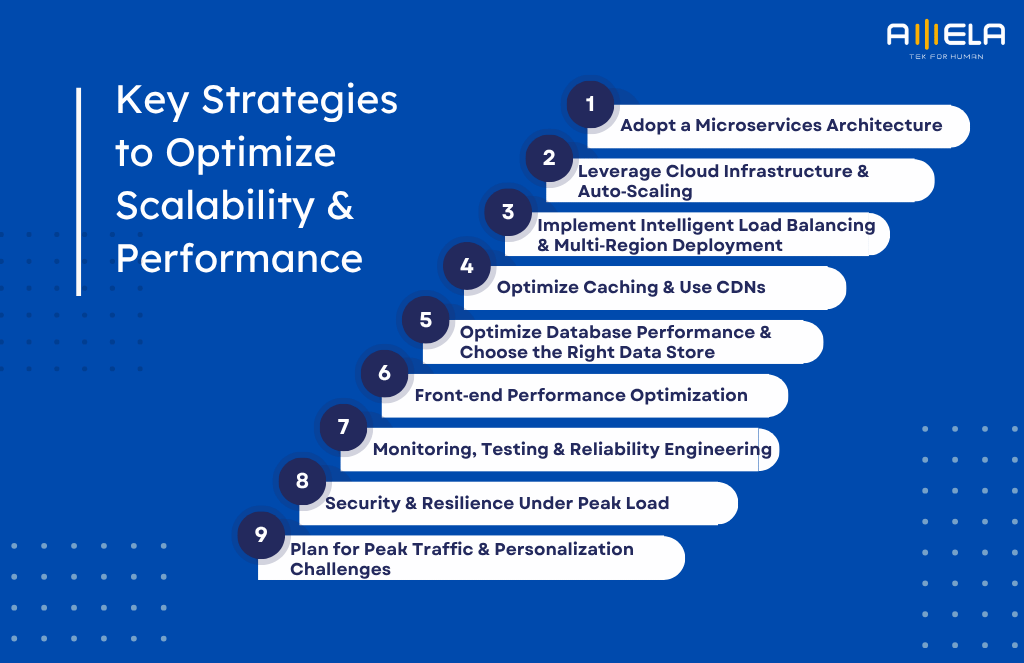
Implement Intelligent Load Balancing & Multi‑Region Deployment
Effective load balancing distributes user requests across multiple servers to prevent overload and maintain high availability for ecommerce sites.
Load balancers sit between your backend servers and the internet, directing each request to the server with the most capacity or lowest latency. This prevents any single node from becoming a bottleneck and allows you to handle spikes smoothly. Intelligent algorithms such as least‑connections, round‑robin and IP hashing optimize routing, while health checks automatically divert traffic from failing servers. Multi‑region deployment builds on this by replicating your application and data in geographically dispersed locations; traffic is routed to the nearest region, reducing latency and ensuring service continuity even if one region fails. A real‑world example is Mouser Electronics: by implementing a database and application load balancer, their global ecommerce platform has achieved continuous availability and zero downtime since 2014. When designing your architecture, choose load balancers that support automatic failover and integrate with DNS for geo‑routing, and consider cloud‑managed services that handle scaling and maintenance for you.
Optimize Caching & Use CDNs
Caching stores frequently accessed data closer to users and applications, cutting latency and offloading work from your databases and application servers.
Ecommerce systems can benefit from multiple cache layers. In‑memory caches like Redis or Memcached speed up database queries and API responses, while HTTP caches such as Varnish or NGINX serve pre‑rendered pages and product data without hitting the origin. Content Delivery Networks (CDNs) extend this concept to the edge, replicating static assets across global nodes so shoppers anywhere experience fast page loads. Modern caching platforms deliver dramatic performance improvements: Varnish Enterprise, for example, reports that its caching software enables 80 % lower latency and 10× higher throughput for some of the world’s largest businesses. Effective caching strategies should include setting appropriate time‑to‑live values, invalidating cached content when inventory or pricing changes and leveraging compression to reduce file sizes. By combining in‑memory caching with a CDN, you can handle spikes in traffic gracefully, reduce backend load, and ensure customers enjoy a responsive shopping experience.
Optimize Database Performance & Choose the Right Data Store
Designing databases for scalability isn’t just about picking a technology – it’s about matching data models and performance characteristics to your use case.
Database bottlenecks often occur when a monolithic system forces all queries through a single server. To handle growing traffic and concurrent requests, modern e‑commerce platforms distribute reads and writes across multiple nodes. Replication adds secondary servers that handle read queries, relieving pressure on the primary database. Sharding partitions data by customer, product or geography so that each shard can be scaled independently. Indexing frequently queried fields and optimizing query structure reduces I/O and improves latency. It’s equally important to select the right database for each service: relational databases ensure consistency for transactions, while NoSQL stores offer flexibility and horizontal scaling for catalog or session data. Managed services from cloud providers simplify operations by handling backups, scaling and high availability, letting development teams focus on features rather than database administration. Together, these approaches prevent database hot‑spots and support a smooth checkout experience even under load.
Front‑end Performance Optimization
Speed on the client side is just as critical as back‑end scalability because shoppers perceive performance through the user interface.
Large images, unminified scripts and excessive third‑party widgets slow down page loads and increase abandonment. Smart front‑end optimization starts with trimming unnecessary bytes: compress HTML, CSS and JavaScript files; minify code to remove comments and whitespace; and use modern image formats like WebP or AVIF. Adopt lazy loading for images below the fold so that they load only when the user scrolls, and preconnect to third‑party domains to reduce DNS lookup times. Browser caching and caching policies help ensure that static assets are stored locally, reducing repeat downloads on subsequent visits. According to a 2026 analysis by the Web Almanac, about 71 % of desktop home page loads and 72 % of mobile home pages correctly implemented text compression. This shows progress but also leaves significant room for improvement, as roughly a quarter of pages still fail to compress text files effectively. Continuously profiling and testing front‑end performance with tools like Lighthouse or WebPageTest helps identify bottlenecks and verify that optimizations have the desired effect. By combining these techniques, you can deliver a fast, responsive e‑commerce experience that delights users and supports your conversion goals.
Beyond the technical measures outlined above, smart outsourcing decisions also influence long‑term scalability. Our IT project outsourcing guide explains how to choose the right partners and engagement models to support sustainable eCommerce growth.
Monitoring, Testing & Reliability Engineering
Effective monitoring and testing provide the visibility needed to maintain performance and diagnose issues before they affect customers. Without real‑time insights, slowdowns or failures can go unnoticed until sales suffer.
A robust observability stack collects metrics, logs and traces across the entire application. Time‑series databases such as Prometheus capture performance data like response times, error rates and resource utilisation. Visualization tools like Grafana or Kibana turn this data into dashboards so teams can spot anomalies at a glance. Alongside monitoring, regular load and stress testing simulate peak conditions to uncover bottlenecks. Run end‑to‑end tests on critical user journeys—like search, add‑to‑cart and checkout—to ensure they stay within acceptable latency thresholds. Incorporating chaos engineering exercises, where components are intentionally disrupted, helps verify that failover mechanisms and redundancy plans work as intended. Reliability engineering isn’t a one‑off project; it’s a continuous discipline of measuring, testing and refining systems to deliver consistent uptime and performance.
Security & Resilience Under Peak Load
Maintaining security and resilience during high‑traffic events is essential for protecting customer data and ensuring uninterrupted service. Traffic spikes often attract malicious actors, and increased load can expose weaknesses in your defences.
A layered security strategy starts with a Web Application Firewall (WAF) that filters out malicious requests and mitigates threats like SQL injection and cross‑site scripting. Distributed Denial of Service (DDoS) protection should be in place to absorb volumetric attacks and block application‑layer exploits. Implementing role‑based access controls ensures that users and services have only the permissions they need. Sensitive data must be encrypted in transit (via HTTPS/TLS) and at rest to meet compliance obligations. Resilience also comes from architectural design: deploy applications across multiple availability zones or regions to provide geographic redundancy; use health checks and auto‑recovery mechanisms so that unhealthy instances are replaced automatically; and keep backup and disaster‑recovery plans up to date. By combining proactive security measures with resilient infrastructure, ecommerce platforms can withstand both legitimate surges and malicious attacks without sacrificing performance or user trust.
Plan for Peak Traffic & Personalization Challenges
Peak shopping events and personalized experiences can strain even well‑designed systems. Preparing ahead means forecasting demand, tuning features and building flexibility into your architecture.
Start by analyzing historical data, marketing calendars and external factors to estimate traffic and order volumes. Use this information to provision extra capacity in advance, but also employ auto‑scaling so the platform can react to unexpected surges. Identify which features are critical for conversions and which can be temporarily disabled or simplified to preserve core functionality—such as turning off video backgrounds or recommendation widgets during peak checkout periods. Real‑time personalization adds computational overhead, so separate the core purchase flow from recommendation engines. Pre‑compute personalized segments or use asynchronous processing to generate recommendations without blocking page loads. Implement kill switches in your codebase to rapidly deactivate non‑essential services if they degrade performance. Finally, rehearse these scenarios with load tests and failover drills so your team understands how to respond when real traffic spikes.
Selecting the Right Development & Outsourcing Partner
Choosing a development partner impacts the scalability and performance of your ecommerce platform for years. Look for firms with proven expertise in building scalable architectures and a track record of delivering high‑traffic sites.
>>> Related: Top 10 eCommerce Development Companies in SEA
A reliable partner should offer deep technical knowledge across microservices, cloud platforms and DevOps practices, as well as experience implementing security and performance best practices. Ask for case studies demonstrating how they’ve handled peak traffic, optimized databases and implemented caching and load balancing. Beyond technical skills, consider communication and cultural alignment—your partner should be transparent, proactive and responsive. If you’re outsourcing, evaluate the vendor’s ability to scale teams quickly and their approach to knowledge transfer and long‑term maintenance.
AMELA Technology combines these strengths, providing flexible engagement models and a seasoned team proficient in custom ecommerce development. To learn more about outsourcing effectively, consult our guide on outsourcing eCommerce development and our list of top ecommerce development companies. These resources can help you evaluate partners and set the foundation for a scalable, high‑performing online store.
Conclusion
Building a high‑performing ecommerce platform isn’t a one‑time project. It requires an architecture that scales horizontally, optimized databases, caching and CDNs to accelerate delivery, and continuous monitoring to catch issues early. Intelligent load balancing and auto‑scaling keep traffic flowing smoothly, while reliable security measures and redundancy protect your site during peak demand. Planning for seasonal spikes and personalization challenges helps maintain a seamless user experience. Choosing the right development partner ensures these strategies are executed effectively and evolve with your business.
The road to ecommerce scalability and performance is ongoing, but with the right tools and expertise, it’s achievable. Partnering with experienced engineers can help you implement these best practices, adapt to changing customer expectations and drive long‑term growth. Ready to unlock your ecommerce scalability and performance? Visit our AMELA Tech page to see how we can help you build and scale a world‑class online store.