
 Jan 30, 2026
Table of Contents
Agile low code development is reshaping how teams build software by combining fast visual development with disciplined Agile delivery. As organizations face constant change and pressure to ship faster, this approach helps teams adapt quickly without sacrificing structure, quality, or long-term scalability.
What Is Low-Code Development?
Low-code development is an approach to building software applications using visual tools, prebuilt components, and minimal hand-written code to accelerate delivery without sacrificing control. In practice, it helps teams ship faster while keeping logic and integrations manageable.
Low-code platforms typically provide:
- Visual drag-and-drop interfaces for UI and workflows
- Prebuilt components for common functions like forms, approvals, and dashboards
- Built-in connectors to databases, APIs, and third-party services
- The ability to extend with custom code when needed
From my experience working in both traditional custom software development and low-code projects, low-code is not about “no developers needed.” It’s about reducing repetitive engineering work—UI scaffolding, workflows, CRUD logic—so developers can focus on what actually creates value: business rules, integrations, performance, and scalability.
The Growing Adoption of Agile + Low-Code Development
Agile and low-code are increasingly adopted together as organizations look for faster, more adaptable ways to deliver software without expanding engineering headcount. Market research and real-world delivery patterns point to the same direction: low-code is becoming part of how Agile teams operate, not a parallel movement.
Industry research underscores this momentum. IDC forecasts that global revenue for low-code, no-code, and intelligent developer technologies (LCNCIDT) will reach approximately USD 21 billion by 2026, reflecting growing enterprise investment in tools that support faster, more iterative, and Agile-aligned development models.
What’s important is where this adoption is happening. Forrester’s research shows that low-code adoption is strongest inside organizations already practicing Agile, rather than in traditional, plan-driven environments. This makes sense in practice: low-code aligns naturally with short sprints, incremental releases, and continuous stakeholder feedback. Teams can validate ideas earlier, adjust priorities faster, and reduce waste without changing their Agile operating model.
In real projects, this trend looks less like “Agile vs. low-code” and more like layering. Agile continues to define how teams plan, collaborate, and learn, while low-code accelerates how quickly those teams can turn decisions into working software.
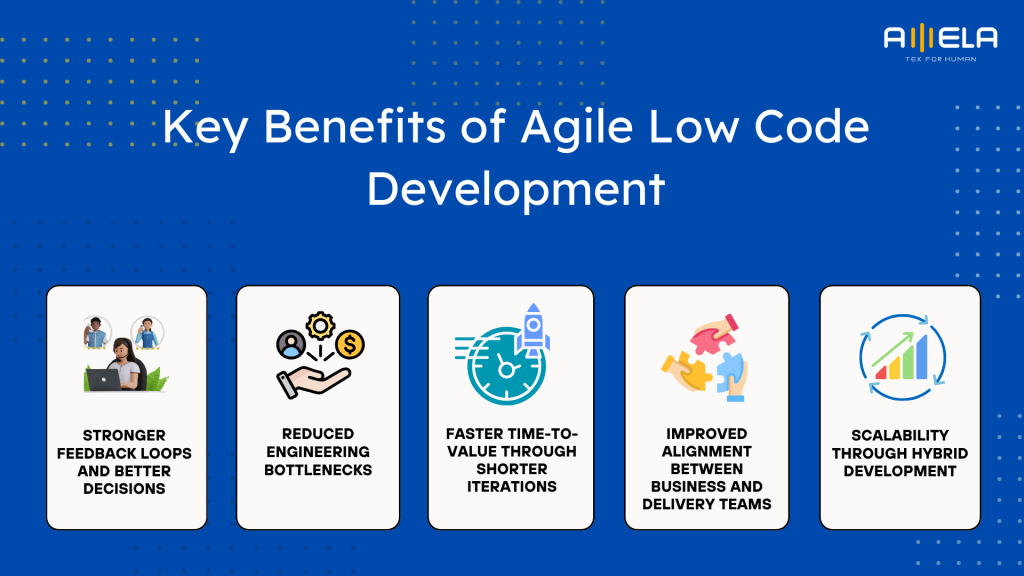
Key Benefits of Agile Low Code Development
Agile low-code development combines rapid execution with disciplined iteration, enabling teams to deliver usable software faster while staying adaptable to change. From hands-on delivery experience, the value doesn’t come from speed alone—it comes from faster learning with lower risk.
Below are the core benefits we consistently see when Agile and low-code are applied together in real projects.
Faster Time-to-Value Through Shorter Iterations
Agile thrives on short cycles and frequent releases. Low-code amplifies this by reducing the effort required to build common UI elements, workflows, and integrations. In practice, teams can move from idea to working feature within the same sprint, which accelerates validation and reduces time spent on assumptions that don’t hold up.
This speed matters most early, when direction is still forming and feedback is critical.
Stronger Feedback Loops and Better Decisions
Agile depends on real feedback, not speculative discussions. Low-code enables teams to show working software earlier and more often, making reviews concrete instead of theoretical. Stakeholders respond better to what they can see and use, which leads to clearer priorities and fewer late-stage changes.
From experience, this improves decision quality more than any planning document ever could.
Reduced Engineering Bottlenecks
Agile teams often face pressure to deliver more without growing headcount. Low-code helps relieve this pressure by abstracting repetitive development work, allowing engineers to focus on complex logic, integrations, and architecture. This keeps sprint velocity stable even as demand increases.
The result is not fewer engineers—but better use of engineering time.
Improved Alignment Between Business and Delivery Teams
Low-code platforms are more accessible to non-engineering stakeholders, which changes collaboration dynamics inside Agile teams. Product owners, analysts, and domain experts can participate more actively in refining workflows and validating outcomes. This reduces translation gaps between “what the business wants” and “what gets built.”
Lower Risk in Early-Stage Development
Agile low-code development reduces risk by making experimentation cheaper. Teams can test ideas, discard weak assumptions, and pivot direction without committing to heavy custom builds upfront. This is especially valuable for MVPs, internal tools, and process automation initiatives.
When uncertainty is high, lowering the cost of change is a strategic advantage.
Scalability Through Hybrid Development
One important benefit is flexibility. Agile low-code does not lock teams into visual tools only. As complexity grows, teams can extend low-code components with custom code while keeping Agile practices intact. This hybrid approach allows systems to evolve without full rewrites.
From experience, this balance prevents the “quick win that becomes a long-term constraint” problem.
>>> Related: Top 10 Hybrid Application Development Companies
Consistent Quality with Built-In Standards
Many low-code platforms include built-in controls for security, performance, and deployment. When combined with Agile quality practices—definition of done, testing, and reviews—this leads to more consistent outcomes across sprints. Teams spend less time fixing basic issues and more time improving functionality.Quality becomes repeatable, not accidental.
Individually, Agile improves adaptability and low-code improves speed. Together, they create a delivery model that learns faster than it builds—and builds only what matters.
Agile Low-Code Development Use Cases
Agile low-code development is most effective when speed, adaptability, and continuous feedback matter more than deep system-level optimization. In practice, teams apply this approach to specific types of problems where fast iteration delivers clear business value.
Below are the most common and proven use cases where Agile low-code development fits naturally.
Internal Business Tools and Dashboards
Internal tools are one of the strongest use cases for Agile low-code development. These systems often support operations, reporting, approvals, or internal workflows that change frequently as the business evolves. Low-code allows teams to adjust screens, logic, and flows quickly within Agile sprints, without heavy redevelopment.
Because internal users provide immediate feedback, Agile iterations remain short and highly focused, making continuous improvement both practical and efficient.
Workflow Automation and Process Management
Organizations increasingly use Agile low-code development to automate manual or fragmented processes such as approvals, onboarding, document handling, or compliance tracking. These workflows typically involve multiple stakeholders, conditional logic, and integrations with existing systems.
Low-code platforms simplify workflow modeling, while Agile ensures processes are refined incrementally instead of locked in upfront. This combination reduces resistance to change and improves adoption.
MVPs and Proofs of Concept
Agile low-code development works well for MVPs and proofs of concept where the goal is learning, not perfection. Teams can validate ideas, user behavior, and business assumptions quickly without investing in full-scale engineering from day one.
This approach is especially useful when product direction is uncertain or when leadership needs evidence before committing to larger budgets.
Customer Portals and Self-Service Applications
Many teams use Agile low-code development to build customer-facing portals for account management, requests, bookings, or support. These applications often require frequent updates based on user feedback, policy changes, or operational needs.
Low-code accelerates UI and workflow changes, while Agile keeps enhancements aligned with real user usage patterns rather than static requirements.
Department-Level Digitalization Initiatives
Departments such as HR, finance, sales, or operations often need tailored applications that don’t justify full-scale custom development. Agile low-code enables these teams to digitalize specific processes without overloading central IT or engineering teams.
The result is faster delivery with controlled scope, while still maintaining governance through Agile practices.
Integration Layers and Orchestration Apps
Low-code is commonly used to build integration layers that connect existing systems, APIs, and data sources. These orchestration applications don’t replace core systems but coordinate them. Agile helps teams evolve integrations safely as dependencies change over time.
This use case benefits from low-code’s abstraction and Agile’s emphasis on incremental change.
When Agile Low-Code Is Not the Right Fit
While powerful, Agile low-code is not ideal for every scenario. Systems requiring extreme performance optimization, complex real-time processing, or deep custom algorithms usually benefit from traditional engineering-first approaches. Understanding these boundaries helps teams use Agile low-code strategically rather than universally.
Across these scenarios, a clear pattern emerges: Agile low-code development excels where requirements evolve, feedback is frequent, and speed matters more than perfect optimization. Used in the right contexts, it becomes a practical delivery approach rather than a compromise.
How to Implement Low-Code Development in an Agile Workflow
Implementing low-code within an Agile workflow is less about tools and more about aligning roles, governance, and delivery cadence. Teams succeed when low-code is treated as an accelerator inside Agile—not a shortcut around it.
Below is a practical, end-to-end way to integrate low-code into Agile delivery without breaking engineering discipline.
Start with Clear Ownership and Product Boundaries
Before development begins, teams should define what the low-code solution is responsible for and what remains in traditional code or core systems. Low-code works best when its scope is explicit—such as workflows, forms, or orchestration—while performance-critical or core logic remains elsewhere.
Clear boundaries prevent platform overuse and protect long-term maintainability.
Embed Low-Code into Sprint Planning
Low-code tasks should be planned like any other Agile work. User stories, acceptance criteria, and sprint goals still apply. The difference is execution speed, not planning rigor.
In practice, low-code allows teams to break stories into smaller increments and deliver visible progress within each sprint. This reinforces Agile’s inspect-and-adapt cycle instead of bypassing it.
Use Rapid Prototyping for Early Validation
Low-code is particularly effective during early sprints. Teams can prototype workflows, screens, and integrations quickly and use sprint reviews to validate assumptions with stakeholders.
This shifts discussions from abstract requirements to concrete usage, reducing misalignment and late-stage changes.
Maintain a Definition of Done
Low-code does not remove the need for quality standards. Agile teams should define what “done” means for low-code components, including functionality, performance expectations, security rules, documentation, and testing.
Treating low-code outputs as production assets—not temporary drafts—keeps quality consistent across the system.
Manage Change Through Backlog, Not Bypass
One common mistake is allowing low-code changes to happen outside the Agile backlog because they feel “easy.” This undermines visibility and prioritization.
All changes—whether visual, logical, or integrational—should flow through the same backlog and review process. This keeps delivery aligned with business priorities and avoids uncontrolled scope growth.
Combine Low-Code with Custom Code Thoughtfully
Agile low-code implementation works best in a hybrid model. Teams should extend low-code components with custom code only where necessary, such as complex logic or integrations.
This preserves flexibility while avoiding overengineering or platform lock-in.
Ensure Governance, Security, and Version Control
Low-code platforms must fit into existing governance structures. Access control, versioning, audit trails, and release management should be clearly defined.
When these controls are aligned with Agile release practices, teams can move fast without compromising compliance or security.
Review, Learn, and Adjust Continuously
Agile implementation doesn’t stop at delivery. Teams should regularly review how low-code impacts velocity, quality, and collaboration, and adjust practices accordingly.
Low-code is most effective when treated as an evolving capability rather than a fixed solution.
Integrating low-code into an Agile workflow succeeds when teams respect both sides of the equation: Agile discipline and low-code speed. When aligned properly, low-code amplifies Agile’s strengths instead of weakening them.
Best Practices for Agile Low-Code Development
Agile low-code development succeeds when speed is balanced with structure, ownership, and long-term thinking. Teams that follow clear best practices avoid common traps such as uncontrolled changes, platform misuse, or short-term wins that create long-term constraints.
- Choose a Platform That Supports Agile, Not Just Speed
Not all low-code platforms are designed for iterative delivery. When selecting a platform, teams should look beyond drag-and-drop features and evaluate how well the platform supports frequent changes, versioning, and collaboration.
A strong Agile-compatible low-code platform should allow incremental updates, easy rollback, integration with APIs, and extension through custom code. Platforms that lock teams into rigid templates or limit extensibility often slow Agile teams down over time instead of helping them move faster.
- Establish Clear Team Roles and Ownership
Low-code does not remove the need for clear roles. Product ownership, technical oversight, and quality responsibility must still be defined. Agile teams perform best when product owners prioritize work, developers ensure technical soundness, and business users contribute domain knowledge without owning production logic.
When ownership is unclear, low-code projects tend to drift, creating inconsistencies and hidden risks.
>>> Related: Dedicated Team in Project Management: Best Practices
- Treat Low-Code Work as First-Class Agile Backlog Items
One common mistake is treating low-code changes as “small tweaks” that bypass Agile planning. All low-code work should flow through the same backlog, prioritization, and review process as traditional development.
This ensures visibility, protects focus, and keeps delivery aligned with business goals rather than ad-hoc requests.
- Use Low-Code to Accelerate Learning, Not Skip Validation
Low-code is most powerful when used to test assumptions quickly. Teams should use early sprints to validate workflows, user behavior, and integration logic, then refine based on feedback.
Skipping validation because building feels “easy” often leads to rushed decisions and rework later. Agile discipline still matters.
- Combine Low-Code and Custom Code Strategically
Agile low-code works best as a hybrid approach. Teams should rely on low-code for repeatable patterns such as forms, workflows, and dashboards, while using custom code for performance-critical logic, complex rules, or core services.
This balance preserves flexibility and prevents platform limitations from becoming architectural bottlenecks.
- Put Governance in Place Without Killing Agility
Governance is essential, especially as low-code adoption scales. Teams should define standards for security, data access, testing, and deployment early, and apply them consistently.
Effective governance supports agility by preventing chaos, shadow IT, and uncontrolled production changes—without slowing teams down with heavy approval layers.
- Start Small, Then Scale Intentionally
Successful Agile low-code initiatives usually begin with a focused pilot, such as an internal tool or a specific workflow. Teams learn what works, adjust practices, and build confidence before expanding to broader use cases.
Scaling intentionally reduces risk and helps organizations build repeatable delivery patterns rather than one-off solutions.
Across teams and industries, the same lesson repeats: Agile low-code development delivers value when speed is paired with discipline.
Challenges in Agile Low-Code Development
Agile low-code development solves speed problems, but it introduces new challenges around governance, scalability, and team alignment. These challenges are not theoretical—they appear repeatedly when teams scale low-code beyond early pilots. The good news is that most of them are predictable and fixable.
Below are the most common challenges, along with practical ways teams address them in real Agile environments.
- Uncontrolled Changes and “Shadow IT”
The challenge: Low-code tools make changes easy, which can encourage stakeholders to bypass Agile processes. Over time, this creates shadow IT, inconsistent logic, and production changes that no one fully owns.
What works: Treat low-code work as first-class Agile backlog items. Enforce sprint planning, reviews, and approvals even for “small” changes. Access control should limit who can deploy, not who can suggest improvements.
- Platform Limitations and Scalability Concerns
The challenge: Low-code platforms abstract complexity, but abstraction has limits. Teams run into constraints when systems require advanced performance optimization, complex business rules, or high-volume transactions.
What works:
Adopt a hybrid architecture early. Use low-code for workflows, UI, and orchestration, and rely on custom services for performance-critical logic. Clear architectural boundaries prevent painful rewrites later.
- Overestimating Speed and Underestimating Complexity
The challenge: Early success can create unrealistic expectations. Stakeholders assume everything will be “fast” forever, even as requirements become more complex.
What works: Reset expectations using Agile metrics, not promises. Track velocity, defect rates, and rework. Make complexity visible during backlog refinement so speed is framed realistically, not emotionally.
- Blurred Ownership Between Business and Technical Teams
The challenge: Low-code increases business involvement, but without clear ownership, decisions become fragmented. Quality issues arise when responsibility for logic, data, and releases is unclear.
What works: Define ownership explicitly. Business users contribute requirements and validation; technical roles own architecture, quality, and production readiness. Collaboration increases—but accountability must remain clear.
- Quality and Testing Gaps
The challenge: Because low-code feels visual and declarative, teams sometimes underinvest in testing. This leads to regressions, inconsistent behavior, and fragile workflows.
What works: Extend Agile testing practices to low-code artifacts. Define acceptance criteria, include regression tests, and validate integrations regularly. Visual development still produces software—and software still needs testing.
- Vendor Lock-In Anxiety
The challenge: Organizations worry that deep platform adoption reduces flexibility or future options. This fear often delays adoption or limits platform use to trivial cases.
What works: Mitigate lock-in through design choices, not avoidance. Keep business logic modular, document workflows, and avoid embedding critical IP solely inside platform-specific components. Hybrid models preserve optionality.
- Governance Slowing Teams Down
The challenge: As low-code scales, governance layers can grow heavy and slow down delivery, undermining Agile principles.
What works: Apply lightweight, automated governance. Define standards once, enforce them through tooling and reviews, and minimize manual approvals. Governance should guide teams, not block them.
Agile low-code development introduces friction precisely because it changes how work gets done. The teams that succeed are not the ones avoiding these challenges, but the ones designing for them early. When Agile discipline, architectural clarity, and governance evolve together, low-code remains a strength rather than a liability.
The Future of Agile Low-Code Development
Agile low-code development is evolving from a speed-focused solution into a core delivery capability for modern software teams. As digital demand grows faster than traditional engineering capacity, low-code is becoming more structured, more technical, and more tightly integrated with Agile ways of working.
Below are the key directions shaping how Agile low-code will evolve in the coming years.
- From Rapid Prototyping to Production-Grade Systems
Early low-code adoption focused heavily on prototypes and simple internal tools. The future is different. Platforms are increasingly designed to support production-grade requirements such as scalability, security, compliance, and lifecycle management.
As a result, Agile teams will rely on low-code not only to validate ideas quickly, but also to deliver long-running systems that evolve incrementally over time. Low-code will shift from “fast to build” to “safe to scale.”
- Deeper Integration with Agile Toolchains
Low-code platforms are moving closer to standard Agile ecosystems. Backlog tools, CI/CD pipelines, testing frameworks, and monitoring systems are becoming native or tightly integrated features rather than external add-ons.
This trend reduces friction between low-code and traditional development, allowing Agile teams to treat low-code artifacts as first-class citizens in their delivery workflow. Planning, reviews, and releases will increasingly span both visual and coded components seamlessly.
- Stronger Role for Professional Developers
Despite common misconceptions, the future of low-code is not developer-free. Instead, developers will play a more strategic role—designing architecture, defining extension points, ensuring performance, and enforcing standards.
Low-code will increasingly handle repeatable patterns, while developers focus on complex logic and system design. This shift allows Agile teams to scale output without diluting engineering quality.
- Expansion Beyond IT Teams
Agile low-code adoption will continue expanding beyond central IT into business units, operations, and product teams. However, this expansion will come with clearer governance models to avoid fragmentation.
Organizations will move toward “federated” delivery models, where central teams define standards and platforms, while distributed teams deliver solutions within Agile guardrails. This balances autonomy with consistency.
- AI-Enhanced Low-Code Capabilities
AI is becoming a major force in low-code evolution. Platforms are beginning to assist with workflow generation, UI suggestions, validation rules, and even optimization recommendations.
In Agile contexts, this will further shorten feedback loops by helping teams move from intent to implementation faster. Importantly, AI will act as an assistant rather than a replacement, supporting decision-making without removing human oversight.
- Greater Emphasis on Governance and Sustainability
As low-code becomes more embedded in core systems, organizations will place stronger emphasis on governance, security, and long-term maintainability. Agile low-code practices will mature beyond experimentation into repeatable operating models.
Teams that succeed will be those that treat low-code as a strategic capability—supported by clear standards, training, and ownership—rather than a shortcut.
What This Means for Agile Teams
The future of Agile low-code development is not about choosing between speed and control. It is about designing delivery models that can adapt continuously without losing quality or direction.
Teams that invest early in the right mindset, structure, and governance will be well-positioned to use low-code as a sustainable accelerator—not just a temporary advantage.
FAQs About Agile Low-Code Development
Is Agile low-code suitable for enterprise systems?
Yes, when applied selectively and with clear boundaries. Many enterprises use Agile low-code for internal tools, workflows, portals, and integration layers, while keeping core systems in traditional code. The key is governance and architecture, not platform choice alone.
Does low-code replace developers in Agile teams?
No. Developers remain critical in Agile low-code teams. Their role shifts toward architecture, integrations, performance, and quality control, while low-code reduces repetitive implementation work. Teams that remove developers entirely usually encounter scalability and maintenance issues later.
How long does it take to build applications with Agile low-code?
Timelines vary by scope, but Agile low-code projects often deliver usable features within the first few sprints. Internal tools or workflow applications may take weeks, while larger platforms evolve over months through incremental releases.
What types of projects work best with Agile low-code?
Agile low-code works best for:
- Internal business tools and dashboards
- Workflow automation and approvals
- MVPs and proof-of-concept applications
- Customer or partner portals
- Integration and orchestration layers
Projects with extreme performance, real-time processing, or highly complex algorithms are usually better suited to traditional development.
Conclusion
Agile low code development is evolving into a practical, long-term delivery model for teams that need speed without chaos. When Agile discipline, clear ownership, and thoughtful architecture are in place, low-code becomes a sustainable accelerator rather than a short-term shortcut.
If you’re exploring how low-code/ no-code development could fit into your product or internal systems, AMELA team is always open to sharing real-world perspectives, trade-offs, and implementation insights to help you move forward with confidence.