
 Mar 29, 2026
Table of Contents
A successful DevOps implementation starts with a clear plan, the right tools, and the right people to carry it through.
For many businesses, DevOps is not difficult because the concept is unclear. It becomes difficult when the rollout lacks structure, ownership, or enough technical support. That is why a practical implementation plan matters. It helps teams improve delivery in a more controlled way, from pipelines and IaC to DevSecOps and monitoring. And when internal capacity is limited, bringing in the right specialists through staff augmentation services can make the implementation much easier to execute.
Why Should Businesses Have a Plan for DevOps Implementation?
A DevOps implementation plan helps businesses improve delivery speed, reduce operational friction, and avoid expensive rollout mistakes.
- It turns DevOps into a business initiative, not just a tool rollout.
Without a plan, teams often adopt CI/CD, automation, or monitoring in isolated ways. That usually creates fragmented workflows instead of a stronger delivery system. A plan helps define goals, ownership, priorities, and expected outcomes before tools are introduced.
- It helps teams focus on the real bottlenecks first.
In practice, the biggest issue is not always deployment speed. Sometimes it is unstable environments, slow approvals, weak handoffs, or poor visibility across teams. A proper plan helps the business identify where DevOps will create the most value first, instead of trying to change everything at once.
- It reduces wasted effort during implementation.
Businesses that move without a roadmap often end up with duplicated tools, inconsistent pipelines, or unclear responsibilities. A structured implementation plan lowers that risk by showing what should be standardized, who owns what, and how teams should adopt new workflows.
- It gives leadership a way to measure progress.
The 2024 DORA report notes that the four DORA metrics remain the industry standard for measuring software delivery performance. That matters because a DevOps plan should not stop at rollout. It should also define how success will be tracked over time.
- It supports long-term performance, not only short-term speed.
Google Cloud’s DORA research program draws on insights from more than 40,000 professionals, and its findings consistently show that strong delivery performance depends on a mix of culture, process, and technical capability, not tools alone. That is exactly why businesses need a real plan behind DevOps adoption.
- It helps businesses scale DevOps more safely.
A phased plan makes it easier to start with one team, one product area, or one workflow, then expand once the process is stable. That usually works better than trying to push DevOps across the whole organization in one go.
- It improves the return on DevOps investment.
Perforce’s 2026 State of DevOps Report, surveying over 820 professionals, confirms that 70% of organizations link DevOps maturity directly to AI success and productivity ROI. This reflects the modern mandate: prioritizing not just faster releases, but the governed, reliable delivery required to scale innovation safely at an enterprise level.
A DevOps rollout works much better when it is aligned with the core activities involved in software project management, especially around planning, ownership, coordination, and delivery control.
Benefits of Implementing DevOps for Businesses
DevOps helps businesses deliver software faster, operate more reliably, and respond to change with less friction across development and operations.
- Faster release cycles
One of the clearest benefits of DevOps is speed. When teams automate builds, testing, deployment, and environment setup, they remove a lot of manual delays that slow delivery down. That does not just mean shipping more often. It means the business can respond to market needs, customer feedback, and internal priorities with much better timing.
- Better collaboration across teams
DevOps works because it reduces the gap between development and operations. Instead of handing work off in silos, teams share more ownership across the delivery lifecycle. In practice, this improves communication, reduces blame culture, and helps issues get solved earlier.
- More stable and reliable deployments
A good DevOps setup makes releases less chaotic. Standardized pipelines, automated testing, and consistent environments all reduce the chance of avoidable failures during deployment. For businesses, that means fewer disruptions, fewer rollback situations, and more confidence when releasing changes.
- Faster problem detection and recovery
DevOps is not only about getting code into production. It also improves how teams monitor systems, detect issues, and respond when something goes wrong. When visibility is stronger, problems are usually found earlier and fixed with less business impact.
>>> Related: Advantages and Disadvantages of DevOps
- Better use of engineering time
Without DevOps, technical teams often spend too much time on repetitive setup, manual deployment work, or chasing environment issues. DevOps helps shift that time toward higher-value work. That is a major advantage for businesses trying to improve output without simply adding more headcount.
- Greater scalability
As products grow, manual processes become harder to manage. DevOps creates a more repeatable operating model, which makes it easier to support larger systems, more environments, and more frequent releases without the same level of operational strain.
- Stronger consistency across environments
A common issue in software delivery is inconsistency between development, staging, and production. DevOps practices help reduce that gap through automation and infrastructure standardization. That consistency improves both release quality and team confidence.
- Better alignment between technical work and business goals
From a business perspective, DevOps is valuable because it helps software teams move with more control. Releases become easier to plan, risks become easier to manage, and technical delivery becomes more connected to business priorities instead of operating as a separate track.
- A stronger foundation for continuous improvement
DevOps gives businesses a better framework for learning and improving over time. When delivery becomes more visible and measurable, teams can spot bottlenecks more clearly and improve the system step by step instead of relying on ad hoc fixes.
The biggest benefit of DevOps is not just faster delivery. It is a more disciplined and scalable way to build, release, and operate software as the business grows. For many businesses, DevOps is part of a broader software enhancement effort aimed at improving release efficiency, product stability, and long-term scalability.
Key Elements in a DevOps Implementation Plan
A strong DevOps implementation plan should define the goals, workflows, responsibilities, automation approach, and control points needed to improve delivery in a structured way.
- Clear business goals
Define what the business wants to improve, such as release speed, deployment stability, scalability, or operational efficiency. - Current-state assessment
Review the existing delivery process, bottlenecks, toolchain, team structure, and environment setup before making changes. - Scope and rollout priorities
Decide where to start, which teams or systems are included, and what should be implemented first. - Roles and ownership
Clarify who owns pipelines, infrastructure, releases, monitoring, security, and incident response. - CI/CD pipeline strategy
Define how code will be built, tested, approved, and deployed across environments. - Infrastructure as Code (IaC)
Standardize infrastructure provisioning and configuration through code to improve consistency, scalability, and repeatability. - DevSecOps integration
Embed security into the delivery process through access control, secrets management, dependency scanning, code scanning, and security checks in the pipeline. - Testing and quality gates
Set rules for automated testing, manual validation, and release criteria. - Monitoring and incident management
Plan for logging, alerting, observability, and response workflows after deployment. - Toolchain and integration
Select the tools that support version control, CI/CD, infrastructure, security, testing, and monitoring, and make sure they work together. - Metrics and success measurement
Track performance with metrics such as deployment frequency, lead time, failure rate, and recovery time. - Training and change management
Prepare teams for new workflows, responsibilities, and ways of working.
As DevOps matures, security becomes part of the delivery workflow itself, which is why ISO 27001 in software development is increasingly relevant for teams building more controlled and scalable release processes.
How to Build a DevOps Implementation Plan
The best way to build a DevOps implementation plan is to treat it as a phased roadmap: start with business goals, fix the biggest delivery bottlenecks first, standardize workflows, then expand automation and governance over time.
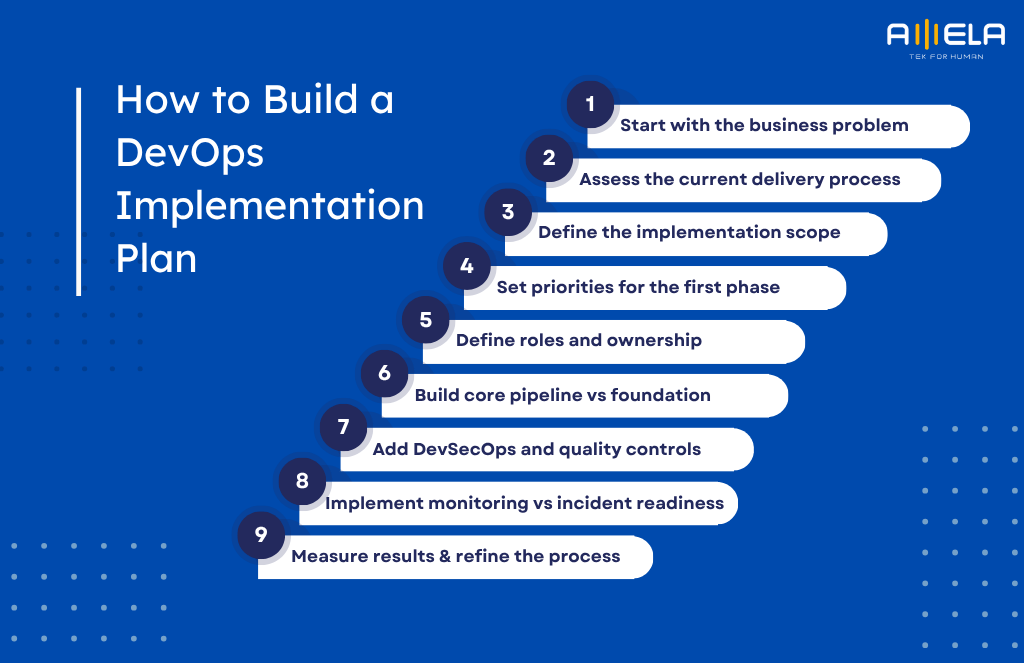
1. Start with the business problem
Begin with the reason the business wants DevOps in the first place. That may be slow releases, unstable deployments, too much manual work, inconsistent environments, or poor visibility after release.
This step matters because DevOps works best when it solves a clear delivery problem. Without that anchor, teams often jump into tools too early.
2. Assess the current delivery process
Map how software moves today, from development to testing to release. Look at handoffs, approval steps, environment setup, deployment flow, testing coverage, and incident handling.
At this stage, the goal is simple: identify where friction is highest. That gives the roadmap a practical starting point instead of a generic one.
3. Define the implementation scope
Do not try to apply DevOps everywhere at once. Choose where the rollout should begin: one product, one team, one service, or one release pipeline.
A narrower starting scope usually works better. It gives the business a chance to test the model, prove value, and adjust before scaling further.
4. Set priorities for the first phase
Once the scope is clear, decide what should be improved first. In most cases, businesses begin with a few core priorities, such as:
- CI/CD automation
- Environment standardization
- Test automation
- Monitoring and alerting
- Release workflow cleanup
This is where the roadmap becomes more useful. It starts showing not just what DevOps is, but what the business will actually change first.
5. Define roles and ownership
A DevOps plan needs clear ownership. Decide who will manage pipelines, infrastructure, monitoring, security checks, and release coordination.
This step is often overlooked, but it has a direct effect on execution. Once ownership is vague, even good processes start breaking down.
6. Build the core pipeline and environment foundation
Now the business can start putting the base structure in place. That usually means:
- Version control standards
- CI/CD pipeline setup
- Infrastructure as Code
- Environment consistency across dev, staging, and production
- Automated deployment flow
This stage creates the technical backbone of the DevOps model. Without it, later improvements tend to stay fragmented.
7. Add DevSecOps and quality controls
After the core pipeline is working, the next step is to build in quality and security. That includes:
- Automated testing
- Quality gates
- Dependency checks
- Code scanning
- Secrets management
- Access control
The point here is not to slow delivery down. It is to make faster delivery safer and more reliable.
8. Implement monitoring and incident readiness
A DevOps roadmap should not stop at deployment. Once software is live, the business needs visibility into performance, failures, and operational health.
That means setting up:
- Logging
- Monitoring
- Alerting
- Incident response flow
- Recovery ownership
This is where DevOps becomes an operating model, not just a release process.
9. Measure results and refine the process
After the first phase is in place, track what changed. Look at deployment frequency, release stability, lead time, incident volume, and recovery speed.
A strong DevOps plan is never just “implemented” once. It improves through iteration. The first rollout should create a foundation, then the roadmap can expand based on what worked and what still needs attention.
10. Scale gradually across the business
Once the first implementation is stable, apply the model to other teams, systems, or products. At that stage, the business can standardize patterns, share tooling, improve governance, and build a more mature DevOps practice across the organization.
That usually works better than trying to enforce one large transformation from day one. DevOps scales more effectively when it grows from proven internal practice.
Challenges in Implementing DevOps and How to Avoid Them
DevOps usually becomes difficult not because the idea is wrong, but because businesses try to move too fast, change too much at once, or treat DevOps as a tool project instead of an operating model.
- Unclear goals from the start
One of the most common issues is starting DevOps without a clear reason. Teams are told to “implement DevOps,” but no one defines what should improve first: release speed, deployment quality, automation, environment consistency, or incident response.
How to avoid it: Set a small number of practical goals early. The plan should answer one simple question: what delivery problem are we trying to solve first?
- Trying to transform everything at once
We often see businesses aim too wide in the first phase. They want to change pipelines, infrastructure, security, testing, monitoring, and team structure all at the same time. That usually creates friction, not momentum.
How to avoid it: Start with one product, one team, or one workflow. A narrower rollout is easier to manage and gives the business room to learn before scaling.
- Tool adoption without process alignment
DevOps can look busy on paper while still not working well in practice. A company may adopt CI/CD tools, cloud automation, and dashboards, but if the delivery process is still unclear, the benefits stay limited.
How to avoid it: Fix the workflow before expanding the toolset. Standardize how code moves, how releases are approved, and how teams collaborate. Then let tools support that structure.
- Weak ownership across teams
Another challenge is unclear responsibility. Pipelines exist, but no one truly owns them. Monitoring is set up, but response expectations are vague. Security checks are added, but not consistently maintained.
How to avoid it: Define ownership early. Teams should know who is responsible for pipelines, infrastructure, monitoring, security controls, and release coordination.
- Resistance to change
DevOps changes how teams work, not just what tools they use. That can create pushback, especially when developers, operations, and security teams are used to separate workflows. In our experience, this is often where implementation slows down quietly. The issue is not open resistance. It is hesitation, partial adoption, and people falling back to old habits.
How to avoid it: Support the transition properly. Explain why the change matters, train teams on the new workflow, and roll out new responsibilities gradually instead of forcing everything at once.
- Too much manual work remains in the process
Some businesses say they have adopted DevOps, but their delivery still depends on manual approvals, manual testing, or manual deployment steps. That slows everything down and increases inconsistency.
How to avoid it: Identify the most repetitive and error-prone steps first, then automate those in phases. Full automation is not the starting point. Useful automation is.
- Security added too late
Security often becomes an afterthought during DevOps rollout. The pipeline gets faster, but access control, secrets management, dependency checks, or release governance are still handled separately.
How to avoid it: Bring DevSecOps in early. It is much easier to build security into the workflow from the beginning than to retrofit it later.
- Lack of measurable progress
Some DevOps initiatives keep moving, but no one can clearly say whether delivery is actually improving. That usually weakens internal support over time.
How to avoid it: Track a few practical metrics from the start, such as deployment frequency, lead time, failure rate, or recovery time. Progress becomes much easier to manage when it is visible.
- Scaling before the first phase is stable
Businesses sometimes try to extend DevOps across the organization too early. If the first rollout is still inconsistent, scaling it usually spreads the same problems wider.
How to avoid it: Stabilize the first implementation first. Once the workflow is proven, scaling becomes much easier and less disruptive.
In practice, successful DevOps implementation usually looks less dramatic than people expect. It is often a series of controlled improvements, not one massive transformation. The companies that do it well are usually the ones that keep the rollout practical, phased, and closely tied to real delivery pain points.
How to Define KPI and Evaluate DevOps Implementation Success
DevOps success should be measured through a small set of KPIs that show whether delivery is becoming faster, more stable, and easier to manage over time.
Start with the business goal
Define what success should look like first, such as faster releases, fewer deployment issues, better stability, or less manual work.
Use the DORA metrics as the core KPIs
These are still the most practical baseline for DevOps evaluation:
- Deployment frequency
- Lead time for changes
- Change failure rate
- Time to restore service
Google notes these four metrics remain the industry standard for measuring software delivery performance.
Add a few operational KPIs
Delivery speed is only one side of the picture. It also helps to track:
- System availability
- Incident volume
- Alert response time
- Mean time between failures
Microsoft also recommends pairing delivery metrics with operational reliability measures.
Measure efficiency, not only release speed
Good supporting KPIs include build success rate, deployment success rate, test automation coverage, and environment provisioning time. These show whether the process is becoming more consistent and less manual.
Compare before and after implementation
The clearest way to evaluate DevOps success is to set a baseline before rollout, then measure how the KPIs improve after each phase.
Review KPIs by phase, not only at the end
DevOps implementation usually happens in waves. Measure results after each stage, such as pipeline setup, IaC rollout, DevSecOps integration, or monitoring improvements. That makes it easier to spot what is working and what still needs attention.
DevOps success is rarely proven in a single month. What matters is whether the trend is improving. A temporary spike in deployment frequency means very little if failure rate also rises or recovery gets worse.
A good DevOps KPI model does not need to be complicated. It just needs to show clearly whether the business is delivering faster, operating more reliably, and reducing friction over time.
Conclusion
In the end, DevOps works best when it is introduced with clear priorities, realistic phases, and measurable goals. Businesses that approach it that way are usually in a much better position to improve delivery speed, system stability, and long-term operational efficiency.
If your business is planning a DevOps rollout and needs the right technical support, AMELA Technology can help set up a team for the implementation, whether that means adding DevOps specialists, extending your current team, or building a stronger delivery model around your goals.