 Jan 19, 2026
Table of Contents
Fintech web development sits at the core of how modern financial services are built, scaled, and trusted online.
As users increasingly manage money through digital platforms, the stakes for reliability, security, and clarity continue to rise. According to Statista, digital banking is expected to generate over USD 2 trillion in net interest income by 2029, reflecting massive and sustained engagement with online financial services.
Having worked with multiple fintech companies across payments, lending, digital banking, and financial infrastructure, we’ve seen firsthand where fintech web projects succeed—and where they fail. This guide is built from that experience, distilling practical lessons, technical realities, and proven approaches to help teams make better decisions in fintech web development.
What is a Fintech Web Development?
Fintech web development is the practice of building secure, scalable, and regulation-ready web platforms for financial products such as digital banking, payments, lending, wealth management, and embedded finance.
It blends modern web engineering with financial logic, compliance, and enterprise-grade security—no shortcuts allowed.
For website development in fintech, ou’re dealing with real money, sensitive data, and zero tolerance for downtime. Every design choice—architecture, APIs, authentication, data handling—must assume audits, attacks, and sudden scale. That’s why fintech teams prioritize reliability, traceability, and security as first-class requirements, not afterthoughts.
At a technical level, fintech web platforms often include:
- Real-time data processing (transactions, balances, risk signals)
- Secure integrations with banks, payment gateways, and third-party providers
- Strong identity and access management
- High availability and performance under peak loads
What makes fintech web development unique is the intersection of speed and trust. Users expect fast, seamless digital experiences like any modern web product, but regulators and financial partners expect strict controls, transparency, and compliance. Balancing those expectations is where real fintech expertise shows.
In short, fintech web development is about building financial systems people can trust—at web scale. Done right, it enables innovation without compromising security or compliance. Done wrong, it puts the entire business at risk.
Why Your Fintech Needs a Website
For fintech companies, a website is a core product asset—not a marketing add-on. It supports trust, growth, compliance communication, and long-term scalability in ways apps and ads alone cannot.
Building Trust and Credibility with Users
Fintech users are cautious by default. They evaluate legitimacy before they ever onboard or move money. A well-structured website signals transparency by clearly explaining who you are, how your product works, and how user data and funds are protected. This matters because trust directly affects adoption. According to the World Economic Forum, trust and security concerns remain one of the biggest barriers to fintech adoption globally. A credible website helps reduce that friction early.
Supporting Customer Acquisition and Growth
Your website is your most scalable acquisition channel. Unlike apps, it is discoverable through search, partnerships, and referrals without forcing immediate commitment. Many fintech users research solutions online before signing up, especially in B2B and regulated use cases. Industry research from McKinsey consistently shows that digital customer acquisition is significantly more cost-efficient when companies invest in strong web presence and content clarity rather than relying only on paid channels.
Explaining Complex Financial Products Clearly
Fintech products are rarely simple. Payments flows, lending terms, compliance rules, or risk models require explanation. A website allows you to break down complex financial logic into clear, structured content—product pages, FAQs, onboarding guides, and documentation. This reduces support load, shortens sales cycles, and improves user confidence before they commit.
Demonstrating Security, Compliance, and Transparency
In fintech, users and partners expect visible proof of responsibility. Your website is where you communicate security practices, regulatory alignment, certifications, and compliance posture. Even when full details cannot be public, clearly stating standards, audits, and safeguards builds confidence with customers, regulators, and enterprise partners alike.
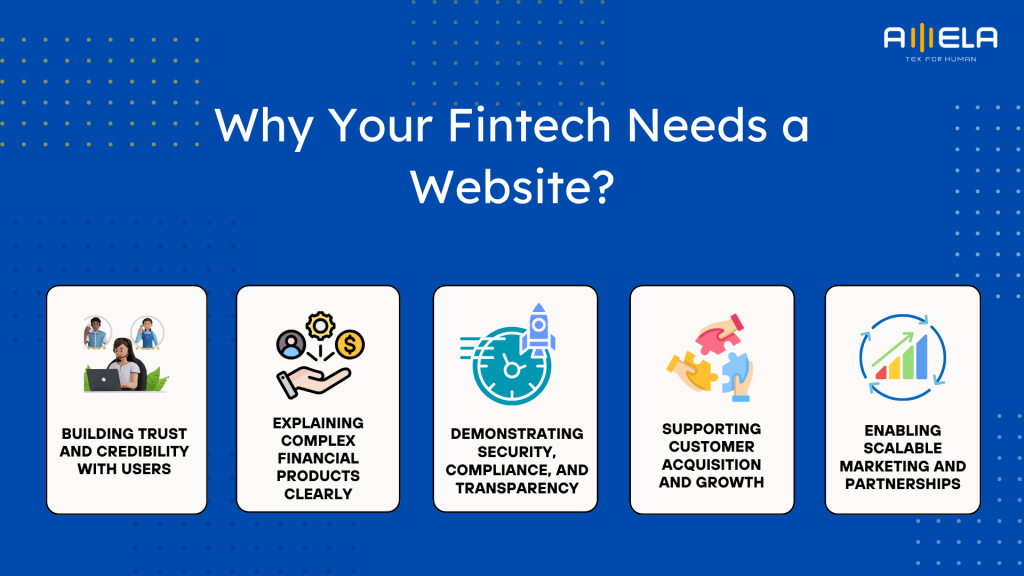
Enabling Scalable Marketing and Partnerships
As fintech products grow, partnerships become critical—banks, payment providers, platforms, or enterprise clients. A professional website acts as a shared reference point for integration discussions, due diligence, and partnership onboarding. It also supports long-term content strategies such as thought leadership, product updates, and compliance communication without depending on third-party platforms.
In fintech, your website is where trust is formed, understanding is built, and growth becomes scalable. Without it, even strong products struggle to convert interest into real adoption.
If you need support in the process, explore our website development services!
Key Types of Fintech Websites
Not all fintech websites serve the same purpose. From experience, the structure and focus of a fintech website should reflect the product model, target users, and regulatory complexity. Below are the most common—and practical—types you’ll see in real fintech delivery.
Digital Banking and Neobank Websites
These websites support consumer or business-facing digital banks. Their primary role is to build trust and explain services clearly—accounts, cards, transfers, fees, and security. Strong neobank websites focus on transparency, clear onboarding paths, and regulatory disclosures, because users are deciding whether to trust a platform with their money.
Payment and Transaction Platforms
Websites for payment gateways, PSPs, or embedded finance providers are often integration-driven. They prioritize API documentation, pricing clarity, uptime status, and use cases for merchants or developers. From what we’ve seen, the best payment fintech websites reduce friction by answering technical and commercial questions upfront, shortening sales and integration cycles.
Lending and Credit Platforms
Lending fintech websites must balance conversion and compliance. They explain eligibility, interest models, risk factors, and repayment terms in plain language while guiding users toward applications. Clear disclosures and educational content are critical here, as lending decisions are regulated and trust-sensitive.
Wealth Management and Investment Platforms
These websites focus heavily on education and credibility. Users expect explanations of investment strategies, risk levels, performance metrics, and regulatory safeguards. A strong web experience helps users understand complex financial concepts before committing funds, which directly impacts retention and long-term engagement.
B2B Fintech and Infrastructure Providers
For fintechs selling APIs, platforms, or financial infrastructure, the website functions as a sales enablement and trust layer. It highlights use cases, architecture, compliance readiness, and integration workflows. In practice, these websites are often reviewed by legal, security, and technical teams—not just end users—so clarity and professionalism matter more than flashy design.
RegTech and Compliance Platforms
Regulatory technology websites serve a highly specialized audience. Their main job is to explain how the product helps companies meet regulatory requirements efficiently. Clear positioning, detailed explanations, and proof of domain expertise are essential, because buyers are evaluating risk reduction, not just features.
In short: The most effective fintech websites are purpose-built. They align structure, content, and UX with the financial product they support—whether that’s onboarding consumers, enabling developers, or convincing enterprises and regulators.
Fintech Website Development Process (Step-by-Step)
In fintech, the development process must be intentional from the first decision.
Every step should reduce regulatory risk, prevent costly rework, and support long-term scalability.
Step 1: Start with risk and scope, not screens
Before any design work begins, clarify what the product is allowed to do and what it must never do. In fintech, missing one constraint can later block compliance or partnership approvals. We map data types (PII, financial data), user roles, and core flows such as onboarding, KYC, transactions, and account recovery. We also define a “definition of done” that includes security controls and audit readiness—not just UI completion.
For example, in a digital payments platform, we identify early which actions move real funds, where transaction limits apply, and which flows require strong authentication. This prevents redesigning payment flows later when compliance teams flag risks.
Step 2: Establish compliance and security baselines early
Fintech teams should agree on security and compliance requirements before implementation starts. This includes authentication rules, encryption standards, logging expectations, and access control boundaries. Aligning early avoids retrofitting security after features are built, which is expensive and risky.
For example, in a lending platform, we define upfront how credit decisions are logged, how underwriting data is stored, and who can access risk models. When regulators or partners request audit evidence, the system already supports it.
Step 3: Design user journeys as financial workflows
Fintech UX is not about visual polish; it is about guiding users through financial decisions safely and clearly. Design journeys around trust moments such as identity verification, consent, confirmations, and error handling. Edge cases should be treated as standard flows, not exceptions.
For example, in a neobank project, onboarding is designed as a verified sequence—KYC, consent, account creation, and initial funding—with clear handling for failed verification or delayed deposits. This reduces drop-offs and support tickets after launch.
Step 4: Choose architecture based on transaction behavior
Architecture decisions should be driven by reliability and integration needs, not convenience. Identify components that must remain stable under load and isolate them from non-critical services. Plan for failures, retries, and third-party outages from the start.
For example, in a payment gateway, transaction processing is separated from dashboards and reporting. This ensures analytics traffic never affects authorization speed during peak payment volumes.
>>> Related: Best Web Development Frameworks
Step 5: Define APIs before building the UI
In many fintech products, APIs are the backbone of the platform. Define API contracts early, including validation rules and error responses. This stabilizes business logic and allows frontend and partner integrations to progress in parallel.
For example, in a banking-as-a-service platform, APIs for account creation, balance queries, and transfers are finalized before the web interface. Partners can integrate early while the UI evolves independently.
Step 6: Embed security controls during development
Security must be part of everyday development, not a final checklist. This includes permission checks, rate limiting, input validation, secrets management, and audit logging at every layer.
For example, in a wealth management platform, role-based access is enforced at the API level so investors, advisors, and admins automatically see different data. Every portfolio action is logged with full context for audit and dispute resolution.
Step 7: Test with real financial scenarios
Fintech testing must reflect real-world financial behavior. Beyond functional tests, teams should simulate failure scenarios, provider delays, partial transactions, and reconciliation edge cases.
For example, in a cross-border remittance product, we test rate changes mid-flow, provider timeouts, and duplicate callback handling to ensure balances remain accurate under stress.
Step 8: Prepare monitoring and incident response before launch
A fintech platform should never go live without observability. Set up monitoring for critical flows, alerts for anomalies, and clear response procedures when incidents occur.
For example, in a digital wallet, we monitor top-up failures, abnormal withdrawals, and login spikes. When something breaks, the team can act immediately instead of waiting for user complaints.
Step 9: Iterate post-launch with controlled releases
Fintech products evolve continuously. Changes should be rolled out in small, controlled releases with clear rollback paths. Post-launch work focuses on hardening and compliance as much as new features.
For example, in a RegTech platform, regulatory updates are deployed behind feature flags so rule changes can go live safely without disrupting existing customers.
Final takeaway: Fintech web development succeeds when each step is driven by risk awareness, clarity, and real financial behavior. When teams follow this process, they build platforms that scale safely instead of reacting to problems after launch.
Fintech Web Development Cost Breakdown
Fintech web development costs vary widely depending on scope, security requirements, and regulatory complexity. Unlike standard web projects, fintech platforms must budget for compliance, data protection, and long-term reliability from day one.
Estimated fintech website development cost ranges (practical view)
From our experience, a fintech web MVP typically starts from USD 40,000–80,000 when it covers core flows such as onboarding, authentication, basic transactions, and admin dashboards.
A production-ready fintech platform with advanced security, third-party integrations, audit logging, and scalability usually falls in the USD 120,000–300,000+ range, depending on depth and region.
These numbers assume professional engineering teams, not shortcuts. Anything significantly cheaper often hides technical or compliance risks that surface later.
Key factors that affect fintech web development cost
Product scope and complexity
The more financial logic involved, the higher the cost. Simple informational fintech sites cost far less than platforms handling payments, lending decisions, or investment transactions. Features like real-time processing, reconciliation, and multi-currency support add meaningful effort.
Security and compliance requirements
Fintech platforms must invest in authentication, encryption, access control, audit trails, and monitoring. If the product touches regulated data or payment flows, compliance-related work can account for a significant portion of the budget.
Third-party integrations
Banks, payment providers, KYC services, fraud tools, and analytics platforms all add complexity. Each integration requires testing, failure handling, and ongoing maintenance, which directly impacts cost.
Architecture and scalability expectations
A platform built to handle thousands of users is very different from one designed for millions. Planning for high availability, redundancy, and peak traffic increases both development and infrastructure costs.
Team location and delivery model
Onshore teams typically come with the highest cost, offshore teams offer lower rates but may require more coordination, and nearshore or hybrid models often strike a balance between cost efficiency and collaboration quality.
Long-term maintenance and evolution
Fintech is never “done.” Ongoing updates for security patches, regulatory changes, and feature improvements should be included in total cost planning, not treated as optional extras.
Fintech web development costs are driven by trust, not just features. Investing upfront in the right architecture, security, and delivery model reduces risk and lowers total cost over the product’s lifetime.
Different Ways to Build Your Fintech Website
There is no single “right” way to build a fintech website—the best approach depends on your timeline, risk tolerance, internal capabilities, and long-term goals.
From experience, fintech teams usually choose one of the models below, or a hybrid of them.
Hire In-House Developers
Hiring developers internally gives you maximum control over product direction and technical decisions. This model works well for fintech companies with a long-term roadmap, strong technical leadership, and the ability to manage compliance and security internally.
The downside is speed and cost. Hiring experienced fintech engineers takes time, and maintaining an in-house team means ongoing expenses for salaries, infrastructure, and compliance readiness. For early-stage fintechs, this model can slow down time to market.
Outsource the Full Project
Outsourcing the entire website development project to a specialized development partner is often the fastest way to launch. This approach is practical when you need a clear scope, predictable budget, and access to fintech expertise without building a team from scratch.
In practice, this works best for MVPs or well-defined platforms where requirements are known upfront. The key is choosing a web development partner with real fintech experience—security, compliance, and financial workflows cannot be learned mid-project.
Build an ODC or Dedicated Team
An Offshore Development Center (ODC) or dedicated team model sits between hiring in-house and full outsourcing. You get a stable team that works exclusively on your product, while the vendor handles hiring, operations, and scaling.
This model is especially effective for fintech companies that want long-term development capacity without the overhead of managing a full internal team. When paired with nearshore delivery, it also supports Agile collaboration and faster feedback loops.
Hybrid Models (Common in Fintech)
Many fintech companies combine models. For example, they keep product ownership and architecture in-house while using a dedicated or nearshore team for implementation and scaling. This setup balances control, speed, and cost, and is common once the product moves beyond MVP.
Final guidance: The right delivery model is the one that matches your fintech’s maturity and risk profile. Whether you hire, outsource, or build a dedicated team, success depends on choosing an approach that supports security, compliance, and long-term growth—not just short-term cost savings.
Security and Compliance in Fintech Web Development
In fintech, security and compliance are not technical concerns—they are business enablers. A fintech website that fails security or compliance reviews will struggle to onboard users, partners, or financial institutions, regardless of how good the product looks.
Security must be designed into the architecture
Fintech websites must assume they are always under scrutiny—from attackers, auditors, and regulators. Security starts at system design. Authentication, authorization, encryption, and secure session handling must be enforced consistently across all layers.
Critical actions such as transactions, profile updates, permission changes, and withdrawals should always require strong verification and generate immutable audit logs. From experience, teams that design these controls early avoid major refactors when external security reviews begin.
Identity and access management are foundational
Managing who can access what is central to fintech security. Role-based access control should be enforced at the API level, not just in the UI. Admin tools, support access, and internal dashboards must be treated as high-risk surfaces.
A common mistake is assuming internal users are “trusted.” In reality, insider risk and misconfigured access are among the most frequent causes of fintech incidents.
Data protection must cover the full lifecycle
Fintech websites handle sensitive data such as personal identities, financial histories, and transaction records. Protecting this data goes beyond encryption. Teams must define how data is collected, stored, accessed, retained, and deleted.
Systems should be designed so sensitive data exposure is minimized by default. This makes compliance easier and reduces impact if incidents occur.
Compliance is a continuous capability, not a launch phase
Regulatory requirements evolve as products expand to new markets or add new features. Fintech websites must be built to support traceability and transparency at all times.
From experience, platforms that embed compliance into core workflows respond far faster to audits. They can answer questions like who approved this transaction, why was this account flagged, or what data was accessed during a support case—without manual reconstruction.
Monitoring, logging, and incident readiness are mandatory
Security and compliance depend on visibility. Fintech websites must log meaningful events, monitor system behavior, and alert teams to anomalies. This is not just for uptime—it’s essential for fraud detection, incident response, and regulatory reporting.
The ability to detect and respond quickly often matters more than perfect prevention.
Best Practices in Fintech Website Development
Beyond security and compliance, fintech websites succeed when engineering discipline meets product clarity. These best practices consistently reduce risk and improve scalability.
- Design for financial clarity and user confidence
Users must understand what is happening to their money at every step. Clear transaction confirmations, visible fees, and understandable error messages reduce costly mistakes and disputes. Ambiguous UX increases support load and erodes trust.
- Separate financial logic from presentation
Core financial logic—transactions, balances, permissions, compliance checks—should be isolated from frontend layers. This separation improves testability, security, and long-term maintainability. It also allows teams to update the UI without risking financial integrity.
- Build resilience into every critical flow
Fintech systems must assume third-party failures, delayed responses, and network issues. Graceful degradation—clear messaging, retries, and safe rollbacks—prevents user panic and operational chaos during incidents.
Systems that fail silently or inconsistently lose trust quickly.
- Use AI responsibly and transparently
AI is increasingly used in fintech for fraud detection, personalization, and risk signals. However, AI should assist decisions, not replace accountability. Outputs must be explainable, logged, and reviewable.
When AI influences financial outcomes, fintech websites must clearly communicate results and escalation paths. Opaque AI behavior creates compliance risk and user frustration.
- Plan for scale before growth forces it
Many fintech platforms grow faster than expected. Clean APIs, modular services, and clear ownership boundaries allow teams to scale without breaking core systems. Scaling should feel incremental—not like rebuilding the foundation.
- Keep delivery iterative but controlled
Fintech websites benefit from iterative releases, but changes must be controlled. Feature flags, staged rollouts, and rollback strategies reduce deployment risk and support compliance requirements.
Conclusion
Fintech web development is not just about building a functional website—it’s about earning trust, meeting regulatory expectations, and scaling securely.
As digital financial services continue to grow, teams that invest early in security, compliance, and solid engineering foundations are far better positioned to compete and adapt.
If you’re planning a fintech product or improving an existing platform, applying the right fintech web development approach from the start can save months of rework and reduce long-term risk. A short expert conversation early often makes a big difference later.