
 Jan 22, 2026
Table of Contents
Dedicated teams project management is about building and leading long-term teams that deliver real product value, not just completing tasks. As digital products grow more complex and requirements change faster than ever, many companies find that traditional project-based outsourcing simply cannot keep up.
In this blog, we share our hands-on perspective on dedicated teams project management—what the model really is, how it compares with other engagement approaches, when it works best, and how to manage it effectively in real-world conditions. Drawing from practical delivery experience, this guide is designed to help business leaders and product owners decide whether a dedicated team is the right fit and how to make it succeed once in place.
Key Takeaways
- Dedicated teams project management works best for long-term, evolving products, where requirements change and continuity matters more than fixed scope.
- The real value comes from stability and ownership, not just having full-time resources assigned to a project.
- Clear product leadership and fast feedback loops are critical; without them, even strong dedicated teams will struggle.
- Cost efficiency is achieved through reduced churn, rework, and re-onboarding, not simply through lower staff rates.
- Dedicated teams outperform other models when quality, maintainability, and delivery predictability matter, especially in distributed or offshore setups.
- Successful management focuses on outcomes, not hours, shifting teams toward product thinking rather than task execution.
What Is the Dedicated Team Model?
The dedicated team model is a long-term collaboration where a client works with a stable, full-time team that operates as an extension of their in-house organization. The team is allocated exclusively to one project, with shared goals, clear ownership, and continuous delivery.
From our experience running dedicated teams for years, this model shines when products are evolving and priorities shift over time. Instead of scoping everything upfront and renegotiating every change, you build momentum with a team that knows your product, users, and tech stack inside out. They attend your standups, think in your roadmap, and flag risks early—because they’re invested. It’s not a “vendor–client” vibe; it’s closer to “this is our team, just in a different location.”
That said, it’s not magic. Dedicated teams work best when clients are ready to lead with clarity—product vision, priorities, and feedback loops matter. When that’s in place, things click fast and delivery feels smooth. When it’s not, things can get messy. But when done right? It’s a solid setup that scales without the constant friction of re-hiring or re-briefing. Pretty sweet, honestly.
Key Benefits of a Dedicated Development Team
In our experience, an outsourced dedicated team pays off when you need compounding delivery speed, stable quality, and real product ownership—not random “extra hands.” Once the same people stay with the product long enough, the team stops just executing tasks and starts preventing problems before they hit production.
- Compounding velocity through deep product context
When the same engineers stay on the same codebase, delivery speeds up for a simple reason: fewer “rediscovery cycles.” We see less time wasted on re-learning architecture, re-reading old tickets, and re-arguing decisions. This is the practical side of what agile research highlights—successful agile transformations can deliver ~30% gains in efficiency when teams operate with strong ways of working and tighter feedback loops.
- Lower hidden cost from churn and re-onboarding
A big chunk of outsourcing cost is invisible: the time spent replacing people, re-aligning expectations, and rebuilding trust. Dedicated teams reduce churn because the model is built around continuity. Gallup estimates replacing technical roles costs ~80% of salary (and leaders/managers can cost far more), which matches what we see: churn isn’t just hiring cost—it’s lost momentum, broken context, and delayed releases.
- Higher quality through shared standards and “memory”
With a stable team, quality becomes a habit rather than a checklist. Teams develop consistent code conventions, predictable review patterns, and better test discipline because they live with the consequences. The result is fewer regressions, less patchwork, and fewer “why did we do it this way?” moments. It’s not glamorous, but it’s the stuff that keeps delivery smooth.
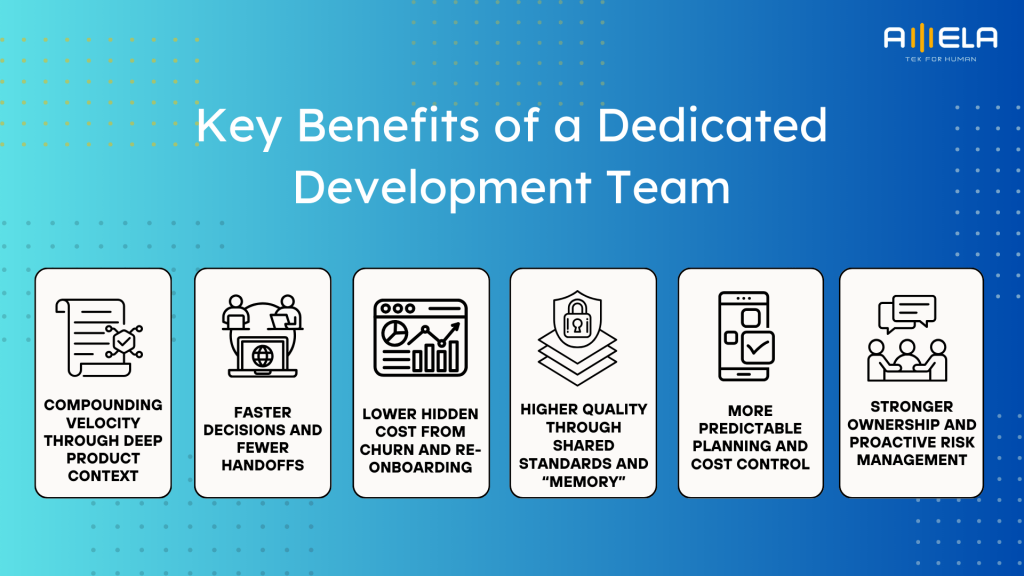
- Faster decisions and fewer handoffs (less coordination tax)
Dedicated teams reduce the “coordination tax” that kills speed in distributed delivery. Once roles settle (PM/PO, tech lead, QA, DevOps), decisions stop bouncing between people who barely know the product. In real operations, this is where cycle time drops—less waiting, fewer meetings, and less rework. It’s a bit of a cheat code when execution matters.
- More predictable planning and cost control
Project-based outsourcing often looks neat on paper, but changes always happen. A dedicated team makes scope flexibility manageable because the team’s capacity is stable and planning becomes a throughput conversation, not a contract renegotiation. From our side, predictability improves because the team’s baseline velocity and quality stabilize over time.
- Stronger ownership and proactive risk management
The biggest difference we feel in dedicated engagements is mindset. A stable team starts acting like “this is our product,” not “this is our ticket.” They flag risks earlier, challenge unclear requirements, and suggest improvements. That’s when the collaboration gets real—and honestly, that’s when clients say the model feels “pretty sweet.”
When to Use vs When Not to Use the Dedicated Development Team Model
The dedicated team model works best in environments where continuity, ownership, and adaptability matter more than fixed scope. Based on what we see in real delivery, here’s how to decide—without sugarcoating it.
When to Use a Dedicated Team?
- Evolving roadmaps and shifting priorities
A dedicated team is a strong fit when requirements are expected to change as the product evolves. Instead of pausing delivery to renegotiate scope, the team can adapt sprint by sprint while maintaining momentum and shared understanding.
- Long-term product development, not one-off delivery
When you are building a product over time, continuity matters. A stable team accumulates product knowledge—architecture decisions, user behavior, and technical trade-offs—which directly improves decision-making and reduces repeated rediscovery work.
- Quality, maintainability, and tech debt control
Teams that stay together naturally develop shared standards and a sense of responsibility for the codebase. This leads to cleaner implementations, fewer regressions, and more deliberate handling of technical debt instead of quick fixes.
- Minimizing disruption from team changes
Frequent team changes slow everything down. A dedicated model reduces the operational friction caused by onboarding, context transfer, and re-alignment, allowing delivery to stay consistent instead of resetting every few months.
- Clear product leadership and fast feedback loops
Dedicated teams perform best when there is a single product owner who can prioritize work and give timely feedback. With clear direction, teams become proactive rather than reactive—and execution starts to feel smooth instead of forced.
>>> Related: All IT Outsourcing Models You Should Know
When Not to Use a Dedicated Team?
- Short-term, clearly defined deliverables
Fixed-scope tasks like small integrations, simple websites, or one-time migrations often perform better under project-based engagement. Dedicated teams shine over time, not in quick hits.
- Limited stakeholder availability
If reviews, approvals, or clarifications take weeks, the team will stall or make assumptions. Either outcome erodes the value of having a dedicated setup.
- Unclear ownership or conflicting priorities
Without a single decision-maker, teams get pulled in different directions. In those cases, a dedicated model can amplify confusion rather than solve it.
- Highly unstable or stop–start budgets
Dedicated teams rely on predictable capacity. Frequent freezes or sudden scale-downs break continuity and dilute the model’s main advantage.
- Very narrow, short-lived expertise needs
Sometimes all you need is a specialist for a few weeks. In that case, staff augmentation or consulting is usually more efficient than forming a full dedicated team.
If the engagement is expected to last 3–6 months or longer, priorities are likely to change, and product quality matters beyond the next release, a dedicated team is usually the right call. If not, forcing this model often creates more friction than value.
Choosing the right model is less about trend-following and more about being honest with how you actually work.
Dedicated Team vs Fixed Price Model: A Practical Comparison
The choice between a Dedicated Team and a Fixed Price model depends on how clear your requirements are, how often they change, and how much control you want over delivery. From our experience, problems usually happen not because one model is bad, but because the wrong model is chosen.
Below is a side-by-side comparison based on real delivery scenarios, not theory.
| Criteria | Dedicated Team Model | Fixed Price Model |
| Scope definition | Flexible and evolving; scope can change sprint by sprint | Must be clearly defined upfront; changes require renegotiation |
| Best suited for | Long-term product development, scaling platforms, evolving roadmaps | Short-term projects with stable, well-defined requirements |
| Cost structure | Monthly cost based on team size and roles | Fixed total cost agreed before development starts |
| Budget predictability | Predictable monthly spend, flexible output | Predictable total cost, limited flexibility |
| Change management | Changes are absorbed naturally into backlog prioritization | Changes trigger change requests, delays, and extra cost |
| Delivery speed over time | Improves as team gains product and domain context | Often slows down when assumptions differ from reality |
| Product ownership | High ownership; team acts as an extension of in-house staff | Limited ownership; team focuses on contract deliverables |
| Client involvement | High collaboration: planning, reviews, ongoing feedback | Lower involvement after requirements are signed off |
| Risk distribution | Shared risk between client and team | Most delivery risk sits with the vendor |
| Quality & maintainability | Improves over time due to continuity and shared standards | Risk of shortcuts to stay within fixed scope and cost |
| Time-to-start | Fast once team is formed | Slower due to detailed upfront specification |
| Transparency & control | High visibility into progress, priorities, and team performance | Progress measured against predefined milestones only |
| Typical engagement length | Medium to long term (3–6 months or more) | Short to medium term (weeks to a few months) |
If you are building a product, expect requirements to evolve, or want the team to think with you—not just execute tasks—the Dedicated Team model is usually the safer and more scalable choice.
If you have a clearly defined scope, limited timeline, and minimal change expected, the projects with Fixed Price model can work well—as long as the requirements are truly locked.
In our experience, most friction comes from forcing a fixed-price contract onto an evolving product. Choosing the right model upfront saves far more time, money, and stress than optimizing the rate later.
>>> Related: Flexible Project-based IT Staffing: What it is?
Dedicated Team vs Time & Material Model: What’s the Real Difference?
Dedicated Team and Time & Material (T&M) often look similar on paper, but in practice they drive very different behaviors, expectations, and outcomes. From our experience, confusion between these two models is a common source of misalignment.
| Criteria | Dedicated Team Model | Time & Material (T&M) Model |
| Team allocation | Stable, full-time team assigned exclusively to one client | Resources allocated based on availability, may change over time |
| Engagement focus | Long-term collaboration and product ownership | Task-based execution and billable effort |
| Cost structure | Monthly fee based on agreed team composition | Pay per actual hours or days worked |
| Budget predictability | High predictability on monthly spend | Variable spend depending on workload |
| Scope flexibility | High; scope evolves through backlog prioritization | Flexible, but changes increase billed hours |
| Team continuity | Strong continuity; team builds deep product context | Context may be lost if resources rotate |
| Client involvement | Ongoing collaboration and planning | Regular tracking of hours, tasks, and burn rate |
| Delivery mindset | Outcome-oriented: focus on long-term product success | Effort-oriented: focus on time spent and tasks completed |
| Quality over time | Improves as team gains ownership and shared standards | Can vary depending on resource stability |
| Scaling team size | Structured and planned scaling | Ad-hoc scaling based on immediate needs |
| Management overhead | Lower after initial setup | Higher due to tracking, approvals, and reporting |
| Typical use case | Product development, platform scaling, long-term roadmaps | Support, maintenance, exploratory or undefined work |
Services with time & material contract works well when work is exploratory, unpredictable, or short-lived—especially when clients want maximum flexibility and are comfortable managing day-to-day tasks and budgets closely.
A Dedicated Team model becomes far more effective once there is a clear product direction and the need for continuity. Instead of tracking hours, both sides focus on outcomes, delivery rhythm, and long-term quality. Less micromanagement, more momentum.
Our practical advice: if your team is spending more time tracking hours than improving the product, it’s usually a sign that the engagement should move from T&M to a dedicated setup.
Dedicated Team vs Staff Augmentation: A Clear, Practical Comparison
Dedicated Team and staff augmentation services are often confused, but they solve very different problems. From our experience working with both models, the choice comes down to ownership vs flexibility and product focus vs individual capacity.
Here’s a side-by-side comparison based on real delivery behavior, not just contract terms.
| Criteria | Dedicated Team Model | Staff Augmentation Model |
| Primary purpose | Build and scale a product or system long term | Fill skill gaps or increase capacity short term |
| Team structure | Stable, cross-functional team (PM/Tech Lead/Dev/QA) | Individual engineers added to an existing team |
| Ownership & accountability | Shared ownership of delivery outcomes | Individual responsibility for assigned tasks |
| Engagement mindset | Product-oriented: roadmap, quality, long-term success | Resource-oriented: tasks, tickets, utilization |
| Client management effort | Moderate (strategic direction, priorities) | High (daily tasking, technical guidance, reviews) |
| Continuity & product knowledge | High; team builds deep product and domain context | Depends on contract length and individual retention |
| Speed to start | Slower initial setup, faster long-term velocity | Very fast onboarding |
| Flexibility in team composition | Planned and structured scaling | Highly flexible, add/remove individuals easily |
| Best suited for | Product development, platform scaling, evolving roadmaps | Short-term needs, niche skills, temporary capacity |
| Risk distribution | Shared between client and delivery partner | Mostly on the client |
| Cost structure | Monthly fee by team size and roles | Pay per resource (monthly or hourly) |
If you already have a strong in-house tech leadership and simply need more hands—or a specific skill fast—staff augmentation is often the cleanest option. It gives flexibility and speed, but it also means you carry most of the delivery responsibility.
If you want a team that thinks with you, challenges requirements, and grows with the product, a dedicated team is the better fit. It requires more alignment upfront, but once it clicks, delivery becomes smoother and more predictable.
A simple rule we use internally:
- Need people? → Staff augmentation
- Need a product team? → Dedicated team
Choosing the right model upfront saves far more pain than switching models mid-project.
Where to Hire a Dedicated Development Team
Where you hire a dedicated team matters just as much as how you manage it. From what we’ve seen across many engagements, the “right” location depends on cost expectations, communication needs, time-zone overlap, and how much ownership you expect the team to take.
In-house (Local Hiring)
Hiring a dedicated team locally gives you maximum control and cultural alignment. Communication is easy, decision-making is fast, and onboarding feels natural. However, this option comes with high cost, longer hiring cycles, and limited scalability, especially for senior or niche roles. From experience, this works best for core leadership roles, not for scaling execution teams.
Nearshore Dedicated Teams
Nearshore teams (e.g. Eastern Europe for Western Europe, LATAM for the US) offer better time-zone overlap and cultural compatibility than offshore options. They’re a solid middle ground when real-time collaboration is critical. That said, costs are still relatively high, and talent competition in popular nearshore regions can limit availability.
Offshore Dedicated Teams (Asia-focused)
Offshore locations—especially Southeast Asia—are where the dedicated team model really shows its strength. Countries like Vietnam offer strong engineering talent, competitive costs, and improving English proficiency, making long-term collaboration viable. From our experience, offshore dedicated teams or ODC (offshore development center) work best when clients want scalability and continuity without ballooning costs. The key is choosing a partner who can manage communication, quality, and retention properly—otherwise the savings evaporate fast.
>>> Related: How to Build a Tech Team in Vietnam
Hybrid Models (Local + Offshore)
Many of our most successful setups are hybrid: product ownership or architecture roles remain local, while execution is handled by an offshore dedicated team. This balances strategic control with cost efficiency and scales surprisingly well once trust is established. It’s not fancy, but it works—and works consistently.
What matters more than geography
Across all regions, we’ve learned that partner maturity beats location every time. A strong partner with solid processes, low attrition, and product-oriented mindset will outperform a poorly managed team—even if they’re sitting next door. Geography sets the baseline; execution decides the outcome.
Our takeaway
If you need tight control and have the budget, local teams make sense. If you need scale, continuity, and cost efficiency, outsourced development teams—when managed well—are hard to beat. And if you want the best of both worlds, a hybrid model is usually the sweet spot.
How to Manage a Dedicated Team
Managing a dedicated team is less about control and more about creating the conditions for focus, ownership, and steady delivery. From our experience, teams perform best when expectations are clear and friction is intentionally removed.
- Anchor everything to outcomes, not activity
Set clear goals for each sprint or cycle—what value should be delivered and why it matters. Avoid measuring success by hours logged or tickets closed. When teams know the outcome, they make better trade-offs on their own.
- Appoint a single decision-maker
Dedicated teams need fast answers. Assign one Product Owner (or equivalent) with real authority to prioritize, accept work, and resolve conflicts. Multiple voices without a decider slow everything down—every time.
- Keep a predictable delivery rhythm
Consistent ceremonies (planning, daily syncs, reviews, retros) create momentum. The goal isn’t more meetings; it’s fewer surprises. Predictability builds trust and lets the team focus.
- Invest early in shared context
Spend time explaining users, past decisions, tech debt, and “why it’s built this way.” Teams with context require less supervision and proactively flag risks. This upfront investment pays back quickly—no joke.
- Balance autonomy with guardrails
Give the team room to own implementation decisions, but set non-negotiables around quality, security, and documentation. Autonomy works when boundaries are clear.
- Communicate asynchronously by default
Use async tools for updates and decisions, and reserve meetings for discussions that truly need real-time input. This reduces time-zone friction and keeps deep work uninterrupted.
- Create fast feedback loops
Review work quickly and give concrete feedback. Slow or vague feedback is a silent productivity killer. Tight loops keep quality high and morale steady.
- Protect team stability
Minimize churn and sudden scope shocks. Dedicated teams compound value over time; constant reshuffling resets progress. Stability is a feature—treat it like one.
- Be transparent about priorities and trade-offs
Share constraints openly—budget, timelines, risks. When teams understand the “why,” they align naturally and stop guessing.
Our takeaway: great dedicated team management feels boring in the best way. Clear goals, steady rhythm, fast decisions, and mutual trust—get these right, and the team will surprise you with how much they can deliver.
Conclusion
Dedicated teams project management works best when companies want long-term ownership, stable delivery, and the flexibility to evolve products without constant friction. When managed well, dedicated teams stop feeling like an external vendor and start operating as a true extension of your in-house organization—aligned with your goals, roadmap, and quality standards.
At AMELA, we support clients with a dedicated team model designed for exactly that balance: competitive staff pricing, deep experience working with global clients, and strong delivery quality that holds up in real production environments. Whether you need to scale quickly, build a product over the long term, or reduce delivery risk while keeping costs under control, our dedicated teams are built to deliver consistently—not just on paper, but in practice.
If you are considering a dedicated team model and want a setup that combines cost efficiency with proven execution, AMELA is ready to help you build a team that actually lasts and performs.
FAQs About the Dedicated Teams
What is the typical cost of a dedicated development team?
Dedicated team cost usually ranges from USD 3,000 to 6,000 per developer per month, depending on location, seniority, and team composition. From our experience, the total monthly cost is more predictable than project-based models because pricing is tied to capacity, not fluctuating scope. What teams often overlook is that stability reduces hidden costs like re-onboarding, rework, and delivery delays.
What are the main challenges of the dedicated team model?
The biggest challenge is not technical—it’s leadership and alignment. Dedicated teams struggle when product ownership is unclear, feedback is slow, or priorities conflict. Without clear direction, even strong teams can drift. Another common challenge is over-managing the team like a time-tracking contract, which kills ownership and motivation.
How long should a dedicated team engagement last?
In practice, dedicated teams deliver the most value after the first 2–3 months. That’s when product context, velocity, and collaboration start to compound. Engagements shorter than three months rarely unlock the real benefits of the model and often feel similar to staff augmentation.
Is a dedicated team better than staff augmentation?
It depends on what you need. If you need individual skills quickly and already have strong in-house leadership, staff augmentation works well. If you want a team that owns delivery, quality, and long-term evolution of a product, a dedicated team is the better fit. The key difference is ownership, not headcount.
How do I ensure quality when working with a remote dedicated team?
Quality comes from process and clarity, not location. Clear acceptance criteria, regular reviews, shared standards, and fast feedback loops matter far more than geography. In our experience, remote teams outperform local ones when expectations and communication are handled well.
Can I scale a dedicated team up or down easily?
Yes, but it should be planned—not reactive. Scaling works best when done incrementally and aligned with roadmap milestones. Sudden changes break continuity and slow delivery. A good partner will help you scale responsibly while protecting team stability.