
 Feb 23, 2026
Table of Contents
Offshore Software Development Vietnam: Business and Cost Benefits
Offshore software development in Vietnam reduces total delivery cost by combining competitive engineering rates with improving communication maturity, structured documentation practices, and reduced coordination overhead.
The financial advantage is not limited to salary differentials. It emerges from how efficiently projects are executed.
1. Competitive Development Pricing with Operational Leverage
Vietnam remains cost-competitive compared to Western markets. According to several research, average development rates in Vietnam range between USD 15–40 per hour, compared to USD 70–150 in the United States.
However, lower pricing only translates into savings when delivery productivity is preserved. Hidden costs often arise when low-cost teams require heavy oversight or frequent correction.
Vietnam’s offshore sector has matured significantly in serving Japan, Australia, and North America. Many firms operate under international quality frameworks such as ISO 27001 (information security) and ISO 9001 (quality management). The International Organization for Standardization reports strong growth in ISO certifications across Southeast Asia over the past decade, reflecting formalized quality governance adoption.
Structured governance reduces:
-
Uncontrolled scope drift
-
Documentation gaps
-
Defect leakage into production
-
Time spent on corrective iterations
When lower hourly rates are combined with structured delivery discipline, businesses experience true cost efficiency rather than false economy.
>>> Related: Cost of Outsourcing IT Services in Different Regions
2. Lower Coordination and Rework Costs Through Communication Maturity
In offshore projects, coordination cost often exceeds development cost. Miscommunication, unclear requirements, and cultural friction can inflate project timelines by 20–30% in poorly structured engagements.
Deloitte’s outsourcing research emphasizes that governance maturity, vendor management discipline, and communication alignment are stronger predictors of outsourcing success than cost savings alone. (Source: Deloitte Insights – Outsourcing Strategy)
Vietnam’s offshore sector has evolved within demanding export markets, particularly Japan, where documentation precision and process adherence are critical. Long-term collaboration with Japanese enterprises has elevated documentation standards, specification discipline, and structured reporting practices across many Vietnamese firms.
Additionally, Vietnam’s time zone positioning enables:
-
Full overlap with Japan and other Asia-Pacific markets
-
Partial daily overlap with Australia
-
Practical coordination windows with Europe
Reduced time lag shortens feedback loops, accelerating sprint iteration cycles and lowering clarification delays.
Improved English proficiency among software professionals also reduces interpretation risk. According to EF English Proficiency Index, Vietnam ranks in the “Moderate Proficiency” tier, showing steady improvement in professional English capability.
Shorter feedback cycles + clearer documentation + process discipline = lower rework cost.
Rework is one of the largest hidden expenses in offshore projects. When requirement misinterpretation drops, velocity stabilizes. When velocity stabilizes, budget predictability improves.
3. Lower Cost of Churn and Knowledge Loss
One of the most underestimated expenses in software development is the cost of attrition. When developers leave mid-project, businesses incur:
-
Recruitment costs
-
Onboarding time
-
Knowledge transfer delays
-
Temporary productivity drops
-
Increased defect risk
According to Gallup’s workplace research, replacing a skilled employee can cost between 50% to 200% of their annual salary, depending on role complexity.
In high-cost markets with talent shortages, churn often creates cascading delays and inflated compensation demands.
Vietnam’s advantage lies in supply elasticity and structured offshore engagement models. Dedicated team or ODC in Vietnam models typically operate under long-term contracts with managed retention programs, reducing abrupt turnover risk. The presence of a broad local talent pool also shortens replacement cycles compared to saturated Western markets.
Additionally, because many offshore engagements in Vietnam are team-based rather than individual contractor-based, knowledge is distributed across the team rather than concentrated in a single developer. This reduces single-point dependency risk.
Lower churn impact directly protects delivery timelines and stabilizes total cost.
4. Reduced Operational and Business Risk Through Government and Ecosystem Support
Vietnam’s government actively promotes the ICT and software sector as a strategic industry. According to the Ministry of Information and Communications and the Ministry of Planning and Investment, technology enterprises may benefit from:
-
Corporate income tax incentives (preferential rates for high-tech enterprises)
-
Tax holidays or reductions during initial years of operation
-
Investment incentives in designated high-tech parks
-
Policies supporting digital transformation and R&D
Vietnam’s Corporate Income Tax Law provides preferential rates as low as 10% for high-tech enterprises for up to 15 years, compared to the standard 20% corporate tax rate. (Source: Vietnam Law on Corporate Income Tax; Ministry of Planning and Investment)
These policies encourage long-term foreign investment and operational stability in the technology sector.
From a business perspective, government-backed industry development reduces:
-
Regulatory unpredictability
-
Infrastructure instability
-
Policy-related risk
Vietnam has also maintained strong macroeconomic stability and consistent GDP growth over the past decade. According to the World Bank, Vietnam’s GDP growth remained among the highest in the region post-pandemic recovery. (Source: World Bank)
Stable macroeconomic conditions lower geopolitical risk exposure compared to some emerging outsourcing markets.
Furthermore, Vietnam’s increasing participation in international trade agreements (CPTPP, EVFTA, RCEP) strengthens cross-border service delivery protection and investor confidence.
5. Time-to-Market Acceleration and Velocity Gains
Time is often more expensive than labor. A delayed product launch can result in lost market share, postponed revenue, and reduced competitive positioning.
According to McKinsey, companies that shorten development cycles and improve product release velocity consistently outperform peers in revenue growth and market responsiveness.
Vietnam’s offshore model contributes to faster delivery in several ways:
- Faster Team Scaling
Because of workforce availability, offshore providers can ramp teams more quickly than enterprises hiring locally. Domestic recruitment in high-cost markets often takes 2–4 months per senior role, while offshore team augmentation can reduce ramp-up time significantly.
Shorter recruitment cycles directly compress project start timelines.
- Extended Development Coverage
Vietnam’s time zone alignment with Asia-Pacific markets enables real-time collaboration for companies in Japan, Singapore, and Australia. For North American and European clients, structured handoff models can create partial follow-the-sun workflows, increasing total productive development hours per 24-hour cycle.
Longer daily development windows increase sprint throughput without increasing internal headcount.
- Reduced Internal Management Overhead
When offshore vendors operate under structured delivery frameworks, enterprises reduce internal supervision burden. Deloitte’s Global Outsourcing Survey highlights that mature outsourcing relationships shift internal teams toward higher-value strategic work rather than day-to-day execution oversight.
Lower management friction improves overall organizational velocity.
6. Improved Budget Predictability and Financial Control
In high-cost markets, rapid salary inflation and competitive hiring pressure can disrupt project budgeting. According to World Bank labor data, Vietnam’s wage growth in the tech sector remains competitive while significantly lower in absolute cost compared to Western economies.
Offshore engagement models such as:
-
Dedicated teams
-
Offshore development centers (ODC)
-
Fixed-scope project contracts
allow businesses to forecast expenditure with greater precision.
Predictable budgeting reduces financial volatility and improves ROI visibility for long-term digital initiatives.
Vietnam vs. Global Delivery Markets: A Structural Cost Analysis
Developer Cost Benchmark: Vietnam vs. US and Global Markets
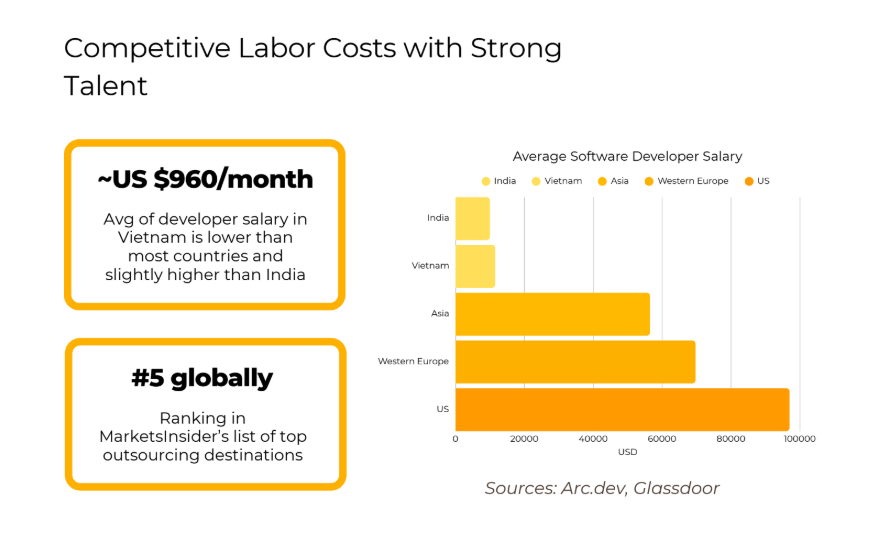
Vietnam offers a strong cost-to-talent ratio, with average software developer salaries significantly lower than Western markets while maintaining competitive engineering capability.
Based on the comparison data (Sources: Arc.dev, Glassdoor), Vietnam’s average software developer salary is approximately USD 960 per month, positioning it lower than most outsourcing destinations and slightly higher than India.
When comparing annual averages across regions:
| Region | Average Annual Developer Salary (USD) | Approx. Monthly Salary (USD) |
| India | ~$20,000 | ~$830 |
| Vietnam | ~$23,000–25,000 | ~$960 |
| Asia (Regional Avg.) | ~$55,000 | ~$4,500 |
| Western Europe | ~$70,000–75,000 | ~$5,800–6,200 |
| United States | ~$100,000 | ~$8,300 |
This gap highlights a 3–4x difference between Vietnam and Western Europe, and up to 4–5x compared to the United States.
Please also note that salary levels in Ho Chi Minh City tend to be higher than Hanoi, reflecting cost-of-living differences and industry concentration, while secondary cities remain more cost-efficient. (Source: TopDev Salary Report).
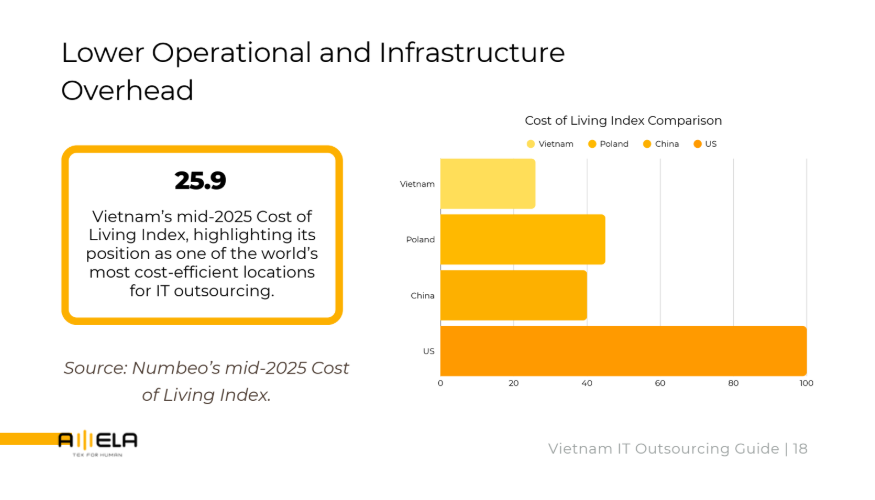
Vietnam’s mid-2025 Cost of Living Index is 25.9, highlighting its position as one of the world’s most cost-efficient locations for IT outsourcing.
From a business standpoint, the financial impact is clear:
-
A 10-developer team in Vietnam may cost roughly the equivalent of 2–3 developers in the US.
-
Long-term product roadmaps become financially sustainable.
-
Budget flexibility allows reinvestment into QA, DevOps, or product innovation rather than absorbing high salary overhead.
Vietnam’s development cost advantage is therefore not simply about low wages. It is about risk-adjusted cost efficiency—the ability to access skilled engineers at materially lower expense while maintaining delivery standards.
1–3–5 Year Financial Model: Offshore Vietnam vs. US Execution
Over a multi-year execution horizon, offshore development cost in Vietnam can reduce direct engineering costs by approximately 60–75% compared to the US, significantly improving long-term ROI.
Below is a consolidated comparison for a 10-developer team executing a continuous product roadmap.
Assumptions
-
Team size: 10 developers
-
US average salary: ~$100,000/year per developer (Glassdoor benchmark)
-
Vietnam average salary: ~$23,000–25,000/year per developer (Arc.dev, Glassdoor)
-
Conservative estimates excluding heavy equity compensation or extreme salary inflation
1–3–5 Year Cost Comparison Table
| Execution Period | United States (10 Devs) | Vietnam (10 Devs) | Estimated Savings | % Cost Reduction |
| 1 Year | ~$1,000,000 | ~$230,000–250,000 | ~$750,000+ | ~75% |
| 3 Years | ~$3,000,000 | ~$690,000–750,000 | ~$2,250,000+ | ~75% |
| 5 Years | ~$5,000,000 | ~$1,150,000–1,250,000 | ~$3,750,000+ | ~75% |
Financial Impact Over Time
The savings compound significantly over longer execution cycles:
-
A 1-year offshore model can fund additional QA, DevOps, or cloud optimization.
-
A 3-year execution can reinvest millions into product innovation or market expansion.
-
A 5-year roadmap may free up nearly USD 4 million in capital allocation flexibility.
The longer the execution timeline, the stronger the cumulative ROI advantage.
Strategic Interpretation
This comparison illustrates why offshore software development in Vietnam is often adopted for:
-
Multi-year SaaS platform growth
-
Enterprise digital transformation programs
-
Continuous product modernization initiatives
The financial leverage becomes exponentially more meaningful over time, especially for companies operating under capital efficiency constraints.