 Jul 24, 2026
Table of Contents
Agile teams can release quickly while still carrying hidden quality risks. A software quality audit in Agile development helps reveal whether requirements, testing, code review, deployment, and defect handling are working consistently across sprints.
The issue is often not a lack of testing. It is fragmented evidence, unclear acceptance criteria, unstable automation, weak control of technical debt, or repeated defects that are fixed without addressing their root causes.
A quality audit reviews these gaps without adding a heavy approval process. Its purpose is to identify risks, assign corrective actions, and help the team improve quality continuously while development continues.
What Is a Software Quality Audit in Agile Development?
A software quality audit evaluates whether a team’s quality practices are suitable, consistently followed, and effective.
It looks beyond whether individual features pass testing. The audit reviews how the team defines requirements, develops code, runs tests, manages defects, approves releases, and follows up on recurring problems.
In Agile projects, audits can use evidence from active and completed sprints rather than waiting until the end of development. This may include:
- User stories and acceptance criteria
- Test results and defect records
- Pull requests and code reviews
- CI/CD pipeline results
- Release approvals
- Incident and retrospective actions
A practical audit covers three areas:
- Product quality: Does the software meet functional and non-functional expectations?
- Process quality: Are development, testing, and release controls applied consistently?
- Evidence quality: Can the team prove what was tested, approved, released, and improved?
A software quality audit is broader than software testing. Testing asks whether the product works. An audit asks whether the overall quality system reliably prevents, detects, and corrects problems.
ISO/IEC TR 29119-6 provides guidance for applying software testing standards in Agile projects, reinforcing the need to adapt quality controls to iterative development rather than treat them as a final-stage activity. (iso.org)
When Does an Agile Team Need a Software Quality Audit?
An Agile team needs a quality audit when delivery continues, but confidence in product stability, testing, or release controls starts to decline.
Common triggers include:
- Production defects or regressions are increasing.
- Releases depend on manual checks or individual knowledge.
- Technical debt is slowing feature delivery.
- Security, performance, or reliability requirements are unclear.
- Several squads follow different quality practices.
- A company is changing vendors or inheriting an existing product.
- Customers or enterprise buyers request evidence of development controls.
- Defects are repeatedly fixed without root-cause analysis.
Audits can be scheduled periodically, but they are often most valuable before a major release, cloud migration, vendor transition, or system modernization. They also provide independent visibility when management cannot verify whether an outsourced team’s quality reports reflect actual delivery practices.
The 7-Step Software Quality Audit Process for Agile Teams
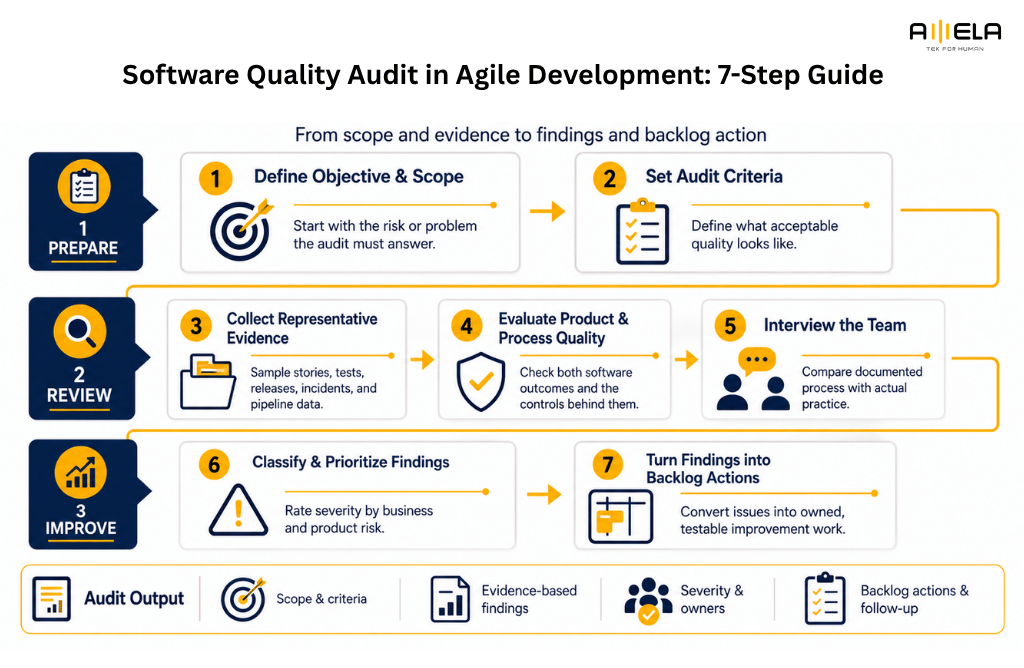
A useful audit follows a defined process: establish the risks, collect representative evidence, evaluate actual practices, and convert findings into owned backlog work.
1. Define the Audit Objective and Scope
Start with the business or technical problem the audit must answer. Without a clear objective, teams often collect large amounts of documentation but produce findings that are too broad to act on.
Possible objectives include:
- Identify why defects escape into production.
- Assess whether the product is ready to scale.
- Review an outsourced development team’s QA process.
- Evaluate release controls before a major launch.
- Understand quality risks in an inherited codebase.
- Prepare for a customer or compliance review.
Then define the audit boundaries:
- Product, service, or system component
- Teams and roles involved
- Sprints or releases to sample
- Environments and deployment processes
- Quality risks included in the review
The scope should be risk-based. For example, if the main problem is repeated payment failures, the audit should focus on payment requirements, integrations, test coverage, deployment history, monitoring, and incident handling—not every project document.
2. Set Clear Audit Criteria
Audit criteria define what “acceptable quality” means. They may come from the Definition of Done, internal engineering standards, contracts, service-level agreements, regulatory obligations, or agreed security and performance requirements.
Criteria may cover:
- Acceptance criteria and requirement traceability
- Code review and testing rules
- Security and access controls
- Performance and reliability expectations
- CI/CD quality gates
- Release approval and rollback procedures
- Documentation and maintenance requirements
The criteria must be documented before reviewing the evidence. Otherwise, the audit may judge teams against expectations they were never given.
This is especially important for non-functional requirements. Teams should define measurable software safety requirements instead of relying on statements such as “the system must be secure” or “the application should perform well.”
3. Collect Representative Audit Evidence
Review evidence from several sprints and releases rather than relying on one successful or failed example.
Useful evidence includes:
- User stories and acceptance criteria
- Test plans, results, and defect records
- Pull requests and code review comments
- CI/CD pipeline results
- Release approvals and rollback records
- Incident reports and root-cause analyses
- Architecture decisions
- Retrospective actions
Select samples based on risk, such as production incidents, complex integrations, major releases, and frequently changed components.
Do not ask the team to recreate missing records purely for the audit. If an important decision, test, or approval cannot be verified, the missing evidence is itself a finding.
4. Evaluate Product and Process Quality
The audit should check both the software outcome and the controls used to produce it.
For each sampled story or release, assess whether:
- Requirements and acceptance criteria were testable.
- Functional and non-functional risks were covered.
- Code reviews were completed by suitable reviewers.
- Automated tests ran at the correct pipeline stages.
- Failed quality checks could block deployment.
- Defects were classified and resolved consistently.
- Security and performance were considered before release.
- Production incidents led to corrective actions.
Avoid judging quality only by the number of defects. A low defect count may reflect limited testing, incomplete reporting, or low product usage rather than a reliable development process.
The auditor should also compare actual practices with the team’s Definition of Done. If a story is regularly marked complete before documentation, regression testing, or deployment checks are finished, the problem is not one missed task—it is a weak completion standard.
5. Interview the Team and Verify Actual Practice
Interviews help reveal the difference between documented procedures and how work is actually completed.
Speak with developers, QA specialists, product owners, DevOps engineers, Scrum Masters, and project managers. Ask them to explain how they handle:
- Requirement changes during a sprint
- Failed automated tests
- Urgent production releases
- Recurring defects
- Security or performance concerns
- Technical debt
- Release approval and rollback
Compare their answers with the collected evidence. A documented process has limited value if team members interpret or apply it differently.
Interviews should not become fault-finding sessions. The objective is to identify unclear ownership, impractical rules, missing skills, and process gaps that affect quality.
The audit should also confirm who owns each control. Quality is shared across product, development, QA, and operations, and should be connected to the wider activities involved in software project management.
6. Classify and Prioritize Audit Findings
Each finding should explain the evidence, business risk, required action, owner, and target date.
Use a simple severity model:
- Critical: Immediate security, compliance, data, or production risk
- High: Likely to cause repeated defects, outages, or failed releases
- Medium: Weak control, inconsistent practice, or growing technical debt
- Low: Documentation or process improvement with limited short-term risk
Avoid vague findings such as “testing is insufficient.” A useful finding is specific:
Four of ten sampled production stories had no traceable acceptance tests, increasing regression and release approval risk.
Each audit finding should contain:
- The observed evidence
- The expected control or requirement
- The potential product or business impact
- The likely root cause
- The recommended corrective action
- The accountable owner
- The expected completion date
Prioritization should reflect risk, not how easy the issue is to fix. A missing document may be less important than an unstable deployment process, even if the document is simpler to correct.
7. Turn Corrective Actions into Agile Backlog Work
An audit creates value only when findings become prioritized, testable, and verified improvements.
Convert findings into backlog items with clear acceptance criteria. For example, “improve release quality” is too broad. A better action might require automated regression tests to run before deployment, failed checks to block release, and the results to be stored for review.
Corrective actions may include:
- Adding or stabilizing automated tests
- Updating the Definition of Done
- Improving API or architecture documentation
- Introducing code or security review gates
- Fixing monitoring and alerting gaps
- Refactoring high-risk technical debt
- Clarifying release ownership
- Training team members on weak practices
Review these items during sprint planning, retrospectives, or release checkpoints. Do not close a finding only because a policy was updated. Verify that the new control is being used and produces the expected evidence.
Larger findings may need a phased software enhancement roadmap so technical improvements can be balanced with feature delivery.
The final audit report should remain concise: scope, criteria, findings, severity, risk, corrective actions, owners, and follow-up dates.
Agile Software Quality Audit Checklist
A practical checklist should focus on the controls most likely to affect release quality, security, maintainability, and production stability.
| Audit area | Questions to review | Evidence |
| Requirements | Are acceptance criteria clear and testable? Are non-functional requirements included? | User stories, specifications, change logs |
| Code quality | Are code reviews completed consistently? Is technical debt recorded? | Pull requests, static analysis, debt backlog |
| Testing | Does testing cover critical business and technical risks? | Test cases, automation reports, defect records |
| CI/CD | Do failed checks block releases? Are deployments repeatable? | Pipeline logs, quality gates, deployment records |
| Security | Are access, dependency, and vulnerability risks reviewed? | Scan reports, access logs, security findings |
| Release management | Are approvals, rollback procedures, and release evidence available? | Release checklist, approvals, rollback plan |
| Incident management | Are production issues investigated and followed by corrective actions? | Incident reports, root-cause analysis |
| Agile governance | Is the Definition of Done applied consistently? Are retrospective actions completed? | Sprint records, retrospective backlog |
The checklist should be adapted to the product’s risk level. A financial platform may require stronger access, audit trail, and data controls, while an internal business tool may place more emphasis on maintainability and operational support.
Avoid measuring compliance by document quantity. One reliable automated control is often more valuable than several manually updated checklists.
Which Metrics Should an Agile Quality Audit Review?
Audit metrics should reveal trends and control weaknesses rather than create a single, artificial quality score.
Useful metrics include:
- Escaped defects: Issues found after release
- Defect reopen rate: Problems marked fixed but later reopened
- Change failure rate: Deployments that cause incidents, rollback, or recovery work
- Automated test stability: Tests that fail intermittently without product defects
- Requirement coverage: Critical requirements linked to tests
- Defect resolution time: Time required to resolve high-risk issues
- Technical debt trend: Whether known debt is increasing or being reduced
- Corrective-action closure rate: Findings completed and verified by the agreed date
A systematic review of Agile quality measurement found that velocity, defect density, and test coverage are commonly used, but warned that velocity alone may conceal technical debt and internal quality problems. (ijicom.respati.ac.id)
Metrics should always be interpreted in context. High test coverage does not prove that important risks are tested, and a low defect count may indicate weak detection rather than strong quality.
For audits, trends across several sprints are more useful than isolated values. The auditor should ask why a metric changed and whether the team’s controls detected and corrected the underlying problem.
Common Mistakes That Make Agile Quality Audits Ineffective
A quality audit becomes ineffective when it focuses on paperwork, blame, or isolated defects instead of the controls causing repeated risk.
Common mistakes include:
- Reviewing only the QA team while ignoring product, development, and DevOps
- Auditing documents without checking actual sprint and release practices
- Treating every deviation as equally serious
- Measuring test volume instead of risk coverage
- Reporting findings without owners or deadlines
- Closing findings before corrective actions are verified
- Using the audit to assign blame
- Allowing a delivery vendor to independently approve its own quality
Findings should be specific and linked to impact. “Testing documentation is incomplete” is too vague. A stronger finding would state that several sampled production stories had no traceable acceptance tests, increasing regression and approval risk.
The audit should also distinguish between a one-time exception and a recurring control failure. One missed code review may be an isolated oversight. Repeated releases without review evidence indicate a process weakness.
Internal vs External Software Quality Audits
Internal audits support continuous improvement, while external audits provide greater independence when risk, vendor performance, or specialist expertise is a concern.
An internal audit is suitable for:
- Routine sprint or release reviews
- Monitoring corrective actions
- Improving team consistency
- Products with mature QA leadership
An external audit is more appropriate when:
- A company is assessing an outsourced vendor
- The product is being acquired or transferred
- Production issues persist despite internal fixes
- Enterprise customers require independent evidence
- The internal team lacks security, performance, or architecture expertise
A hybrid approach often works best: internal teams monitor quality regularly, while an independent reviewer evaluates higher-risk releases or recurring problems.
Organizations can also outsource quality assurance when they need independent testing, process assessment, or additional QA expertise without building a larger permanent team.
Frequently Asked Questions
How often should Agile teams conduct quality audits?
There is no universal schedule. Lightweight checks can happen at major releases or quarterly, while deeper audits are more useful after recurring incidents, vendor changes, rapid team growth, or before compliance reviews.
Who should perform a software audit?
An audit may be led by a QA manager, engineering lead, internal audit team, or independent specialist. For vendor assessments or high-risk systems, an external reviewer provides stronger independence.
What should a software quality audit report include?
The report should include the audit scope, criteria, evidence reviewed, findings, severity, business impact, recommended actions, owners, deadlines, and follow-up status.
Is a software quality audit the same as software testing?
No. Testing checks whether the product behaves as expected. A quality audit examines whether the broader system of requirements, development, testing, deployment, and corrective action works consistently.
Can an audit be performed while development continues?
Yes. Agile audits can sample completed stories, active sprints, pipeline records, releases, and incidents without stopping delivery. Corrective actions can then be added to the backlog and prioritized alongside feature work.
Conclusion
A software quality audit in Agile development should improve visibility, ownership, and risk control without becoming a slow approval gate.
The most valuable audits focus on real sprint evidence, compare documented processes with actual practices, and convert findings into prioritized backlog work. They also verify that corrective actions are working rather than closing issues after a policy update.
For teams that need independent assessment, remediation support, or ongoing operational monitoring, AMELA Technology provides QA, software enhancement, and managed IT services across the product lifecycle.