 Oct 25, 2026

Table of Contents
AI already helps businesses forecast demand, detect fraud, classify documents, and recommend decisions. But what happens when a task requires more than a prediction? An IT incident, for example, may require collecting logs, checking recent deployments, identifying a likely cause, and deciding what to do next. A conventional AI model can support individual steps, while an agentic system can coordinate several of them toward a defined goal.
Understanding agentic AI vs traditional AI helps businesses choose the right architecture for each workflow. The distinction affects not only what a system can do, but also its integration requirements, operating costs, security controls, and need for human oversight.
Agentic AI is not automatically the better option. The practical question is whether a workflow benefits from autonomous, multistep execution or can be handled more efficiently by a focused model and established software rules.
What Is Traditional AI vs Agentic AI?
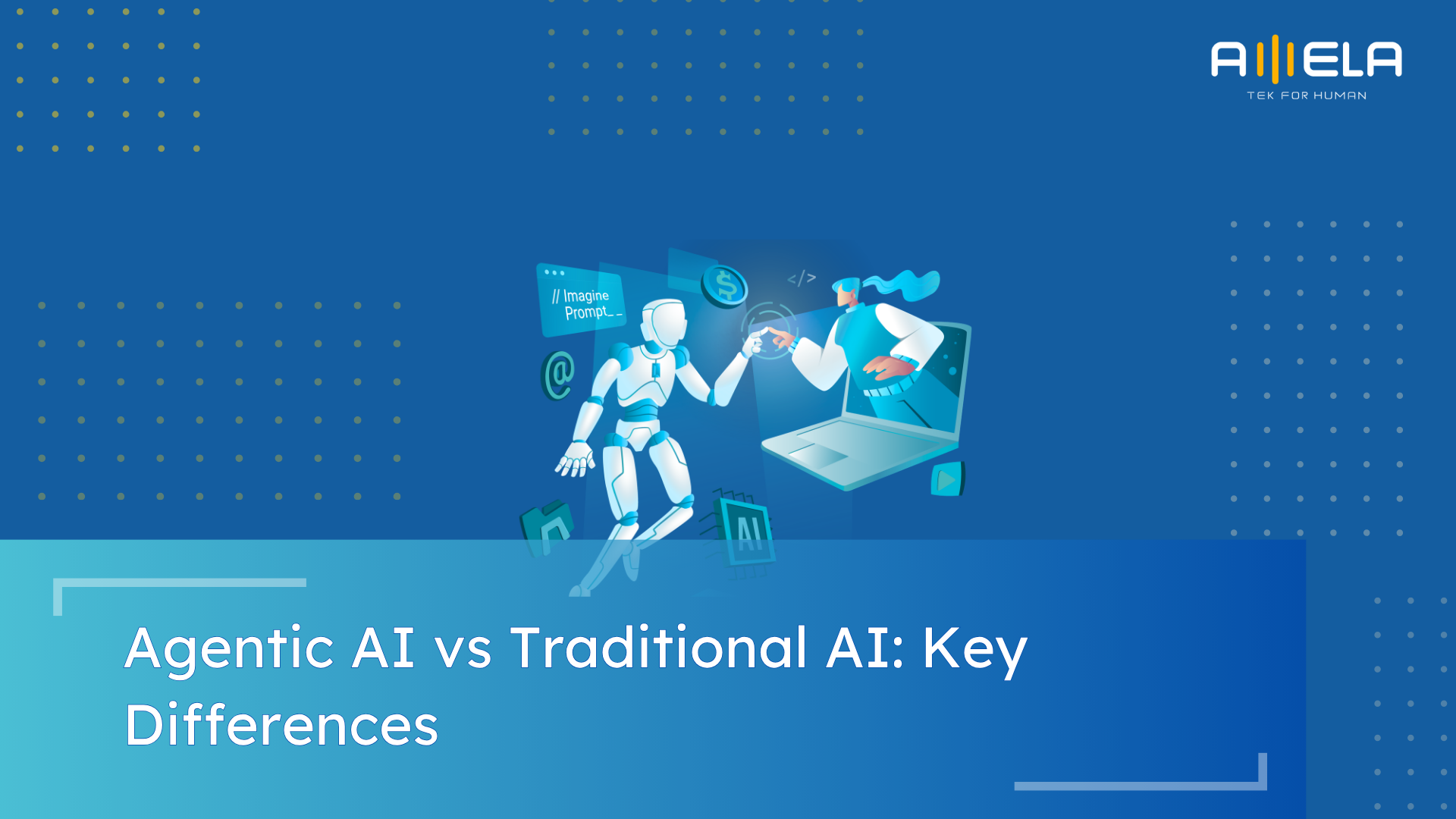
Traditional AI typically performs a defined prediction, classification, recommendation, or generation task, while agentic AI can use models, tools, and feedback to pursue a goal through multiple steps.
The distinction is primarily about how the system is designed to operate, not simply which AI model it uses.
What Is Traditional AI?
Traditional AI commonly refers to systems built for specific tasks using machine learning, statistical models, rules, or other established AI techniques.
Examples include:
- Predictive analytics: Forecasting sales, demand, or equipment failure.
- Classification: Categorizing support tickets, documents, or transactions.
- Recommendation systems: Suggesting products, content, or relevant options.
- Anomaly detection: Identifying unusual transactions or operational patterns.
- Generative AI applications: Producing a summary, draft, or answer in response to an input.
These systems can be highly effective when the task and expected output are well defined. A fraud detection model, for instance, can assign a risk score to a transaction, leaving a separate payment system to apply its decision rules.
Traditional AI is not necessarily static or rule-bound. Models can learn from new training data, and AI outputs can feed into complex automated pipelines. The key distinction is that a conventional implementation does not necessarily plan and coordinate its own next steps.
What Is Agentic AI?
Agentic AI refers to systems designed to pursue goals by reasoning about a task, selecting actions, using available tools, and adjusting their approach based on intermediate results.
A typical agentic workflow may:
- Interpret a goal and gather relevant context.
- Determine which steps or tools are needed.
- Execute permitted actions through APIs or connected applications.
- Evaluate the results and decide whether another step is necessary.
- Stop, retry, or request human assistance when appropriate.
For example, an IT operations agent might investigate an alert by retrieving relevant logs, checking recent deployments, comparing findings with known incidents, and preparing a remediation recommendation.
AWS’s technical guide to the foundations of agentic AI explains the role of goal-oriented reasoning, tool use, and action in agentic systems.
The important difference is that an agentic system can coordinate a sequence of tasks instead of returning only one prediction or response. That added flexibility also introduces more opportunities for errors, making permissions, validation, and monitoring essential.
Is Agentic AI the Same as Generative AI?
No. Generative AI describes systems that produce outputs such as text, code, images, or summaries. Agentic AI describes a way of organizing AI capabilities to pursue a goal through actions and feedback.
An application that uses a language model to summarize a report is generative AI, but it is not necessarily agentic. An application that retrieves several reports, compares their contents, identifies missing information, and prepares a result through a controlled sequence of tool calls is closer to an agentic workflow.
The two approaches often work together: a generative model may provide the reasoning capability, while the agent architecture determines how that capability is used to complete a task.
6 Key Differences Between Agentic AI and Traditional AI
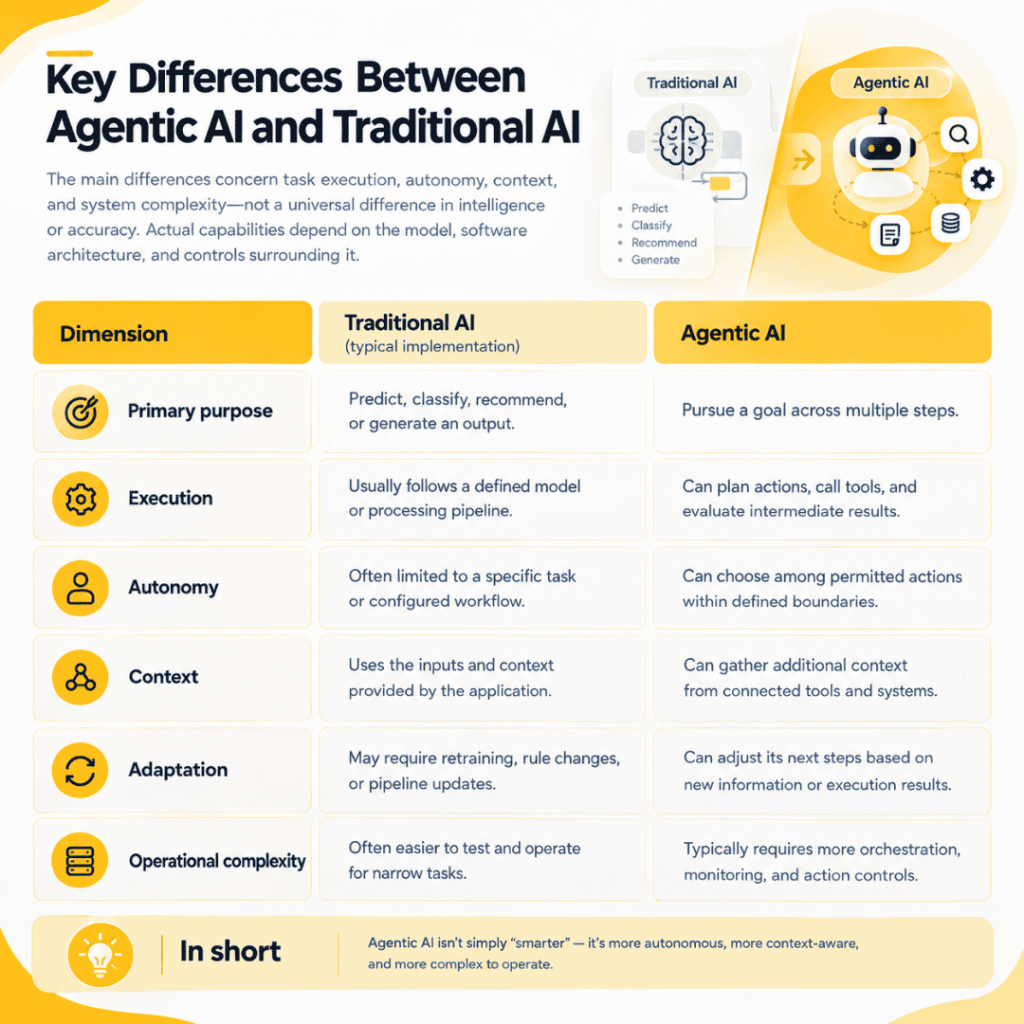
The main differences concern task execution, autonomy, context, and system complexity—not a universal difference in intelligence or accuracy. Actual capabilities depend on the model, software architecture, and controls surrounding it.
| Dimension | Traditional AI (typical implementation) | Agentic AI |
| Primary purpose | Predict, classify, recommend, or generate an output | Pursue a goal across multiple steps |
| Execution | Usually follows a defined model or processing pipeline | Can plan actions, call tools, and evaluate intermediate results |
| Autonomy | Often limited to a specific task or configured workflow | Can choose among permitted actions within defined boundaries |
| Context | Uses the inputs and context provided by the application | Can gather additional context from connected tools and systems |
| Adaptation | May require retraining, rule changes, or pipeline updates | Can adjust its next steps based on new information or execution results |
| Operational complexity | Often easier to test and operate for narrow tasks | Typically requires more orchestration, monitoring, and action controls |
1. Task execution: single output vs multistep workflow
A traditional model might classify an invoice as valid or invalid. A surrounding application then decides what happens next.
An agentic workflow could extract the invoice details, retrieve a matching purchase order, investigate discrepancies, and route the result for approval. The distinction lies in coordinating the work, not simply producing a more sophisticated answer.
2. Autonomy: predefined flow vs selected actions
Conventional AI implementations often operate within a predefined pipeline. Agentic systems can choose the next step according to what they discover, provided the available actions and permissions allow it.
This does not mean agents should have unrestricted control. In production, action boundaries should be explicit, and high-impact decisions may require approval.
3. Context: supplied inputs vs information gathering
A traditional model generally processes the data provided to it by the surrounding application. An agent can retrieve additional information through approved tools as the task progresses.
That is useful when the relevant context is distributed across several systems, but it also makes access controls and data quality more important.
4. Adaptation: updated models vs runtime decisions
Traditional AI systems can adapt through retraining, feedback, or changing rules. Agentic systems add another capability: they can change their execution path during a task when new information becomes available.
This runtime flexibility is not the same as automatically learning or improving the underlying model.
5. Reliability: bounded outputs vs longer execution chains
A narrowly scoped model can be evaluated against a defined test set. An agentic workflow must also be tested for tool failures, incorrect intermediate results, repeated actions, and unsuccessful handoffs.
Each additional step can introduce another failure point. Validation between steps helps contain those failures.
6. Cost and complexity: focused processing vs orchestration
Traditional AI can be more economical for high-volume, predictable tasks. Agentic AI may require additional model calls, API integrations, execution tracking, and human review.
The right comparison is the total cost of achieving a successful business outcome—not simply the cost of one model call.
When Traditional AI Is the Better Choice
Traditional AI is often the better fit when a task is predictable, high-volume, and easy to evaluate using defined inputs and outputs.
High-volume, well-defined decisions
Fraud scoring, demand forecasting, product recommendations, and image classification usually benefit from specialized models. These systems can process large volumes of data without requiring an agent to plan each step.
For example, a retailer can use a forecasting model to estimate demand by product and location, then apply established replenishment rules to determine stock quantities.
Low-latency and cost-sensitive workloads
If a system must process thousands of requests quickly, adding agentic reasoning and repeated tool calls may create unnecessary cost and delay. A focused model or conventional software pipeline can be easier to optimize.
Processes governed by strict rules
Eligibility checks, transaction validation, and basic ticket routing often follow clear criteria. Deterministic code can enforce those rules more consistently than asking an agent to interpret them each time.
Traditional AI is therefore not an outdated alternative to agentic AI. For narrowly defined tasks, it may be the simpler, more reliable foundation. An agent should be introduced only when its ability to coordinate actions provides enough value to justify the additional complexity.
When Agentic AI Makes More Sense
Agentic AI is most useful when completing a task requires gathering information, selecting actions, and responding to intermediate results across multiple steps.
Multistep tasks across several systems
Some workflows cannot be completed through one prediction or model response. They require information from different applications, followed by a sequence of decisions.
An IT incident investigation is a good example. The system may need to retrieve logs, inspect recent deployments, compare symptoms against known issues, and prepare a response based on what it finds.
A traditional model can classify the incident or predict its likely cause. An agentic workflow can coordinate the wider investigation using approved tools and defined action boundaries.
AMELA’s guide to AI incident triage and root cause analysis explores this related operational problem.
Workflows with changing context
Agentic AI can be useful when the next step depends on information discovered during execution.
A customer support agent might first search a knowledge base, discover that the issue involves a billing discrepancy, and then retrieve the relevant transaction record. If the records conflict, it can escalate the case instead of continuing with an unsupported assumption.
Tasks requiring flexible decisions
Research, troubleshooting, and operational exception handling often involve incomplete information and several possible paths. Agents can select among permitted tools and adjust their approach as results arrive.
That flexibility has limits. The workflow still needs clear objectives, validation rules, and escalation conditions. For high-impact actions, recommendations may be appropriate where automatic execution would introduce unacceptable risk.
Traditional AI vs Agentic AI: One Business Task, Two Approaches
The difference becomes clearer when both approaches address the same problem: investigating an IT incident.
Imagine a company detects a sudden increase in application errors after a software release.
A traditional AI workflow might classify the incident, estimate its severity, and predict the most likely cause. An existing monitoring or incident-management system then routes the result to the appropriate engineer.
An agentic AI workflow can go further:
- Retrieve the relevant error logs and incident history.
- Check recent deployments and configuration changes.
- Compare the evidence against known failure patterns.
- Prepare a likely root cause and recommended remediation.
- Verify whether additional diagnostic information is needed, or escalate to an engineer.
The agentic approach can coordinate the investigation dynamically, while the traditional model provides focused predictions within a defined process.
However, this flexibility adds complexity. The agent might retrieve irrelevant logs, misinterpret evidence, or recommend an unsafe change. An effective implementation validates findings and requires authorization before consequential actions.
The best design may combine both approaches: a conventional model detects and classifies the incident, an agent investigates it, and deterministic rules control which remediation steps are permitted.
Costs, Risks, and Limitations of Agentic AI
Agentic AI introduces more execution flexibility, but it can also increase operating costs, failure points, integration work, and security exposure.
Higher runtime and orchestration costs
An agent may call a model several times, retrieve data from multiple systems, retry failed operations, and validate its results. These steps consume resources beyond the initial model inference.
Measure cost per successfully completed task, including infrastructure, integration maintenance, and human review. A simpler model may be more economical when the workload is predictable.
Errors can propagate across steps
A flawed intermediate result can influence subsequent decisions. For example, an agent investigating an incident might misinterpret an outdated log entry and build its remediation recommendation around the wrong cause.
Use validation between critical steps, limit retries, and make it easy to stop or escalate a workflow when evidence is insufficient.
Security and access-control risks
Agents that can access business applications introduce risks around sensitive data, excessive permissions, malicious instructions embedded in retrieved content, and unintended actions.
The Cloud Security Alliance and Google Cloud’s 2025 State of AI Security and Governance report found that 52% of surveyed organizations ranked sensitive data exposure as their top AI security concern.
This reinforces the need for least-privilege access, secure integrations, execution logs, and human approval for high-impact actions. AMELA’s guide to security risks with AI applications provides further context on these controls.
How to Choose Between Traditional AI and Agentic AI
Choose the simplest architecture that can reliably complete the task, and introduce agentic capabilities only when they deliver measurable value.
Ask three questions before deciding:
- Are the inputs and steps predictable? If the task involves classification, forecasting, or fixed decision rules, traditional AI may be sufficient.
- Does the workflow require dynamic, multistep execution? If it must retrieve information, select tools, and adjust actions based on intermediate results, agentic AI may be appropriate.
- What happens if the system makes a mistake? High-impact workflows need stronger validation, restricted permissions, and human approval regardless of the architecture.
Also consider latency, operating costs, integration complexity, and how easily the result can be evaluated.
For many businesses, the answer is a hybrid system rather than an either-or choice. Traditional models can handle high-volume predictions, deterministic software can enforce business rules, and agents can coordinate tasks that require flexible execution.
When planning adoption, AI and automation deployment for mid-market companies provides related guidance on aligning AI capabilities with practical business requirements.
How to Implement a Hybrid AI Architecture
A hybrid architecture combines traditional AI, deterministic software, and agentic workflows according to each component’s strengths.
1. Start with one business workflow
Choose a process with measurable outcomes, such as reducing incident-investigation time or improving document-processing efficiency. Establish a baseline before introducing AI.
2. Assign each component a clear responsibility
Use traditional AI for prediction and classification, deterministic code for strict rules and validation, and agentic AI for tasks that require flexible, multistep execution.
Keep human approval for decisions that have significant financial, operational, or security consequences.
3. Test the complete workflow
Evaluate normal cases as well as missing data, conflicting results, unavailable APIs, and unauthorized requests. Measure accuracy, completion rate, latency, total cost, and how often people need to intervene.
4. Monitor and improve gradually
Log executions, investigate failures, and update the workflow based on measured performance. Expand only after the initial use case demonstrates reliable business value.
Companies with custom integration requirements or specialized workflows may need tailored architecture and engineering.
FAQs About Agentic AI vs Traditional AI
Is agentic AI better than traditional AI?
Not in every situation. Traditional AI often works better for predictable, narrowly defined tasks, while agentic AI is useful for workflows requiring dynamic decisions and multiple actions.
Is agentic AI a type of generative AI?
Not exactly. Generative AI produces content, while agentic AI describes a system that uses reasoning, tools, and feedback to pursue a goal. An agent can use a generative model as one component.
Can traditional AI and agentic AI work together?
Yes. A conventional model can classify a case or estimate risk, while an agent investigates the result and coordinates approved follow-up actions.
Is agentic AI more expensive?
It can be because of additional model calls, integration work, monitoring, and human review. Compare the total cost per successfully completed task rather than individual inference costs.
Does agentic AI replace traditional machine learning?
No. Traditional machine learning remains valuable for prediction, classification, and pattern recognition. These capabilities can also serve as components within an agentic workflow.
Conclusion
Agentic AI vs traditional AI is not a choice between old and new technology. It is a decision about how much autonomy a business workflow actually needs.
Traditional AI remains effective for defined tasks, while agentic AI can coordinate more complex work across systems. In many cases, combining both approaches offers a better balance of flexibility, reliability, and cost.
Start with a clear business objective, select the simplest architecture that meets it, and expand only when results justify the additional complexity. AMELA Technology supports businesses developing tailored AI solutions through its AI development services.