 Aug 18, 2026
Table of Contents
Modern software teams are expected to release faster, maintain reliable infrastructure, and support increasingly complex cloud environments. However, building an experienced DevOps team isn’t always straightforward. Senior DevOps engineers are in high demand, and recruiting the right talent can take months while critical projects continue to move forward.
DevOps staff augmentation offers a practical alternative. Instead of delaying cloud migration, CI/CD implementation, or infrastructure modernization while hiring internally, companies can integrate experienced DevOps engineers into their existing teams to address immediate technical needs.
This approach is particularly valuable when organizations need specialized expertise, temporary delivery capacity, or additional support during periods of rapid growth. In this guide, we’ll explain how DevOps staff augmentation works, when it makes sense, how to choose the right partner, and which companies stand out in today’s market.
What Is DevOps Staff Augmentation?
DevOps staff augmentation is a hiring model where external DevOps engineers join your existing development team to provide specialized skills while your company retains full control over the project.
Unlike traditional outsourcing, where an external vendor manages an entire project, augmented DevOps engineers work as part of your internal engineering organization. They participate in sprint planning, daily stand-ups, code reviews, incident response, and infrastructure planning alongside your in-house developers.
Depending on the project’s needs, organizations may augment individual specialists or multiple DevOps roles, including:
- Cloud engineers
- Kubernetes engineers
- CI/CD specialists
- Site Reliability Engineers (SREs)
- Platform engineers
- DevSecOps engineers
This model is particularly useful when a project requires expertise that the current team lacks or when delivery timelines cannot accommodate a lengthy recruitment process.
For example, a SaaS company preparing for a large product launch may need to redesign its deployment pipeline, automate infrastructure provisioning, and strengthen monitoring before traffic increases. Rather than pausing the project to hire full-time employees, the company can augment experienced DevOps engineers who immediately contribute to these initiatives while working within existing Agile processes.
It’s also important to distinguish DevOps staff augmentation from consulting. Consultants typically assess problems and recommend solutions, while augmented engineers become active contributors who implement infrastructure, automate deployments, optimize cloud environments, and collaborate with the product team throughout delivery.
The result is a flexible extension of the engineering team—allowing businesses to scale DevOps capabilities without restructuring their organization or committing to permanent headcount from day one.
Why Companies Choose DevOps Staff Augmentation
Companies use DevOps staff augmentation to access specialized expertise, remove delivery bottlenecks, and scale infrastructure projects without waiting for lengthy hiring cycles.
As software delivery becomes more dependent on cloud platforms, automation, and reliable infrastructure, many engineering teams discover that their biggest constraint is no longer application development—it is the ability to build and operate modern DevOps practices efficiently.
Access Specialized Skills Faster
Modern DevOps spans multiple disciplines, making it difficult for one engineer to cover every area of expertise.
A cloud migration may require AWS or Azure specialists, while a Kubernetes deployment demands experience with container orchestration, Infrastructure as Code (IaC), and deployment automation. Similarly, improving release speed often involves engineers familiar with Jenkins, GitHub Actions, GitLab CI, Argo CD, or Terraform.
Instead of spending months recruiting niche expertise, companies can augment experienced DevOps engineers who have already worked with similar technologies and environments.
This is especially valuable for projects with defined technical goals, such as:
- Migrating applications to the cloud
- Building CI/CD pipelines
- Automating infrastructure provisioning
- Improving observability and monitoring
- Modernizing legacy deployment processes
Reduce Hiring Delays
Hiring experienced DevOps engineers is often slower than the projects that require them.
Infrastructure initiatives rarely pause while recruitment takes place. Whether the goal is improving deployment reliability or preparing systems for increased traffic, delaying implementation can postpone product releases and increase operational risk.
DevOps staff augmentation allows organizations to add qualified engineers within weeks instead of waiting through a full recruitment cycle. Once the project reaches a stable stage, the company can scale the augmented team up or down based on current priorities.
For organizations that already have an internal engineering team, this model often provides a faster alternative to expanding permanent headcount. AMELA’s staff augmentation services follow this approach by embedding experienced engineers directly into existing Agile teams, allowing businesses to strengthen delivery without changing project ownership.
Scale Engineering Capacity During Critical Projects
Infrastructure workloads often fluctuate throughout a project, making flexible team scaling more efficient than permanent hiring.
For example, a company may need additional DevOps support when:
- Launching a new SaaS platform
- Migrating workloads to AWS, Azure, or Google Cloud
- Implementing Kubernetes
- Establishing Infrastructure as Code
- Preparing for a high-traffic product release
- Improving disaster recovery and system resilience
After these initiatives are completed, the same level of infrastructure work may no longer be necessary. Staff augmentation enables companies to align engineering capacity with actual project demand.
Lower Delivery Risk Through Experience
Experienced DevOps engineers can help teams avoid common infrastructure and deployment issues before they affect production.
Rather than learning through trial and error, augmented specialists often bring practical experience from previous cloud migrations, CI/CD implementations, and large-scale production environments.
This experience can help reduce risks such as:
- Manual deployment errors
- Inconsistent infrastructure configuration
- Slow release processes
- Limited system visibility
- Scaling challenges during traffic growth
The greatest value is not simply having another engineer on the team. It is bringing in someone who has already solved similar DevOps challenges and can contribute from the early stages of the project.
Top 3 DevOps Staff Augmentation Companies
The best DevOps staff augmentation partner should provide experienced engineers who can integrate into existing development teams, adapt to your delivery process, and contribute across cloud infrastructure, automation, and operations.
1. AMELA Technology
From our perspective, AMELA Technology stands out for companies looking for a long-term engineering partner rather than simply an individual contractor.
Unlike providers that focus only on sourcing talent, AMELA has extensive experience augmenting DevOps engineers as part of global software development teams. This is particularly valuable because DevOps rarely works in isolation—engineers need to collaborate closely with backend developers, frontend developers, QA engineers, product owners, and architects throughout the delivery lifecycle.
AMELA’s DevOps engineers have experience supporting projects involving:
- AWS, Microsoft Azure, and Google Cloud Platform
- Kubernetes and Docker
- CI/CD implementation with Jenkins, GitHub Actions, GitLab CI, and Argo CD
- Infrastructure as Code using Terraform and Ansible
- Monitoring and observability with Prometheus, Grafana, and ELK
- Cloud migration and infrastructure modernization
- Release automation and production support
- Infrastructure maintenance and continuous optimization
Another strength is flexibility. Businesses can augment a single DevOps engineer to remove a specific bottleneck or build a cross-functional engineering team that combines software developers, QA engineers, and DevOps specialists under one delivery model.
For organizations planning to strengthen their cloud capabilities while accelerating software delivery, AMELA’s guide to building a modern DevOps team offers additional insights into the roles and responsibilities involved.
2. Toptal
Toptal is a strong option for companies looking for highly experienced freelance DevOps professionals.
Its global talent network includes engineers with expertise in cloud infrastructure, Kubernetes, CI/CD, and platform engineering. Businesses that already have mature engineering processes often use Toptal to quickly bring in senior specialists for short-term initiatives such as cloud migration or infrastructure optimization.
Because the model emphasizes premium freelance talent, it is generally better suited to organizations that already have established technical leadership and are comfortable managing distributed contractors.
3. BairesDev
BairesDev is well known for providing nearshore software engineering and DevOps talent to North American and enterprise clients.
Its DevOps capabilities cover cloud architecture, deployment automation, Kubernetes, Infrastructure as Code, monitoring, and site reliability engineering. The company is particularly suited to larger digital transformation initiatives where businesses need to scale engineering teams across multiple technical disciplines.
Organizations undertaking long-term modernization programs may also benefit from BairesDev’s ability to combine DevOps specialists with software developers, QA engineers, and cloud experts under the same engagement model.
Ultimately, the right provider depends on your delivery model. If your priority is embedding experienced DevOps engineers directly into an existing Agile team while retaining full project ownership, choose a partner with proven experience integrating into client engineering organizations—not simply supplying technical resources.
When Should You Use DevOps Staff Augmentation?
DevOps staff augmentation delivers the most value when your engineering team has clear infrastructure goals but lacks the capacity or specialized expertise to achieve them efficiently.
While every organization has different technical priorities, several situations consistently benefit from adding experienced DevOps engineers.
Your Team Is Migrating to the Cloud
Cloud migration often requires expertise in infrastructure architecture, networking, security, and automation that many product teams do not use every day.
Augmenting cloud specialists can help accelerate migrations while reducing the risk of downtime, configuration issues, or unexpected infrastructure costs.
You Need to Modernize CI/CD
Manual deployments slow releases and increase the likelihood of human error.
A DevOps engineer can help design automated CI/CD pipelines, improve release consistency, and shorten deployment cycles without disrupting the existing development workflow.
Infrastructure Is Becoming a Bottleneck
As products grow, developers often spend more time maintaining environments than building new features.
Common warning signs include:
- Frequent deployment failures
- Slow release cycles
- Manual infrastructure provisioning
- Poor monitoring and alerting
- Increasing production incidents
In these situations, augmenting DevOps expertise can free application developers to focus on product delivery while infrastructure improvements happen in parallel.
Your Startup Is Scaling Quickly
Startups frequently need enterprise-grade infrastructure before they are ready to build a full in-house DevOps team.
Rather than hiring multiple specialists immediately, many startups begin with one or two experienced DevOps engineers who establish cloud architecture, deployment pipelines, monitoring, and security best practices before transferring knowledge to the internal team.
Our guide to DevOps for startups explores how early DevOps investments can support faster product growth without creating unnecessary operational complexity.
Your Team Needs Temporary Specialist Expertise
Some initiatives require advanced DevOps skills for only a limited period, including:
- Kubernetes implementation
- Infrastructure as Code adoption
- Multi-cloud architecture
- Disaster recovery planning
- Platform modernization
- Security and compliance improvements
Once these projects are complete, the required level of DevOps support often decreases, making staff augmentation more cost-effective than permanent hiring.
How to Successfully Integrate Augmented DevOps Engineers
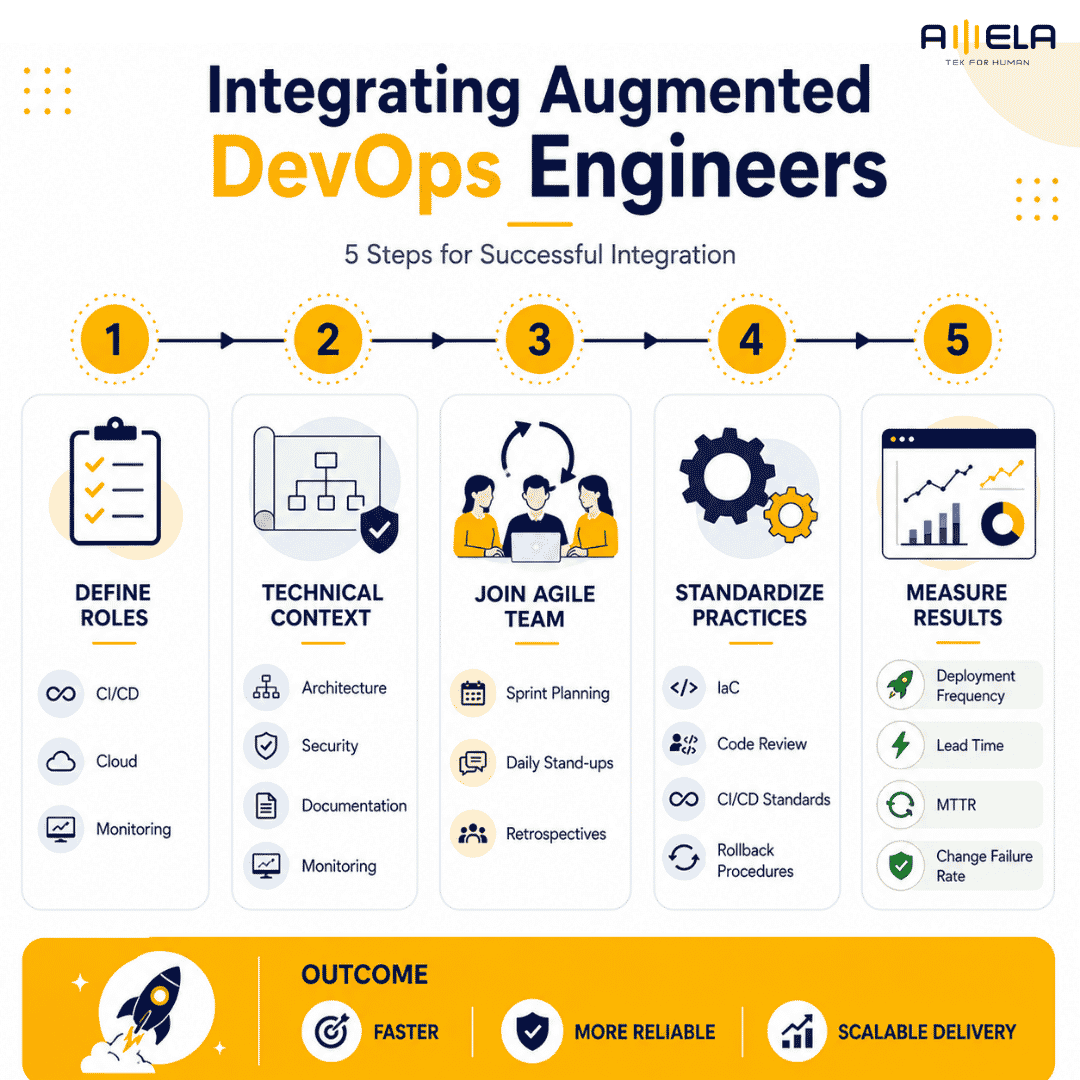
Successful DevOps staff augmentation depends on integrating external engineers into your delivery process—not treating them as a separate infrastructure team.
Define Clear Responsibilities
Before onboarding begins, identify what the augmented engineers will own.
For example, responsibilities may include:
- CI/CD implementation
- Infrastructure automation
- Cloud platform management
- Monitoring and observability
- Kubernetes administration
- Deployment optimization
Clear ownership prevents duplicated work and reduces confusion between internal and augmented teams.
Provide Technical Context Early
DevOps engineers need access to more than source code.
Early onboarding should include:
- Infrastructure diagrams
- Cloud architecture
- Existing deployment process
- Security policies
- Monitoring dashboards
- Incident response procedures
- Technical documentation
This shortens the time needed to contribute effectively.
Include DevOps Engineers in Agile Delivery
Augmented engineers should participate in the same delivery process as the internal team.
That includes:
- Sprint planning
- Daily stand-ups
- Backlog refinement
- Architecture discussions
- Retrospectives
- Production reviews
Treating DevOps as a core engineering function—not a separate operations group—improves collaboration and delivery consistency.
Standardize Infrastructure Practices
Agree on common standards before significant implementation begins, including:
- Branching strategy
- Infrastructure as Code conventions
- CI/CD workflow
- Code review requirements
- Monitoring standards
- Rollback procedures
- Definition of Done
A structured onboarding process also makes future team scaling significantly easier.
Organizations introducing DevOps for the first time may benefit from following a structured DevOps implementation plan to align infrastructure improvements with business priorities.
Measure Operational Improvements
The success of DevOps staff augmentation should be measured using delivery outcomes rather than team size.
Useful metrics include:
- Deployment frequency
- Lead time for changes
- Mean time to recovery (MTTR)
- Change failure rate
- Infrastructure provisioning time
- Environment setup time
These indicators provide a clearer picture of whether DevOps improvements are making software delivery faster, more reliable, and easier to scale.
Common Mistakes to Avoid
Many DevOps staff augmentation initiatives fail not because of technical capability, but because of poor planning and integration.
Hiring Before Defining the Problem
If the team doesn’t know whether the bottleneck is CI/CD, cloud infrastructure, Kubernetes, or security, it’s difficult to bring in the right specialist. Start by identifying the constraint, then augment accordingly.
Treating DevOps as an Isolated Function
DevOps engineers should work alongside developers, QA engineers, and product teams—not as a separate operations group. Collaboration is essential for improving delivery speed and reliability.
Weak Documentation and Onboarding
Even experienced DevOps engineers need context. Missing infrastructure documentation, inconsistent deployment processes, or limited system access can significantly delay productivity.
Focusing Only on Tools
Adopting Kubernetes, Terraform, or Jenkins does not automatically improve DevOps maturity. Successful teams also establish clear workflows, automation standards, monitoring practices, and shared ownership across engineering.
FAQs
Is DevOps staff augmentation better than hiring full-time engineers?
It depends on your goals. Staff augmentation is often the better option when you need specialized expertise quickly or additional capacity for a defined project. Permanent hiring is more suitable for long-term organizational growth.
How quickly can augmented DevOps engineers start contributing?
Experienced engineers can often become productive within a few weeks, provided they receive proper onboarding, documentation, and access to development and cloud environments.
What skills should a DevOps engineer have?
The required skills depend on the project, but common areas include cloud platforms (AWS, Azure, or Google Cloud), CI/CD, Infrastructure as Code, Kubernetes, Docker, monitoring, scripting, and security best practices.
Is DevOps staff augmentation suitable for startups?
Yes. Many startups use augmentation to establish scalable infrastructure and deployment automation before investing in a full in-house DevOps team.
Can augmented DevOps engineers work with our existing developers?
Yes. In a staff augmentation model, DevOps engineers become part of your existing Agile team, collaborating with developers, QA engineers, architects, and product managers throughout the project.
Conclusion
DevOps staff augmentation enables companies to strengthen cloud infrastructure, automate software delivery, and scale engineering capacity without the delays of traditional hiring.
The greatest value comes from using experienced DevOps engineers where they can have the biggest impact—whether that’s building CI/CD pipelines, modernizing cloud infrastructure, improving observability, or supporting Kubernetes deployments.
By defining clear responsibilities, integrating augmented engineers into existing Agile teams, and measuring delivery outcomes, businesses can improve both development speed and operational reliability.
If you’re looking to expand your engineering capabilities with experienced DevOps professionals, AMELA Technology provides flexible DevOps staff augmentation services that integrate seamlessly with existing development teams, helping organizations accelerate delivery while maintaining full control over their products.