 Dec 25, 2025
Table of Contents
The discovery phase in software development is the foundation that determines whether a project moves forward with clarity or uncertainty. Before design, before coding, and before major investment, discovery helps teams understand the problem, align stakeholders, assess business potential, and validate technical feasibility.
In this guide, we’ve broken down the discovery phase in software development from a practical, real-world perspective—covering what it is, why it exists, who should be involved, key activities, timelines and costs, common risks, and frequently asked questions. Whether you’re building an MVP, scaling a product, or outsourcing development, this article is designed to help you make better early-stage decisions and avoid costly missteps later.
What Is the Discovery Phase in Software Development?
The discovery phase in custom software development is the structured process where teams clarify business goals, user needs, technical constraints, and project risks before any real development begins.
In simple terms, it’s the phase where everyone gets on the same page—before money, time, and energy are burned on the wrong thing.
From our experience, the discovery phase is not about producing code. It’s about reducing uncertainty. This is where teams validate assumptions, align stakeholders, and define what should actually be built—and just as importantly, what should not.
Why Does the Discovery Phase Exist in Software Development?
The discovery phase exists to turn assumptions into shared understanding before they turn into costly mistakes. From our experience, most software problems don’t start with bad code—they start with unclear thinking. Discovery is the phase that fixes that.
Below are the real goals of the discovery phase, explained from how it plays out in actual projects.
To align everyone around the same problem (not just the same solution)
One of the biggest reasons discovery exists is alignment. Stakeholders often agree on what they want to build, but for completely different reasons. Without discovery, teams move forward believing they’re aligned, only to realize halfway through that everyone had a different definition of success.
Discovery forces these differences to surface early. It creates a shared understanding of the problem being solved, the users affected, and the outcomes that matter. This alignment sounds basic, but skipping it is how projects quietly derail.
To define clear goals and success criteria
During discovery, goals are translated from vague statements like “we need a better system” into measurable outcomes. Is success more users, faster operations, lower costs, or fewer errors? Often, it’s a mix—but the priorities must be clear.
From experience, teams that skip this step end up arguing about direction later. Discovery gives everyone a clear north star so decisions during development are easier and faster. No guesswork, no second-guessing.
To uncover risks before they become blockers
Every project has risks—technical, business, operational, or regulatory. Discovery exists to expose them early, when they are still cheap to address.
We’ve seen projects where critical constraints only surfaced during development, forcing rework or redesign. Discovery brings these constraints into the open early so teams can plan around them instead of reacting under pressure. It’s not about being pessimistic; it’s about being realistic.
To validate assumptions about users and workflows
Many product decisions are based on assumptions that feel “obviously true.” Discovery challenges those assumptions by examining real user behavior, workflows, and pain points.
This is where teams often have their “aha” moment. Features once considered essential turn out to be unnecessary, while overlooked needs become high priority. Catching this early prevents teams from building the wrong thing really well—which happens more often than people like to admit.
To shape the right scope and avoid scope creep
Discovery helps define what belongs in the initial scope and what doesn’t. By clarifying priorities and constraints, teams can consciously decide what to build now and what to defer.
When scope is not clearly defined upfront, it tends to expand quietly during development. Discovery doesn’t eliminate change, but it creates a shared reference point that makes scope changes intentional rather than accidental. That alone saves time, money, and sanity.
To create a realistic foundation for planning
Estimates, timelines, and budgets are meaningless without context. Discovery provides the information needed to create realistic plans based on complexity, dependencies, and risk—not wishful thinking.
From experience, projects that start with discovery have fewer surprises later and better trust between clients and teams. Everyone knows what they’re signing up for, which makes delivery smoother. No drama, no fire drills.
A practical takeaway
The discovery phase exists to protect both the product and the people building it. It replaces assumptions with clarity and creates a solid foundation for decisions that follow.
Skipping discovery might feel faster in the moment, but it almost always leads to rework and frustration later. Discovery is not overhead—it’s the phase that makes the rest of the project worth doing.
What Do You Get After the Discovery Phase?
A well-run discovery phase leaves you with clarity, alignment, and a concrete plan—not just a bunch of notes. From our experience, the real value of discovery is in the outputs it produces. These artifacts become the foundation for design, development, and decision-making going forward.
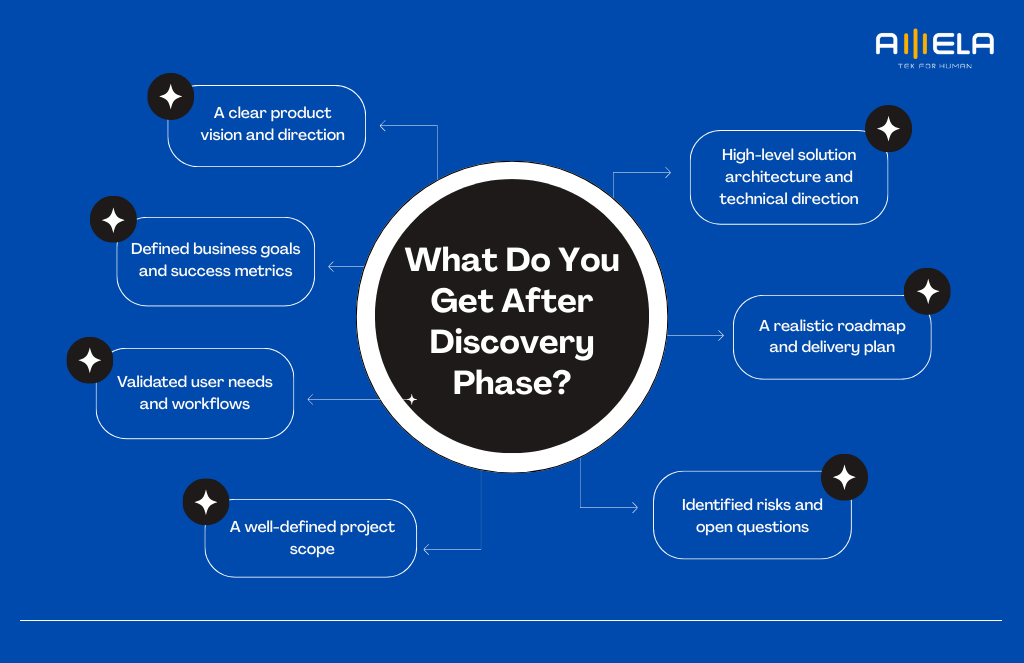
Here’s what teams should realistically expect to walk away with after the discovery phase is done right.
A clear product vision and direction
One of the most important outcomes of discovery is a shared product vision. This goes beyond a feature list. It clearly states what problem the product is solving, for whom, and why it matters.
When this vision is documented and agreed upon, it becomes a reference point for future decisions. If a feature request doesn’t support the vision, it’s easier to push back. From experience, this alone prevents a lot of unnecessary scope creep.
Defined business goals and success metrics
Discovery turns high-level ideas into specific, measurable goals. Whether the focus is efficiency, growth, cost reduction, or user adoption, teams leave discovery knowing how success will be measured.
This clarity makes trade-offs during development much easier. When constraints appear—as they always do—teams can prioritize based on outcomes instead of opinions.
Validated user needs and workflows
After discovery, teams should have a solid understanding of who the users are and how they actually work. This often includes user personas, journey maps, or workflow diagrams that reflect real behavior, not assumptions.
From experience, these insights frequently change what gets built. Features that seemed critical at the start may drop in priority, while overlooked pain points move to the top. This is where discovery quietly saves months of rework later.
A well-defined project scope
Another key output is a clearly defined scope for the next phase. This includes what will be built, what won’t, and what is intentionally deferred.
Having this documented creates a shared contract between stakeholders and the delivery team. It doesn’t freeze the project, but it makes changes explicit and manageable instead of chaotic.
High-level solution architecture and technical direction
Discovery typically results in a high-level technical approach that outlines system components, integrations, and major constraints. This is not a detailed technical design, but it gives teams confidence that the solution is feasible and scalable.
From a development perspective, this early architectural clarity helps avoid dead ends and major redesigns once implementation begins.
A realistic roadmap and delivery plan
After discovery, teams should have a roadmap that reflects priorities, dependencies, and risk areas. This roadmap supports more accurate estimates for timeline and budget, grounded in actual understanding rather than guesswork.
We’ve found that projects with this level of planning move faster overall, even if discovery takes a few extra weeks upfront. Less rework, fewer surprises—that’s the trade.
Identified risks and open questions
A good discovery phase doesn’t pretend everything is solved. It clearly documents risks, assumptions, and unanswered questions, along with suggested mitigation strategies.
This transparency helps stakeholders make informed decisions and prepares the team for what’s coming. No false confidence, no last-minute panic.
A final perspective from experience
When discovery is done properly, teams don’t walk away with “documents”—they walk away with confidence. Confidence that the problem is understood, the direction makes sense, and the next phase is worth investing in.
If you finish discovery and still feel uncertain, that’s a signal something was missed. The goal isn’t perfection—it’s clarity that moves the project forward without surprises.
Who Are Needed in the Discovery Phase?
The discovery phase in custom software development process works best when only the essential roles are involved, with optional roles added based on project size and complexity. From our experience, discovery becomes inefficient when too many people join without clear purpose. Clarity beats headcount every time.
Necessary roles (must-have) include:
Business stakeholder / Product owner
This role owns the business goals and has decision-making authority. They define priorities, confirm success criteria, and resolve trade-offs. Without this role, discovery lacks direction and decisions get delayed—simple as that.
Product manager or product-thinking role
Whether it’s a dedicated product manager or someone wearing the product hat, this role translates business goals into product scope and priorities. They keep discovery focused on solving the right problem instead of drifting into opinions or feature debates.
Technical lead / Solution architect
The technical lead ensures ideas discussed during discovery are feasible, scalable, and realistic. They identify constraints, integration challenges, and technical risks early, preventing costly redesigns later.
Senior developer (representative)
Having at least one experienced developer involved provides ground-level insight into effort, complexity, and edge cases. This role helps bridge the gap between planning and execution, ensuring discovery outputs can actually be built.
Optional roles (depends on team size and project complexity)
UX/UI designer or UX researcher
For user-facing products, this role helps validate user workflows and usability risks. In smaller teams, UX responsibilities are often combined with product or handled lightly during discovery.
QA or testing representative
QA input helps define acceptance criteria and identify edge cases early. For smaller projects, this perspective can often be covered by the technical lead instead of a dedicated role.
Project manager or delivery lead
This role helps structure discovery sessions, timelines, and outputs. It becomes more valuable in larger or distributed teams, but is usually unnecessary for small, focused projects.
Discovery does not require a large team—it requires clear ownership and the right perspectives. Start with the necessary roles, and only add optional ones when complexity demands it. From our experience, lean discovery teams move faster, make better decisions, and hand off more smoothly into development.
>>> Related: Mobile App Development Team: Roles & Structure
Risks of Skipping the Discovery Phase in Development Process
Skipping the discovery phase doesn’t save time—it usually shifts problems downstream, where they’re far more expensive to fix. From our experience, teams that skip discovery often move fast at the start, then slow to a crawl once misunderstandings and rework pile up. Below are the most common risks we see in real projects.
- Building the wrong product (even if it’s well built)
Without discovery, teams often build based on assumptions rather than validated needs. Features may work exactly as specified, yet fail to solve the real problem users have.
This is one of the most painful outcomes because the engineering effort is real, but the value isn’t. Fixing this later usually means redesigning flows, rewriting logic, or in some cases, starting over. Ouch.
- Constant scope creep and unclear priorities
When goals and scope aren’t clearly defined upfront, everything feels like a priority during development. New requests slip in quietly, timelines stretch, and teams struggle to say no because there’s no shared reference point.
Discovery doesn’t eliminate change, but it creates a baseline that makes changes intentional rather than chaotic. Without it, scope creep becomes the default state.
If you outsource development project, explore how to write RPF for software development project to evaluate vendor before jumping into discovery phase.
- Unrealistic timelines and budgets
Estimates created without discovery are usually guesses. Hidden complexity, dependencies, and constraints surface only after development begins, forcing revisions to timelines and budgets.
From experience, this is where trust starts to erode. Stakeholders feel surprised, teams feel pressured, and delivery turns into a series of compromises rather than a planned execution.
This is where a structured discovery phase makes a difference. At AMELA, we help teams surface complexity early and build timelines and budgets they can realistically commit to.
- Technical rework and architectural dead ends
Skipping discovery often means technical decisions are made too early or without enough context. Teams may choose architectures or tools that don’t scale, don’t integrate well, or don’t fit future requirements.
Once development is underway, changing these decisions is costly. We’ve seen projects spend months undoing early choices that could have been avoided with a few weeks of discovery.
- Poor user experience and low adoption
When user workflows aren’t explored early, usability issues surface late—usually after launch. At that point, fixing UX problems often requires changes across design, logic, and data models.
Discovery helps teams understand how users actually work, not how stakeholders assume they work. Skipping this step often leads to products that technically function but feel frustrating to use.
- Increased team friction and misalignment
Without shared understanding established during discovery, different team members often hold different interpretations of the same requirements. This leads to debates, rework, and finger-pointing during development.
Discovery aligns expectations early, reducing conflict and keeping teams focused on delivery instead of clarification. No alignment upfront usually means drama later—no way around it.
- Higher long-term cost
Ironically, skipping discovery to save money almost always increases total project cost. Rework, delays, and rushed fixes add up quickly, especially once systems are already in use.
From experience, discovery is one of the lowest-cost phases with the highest return. Skipping it is rarely a calculated risk—it’s usually an expensive one.
- A practical takeaway
The risk of skipping the discovery phase is not just project failure—it’s wasted effort with false confidence. Teams feel busy, progress looks real, but value delivery falls short.
Discovery is where teams slow down just enough to avoid crashing later. Skip it, and the project starts with a blindfold on.
What Activities Happen in the Discovery Phase?
The discovery phase is not a single meeting or a document-writing exercise—it’s a focused set of activities designed to replace assumptions with clarity. From our experience, the most effective discovery phases follow a structured rhythm, even if the project itself is agile or fast-moving.
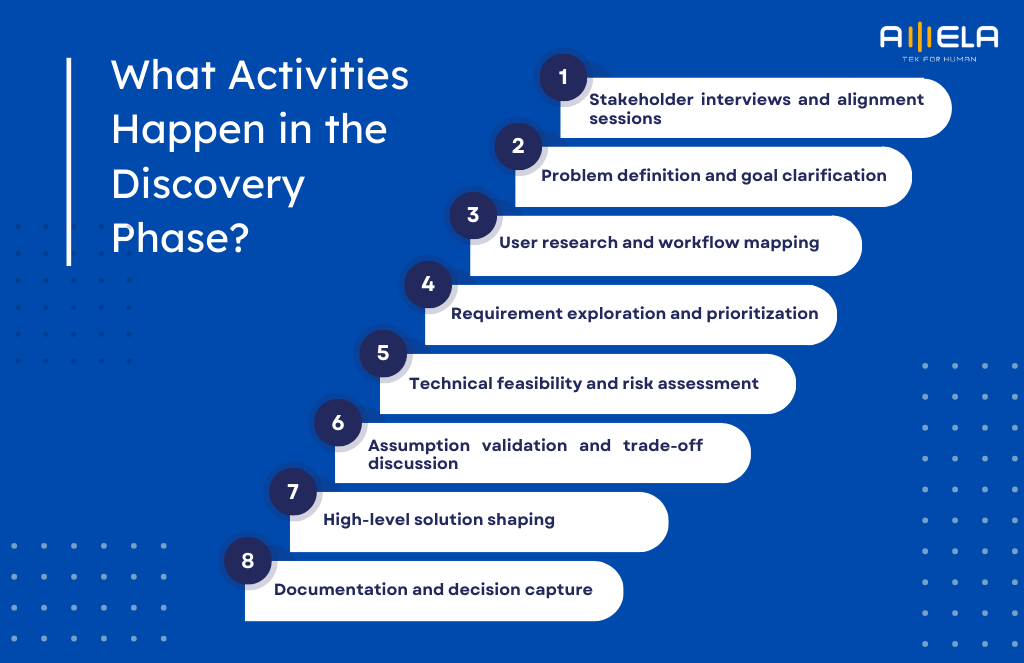
Below are the core activities that typically take place during discovery, and why each one matters.
Stakeholder interviews and alignment sessions
Discovery usually starts with conversations. Stakeholders, product owners, and key team members are interviewed to understand goals, expectations, constraints, and success criteria.
These sessions are where misalignment often surfaces early. Different stakeholders may describe the same project in very different ways. Discovery creates a shared understanding before those differences turn into conflicts during development.
Problem definition and goal clarification
Once inputs are gathered, the team works to clearly define the problem being solved. This includes identifying the core business challenge, target users, and desired outcomes.
From experience, teams that skip this step jump straight to solutions and later realize they solved the wrong problem. Discovery slows things down just enough to make sure everyone is aiming at the same target.
User research and workflow mapping
Understanding how users actually work is a key discovery activity. This may involve user interviews, journey mapping, or analyzing existing processes.
The goal is to identify pain points, inefficiencies, and opportunities for improvement. These insights often reshape feature priorities and simplify the solution. When teams do this well, UX issues rarely come as a surprise later.
Requirement exploration and prioritization
During discovery, requirements are explored at a high level—not fully specified, but clearly understood. The team identifies core features, nice-to-haves, and non-goals.
Prioritization is critical here. Not everything can or should be built at once. Discovery helps teams focus on what delivers the most value first, keeping scope realistic and manageable.
Technical feasibility and risk assessment
The technical team evaluates potential architectures, integrations, and constraints. This includes assessing existing systems, data sources, performance expectations, and security requirements.
From experience, this activity prevents teams from committing to solutions that look good on paper but are difficult or costly to implement. It also surfaces risks early, when they are easier to mitigate.
Assumption validation and trade-off discussion
Discovery is where assumptions are challenged. What assumptions are we making about users, scale, timelines, or budget? Which ones are risky?
The team discusses trade-offs openly—speed vs. quality, flexibility vs. simplicity, cost vs. scalability. Making these trade-offs explicit early prevents disappointment later.
High-level solution shaping
As understanding deepens, the team outlines a high-level solution approach. This includes defining system boundaries, major components, and integration points.
This is not detailed design, but it gives everyone confidence that the solution is feasible and aligned with goals. It also sets the stage for design and development phases.
Documentation and decision capture
The final discovery activity is documenting key decisions, assumptions, risks, and next steps. These artifacts serve as a reference throughout the project.
From experience, this documentation doesn’t need to be heavy—but it must be clear. If decisions live only in people’s heads, they tend to get re-litigated later.
The discovery phase is effective because it turns conversations into decisions and uncertainty into direction. Each activity plays a role in reducing risk and aligning the team.
When these activities are done properly, development doesn’t just start faster—it starts smarter.
Discovery Phase Timeline & Cost
The discovery phase is short, focused, and designed to save time and money later. From our experience, spending a few weeks on discovery often prevents months of rework during development. That’s the real value.
Typical discovery timeline
For small projects or MVPs, discovery usually takes 1–2 weeks. The problem space is limited, decision-making is fast, and assumptions can be validated quickly.
For mid-sized products, discovery commonly runs 2–4 weeks. This allows time to align stakeholders, understand users, assess integrations, and define a realistic scope.
For large or enterprise systems, discovery often takes 4–6 weeks or more, especially when legacy systems, compliance, or multiple teams are involved. Longer discovery here reduces delivery risk significantly.
What influences the timeline?
Discovery moves faster when goals are clear, stakeholders are available, and existing systems are documented. It slows down when requirements are vague, integrations are complex, or decisions are delayed. Integration-heavy projects almost always need more time—no surprise there.
Discovery phase cost
Discovery typically represents 5–15% of the total development budget. While it may seem like an extra step, it is one of the lowest-cost phases with the highest return. From experience, skipping or rushing discovery almost always increases total project cost later.
Common pricing models
If you outsource software development or discovery phase, it can be priced as:
- Fixed-price, with defined scope and outputs
- Time and materials, for complex or evolving projects
- Included in development, as a dedicated upfront phase
How AMELA Supports Your Software Development Discovery Phase?
From our experience, a smooth discovery phase prevents misalignment and reduces risk throughout delivery.
At AMELA, we begin every outsourced project with a structured discovery process focused on understanding business goals, user needs, and technical constraints before development starts.
How AMELA helps during discovery:
- Alignment workshops to clarify business objectives, users, and success metrics
- Business viability assessment by BA to validate growth opportunities and scalability assumptions
- Technical feasibility review by solution architects and senior engineers
- Clear, actionable outputs including scope, high-level architecture, risks, and roadmap
By combining business insight with technical expertise early, we help outsourced projects start on solid ground—reducing risk and setting a clearer path for sustainable growth.
Conclusion
The discovery phase in software development is not an optional step—it is the foundation that makes delivery predictable and effective. Teams that invest time in discovery gain clarity, alignment, and confidence before committing to build.
If you’re planning a new software initiative or considering outsourcing software development services, starting with a structured discovery phase can make all the difference. With the right approach and the right partner, discovery becomes a strategic advantage rather than an overhead.
FAQs
Below are the most common questions we hear from teams considering or starting a discovery phase, based on real project experience.
What are the most common discovery phase mistakes?
The biggest mistake is treating discovery as a documentation exercise instead of a decision-making phase. Teams sometimes collect a lot of information but fail to align on priorities, scope, or success criteria.
Other common mistakes include skipping user validation, involving too many stakeholders without clear ownership, and jumping into design or development before assumptions are tested. From experience, these mistakes usually lead to rework later—just delayed, not avoided.
What is a simple discovery phase checklist?
A discovery phase does not need to be heavy, but it should cover the essentials. A solid checklist usually includes:
- Business goals and success metrics are clearly defined
- Target users and core workflows validated
- Key assumptions and risks documented
- High-level scope and priorities agreed
- Technical feasibility and major constraints reviewed
- Next steps and ownership clearly outlined
If these points are not clear at the end of discovery, the phase is likely incomplete.
What is the difference between the discovery phase and requirements gathering?
Requirements gathering focuses on what features the system should have. It is often solution-oriented and assumes the problem is already understood.
The discovery phase is broader. It focuses on why the product is needed, who it is for, and whether the proposed solution makes sense at all. Discovery often reshapes or even reduces requirements before they are finalized. From experience, discovery answers the “are we building the right thing?” question, while requirements gathering answers “how do we build it?”
Can discovery phase outputs change later?
Yes—and that’s expected. Discovery is about reducing uncertainty, not eliminating it completely. As development progresses, new insights may emerge. The difference is that changes are made with context and intent, rather than confusion.
Teams that document discovery decisions clearly find it much easier to manage changes later without derailing the project.
Is discovery phase really necessary for small projects?
In most cases, yes—just in a lighter form. Smaller projects still benefit from clear goals, validated assumptions, and defined scope. For small teams, discovery might take days instead of weeks, but skipping it entirely often leads to wasted effort.
From experience, the smaller the project, the less room there is for wrong assumptions—making discovery even more valuable.