![Golang Outsourcing: Benefits, Costs & Case Studies [Full Guide]](https://amela.tech/wp-content/uploads/2026/05/golang-outsourcing.png)
 May 25, 2026
Table of Contents
Deploying high-concurrency cloud architectures requires specialized engineering that local talent pools struggle to supply cost-effectively. Golang outsourcing allows enterprises to scale their infrastructure smoothly while reducing development time-to-market.
Building scalable backends has shifted away from resource-heavy runtimes toward compiled, efficient languages. Google’s Go (Golang) has become the backbone of modern enterprise applications, microservices, and cloud-native tools. However, assembling an in-house Go team presents a clear bottleneck for technical leaders: steep compensation packages and prolonged hiring cycles. Navigating these constraints requires a clear strategy, which you can explore deeper in our IT outsourcing guide.
Why Global Tech Leaders Outsource Golang Development
Tech leaders outsource Golang development to eliminate local hiring friction, reduce infrastructure overhead via lightweight concurrency, and instantly access specialized backend architects who can deploy distributed microservices without operational delays.
1. High-Load Scaling with Lower Compute Costs
Unlike high-level interpreted languages or heavy runtime environments like Java, Go compiles directly to machine code. It bypasses the resource-heavy overhead of standard virtual machines. According to ecosystem technical reviews by S3Corp, a typical Go microservice consumes as little as 10–20MB of RAM, whereas an equivalent Java-based service frequently demands 100–200MB.
By outsourcing development to engineers who understand Go’s native concurrency primitives—specifically Goroutines and channels—enterprises achieve massive horizontal scaling. Goroutines consume only a few kilobytes of memory compared to the megabytes required by traditional operating system threads. For high-transaction platforms, this optimization directly translates to smaller cloud instance sizes, lower CPU utilization, and major reductions in monthly cloud infrastructure bills.
2. Bypassing the Local Talent Deficit
Finding senior backend engineers with production-grade Go experience is a notable roadblock. Market data from Rustify’s 2026 Report highlights that senior Go developer compensation in the United States spans between $165,000 and $200,000 annually. This premium reflects a structural shortage: market demand continues to outpace the supply of systems-level engineers.
Outsourcing effectively broadens the talent search globally. Instead of spending 8 to 12 weeks competing for local talent in saturated domestic markets, engineering managers can onboard fully vetted, cross-functional offshore Go teams within days.
3. Accelerated Time-to-Market for Microservices
Go’s design prioritizes explicit code, minimal syntax, and quick compilation speeds. These features streamline continuous integration and continuous deployment (CI/CD) pipelines because deployments compile down to a single binary with zero external dependencies.
External Golang engineering vendors bring established microservices frameworks, predefined service discovery templates, and clean gRPC integration protocols to your project. This specialization cuts down architectural planning time, enabling teams to push stable backend updates to production faster than teams working with bloated frameworks.
How Much Does it Cost to Outsource Golang Development?
Outsourcing Golang development balances specialized technical expertise with cost optimization, as global hourly rates vary from $150/hour in North America to $25–$50/hour in mature Southeast Asian tech hubs like Vietnam.
Enterprise engineering budgets depend directly on geographic placement and local seniority density. Golang requires deep systems-level engineering and knowledge of distributed runtimes, meaning it commands a 15–25% premium over standard web stacks like PHP or basic JavaScript.
A global breakdown compiled from the SmartDev’s Budget Planning Guide outlines the average hourly rates across major outsourcing regions:
| Region | Mid-Level Rate | Senior/Architect Rate | Key Delivery Hubs |
| North America | $100 – $150 / hr | $150 – $250+ / hr | San Francisco, New York, Toronto |
| Western Europe | $70 – $110 / hr | $110 – $160+ / hr | London, Berlin, Amsterdam |
| Eastern Europe | $40 – $65 / hr | $65 – $100 / hr | Warsaw, Bucharest, Prague |
| Latin America | $35 – $65 / hr | $65 – $110 / hr | São Paulo, Mexico City, Medellín |
| Southeast Asia | $25 – $35 / hr | $35 – $50 / hr | Ho Chi Minh City, Hanoi, Manila |
While Western markets require substantial capital, regions like Southeast Asia provide an attractive alternative for specialized cloud-native development. Specifically, IT outsourcing development in Vietnam has grown rapidly because local universities graduate over 55,000 IT professionals annually. For an enterprise looking to scale up, the standard golang developer hourly rate in Vietnam delivers highly optimized, production-ready microservices at a fraction of Western operational costs.
Choosing the Right Model: Staff Augmentation vs. Dedicated Go Teams
Selecting between Go staff augmentation and dedicated engineering teams depends on whether your project requires immediate tactical support for existing codebases or end-to-end architectural delivery of cloud-native systems.
Deploying a backend modernization strategy requires matching your system’s current lifecycle stage to the correct collaboration framework. Every model impacts control, agility, and overall code quality differently. Navigating these tradeoffs effectively means carefully weighing the foundational outsourcing software development pros and cons before committing resources.
| Model | Pros | Cons |
| Go Staff Augmentation | Fast to start; easy to add Go developers to your existing team; good for short-term gaps or specific tasks; you keep full control. | Needs strong internal management; not ideal if you lack a senior Go architect; delivery ownership stays mostly with your team. |
| Dedicated Go Team | Full team support; better for complex or long-term projects; vendor can manage delivery, QA, DevOps, and performance; useful for building systems from scratch. | Takes longer to set up; needs clear alignment and communication; usually requires a longer-term commitment. |
Staff Augmentation: Plugs Direct Architectural Gaps
This model works best when you already possess an established in-house engineering team, a clear product roadmap, and a senior Go architect to oversee the codebase.
- When to deploy: If you are migrating a few legacy modules from Node.js to Go or need to scale your REST API endpoints rapidly to meet a short-term traffic spike.
- External engineering benefit: You bypass long onboarding periods by integrating isolated, high-tier Go developers directly into your existing Jira workflows and daily standups.
Dedicated Go Teams (Offshore Go Development Team)
For greenfield enterprise products or complete system overhauls, a self-managed, cross-functional dedicated product team is the preferred architecture. This setup typically bundles senior Go backend engineers, DevOps specialists proficient in Kubernetes/Docker, QA automation engineers, and a technical Scrum Master.
- When to deploy: When you need to build a distributed microservices platform, real-time data streaming infrastructure, or a multi-tenant SaaS architecture completely from scratch.
- Engineering benefit: The vendor takes full ownership of delivery metrics, service-level agreements (SLAs), and code performance benchmarks, allowing your core product team to focus entirely on market strategy.
Case Studies: What Successful Golang Outsourcing Looks Like
Successful Golang outsourcing is not always about “rewriting everything in Go.” In real projects, the best outcomes usually come from choosing the right services to modernize first: payment flows, APIs, data pipelines, caching layers, or high-traffic backend components.
Go is widely used by companies that need scalable backend systems, especially when teams want simpler concurrency, faster deployment, and easier microservice maintenance. The official Go case study page highlights several real examples, including PayPal, American Express, Monzo, Dropbox, MercadoLibre, Netflix, and Uber, showing how Go is used across payments, commerce, infrastructure, and high-traffic systems.
Monzo — Building a Bank with Go Microservices
Monzo is one of the most relevant examples for financial technology teams considering Golang outsourcing. As a digital bank, Monzo needed backend services that could support fast iteration, reliable financial workflows, and a microservices-based architecture.
Instead of relying on one large backend application, Monzo built small, focused services around clear responsibilities. Go was a strong fit because it made it easier for engineers to build simple networked services with native concurrency support. The official Go case study page quotes Monzo’s view that Go is well-suited for microservice architectures, especially because its concurrency model helps create small services focused on the “single responsibility principle.”
A realistic outsourcing lesson here is clear: a company does not need to migrate the entire banking platform at once. A specialized Golang team could start with one high-pressure domain, such as payment processing, notification delivery, ledger support, internal APIs, or transaction monitoring. Once the first service proves stable, the team can continue decomposing the monolith gradually.
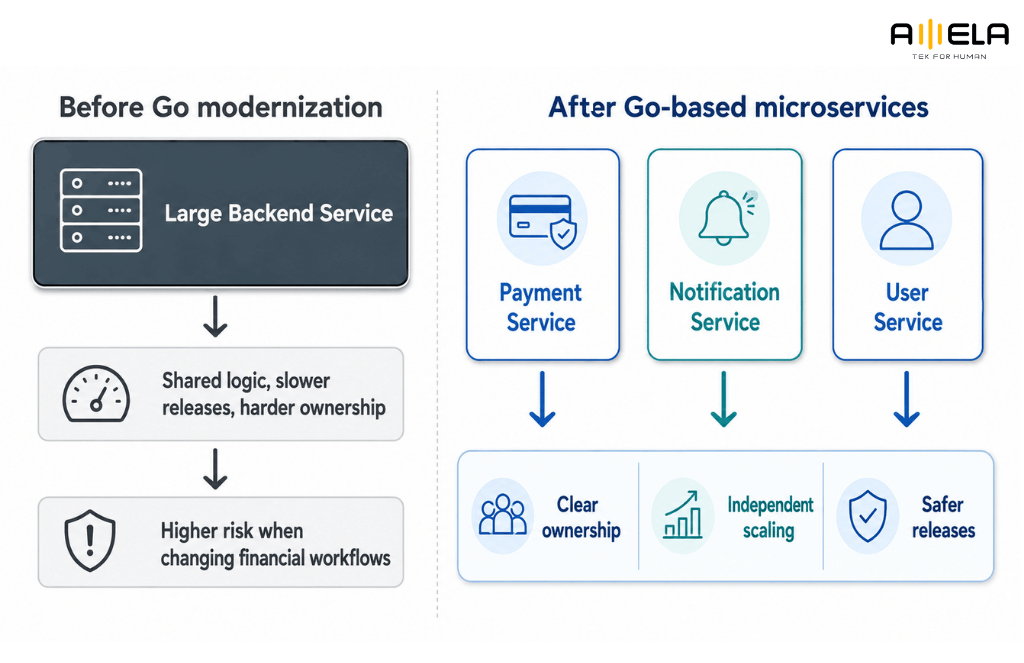
Practical result: The strongest business impact is not just lower latency. It is better team ownership, safer releases, and the ability to scale specific services without touching the entire system. For fintech products, that matters because reliability and change control are just as important as raw speed.
How to Hire a Golang Developer or Team?
To hire elite Golang talent, engineering leaders must shift from generic syntax testing to evaluating cloud-native architecture mastery, runtime concurrency profiling, and vendor operational alignment through low-risk technical pilots.
Step 1: Pivot Away From Standard LeetCode Testing
Data from the HackerRank 2025 Developer Skills Report highlights that typical algorithmic coding puzzles often fail to mirror modern enterprise software needs, causing unnecessary friction and screening out qualified engineering talent. When looking to hire golang developers, evaluating practical distributed systems design yields better architectural outcomes than testing abstract textbook puzzles.
Your practical screening framework should focus on testing real-world backend design constraints:
- The Framework vs. Native Dilemma: Evaluate whether the candidate defaults blindly to heavy third-party dependencies or understands when to leverage Go’s native capabilities. Technical data from the JetBrains State of Developer Ecosystem Report shows that a significant portion of professional Go engineers build web services entirely within the built-in net/http standard library to ensure low runtime overhead and clean dependency management.
- Concurrency Guardrails: Require candidates to construct a multi-threaded data pipeline and explain how they prevent goroutine leaks or race conditions under variable traffic loads.
Step 2: Vet for Cloud-Native Ecosystem and Tooling Maturity
Go does not operate in isolation; it serves as the core foundational layer for modern containerized platforms. A qualified developer or golang software development services provider must demonstrate clear familiarity with automated code quality controls and cloud infrastructure.
According to Google’s official Go Developer Survey findings, over half of professional Go developers utilize golangci-lint to enforce structural code quality, while AWS remains the dominant deployment target. Your vetting process should confirm that engineers are highly proficient in constructing multi-stage Docker builds, managing container resources inside Kubernetes, and integrating distributed tracing frameworks like OpenTelemetry.
Step 3: Evaluate Vendor-Specific Capabilities (If Choosing an Agency)
If your strategy leans toward outsourcing rather than individual hiring, you must evaluate the agency’s broader organizational architecture. A generalist software shop cannot safely deliver a high-performance Go backend. When auditing a golang development company, look for three structural indicators:
- Infrastructure Stack Alignment: Verify their hands-on experience handling high-throughput distributed message brokers (like Apache Kafka or NATS) and low-latency transport layers like gRPC and Protocol Buffers.
- Senior Architectural Leadership: Ensure the agency has dedicated Tech Leads who can actively audit code for systems-level issues, such as avoiding excessive heap allocations that trigger heavy runtime garbage collection (GC) pauses.
- Contract-First API Design: Confirm they establish strict architectural contracts before writing code, keeping cross-functional teams aligned throughout the development lifecycle.
Step 4: Initiate a Low-Risk Technical Pilot Project
Before committing to a long-term contract or a massive team scaling phase, mitigate your financial and operational risk by launching a small, paid 2-to-4-week Proof of Concept (PoC).
Use this phase to evaluate actual engineering delivery metrics rather than relying on marketing materials. Measure their communication responsiveness across time zones, check their adherence to your internal Git workflows, and ensure their testing frameworks capture race conditions before code reaches staging environments. This hands-on evaluation provides clear, data-driven validation before you formally establish a long-term offshore backend team that can scale.
![Top Golang Outsourcing Agencies: Benefits, Costs, and Case Studies [Full Guide] image 1](https://amela.tech/wp-content/uploads/2026/05/golang-outsourcing-inline-1.png)
Top 10 Golang Outsourcing Agencies to Consider
Selecting a Golang outsourcing partner requires verifying their deep competencies in cloud-native infrastructure, concurrency patterns, and distributed microservices rather than general web frameworks.
Evaluating vendors for golang software development services requires looking past basic portfolio sites to examine their architectural maturity, DevOps integration, and experience with low-latency engineering. Below is a curated review of ten specialized agencies capable of deploying high-performance Go codebases:
AMELA Technology
- Core Focus: Scale-up and enterprise offshore engineering squads.
- Why They Stand Out: Operating as a premium offshore go development team, AMELA Technology combines highly competitive Southeast Asian developer rates with advanced expertise in cloud architecture, gRPC pipelines, and high-load backend modernization. Their engineering teams specialize in migrating legacy systems to optimized Go microservices without breaking live production environments.
N-iX
- Core Focus: Enterprise-level digital transformation and big data pipelines.
- Why They Stand Out: With a broad global footprint across Europe and the Americas, N-iX houses a deep talent pool of senior developers capable of aligning Go architectures with complex enterprise compliance frameworks and large-scale data stream processing.
Itransition
- Core Focus: Custom enterprise software and cross-platform technical solutions.
- Why They Stand Out: Itransition focuses heavily on rigorous quality management, adhering closely to formal Go style guides and automated QA testing loops. They excel at building highly secure, corporate-grade microservices for sectors like insurance and finance.
Digis
- Core Focus: Rapid scale-up staff augmentation for high-throughput backends.
- Why They Stand Out: Known for their stringent technical screening protocols, Digis connects engineering teams with mid-to-senior Go professionals who understand Docker initialization, Helm chart optimization, and message broker architectures like Kafka and NATS.
Rubyroid Labs
- Core Focus: Agile product development and custom web/mobile APIs.
- Why They Stand Out: They excel at building fast, robust server-side APIs using lightweight Go frameworks like Gin and Echo. This makes them a strong choice for businesses needing quick product rollouts and scalable backend integrations.
Scalac
- Core Focus: Advanced distributed systems and functional cloud integrations.
- Why They Stand Out: While known historically for Scala, their Go engineering branch excels at building complex cloud-native architectures that emphasize data immutability and highly responsive distributed systems.
Code & Pepper
- Core Focus: Fintech backend engineering and secure API optimization.
- Why They Stand Out: They specialize in building performance-optimized transaction engines and security-first APIs, helping fintech companies minimize compute overhead while maintaining rigid data privacy standards.
Conclusion
Outsourcing Golang development bridges the local tech talent gap while ensuring your infrastructure scales efficiently. Partnering with a specialized team converts high-load backend modernization risks into predictable, cost-optimized delivery cycles.
Migrating legacy backends or building greenfield cloud architectures is not merely a language choice—it is a strategic decision to eliminate technical debt and reduce structural computing costs. As global enterprise tech demands continue to scale up, matching your workflows with specialized talent is essential to maintaining an operational edge.
By leveraging an external golang offshore development center, engineering leaders can bypass local recruitment bottlenecks and deploy production-ready code faster. When you choose to hire golang developers with verified expertise in concurrency and microservices design, you ensure your software stack remains secure, responsive, and highly efficient for years to come.