 Feb 11, 2026
Table of Contents
Understanding how to hire offshore developers is less about finding cheaper talent and more about building a delivery model that actually works across distance, culture, and time zones. As more companies turn to offshore development to scale faster and stay competitive, hiring decisions have become strategic rather than operational. Yet many teams struggle—not because offshore talent lacks capability, but because the hiring process fails to account for execution readiness, collaboration style, and long-term ownership.
This guide on hiring offshore developers is based on real delivery experience, not theory. It breaks down how to evaluate candidates, where to hire, how much it costs, and—most importantly—how to make offshore hiring work in practice without losing control, quality, or momentum.
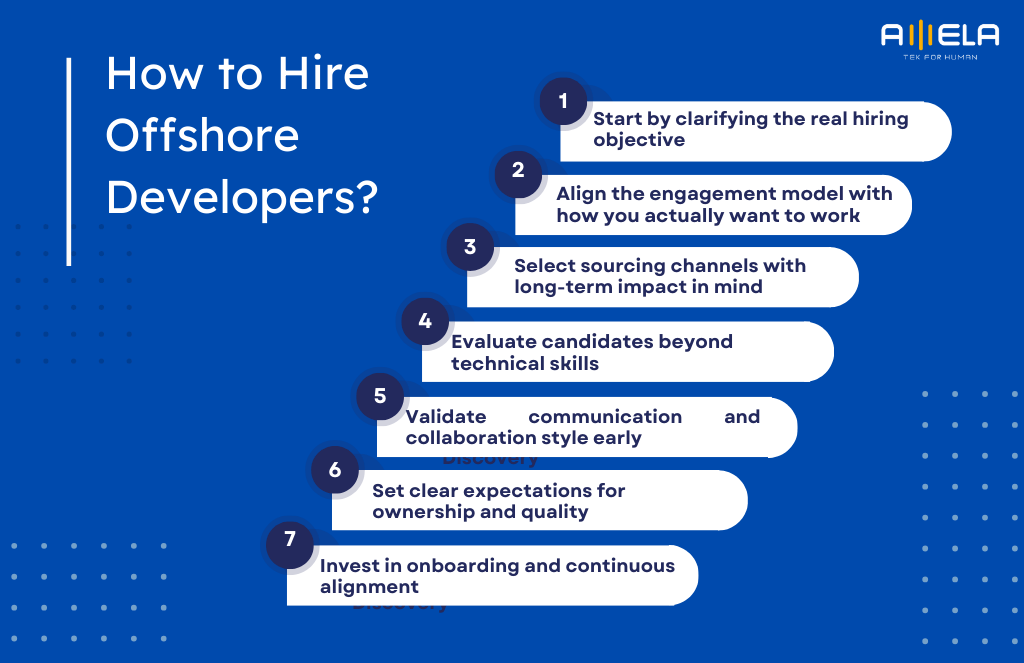
How to Hire Offshore Developers? Step by Step Guide
Hiring offshore developers works best when you treat it as a structured decision process, not a talent shopping exercise.
From our experience supporting companies across different markets, the biggest successes come from teams that slow down at the beginning to get the fundamentals right. Below is a practical, step-by-step guide that reflects how offshore hiring actually works in real projects.
Step 1: Start by clarifying the real hiring objective
Hiring offshore developers often fails when companies rush straight into sourcing without aligning internally on what problem they are trying to solve. From experience, the most effective teams take time upfront to define the role in terms of expected outcomes, not just skills. This means understanding what the developer should deliver in the first few months, how much ownership is expected, and how this role fits into the existing team. When hiring goals are vague, even strong developers struggle to add value because success was never clearly defined.
Step 2: Align the engagement model with how you actually want to work
One common mistake is choosing an engagement model based on convenience or cost rather than day-to-day collaboration needs. Offshore hiring works best when the model reflects how closely the developer will be involved in decision-making, planning, and long-term maintenance. In practice, mismatches happen when teams expect long-term ownership but hire on short-term or task-based terms. Clarifying this early avoids frustration on both sides and creates realistic expectations for responsibility and continuity.
Step 3: Select sourcing channels with long-term impact in mind
Where you hire offshore developers from matters more than many teams expect. Different sourcing channels carry different trade-offs in speed, control, and delivery risk. From experience, the key is not choosing the fastest or cheapest option, but selecting a channel that aligns with your internal capacity to evaluate, onboard, and support offshore talent. Poor sourcing decisions often lead to hidden costs later, especially when quality or accountability issues emerge.
Step 4: Evaluate candidates beyond technical skills
Technical tests alone are not enough. Offshore developers must work with partial context, async communication, and evolving requirements.
In real interviews, we focus on:
-
How candidates explain past decisions and trade-offs
-
How they react when requirements are unclear
-
Whether they ask thoughtful questions or wait for instructions
Developers who think critically reduce risk more than those who simply follow tasks.
Step 5: Validate communication and collaboration style early
Offshore development relies heavily on communication, especially across time zones and cultures. From experience, teams that assess communication style early avoid many downstream issues. This is less about language fluency and more about clarity, structure, and responsiveness. Developers who can explain progress, flag risks early, and summarize decisions clearly tend to integrate smoothly into distributed teams and maintain alignment over time.
Step 6: Start small before scaling
Instead of committing to a large dedicated team for a project immediately, begin with a limited scope or trial period. This allows both sides to test working rhythm, quality expectations, and decision-making flow.
From experience, gradual scaling:
-
Exposes gaps early while the cost is low
-
Builds trust through real delivery, not promises
-
Improves long-term retention and performance
Strong offshore teams are built incrementally, not rushed.
Step 7: Set clear expectations for ownership and quality
Once hiring is confirmed, success depends on how clearly ownership is defined. Offshore developers need to know what they are responsible for—and what they are not.
Effective teams align on:
-
definition of done and quality standards
-
escalation rules and decision authority
-
review and feedback cycles
This clarity removes ambiguity and prevents silent delivery risks.
Step 8: Invest in onboarding and continuous alignment
Hiring offshore developers does not end on day one. Long-term success depends on how well developers are onboarded into the system, the product context, and the team’s decision-making culture. Teams that invest in proper onboarding, regular alignment check-ins, and shared goals consistently see higher productivity and retention. Treating offshore developers as long-term collaborators rather than external resources changes the quality of outcomes significantly.
The most effective way to hire offshore developers is to design the process around execution, not just talent acquisition. When hiring decisions align with real delivery needs, collaboration style, and long-term goals, offshore developers become a strategic advantage rather than a recurring challenge.
How to Evaluate Offshore Developers?
Evaluating offshore developers is not about finding the “best CV,” but about identifying people who can think clearly, execute reliably, and collaborate across distance and context. From our experience working with global clients and distributed teams, the biggest hiring mistakes happen when companies over-index on technical skills and under-evaluate execution readiness.
Below are the core qualities we consistently assess when evaluating offshore developers—and why each one matters in real projects, not just interviews.
1. Technical competence that matches your problem, not generic skills
Strong offshore developers are not those who “know many technologies,” but those who understand why a specific stack is used and where it breaks. We always look for depth in the technologies relevant to the project domain, not surface-level familiarity.
In practice, this means:
-
asking candidates to explain trade-offs they have made before
-
reviewing how they debug or refactor existing code, not just write new features
-
checking whether they understand non-functional requirements like performance, security, and scalability
A developer who can talk clearly about past technical decisions is far more valuable than one who simply lists tools.
2. Ability to work with incomplete or evolving requirements
In offshore setups, requirements are rarely perfect. Good developers know how to ask the right questions early, instead of waiting until problems appear in code.
From experience, strong candidates:
-
actively clarify assumptions instead of silently filling gaps
-
propose alternative approaches when requirements are vague
-
understand that “clear on paper” does not always mean “ready for execution”
This trait directly reduces rework, delays, and frustration later in the project.
3. Communication clarity, not just language ability
Fluent English is helpful, but clarity is more important than vocabulary. We look for developers who can:
-
explain technical issues in simple, structured ways
-
summarize decisions and next steps clearly
-
signal risks early instead of hiding uncertainty
In real offshore projects, developers who communicate clearly save more time than those who simply “follow instructions.”
4. Ownership mindset and accountability
One of the most important qualities we evaluate is whether a developer sees themselves as responsible for outcomes, not just tasks.
Practically, this shows up when developers:
-
proactively report issues instead of waiting for reviews
-
follow up on unresolved problems
-
treat quality and delivery timelines as shared responsibility
This mindset is critical in offshore teams, where managers cannot monitor every detail daily.
5. Adaptability to processes, tools, and client culture
Offshore developers often work with clients from different industries, time zones, and cultures. Strong candidates demonstrate flexibility in adapting to new workflows or coding standards, accepting feedback without defensiveness and aligning with the client’s working style, not forcing their own.
Technical skill can be taught. Adaptability usually cannot.
6. Long-term stability and learning attitude
Finally, we always consider whether a developer is suitable for long-term collaboration, not just short-term delivery. Offshore hiring works best when teams grow together.
We pay attention to learning habits and curiosity, willingness to improve beyond current responsibilities, consistency across previous roles.
Stable teams outperform “hero developers” almost every time.
When evaluation focuses on execution, communication, and ownership—not just technical checklists—offshore hiring becomes far more predictable and successful.
Where to Hire Offshore Developers (With Real Options)
Where you hire offshore developers will shape cost, control, risk, and long-term outcomes more than most teams expect.
1. Remote Freelance Platforms
Remote freelance platforms are often the fastest way to access offshore developers, especially when you need short-term execution or want to test an idea with minimal commitment. Platforms like Upwork, Toptal, and Freelancer give you direct access to a global talent pool across many skill levels and price ranges.
The biggest advantage is flexibility. You can hire quickly, adjust scope easily, and stop work without long-term obligations. For early-stage experiments or isolated tasks, this model can work well.
In practice, the downside becomes clear as complexity grows. Quality varies significantly, long-term ownership is weak, and project continuity depends heavily on individual availability. Many teams underestimate the management effort required to coordinate freelancers and maintain consistent standards.
Typical platforms to consider:
-
Upwork – large talent pool, flexible pricing, broad skill coverage
-
Toptal – smaller pool, higher cost, stronger pre-vetting
-
Freelancer – competitive pricing, but requires careful screening
This approach works best when scope is limited, internal technical leadership is strong, and long-term system ownership is not critical.
2. Offshore Software Development Companies
Working with an offshore software development company is a common choice for teams that need stability, scale, and predictable delivery. Instead of hiring individuals, you engage a company that provides developers supported by project management, QA, and delivery governance.
From experience, this model significantly reduces hiring friction and execution risk for long-term or business-critical systems. You gain access to structured teams, established processes, and continuity even when individual engineers rotate.
The trade-off is lower flexibility compared to freelancing and a higher headline cost. However, many teams find that total cost of ownership is lower once rework, attrition, and coordination overhead are factored in.
Well-known offshore development companies:
-
AMELA Technology – Vietnam-based, strong in dedicated teams and long-term delivery
-
Savvycom – Vietnam-based, experienced in enterprise and product development
-
Cleveroad – Eastern Europe-based, strong product engineering focus
This option fits teams building core products, scaling engineering capacity, or needing long-term collaboration rather than short-term execution.
3. Direct Offshore Hiring (Your Own Remote Employees)
Direct offshore hiring means recruiting developers as your own full-time employees, often working remotely from another country. This approach offers maximum control over culture, priorities, and long-term knowledge retention.
The advantage is deep alignment. Developers become part of your organization, follow your processes, and grow with the product. Over time, this can build strong internal capability and reduce reliance on external vendors.
In practice, the challenge lies in execution. Companies must handle local compliance, payroll, legal requirements, onboarding, and retention—often in unfamiliar markets. Without strong internal support, this model can introduce significant operational risk.
Common ways companies do this:
-
Hiring via LinkedIn with local recruiters
-
Using Remote.com or Deel for employer-of-record support
-
Building local hiring pipelines through regional job boards
This approach works best for companies with experience managing distributed teams and the infrastructure to support international employment.
Practical takeaway
The best place to hire offshore developers depends on how much control, stability, and responsibility you need. Freelance platforms optimize for speed, development companies optimize for delivery, and direct hiring optimizes for ownership. Choosing the wrong channel often creates problems that no amount of talent can fix later.
Offshore developer cost varies widely by region, skill level, and engagement model—but in practice, most companies pay between USD 20 and USD 70 per hour depending on where and how they hire.
From our experience supporting global clients, cost decisions that ignore delivery context often lead to hidden expenses later. Below is a realistic, region-based breakdown with context on what those numbers actually mean.
How Much Does It Cost to Hire an Offshore Developer?
Offshore developer cost varies widely by region, skill level, and engagement model—but in practice, most companies pay between USD 20 and USD 70 per hour depending on where and how they hire.
From our experience supporting global clients, cost decisions that ignore delivery context often lead to hidden expenses later. Below is a realistic, region-based breakdown with context on what those numbers actually mean.
>>> Related: How Much Does it Cost to Hire a Software Developer?
Average Offshore Developer Cost by Region
| Region / Country | Typical Hourly Rate (USD) | Monthly Cost (Full-time) | What You’re Paying For |
| Vietnam | $20 – $40 | $3,200 – $6,400 | Strong engineering base, good cost–quality balance |
| India | $20 – $35 | $3,200 – $5,600 | Large talent pool, wide variance in quality |
| Philippines | $25 – $45 | $4,000 – $7,200 | Strong communication, smaller tech depth |
| Eastern Europe (Poland, Ukraine, Romania) | $35 – $65 | $5,600 – $10,400 | Senior-heavy talent, strong architecture skills |
| Latin America (Brazil, Mexico, Colombia) | $35 – $60 | $5,600 – $9,600 | Time-zone alignment with US teams |
| Western Europe / US (nearshore, not offshore) | $70 – $120+ | $11,000+ | High cost, strongest market familiarity |
Monthly cost assumes ~160 working hours.
Best Countries to Hire Offshore Developers
- Southeast Asia (Vietnam, Philippines)
Vietnam consistently offers one of the best cost-to-capability ratios. From experience, clients choosing Vietnam are usually optimizing for long-term delivery, scalability, and technical consistency rather than just low hourly rates. Costs stay predictable, and engineering quality scales well when supported by structured offshore delivery teams.
The Philippines often comes into play when communication and customer-facing roles matter more than deep engineering complexity. Costs are slightly higher, but language clarity is a strong advantage.
- South Asia (India)
India remains one of the most price-competitive markets, but it also has the widest quality spread. From experience, success here depends heavily on screening, management maturity, and whether developers are working within a strong delivery structure. Lower rates can quickly be offset by rework if expectations are unclear.
- Eastern Europe
Eastern European developers typically cost more but bring strong system design and architectural thinking. This region is often chosen when technical complexity is high and teams need developers who can operate with minimal guidance. The trade-off is budget and, in some cases, limited scalability.
- Latin America
Latin America is popular with North American companies due to time zone alignment. Costs are mid-range, and collaboration can feel more “real-time.” However, competition for senior talent has driven rates upward in recent years.
Why Hourly Rate Alone Is a Misleading Metric
From real projects, the cheapest developer is rarely the lowest-cost option overall. Teams often underestimate:
-
rework caused by unclear requirements
-
time lost to communication and coordination
-
attrition and knowledge transfer costs
-
management overhead
A USD 25/hour developer who needs constant clarification can cost more than a USD 40/hour developer who works independently and prevents mistakes.
Conclusion
Knowing how to hire offshore developers effectively means designing the process around execution, not just recruitment. Successful offshore hiring comes from clear objectives, the right sourcing channels, realistic cost expectations, and a strong focus on communication, ownership, and long-term alignment. Teams that treat offshore developers as strategic contributors—rather than interchangeable resources—consistently achieve better outcomes.
From experience, offshore hiring works best when decisions are made deliberately at each step, from evaluation to onboarding. When done right, offshore developers become a scalable extension of your team, helping you move faster while maintaining quality, transparency, and control.