
 Jan 14, 2026
Table of Contents
Nearshore agile software development combines the flexibility of Agile methods with the collaboration benefits of working with teams in nearby regions.
By reducing time-zone gaps and improving real-time communication, this model helps companies deliver software faster while staying adaptable as requirements evolve. For organizations balancing speed, quality, and cost, nearshore agile software development has become a practical and sustainable approach.
What is Agile Nearshore Development?
Agile nearshore development combines Agile delivery methods with software teams located in nearby countries, offering close collaboration without the high cost of fully onshore teams. It keeps the flexibility of Agile while reducing the communication friction often seen in offshore models.
In an Agile nearshore setup, teams build software in small, iterative cycles and deliver usable features early instead of waiting until the end. Developers, designers, and business stakeholders work closely together, review progress every one to two weeks, and adjust quickly based on feedback. The focus is on lowering risk, responding to change, and delivering real value sooner.
What makes nearshore Agile different is time-zone and cultural proximity. Compared to offshore development teams, nearshore teams share overlapping working hours, making daily stand-ups, sprint reviews, and fast decisions realistic. Compared to onshore teams, nearshore offers similar collaboration benefits at a more competitive cost. This balance when comparing to onshore vs offshore is why Agile nearshore development works especially well for modern projects where requirements evolve and speed matters.
Nearshore Agile Development Use Cases
Agile nearshore development works best when speed, collaboration, and flexibility matter more than pure cost savings.
Below are three real-world use cases across different industries, showing when and why this model makes sense.
Use Case 1: Fintech platform scaling fast in a regulated market
Industry: Fintech / Financial Services
Scenario: A growing fintech company needs to scale its digital banking platform while complying with strict regulations.
In fintech, requirements change constantly due to compliance updates, security standards, and market pressure. The company already has a strong product team but lacks enough engineers to deliver features fast. By working with a nearshore Agile team, they extend their development capacity without losing control.
Because the nearshore team works in a similar time zone, daily stand-ups, sprint reviews, and security discussions happen in real time. This is critical when dealing with sensitive financial data. Agile delivery allows the team to release small, compliant updates frequently instead of risky large releases. The result is faster time to market, better audit readiness, and fewer late-stage surprises.
Use Case 2: E-commerce business modernizing legacy systems
Industry: E-commerce / Retail
Scenario: A mid-sized retailer wants to modernize an outdated e-commerce platform without disrupting ongoing sales.
Legacy systems are risky to replace all at once. In this case, Agile nearshore development supports an incremental modernization strategy. The nearshore team works alongside the internal IT team to gradually rebuild key components—checkout, inventory sync, and promotions—one sprint at a time.
Nearshore collaboration helps because business stakeholders can join sprint demos during working hours and give immediate feedback. Agile iterations reduce risk by validating changes early, while nearshore proximity keeps communication smooth during peak sales periods. Over time, the company transitions to a modern platform without a “big bang” migration.
Use Case 3: SaaS startup accelerating product-market fit
Industry: SaaS / B2B Software
Scenario: A startup needs to iterate quickly based on customer feedback while keeping burn rate under control.
Early-stage SaaS products live or die by speed. Features that look great on paper often fail in real usage. With an Agile nearshore team, the startup gains a dedicated development squad that can pivot quickly as priorities change.
Short feedback loops are essential here. Product managers review progress every sprint, adjust the backlog weekly, and test features with real users immediately. Nearshore teams make this collaboration feel natural, not delayed. Compared to offshore models with heavy handovers, nearshore Agile keeps momentum high while maintaining predictable costs. For startups, that balance is gold.
>>> Related: Outsourcing SaaS Development: A Comprehensive Guide
Benefits of Agile Nearshore Development
Agile nearshore development combines the speed of Agile delivery with the collaboration advantages of working in nearby time zones. It helps teams move faster, reduce risk, and stay aligned as requirements evolve.
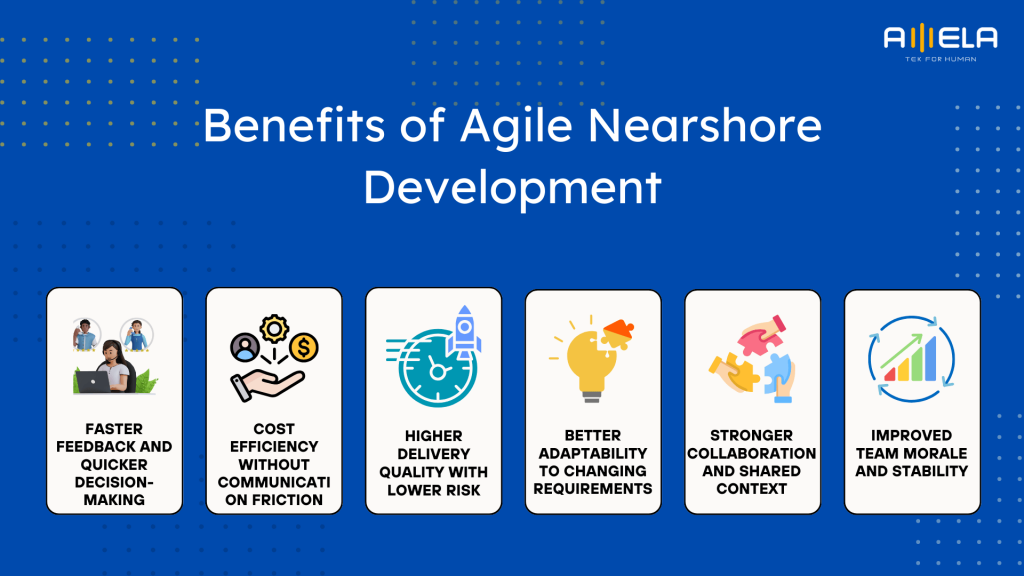
Faster feedback and quicker decision-making
Agile thrives on rapid feedback. Nearshore teams operate within overlapping working hours, which makes daily stand-ups, sprint reviews, and backlog discussions smooth and timely. Questions get answered the same day instead of sitting idle overnight. That speed compounds over time and directly shortens release cycles.
Stronger collaboration and shared context
When teams can talk in real time, misunderstandings drop sharply. Nearshore Agile teams participate more actively in planning and problem-solving because they are not working in isolation. Over multiple sprints, they build product context and act more like an extension of the internal team than an external vendor.
Agile teams overwhelmingly cite better teamwork and communication as key benefits. For example, about 60% of Agile users say their team’s collaboration has improved after adopting Agile. (The BusinessWire report notes “improved collaboration and better alignment” with business goals as top outcomes.)
Better adaptability to changing requirements
Agile assumes change, and nearshore delivery supports that mindset. When priorities shift, teams can realign quickly without long handover delays. This flexibility is especially valuable in fast-moving industries where market, user, or regulatory requirements change often.
Higher delivery quality with lower risk
Frequent iterations, continuous testing, and early stakeholder feedback help catch issues before they grow expensive. Nearshore proximity makes it easier to review work incrementally and address quality concerns early, reducing last-minute surprises before release.
Cost efficiency without communication friction
Nearshore development typically costs less than hiring locally while avoiding many of the coordination challenges of far-off offshore models. Companies get access to skilled engineers at competitive rates without sacrificing collaboration or delivery speed.
Improved team morale and stability
Agile nearshore teams tend to be more engaged because they are closely involved in product decisions and outcomes. This sense of ownership improves retention and continuity, which is critical for long-term projects that require deep product knowledge.
Agile nearshore development works best when collaboration, flexibility, and speed matter. It offers a balanced model that supports Agile principles without the delays and misunderstandings that can slow distributed teams.
>>> Related: Outsourcing Development Team: A Complete Guide
How Agile Works in Nearshore Software Development
Agile works especially well in nearshore software development because time-zone overlap enables fast feedback, shared ownership, and continuous alignment.
When teams can collaborate in real time, Agile principles stop being theory and start delivering results.
Core Agile principles in a nearshore setup
At its core, Agile focuses on short delivery cycles, close collaboration, and constant improvement. Nearshore development strengthens these principles by removing one of Agile’s biggest enemies: delayed communication. With overlapping working hours, nearshore teams can clarify requirements quickly, resolve blockers early, and keep momentum high throughout each sprint.
From experience, nearshore Agile teams behave less like vendors and more like extended product teams. They attend ceremonies regularly, understand business context, and contribute proactively instead of waiting for instructions.
Phase 1: Product discovery and backlog alignment
Agile nearshore projects usually start with collaborative discovery. Product goals, user needs, and technical constraints are discussed openly between the client and the nearshore team. Instead of locking everything upfront, the team builds a prioritized backlog that can evolve over time.
Nearshore proximity makes these discussions far more effective. Workshops, refinement sessions, and roadmap reviews happen live, which helps avoid misinterpretation and sets a shared direction early.
Phase 2: Sprint planning and commitment
In Agile, planning is not about predicting everything—it’s about making realistic commitments. During sprint planning, the nearshore team works closely with product owners to select achievable tasks based on priority and capacity.
Because communication happens in real time, scope questions and dependencies are resolved quickly. This leads to more accurate sprint commitments and fewer mid-sprint surprises.
Phase 3: Iterative development and daily collaboration
This is where Agile nearshore development really shines. Daily stand-ups, quick syncs, and ad-hoc discussions keep work moving smoothly. Issues are raised early, not days later.
Nearshore teams can ask questions, validate assumptions, and adjust implementation details as they build. This tight feedback loop reduces rework and keeps development aligned with actual business needs.
Phase 4: Sprint review and stakeholder feedback
At the end of each sprint, the team demonstrates working software to stakeholders. Feedback is gathered immediately, while context is still fresh. Nearshore teams benefit from being able to discuss changes live instead of relying on long written feedback.
This phase ensures that the product evolves in the right direction and that expectations stay aligned across teams.
Phase 5: Retrospective and continuous improvement
Agile is not just about delivery; it’s about learning. In retrospectives, the team reflects on what worked, what didn’t, and how to improve the next sprint. Nearshore teams participate fully in these discussions, contributing ideas rather than just receiving instructions.
Over time, this builds trust, improves efficiency, and strengthens collaboration across borders.
Why this model works
Agile needs speed, clarity, and human interaction. Nearshore development provides exactly that. By combining Agile principles with geographic and cultural proximity, teams can adapt faster, communicate better, and deliver higher-quality software with less friction.
Agile vs Other Software Development Approaches
Agile stands out because it embraces change and continuous feedback, while traditional models prioritize predictability and upfront planning.
Below is a clear comparison between Agile and Waterfall, focusing on criteria that matter most in real projects—especially in nearshore delivery.
| Criteria | Agile Development | Waterfall Development |
| Planning approach | Iterative and flexible planning that evolves sprint by sprint | Fixed upfront planning with detailed requirements defined at the start |
| Change handling | Welcomes change at any stage based on feedback | Changes are costly and difficult once development begins |
| Delivery style | Frequent, incremental releases of working software | Single final delivery at the end of the project |
| Client involvement | Continuous involvement through reviews and feedback | Limited involvement after initial requirement phase |
| Risk management | Risks identified early through regular testing and demos | Risks often surface late, near project completion |
| Time to value | Faster value delivery with usable features early | Value realized only after full project completion |
| Best suited for | Complex, evolving, or uncertain requirements | Stable, well-defined requirements with low uncertainty |
| Fit for nearshore teams | Excellent fit due to real-time collaboration and feedback loops | Less effective due to rigid phases and delayed communication |
Agile is better suited for modern software development where requirements change and speed matters. Waterfall can still work for projects with fixed scope and low uncertainty, but it lacks the flexibility most digital products need today. In nearshore environments—where collaboration is a key advantage—Agile consistently delivers better outcomes.
Agile in Nearshore Software Development: Step by Step Guide
Agile nearshore delivery succeeds when you design for collaboration first, then enforce execution discipline sprint by sprint. From real-world programs, most failures come from treating Agile as a ceremony checklist instead of an operating model.
Step 1: Align on outcomes, not just Agile terminology
In practice, many teams say “we do Agile” but expect fixed scope and fixed timelines. That mismatch kills momentum early. Before writing a single user story, align on what is flexible (scope, approach) and what is fixed (goals, timelines, constraints). When both sides agree on this contract, Agile stops being a buzzword and starts working.
From experience, a short alignment workshop beats weeks of rework later.
Step 2: Appoint a real product owner with authority
Agile nearshore teams stall when decisions are slow. The product owner must be empowered to prioritize, accept, and reject work without long approval chains. If every question needs escalation, sprint flow breaks.
In strong setups, nearshore engineers interact directly with the product owner, clarify assumptions quickly, and move forward with confidence. This single role often determines whether Agile feels fast or painfully slow.
Step 3: Build a backlog that teams can actually execute
A backlog is not a wish list. Effective backlogs contain small, testable stories with clear acceptance criteria and business context. Nearshore teams need to understand why something matters, not just what to build.
Regular backlog refinement sessions—held live—are critical. They reduce ambiguity early, when changes are cheap, instead of during development, when changes are expensive.
Step 4: Enforce Agile rhythm without over-engineering it
Agile works through consistency. Daily stand-ups, sprint planning, reviews, and retrospectives should happen on schedule and with purpose. Skip them, and alignment erodes. Overcomplicate them, and teams disengage.
From the field, the sweet spot is simple ceremonies with clear intent:
- Stand-ups expose blockers
- Planning sets realistic commitments
- Reviews validate value
- Retrospectives improve how the team works
Nothing more, nothing less.
Step 5: Use time-zone overlap deliberately
Nearshore’s biggest advantage is overlapping working hours—waste it, and you lose the model’s value. Use overlap time for discussions, decisions, and feedback. Push async work (coding, testing) outside that window.
Teams that treat overlap hours as “meeting time” and non-overlap hours as “deep work time” consistently outperform those that mix everything randomly.
Step 6: Measure predictability, not just speed
Velocity alone is a vanity metric. Experienced teams track delivery predictability, defect trends, and cycle time. These metrics reveal whether Agile is reducing risk or simply creating motion.
When issues appear, adjust process in retrospectives. Agile only works if teams are willing to change how they work—not just what they build.
Step 7: Treat Agile as a continuous operating model
Agile implementation is never “done.” Teams evolve, products mature, and priorities shift. Successful nearshore Agile programs revisit roles, workflows, and communication patterns regularly.
From experience, the best teams don’t chase perfect Agile. They focus on clarity, trust, and steady improvement—and let the framework serve the product, not the other way around.
Expert takeaway
Nearshore agile development works when leadership commits to transparency, teams are empowered to decide, and collaboration happens in real time. Get those fundamentals right, and Agile becomes a delivery advantage—not a process burden.
Best Practices in Nearshore Agile Development
Nearshore Agile works best when you design for real collaboration, not just process compliance. From what we’ve implemented and refined over multiple programs, these practices consistently separate high-performing teams from the rest.
- Treat nearshore teams as part of the product team
We’ve learned that nearshore Agile fails the moment teams are treated as “extra capacity.” We involve nearshore engineers in discovery, refinement, and reviews—not just execution. When they understand the business context and user goals, quality improves and rework drops fast.
- Lock in overlapping hours and protect them
Time-zone overlap is the biggest advantage of nearshore delivery, so we use it deliberately. We reserve overlap hours for decisions, discussions, and feedback, and we keep deep focus work outside that window. When overlap time gets eaten by random meetings, Agile momentum slows immediately.
- Keep requirements small, clear, and testable
From experience, large or vague user stories are the fastest way to derail a sprint. We break work into small, well-defined stories with explicit acceptance criteria. This makes planning more accurate and gives nearshore teams the confidence to move fast without constant clarification.
- Make feedback frequent and specific
We don’t wait until the end of a release to give feedback. Sprint reviews are used to validate real progress, not to “show something.” Clear, timely feedback helps teams correct direction early, when changes are still cheap.
- Balance documentation with conversation
We document decisions and requirements, but we never replace conversation with documents. Nearshore Agile works when teams talk through complexity in real time, then capture outcomes briefly and clearly. Over-documentation slows teams down; under-documentation creates confusion later.
- Measure what actually matters
We’ve seen teams obsess over velocity while missing bigger problems. Instead, we track predictability, defect trends, and cycle time. These metrics tell us whether Agile is reducing risk and improving flow—not just increasing activity.
- Invest in trust and continuity
Stable teams outperform rotating teams every time. We prioritize long-term collaboration, shared ownership, and mutual trust. When nearshore teams feel accountable for outcomes—not just tasks—Agile becomes far more effective.
>>> Related: A Comprehensive Guide to Outsourcing IT Project
Nearshore Agile success is less about frameworks and more about behavior. When teams communicate openly, decide quickly, and improve continuously, Agile stops feeling like a process and starts feeling like a competitive advantage.
Challenges of Nearshore Agile Development
Nearshore Agile can unlock speed and alignment—but only if teams actively manage its friction points. From what we’ve seen in delivery, these challenges surface most often and need deliberate handling.
- Alignment gaps despite proximity
Nearshore teams may share time zones, but if product goals, priorities, or definitions of “done” are unclear, misunderstandings still happen—just faster. In practice, we address this by investing heavily in backlog refinement. User stories are kept small, prioritized clearly, and written with explicit acceptance criteria and business context. This shared clarity prevents misalignment early, when changes are cheap, instead of during development, when they are costly.
- Decision latency on the client side
Agile delivery depends on fast decisions, yet progress often stalls when approvals require multiple stakeholders or long internal escalation chains. The most effective solution we’ve seen is empowering a single product owner with real authority to prioritize and accept work. When decisions are made within sprint boundaries, nearshore teams maintain momentum and Agile delivery stays predictable.
- Over-reliance on meetings
Because nearshore collaboration feels easy, teams tend to over-schedule. Too many syncs eat into build time and exhaust the team. We manage this by treating overlapping hours as a limited, valuable resource. High-impact discussions, planning, and reviews happen live, while routine updates move to async channels. This balance protects focus time and keeps delivery flowing.
- Cultural assumptions and communication style
Differences in how feedback is given, how risks are raised, or how decisions are challenged often go unspoken. We’ve learned to address this early by setting clear collaboration norms—how to escalate issues, how to disagree constructively, and how decisions are finalized. Making these expectations explicit prevents small issues from staying hidden until they become blockers.
- Scaling complexity as teams grow
Finally, scaling complexity as teams grow can erode the benefits of nearshore Agile. Small, focused teams collaborate smoothly, but as scope and headcount increase, coordination overhead rises quickly. The solution is planning for scale early by introducing clear team boundaries, shared technical standards, and strong technical leadership. This preserves velocity and avoids painful reorganization later in the project lifecycle.
The practical takeaway is clear: nearshore agile software development is not automatic. Teams that invest in alignment, empower decision-making, protect focus time, and plan for growth turn nearshore Agile into a lasting advantage. Teams that ignore these areas see the benefits fade fast—regardless of time-zone proximity.
Build Your Development Team with AMELA Technology
Build your team with Agile development at AMELA Technology—whether you need offshore or nearshore delivery, flexible IT outsourcing engagement models, or dedicated engineers at competitive rates. We support Agile, Scrum, and Waterfall projects, adapting our approach to your product stage, timeline, and risk profile.
From end-to-end delivery to hiring experienced developers to extend your team, AMELA helps you move fast without losing control. Choose the model that fits—dedicated teams, team extension, or project-based—and let us handle execution while you focus on outcomes.
Conclusion
Nearshore agile software development works best when teams focus on collaboration, clear ownership, and continuous improvement.
When implemented thoughtfully, it enables faster feedback, lower risk, and stronger alignment between business and engineering. If you’re exploring nearshore agile software development for your next project, choosing the right partner and engagement model can make all the difference.