
 Mar 28, 2026
Table of Contents
Outsource PHP web development is often a practical choice for companies that need to build or improve PHP-based websites without expanding an in-house team too quickly.
PHP still powers many business websites, CMS platforms, customer portals, and custom web applications. That is why companies often have to decide whether to hire internally, build a PHP development team, or work with an external partner. For many, outsourcing is the more flexible option, especially when they need reliable delivery and broader web development support without adding long-term overhead.
What Is Outsourcing PHP Development?
Outsourcing PHP development means hiring an external team or partner to build, maintain, or improve PHP-based websites and web applications instead of handling all development in-house.
In simple terms, a company chooses outsourcing when it needs PHP expertise, faster delivery, or more flexible resourcing without building a full internal team. That support can cover different needs, from a small website refresh to a full web platform, ongoing maintenance, backend development, or performance optimization.
In our view, outsourcing PHP development is usually less about replacing an internal team and more about filling a gap. Some businesses need experienced developers for a short-term project. Others need a long-term partner who can handle delivery more consistently. PHP is still widely used for business websites, custom platforms, CMS-based systems, and web applications, so outsourcing often becomes a practical way to access that expertise without slowing the project down.
Why PHP for Web Development?
PHP remains a practical choice for web development because it is mature, widely supported, and still deeply embedded in the web ecosystem. The official PHP site describes it as a language especially suited to web development, while W3Techs reports that PHP is used by 71.7% of websites whose server-side language is known as of March 24, 2026. In real projects, that matters because it gives companies access to a large talent pool, proven frameworks, strong CMS support, and a lower-risk path for building or maintaining business websites, portals, and web applications.
Why Choose Outsourcing for PHP Web Development?
Outsourcing web development helps companies access the right skills faster, control delivery costs more flexibly, and move projects forward without building a full in-house team from scratch.
Faster access to PHP expertise
PHP is common, but strong PHP delivery is not just about knowing the language. Projects often need experience with frameworks, CMS platforms, backend architecture, API integration, security, and long-term maintenance. Outsourcing makes it easier to bring in that experience without spending months hiring internally.
More flexible team setup
Not every project needs a permanent team. Some companies only need a few developers for a rebuild, migration, or feature rollout. Others need steady support over a longer period. Outsourcing gives more room to scale the team up or down based on the actual workload.
Lower hiring pressure
In-house hiring takes time, and for many businesses, the challenge is not only finding developers but finding people who can join quickly and contribute with minimal ramp-up. With outsourcing, the team structure is usually ready much earlier, which helps projects start sooner.
Better fit for maintenance-heavy work
A lot of PHP projects are not greenfield builds. They are existing websites, CMS-based systems, customer portals, or internal platforms that already need fixes, upgrades, or performance work. Outsourcing often works well here because companies can bring in support without disrupting the rest of the business.
Practical cost control
Building an internal team comes with salary, hiring, onboarding, management, and retention costs. Outsourcing does not automatically mean “cheap,” but it often gives companies a clearer way to match spending to actual project scope instead of carrying fixed internal overhead too early.
Easier access to broader delivery support
PHP work rarely exists on its own. A project may also need frontend development, QA, DevOps, UI design, or business analysis. One advantage of outsourcing is that companies can often get a more complete delivery setup instead of solving every role one by one.
Useful when speed matters
We often see outsourcing make the most sense when the business already knows what it needs and wants to move without delay. If the goal is to launch, upgrade, stabilize, or extend a PHP-based product quickly, an experienced external team can reduce a lot of startup friction.
Sometimes the internal team is overloaded. Sometimes the company is between hires. Sometimes the product has outgrown the current setup. In those cases, outsourcing is less about strategy on paper and more about keeping momentum while the business catches up.
When to Outsource PHP Web Development
PHP web development is worth outsourcing when a company needs faster delivery, stronger technical support, or a more flexible way to manage web projects without building a full internal team.
- The website matters, but it is not the main product
Many companies rely on their website for lead generation, customer access, bookings, or content management, but the website is still not the core thing they sell. In that situation, outsourcing is often more practical than building a permanent in-house PHP team just to keep the site moving.
- Existing PHP systems already shape the project
A lot of websites already run on WordPress, Laravel, or older custom PHP codebases. If the goal is to improve performance, redesign the frontend, add new functions, or clean up technical debt without rebuilding from scratch, external PHP support can be the most efficient route.
- Internal capability is uneven
Sometimes the business already has product people, designers, or frontend developers, but lacks solid PHP experience on the backend side. Outsourcing helps close that gap without forcing the whole project to slow down while the company searches for full-time hires.
- Maintenance is the real workload
Not every PHP project is a fresh build. In many cases, the bigger challenge is ongoing work: plugin updates, bug fixes, API changes, form issues, security patches, CMS maintenance, and server-related problems. That kind of support is often easier to outsource than manage internally.
- Delivery speed matters more than team building
If the business needs to launch quickly, migrate an old site, stabilize a fragile platform, or release new features on a tight web development timeline, outsourcing can reduce delay. Hiring internally first may take longer than the actual project window allows.
- The website directly affects revenue or operations
Some PHP websites are business-critical. They may support ecommerce, booking flows, customer portals, lead capture, or internal workflows. If downtime, broken forms, or unstable performance can hurt the business directly, experienced external support becomes much easier to justify.
- Legacy code is becoming a risk
Older PHP platforms often become difficult to update, especially if the codebase has grown without structure or depends too heavily on one developer. Outsourcing can help bring in people who know how to work with legacy systems, reduce fragility, and make future changes safer.
- The PHP work is only one part of a bigger web project
Many web projects also need frontend updates, QA, DevOps, SEO improvements, UI adjustments, or CMS restructuring. In that case, outsourcing works well because the company can get broader delivery support around the PHP work instead of solving each role separately.
- Flexibility is more useful than a fixed team
Some companies only need help for a redesign, a migration, a short feature rollout, or a few months of maintenance. Outsourcing gives them a way to match support to the actual workload rather than carrying full-time internal cost the whole time.
In practice, outsourcing PHP web development makes the most sense when the website needs to keep moving, but building and managing an in-house PHP setup would create more friction than value.
Steps to Outsource PHP Web Development
A good PHP outsourcing process starts before vendor outreach. The strongest projects usually come from clear internal thinking, not from sending vague requirements to multiple agencies and hoping one of them figures it out.
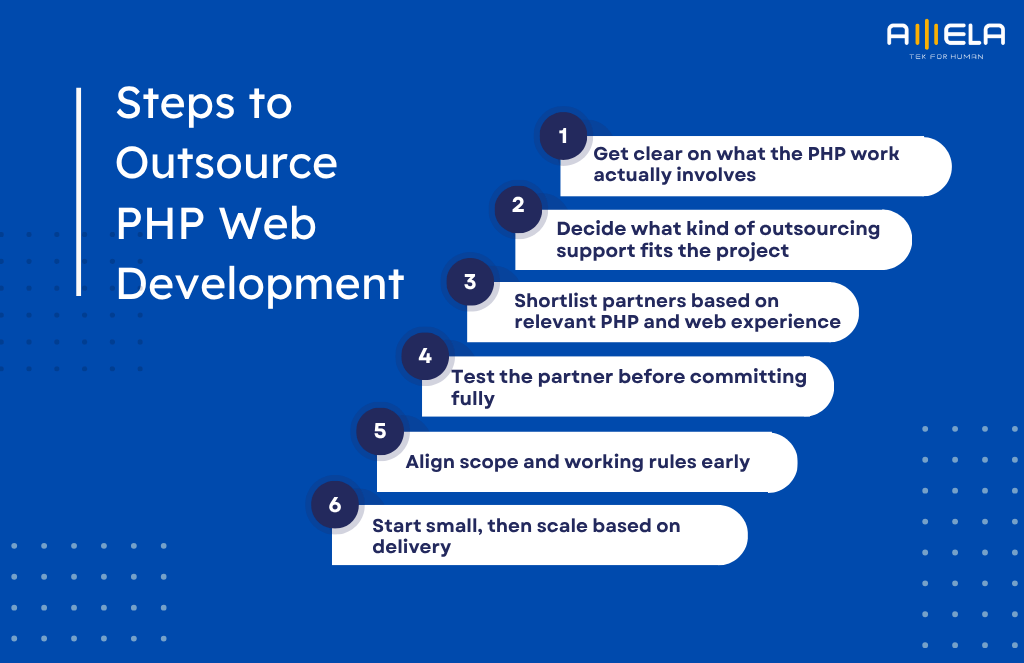
1. Get clear on what the PHP work actually involves
Before looking for an external development team, the company needs to define the real shape of the project. That sounds obvious, but this is where many outsourcing efforts start to drift. “We need PHP developers” is not a useful brief. “We need to rebuild a Laravel-based customer portal, clean up slow backend logic, and support ongoing maintenance after launch” is much easier for a partner to respond to properly.
For web projects, the first step is usually to separate the visible need from the technical one. A company may think it needs a website redesign, but the real issue might be messy WordPress structure, unstable plugins, poor backend performance, or a codebase that no one wants to touch anymore. The clearer that picture is, the easier it becomes to find the right delivery model.
It helps to define a few things early: what platform the site is built on, what needs to change, what must stay, what problems are already happening, and whether the project is a one-time build or a longer support need. In our experience, outsourcing becomes much smoother when the company can explain the current situation honestly, including technical debt, content gaps, workflow issues, and internal constraints. A rough but accurate brief is far more useful than a polished one that hides the real problems.
2. Decide what kind of outsourcing support fits the project
Not every PHP outsourcing setup should look the same. Some companies need one or two experienced developers to support an internal team. Others need a full delivery partner who can handle planning, development, QA, deployment, and post-launch support. If that is not decided early, vendor conversations tend to go in circles.
For a web-specific PHP project, the right model usually depends on who owns the product direction and how much of the execution the company can manage internally. If the business already has a product owner, clear priorities, and a designer or frontend team, it may only need backend-focused PHP support. If the project is broader, such as rebuilding a site, cleaning up architecture, improving CMS flexibility, and handling launch end to end, then a more complete outsourcing team often makes more sense.
This step also affects budget and expectations. A company that only needs coding support should not pay for a full-service structure it will not use. On the other hand, a business with no internal technical lead may struggle if it hires individual developers and expects them to self-organize the entire project. Good outsourcing decisions usually come from matching the delivery model to the company’s actual operating reality, not to an idealized version of it.
3. Shortlist partners based on relevant PHP and web experience
Once the project scope and support model are clearer, the next step is to narrow the field. This is where companies often lose time by reviewing too many generalist vendors. A better approach is to focus on partners who have real experience with the kind of PHP web work the project needs.
That does not just mean asking whether they know PHP. It means looking at whether they have worked with the same kind of stack, site structure, or business situation. A team that is strong in Laravel product development may not be the best fit for a WordPress-heavy website migration. A vendor that mainly handles brochure sites may not be ready for a PHP-based booking platform or customer portal. The fit matters more than the logo list.
We usually suggest looking for evidence in four vendor selection areas: technical relevance, web project experience, communication quality, and delivery maturity. Can they speak clearly about platforms like Laravel, WordPress, or custom PHP systems? Do they understand web-specific concerns such as page performance, CMS maintainability, SEO structure, forms, integrations, and ongoing support? Do they ask useful questions, or do they jump straight to quoting? That early behavior often tells you a lot. A strong partner usually tries to understand the problem before trying to win the deal.
4. Test the partner before committing fully
Before moving forward, the company should check whether the partner can actually handle the kind of PHP web work involved, not just talk about it well in sales conversations.
Focus on a few things:
- How they approach the current PHP stack
- How they identify risks in the codebase or website structure
- How they handle testing, staging, and deployment
- How clearly they communicate technical trade-offs
- How their team works day to day
For PHP web projects, this step matters because many vendors can build pages, but fewer can deal well with legacy code, plugin conflicts, backend issues, or maintainability problems. We usually pay close attention to how they answer practical questions. Strong partners tend to ask smart follow-up questions and explain risks early instead of making the project sound easier than it is.
5. Align scope and working rules early
Once an onshore/ nearshore or offshore partner is selected, the next priority is making sure both sides are aligned before development begins. A lot of outsourcing issues come from unclear assumptions, not weak coding.
That alignment should cover:
- What is included in scope
- What is not included
- Who owns design, content, hosting, and approvals
- How feedback will be shared
- How bugs, change requests, and priorities will be handled
- What “done” actually means
For web-specific PHP projects, this helps a lot because the work often touches both technical and non-technical tasks. A redesign may depend on content. A launch may depend on hosting access. A backend update may affect forms, tracking, or SEO structure. If ownership is unclear, progress slows down quickly.
6. Start small, then scale based on delivery
It is usually better to begin with a defined first phase instead of handing over everything at once. That gives the company a chance to see how the partner performs in real delivery conditions.
A good starting scope could be:
- A technical audit
- A maintenance sprint
- A website migration phase
- A backend cleanup task
- One key feature or module
This kind of setup makes it easier to evaluate the relationship through actual work. You can see how the team handles existing PHP code, how they communicate blockers, how stable their QA process is, and whether they can work well with the site as it really is. If that first phase goes well, expanding the engagement becomes much safer and more practical.
Challenges in Outsourcing PHP Website Development and How to Solve Them
The biggest risks in outsourcing software development usually come from unclear scope, weak communication, legacy code surprises, and mismatched expectations around ownership, speed, and quality.
Unclear project scope
A lot of PHP website projects start with a rough goal like redesign the site, improve performance, or rebuild the backend. That sounds fine at first, but vague scope creates problems quickly once development begins.
How to solve it: Define the actual work in concrete terms before kickoff. That should include the current platform, pages involved, integrations, known issues, must-have improvements, and what is outside scope. For PHP web projects, it helps to separate visual changes from backend work, because those often get mixed together too easily.
Legacy code and hidden technical debt
This is one of the most common PHP-specific issues. Older websites may run on outdated frameworks, custom code, unstable plugins, or heavily modified CMS setups. On paper, the project may look simple. In reality, small changes can trigger bigger problems.
How to solve it: Start with a technical review or audit before committing to full delivery assumptions. We usually find that a short discovery phase saves a lot of pain later. The team needs to understand code quality, dependency risk, hosting setup, and maintainability before promising exact timelines.
Communication gaps between business and technical teams
Website projects often sit in the middle of marketing, operations, and engineering. The outsourced team may understand the code, while the client team understands the business need, but the link between those two sides is sometimes weak.
How to solve it: Create a simple working rhythm early. Decide who gives feedback, who approves changes, how priorities are updated, and how blockers are escalated. One clear point of contact on each side usually helps more than large group chats with too many voices.
Weak ownership of content, design, or inputs
In many outsourced web projects, development gets blamed for delays that actually come from missing content, late approvals, or unclear design direction. PHP websites often depend on these inputs more than teams expect.
How to solve it: Set ownership clearly from the start. Be specific about who provides copy, visuals, SEO requirements, access credentials, and final approvals. It sounds basic, but this is where many projects quietly lose momentum.
Quality issues that appear late
A website can seem fine in staging and still fail in live use. PHP sites often run into issues with forms, plugin behavior, mobile responsiveness, caching, tracking scripts, or browser inconsistencies after launch.
How to solve it: Agree on QA expectations early. That should cover device testing, browser testing, form testing, broken-link checks, staging review, and launch checklist responsibilities. For business-critical sites, post-launch support should be part of the plan, not an afterthought.
Overdependence on one developer or vendor
Some outsourced PHP projects become too dependent on one person who understands the codebase. That may feel efficient at first, but it creates long-term risk if that person becomes unavailable.
How to solve it: Ask for better documentation, code review practices, shared access, and structured handover processes. Even in a small team setup, the project should not live only in one developer’s head.
Mismatch between speed and maintainability
Some vendors move fast by taking shortcuts. The website gets delivered, but the code is messy, updates become harder, and future changes cost more than expected. PHP projects are especially vulnerable to this when the business is under time pressure.
How to solve it: Do not evaluate the partner only on launch speed. Ask how they structure code, manage plugins or dependencies, document changes, and prepare the site for future updates. Fast delivery is useful, but not if it leaves behind a fragile system.
Limited flexibility after launch
A startup or growing business may need to revise pages, change positioning, add new sections, or update flows quickly after launch. Some outsourced builds are too rigid, which makes every small update slower than it should be.
How to solve it: Choose a setup that matches the pace of the business. If the website is likely to change often, maintainability and editability should be part of the build decision from the start. A site that is easy to update usually creates more long-term value than one that is overly customized too early.
Conclusion
Choosing to outsource PHP web development is rarely just about reducing cost. More often, it is about gaining the right technical support, keeping web projects moving, and avoiding the delay that comes from trying to build everything internally under pressure. For companies working with WordPress, Laravel, custom PHP systems, or older websites that need improvement, outsourcing can offer a more flexible path to delivery.
At the same time, outsourcing only works well when the setup is thoughtful. Clear scope, realistic expectations, strong communication, and the right IT outsourcing company all make a big difference. In our view, companies get the best results when they treat outsourcing as a way to strengthen execution, not just hand work off. With the right structure in place, outsource PHP web development can become a reliable way to build, maintain, and scale web platforms with less friction over time.