
 Feb 1, 2026
Table of Contents
Outsourced product development has become a common strategy for companies looking to build, scale, or modernize digital products efficiently. As internal teams face increasing pressure around speed, skills, and capacity, many organizations turn to outsourcing product development to stay competitive without compromising quality.
This guide draws from real project experience and credible market insights to explain what outsourcing product development involves, when it makes sense, its benefits and challenges, how the process works, typical costs, common mistakes to avoid, and how to choose the right partner—so you can make informed, realistic decisions rather than relying on theory alone.
Key Takeaways
-
Outsourcing product development is a strategic delivery choice, not just a cost-saving tactic, and works best when aligned with clear product goals and ownership.
-
The right engagement model matters—dedicated teams, project-based delivery, or hybrid setups should match your product’s maturity and level of uncertainty.
-
Speed and access to specialized expertise are the primary advantages, especially for products requiring fast iteration or niche technical skills.
-
Costs are driven by complexity, scope clarity, and team structure, not just hourly rates or location.
-
Common outsourcing failures stem from weak governance, unclear ownership, and poor onboarding, rather than technical capability.
-
Successful outsourcing relies on partnership, transparency, and process discipline, enabling external teams to contribute meaningfully to long-term product success.
What Is Outsourced Product Development
Outsourced product development means hiring an external team or partner to design, build, and deliver a product on your behalf, instead of relying solely on internal resources. It’s not just “contracting work out”—it’s about partnering with outside experts who can contribute expertise, capacity, and process discipline to achieve your product goals.
What many companies discover—especially quickly growing startups and mid-sized enterprises—is that outsourcing is not a fallback for missing internal skills. It’s a strategic way to accelerate delivery, improve product quality, and reduce operational risk, particularly in fast-moving markets where speed and adaptability are competitive advantages.
Outsourced Software Product Development Market Size
Outsourced product development is growing fast, backed by strong macro-level data from the global IT and software outsourcing markets. While research firms rarely isolate it as a standalone category, multiple reliable indicators clearly show its scale and momentum.
Key data points:
- Global IT outsourcing market reached ~USD 745B in 2024 and is projected to reach USD 1,219.31 billion by 2030, driven by demand for software, cloud, and digital product delivery
- Software development outsourcing market, where outsourced product development is a core component, is estimated at ~USD 535B in 2024 and forecast to grow steadily through the next decade.
- Research firms consistently note that product-oriented engagements (platforms, custom systems, SaaS development outsourcing) are among the fastest-growing segments within software outsourcing, as companies outsource not just coding but full product ownership. (Source: Mordor Intelligence)
What this means: outsourcing product development is no longer a niche cost-saving tactic. It has become a mainstream delivery model used by startups, scale-ups, and enterprises to build, scale, and evolve digital products faster than internal teams alone can manage.
When You Need to Outsource Product Development
Outsourced product development becomes relevant when internal constraints begin to slow down delivery, increase risk, or limit product quality. The scenarios below highlight where outsourcing creates the most impact.
- Time-to-market pressure
Rapid delivery timelines often outpace internal hiring and onboarding capacity. Outsourcing enables faster project kickoff, parallel execution, and quicker releases without lowering engineering standards.
- Specialized skill gaps
Modern products frequently require expertise in cloud architecture, DevOps, security, or data engineering. External teams provide immediate access to these skills without long-term recruitment overhead.
- Overloaded internal teams
Internal engineers are often tied up with maintenance and operational work. Outsourcing allows new product initiatives to move forward while core teams stay focused on strategic priorities.
- Need for cost flexibility
Fixed headcount introduces long-term financial commitment. Outsourced product development converts costs into flexible, phase-based investment that can scale up or down with product needs.
- New product or market exploration
Early-stage products and market expansion carry uncertainty. Outsourcing supports faster experimentation and validation while limiting exposure if assumptions change.
- Lack of delivery maturity
Experienced outsourcing partners bring proven Agile processes, QA discipline, and delivery governance, helping organizations raise execution quality without building systems from scratch.
In practice, outsourcing works best when it removes structural bottlenecks—capacity, expertise, speed, or process—that internal teams cannot address efficiently on their own.
Benefits of Outsourcing Product Development
Outsourcing product development delivers measurable advantages when it is used to strengthen execution, reduce structural risk, and accelerate learning—not merely to cut costs. Below are the key benefits, explained with depth and practical context.
Faster Time-to-Market and Shorter Feedback Loops
One of the most immediate benefits is speed. Outsourced product teams are typically pre-formed, already aligned on Agile delivery, and able to start execution within weeks rather than months. This allows companies to compress discovery, build, and release cycles, which is critical when validating product–market fit or responding to competitive pressure.
In practice, faster delivery also means earlier user feedback, enabling teams to correct assumptions before they become expensive architectural decisions. This speed advantage compounds over multiple iterations.
Access to Proven Product and Engineering Expertise
Modern product development requires more than generalist developers. It demands experience in system design, scalability, security, DevOps automation, and user-centered design. Outsourcing provides access to teams that have already built and scaled similar products, reducing trial-and-error risk.
Instead of learning through mistakes on a live product, companies leverage pattern knowledge—what works, what breaks at scale, and where technical debt usually appears.
Flexible Scaling Without Long-Term Hiring Risk
Product development workloads fluctuate across phases: discovery, MVP, growth, optimization, and maintenance. Outsourcing allows organizations to scale teams up or down based on real demand, rather than locking into permanent headcount.
This flexibility is especially valuable for:
- Early-stage products with uncertain trajectories
- Growth-stage platforms facing temporary demand spikes
- Enterprises running multiple initiatives in parallel
It keeps delivery responsive while maintaining financial discipline.
Improved Cost Control and Budget Predictability
Outsourcing does not automatically mean “cheaper,” but it does mean more predictable cost structures. Engagements are typically scoped by milestones, capacity, or outcomes, which makes budgeting clearer than incremental internal hiring.
This predictability is particularly important for product leaders managing long roadmaps, where cost overruns often come from scope creep rather than hourly rates.
Stronger Delivery Processes and Quality Standards
Established outsourcing partners bring mature delivery practices that many organizations struggle to institutionalize internally—Agile planning discipline, QA automation, CI/CD pipelines, documentation standards, and transparent reporting.
These practices reduce defects, improve release reliability, and create repeatable delivery performance, especially for teams that previously relied on informal or ad-hoc processes.
Reduced Execution and Technical Risk
Experienced product teams have already encountered common failure modes: over-engineered MVPs, brittle architectures, poor scalability decisions, or unclear ownership boundaries. Outsourcing transfers part of that execution risk to teams that know how to avoid these traps.
Over time, this results in:
- Fewer rewrites
- Lower long-term maintenance costs
- More stable product evolution
Greater Focus on Core Product Strategy
By outsourcing execution-heavy work, internal teams can focus on what they uniquely own: product vision, customer discovery, prioritization, and business alignment. This separation of concerns improves decision quality and reduces leadership bandwidth drain.
Instead of managing day-to-day implementation details, stakeholders spend more time on direction, validation, and outcomes.
Bottom line: outsourcing product development works best when it is used to enhance delivery capability, speed, and resilience. When structured as a partnership rather than a task handoff, it becomes a strategic lever for building stronger products with less friction and lower long-term risk.
Disadvantages of Outsourcing Product Development
Outsourced software product development delivers clear benefits, but it also introduces risks that must be understood and managed deliberately. Most failures occur not because outsourcing is flawed, but because expectations, governance, or execution models are poorly defined.
Below are the key disadvantages, analyzed from a delivery and product-management perspective.
>>> Related: IT Project Outsourcing Guide
Reduced Direct Control Over Day-to-Day Execution
Outsourcing inherently adds distance between product owners and the development team. Decisions that would normally happen informally inside an internal team require clearer processes, documentation, and communication cycles.
Without strong product ownership and decision clarity, this can lead to:
- Slower feedback loops
- Misaligned priorities
- Over-reliance on written specifications
This risk increases when roles and escalation paths are not clearly defined upfront.
Communication and Context Gaps
External teams do not automatically share your company’s institutional knowledge, domain nuance, or customer context. If discovery and onboarding are rushed, teams may execute correctly against incomplete understanding.
Common consequences include:
- Features that meet requirements but miss intent
- Rework due to misunderstood assumptions
- Increased clarification cycles
This is why product context transfer is often more critical than technical onboarding.
Time Zone and Cultural Differences
Distributed teams may operate across different time zones and working cultures. While this can enable extended delivery hours, it also introduces coordination complexity.
Challenges often appear in:
- Scheduling real-time discussions
- Decision turnaround time
- Differences in communication styles or expectations
These issues are manageable, but only with intentional overlap planning and communication norms.
Dependency on the External Partner
Over time, deep reliance on an outsourced team can create dependency risks, particularly if knowledge transfer, documentation, or internal capability development is neglected.
This may result in:
- Reduced internal visibility into the product
- Difficulty transitioning work in-house or to another vendor
- Higher switching costs
Mitigating this requires proactive knowledge sharing and architectural transparency.
Quality Variability Across Vendors
Not all outsourcing providers operate at the same level of product maturity. Some teams focus on task completion rather than outcome ownership, which can lead to superficial delivery.
Risks include:
- Accumulating technical debt
- Inconsistent quality standards
- Short-term delivery at the expense of long-term maintainability
Vendor selection and delivery governance directly determine whether this becomes an issue.
Security and IP Considerations
Sharing product roadmaps, source code, and customer data with external teams introduces security and intellectual property risks if safeguards are weak.
These risks are heightened when:
- Contracts lack clear IP ownership clauses
- Access controls are poorly managed
- Security practices are not audited
Strong legal frameworks and technical controls are essential, especially for regulated industries.
In summary, the disadvantages of outsourcing product development are real but predictable. When companies approach outsourcing as a tactical shortcut rather than a structured partnership, these risks surface quickly. When governance, ownership, and communication are designed intentionally, most drawbacks can be minimized or avoided entirely.
Outsourcing Product Development Process
A successful outsourced product development initiative follows a clear, staged process. From experience, problems rarely come from outsourcing itself—they come from skipping steps, rushing alignment, or choosing the wrong engagement model too early.
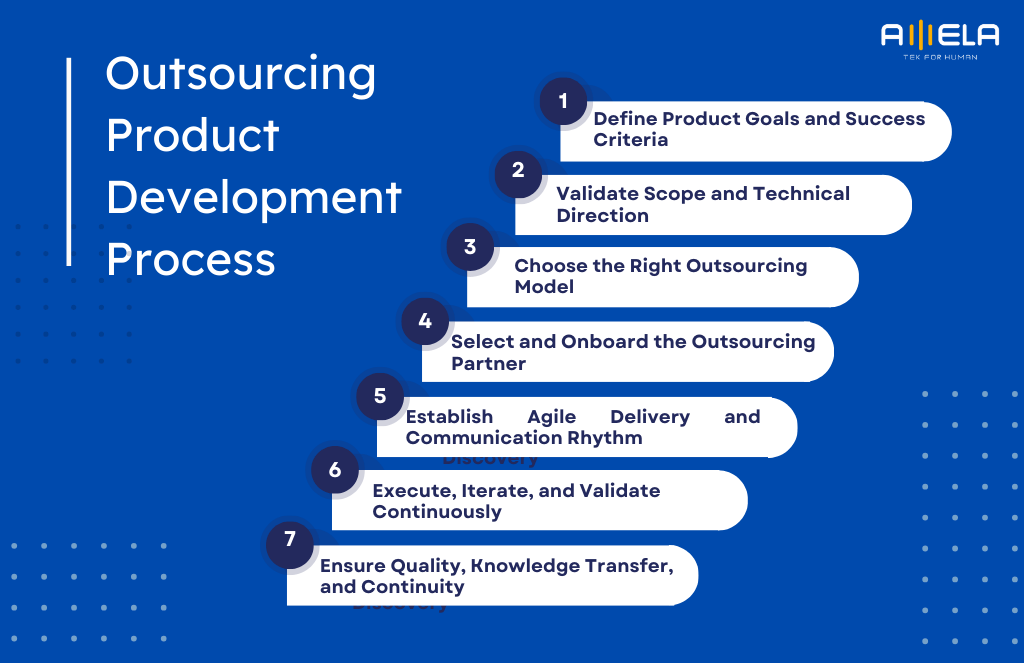
Below is a practical, end-to-end process that reflects how outsourced product development actually works in real projects.
1. Define Product Goals and Success Criteria
Before involving any external team, product owners need clarity on why the product exists and what success looks like. This does not require a perfect specification, but it does require alignment on business objectives, target users, core problems, and measurable outcomes.
At this stage, strong teams focus on:
- Product vision and value proposition
- Target users and priority use cases
- High-level scope boundaries and constraints
Clear intent early reduces ambiguity later, especially when teams are distributed.
2. Validate Scope and Technical Direction
Once goals are clear, the next step is translating intent into a feasible delivery plan. This includes defining high-level architecture, identifying technical risks, and deciding what must be built now versus later.
In practice, this is where many outsourcing engagements succeed or fail. Early technical validation prevents over-engineering MVPs or underestimating scalability needs.
3. Choose the Right Outsourcing Model
Selecting the right outsourcing model is a structural decision that shapes communication, accountability, and cost. The model should reflect product maturity, uncertainty level, and internal involvement—not just budget.
Common outsourcing models compared:
| Model | Description | Best For | Trade-offs |
| Dedicated Team | Long-term external team works as an extension of your organization | Ongoing product development, evolving roadmaps | Requires strong product ownership |
| Project-Based | Fixed scope, timeline, and deliverables | Well-defined products or MVPs | Less flexibility for change |
| Staff Augmentation | External specialists join internal teams | Skill gaps, temporary scaling | Higher coordination effort |
| Hybrid Model | Combination of internal team + outsourced delivery | Complex products with internal oversight | More governance required |
From experience, teams often default to project-based models too early. Products with uncertainty usually benefit more from dedicated or hybrid approaches.
4. Select and Onboard the Outsourcing Partner
IT vendor selection goes beyond technical skill. Strong partners demonstrate product thinking, communication discipline, and delivery transparency—not just coding ability.
Onboarding should include:
- Product and domain walkthroughs
- Access to documentation, tools, and environments
- Alignment on working agreements and escalation paths
This phase sets the tone for trust and collaboration.
5. Establish Agile Delivery and Communication Rhythm
Most outsourced product development today runs on Agile or Agile-hybrid workflows. What matters is not the framework name, but the operating rhythm.
Effective setups include:
- Regular sprint planning and reviews
- Clear backlog ownership
- Frequent demos and feedback loops
This cadence keeps external teams aligned with evolving priorities and reduces surprise late in the cycle.
6. Execute, Iterate, and Validate Continuously
Execution is not a linear build phase. Features are developed, tested, reviewed, and refined in short cycles. Feedback—whether from stakeholders, users, or data—feeds directly into prioritization.
Teams that succeed treat outsourced partners as collaborators in problem-solving, not just delivery engines.
7. Ensure Quality, Knowledge Transfer, and Continuity
As the product stabilizes, focus shifts to sustainability. This includes documentation, testing coverage, architectural clarity, and handover readiness.
Key activities include:
- QA and performance validation
- Knowledge sharing and documentation
- Planning for scaling, maintenance, or partial internalization
Ignoring this step often leads to long-term dependency or brittle systems.
Common Mistakes in Outsourcing Product Development
Most failures in product development outsourcing don’t come from poor engineering—they come from structural and decision-making mistakes made early. Below are the most common pitfalls we see, along with why they happen in practice.
- Treating Outsourcing as Task Delegation Instead of Product Ownership
A frequent mistake is viewing outsourced teams as executors of predefined tasks rather than contributors to product outcomes. When vendors are handed static requirements with no context, delivery becomes mechanical and misaligned with real user needs.
Successful engagements give external teams visibility into why features matter, not just what to build. Product ownership cannot be outsourced, but product thinking should be shared.
- Starting with Overly Rigid or Incomplete Requirements
Teams often try to “lock everything down” before development begins, or the opposite—start with vague ideas and no prioritization. Both extremes create friction once real constraints surface.
Strong product teams define intent, constraints, and priorities early, while allowing details to evolve through iteration and feedback.
- Choosing a Vendor Based Primarily on Cost
Cost-driven selection often leads to hidden trade-offs in quality, communication, and long-term maintainability. Lower hourly rates can quickly be offset by rework, delays, or technical debt.
In practice, the most sustainable partnerships balance cost with delivery maturity, domain experience, and accountability.
- Selecting the Wrong Engagement Model
Using a fixed-scope project model for an evolving product—or a dedicated team for a short, well-defined build—creates misaligned incentives. This often leads to scope disputes, change friction, or inefficient team utilization.
The IT engagement model should match product uncertainty and internal involvement, not procurement convenience.
- Weak Product Ownership on the Client Side
Outsourced teams still need clear decision-makers. When product ownership is fragmented or unavailable, teams lose direction and velocity drops.
Consistent prioritization, timely feedback, and empowered decision-making are essential—even with the best external teams.
- Underestimating Onboarding and Context Transfer
Teams are often expected to “start coding” immediately. Without proper domain walkthroughs, architecture context, and business understanding, early work frequently requires revision.
Investing time upfront in onboarding significantly reduces downstream friction and rework.
- Poor Communication Cadence and Feedback Discipline
Irregular check-ins or delayed feedback create alignment drift. Small misunderstandings compound over time, turning into major course corrections late in the cycle.
Regular demos, clear escalation paths, and short feedback loops keep delivery predictable.
- Ignoring Knowledge Transfer and Long-Term Ownership
Some organizations focus only on delivery milestones and neglect documentation, architecture clarity, and internal knowledge sharing. This creates dependency and limits future flexibility.
Planning for sustainability early ensures smoother scaling, maintenance, or partial internalization later.
In summary, outsourcing product development fails when it’s treated as a shortcut rather than a structured partnership. Avoiding these mistakes requires clarity, intentional governance, and continuous collaboration—far more than technical execution alone.
Top outsourced product development companies
The right outsourced product development partner combines product thinking, engineering depth, and delivery discipline—not just development capacity.
The table below compares five well-known providers that are frequently selected for end-to-end product development projects, across startups, scale-ups, and enterprises.
| Company | Core Strength | Delivery Model | Best For | Typical Engagement |
| AMELA Technology | Product-oriented engineering + Agile delivery | Dedicated team, hybrid, project-based | SaaS, enterprise platforms, long-term products, Start-ups | Full product lifecycle (discovery → scale) |
| ThoughtWorks | Strong product strategy & Agile consulting | Project-based, long-term partnership | Enterprises undergoing digital transformation | Complex, large-scale systems |
| EPAM Systems | Enterprise-grade engineering & architecture | Dedicated teams, managed delivery | Large enterprises, regulated industries | High-complexity product platforms |
| Intellectsoft | Custom product development & UX | Project-based, hybrid | Mid-market digital products | MVPs and platform builds |
| Netguru | Design-driven product delivery | Dedicated teams, project-based | Startups, growth-stage products | MVP to growth phase |
What to note:
- Product-centric delivery: AMELA Technology and ThoughtWorks emphasize product thinking alongside execution, reducing rework and alignment gaps.
- Enterprise scale: EPAM Systems excels in large, complex environments where governance and architecture are critical.
- Speed and flexibility: Netguru and Intellectsoft are often chosen for fast MVPs or focused product initiatives.
Key takeaway: there is no universally “best” outsourcing product development company. The right choice depends on your product maturity, complexity, and how closely you want the partner involved in product decisions—not just implementation.
Tips for Choosing the Right Product Development Company for Your Project
Choosing a product development partner is less about who writes code fastest and more about who can consistently make the right decisions under uncertainty. Based on real delivery experience, the tips below help separate short-term vendors from long-term product partners.
- Look for Product Thinking, Not Just Engineering Capacity
Strong product development companies don’t wait for perfect requirements. They ask questions about users, trade-offs, and success metrics. This signals that the team understands outcomes, not just tasks.
During evaluation, pay attention to whether they challenge assumptions respectfully rather than agreeing with everything you say.
- Assess Experience with Similar Product Stages
Building an MVP, scaling a platform, and modernizing a legacy system require very different skill sets. A partner that excels in one stage may struggle in another.
Ask for examples that match your product’s current maturity, not just impressive end results.
- Evaluate Delivery Process and Transparency
Reliable partners can clearly explain how work is planned, tracked, reviewed, and adjusted. This includes sprint cadence, reporting structure, and how risks are surfaced early.
If the delivery process feels vague, execution issues often follow.
- Clarify Ownership and Decision-Making Early
Product success depends on fast, clear decisions. A good partner defines who owns backlog prioritization, technical direction, and release approval from day one.
Ambiguity here is one of the fastest ways to slow down delivery.
- Validate Communication Quality, Not Just Language Skills
Clear communication is about structure, responsiveness, and feedback discipline—not just fluency. Observe how questions are asked, how feedback is handled, and how clearly trade-offs are explained.
These signals matter more than polished sales presentations.
- Examine Long-Term Support and Knowledge Transfer
Product development does not end at launch. The right partner plans for documentation, maintainability, and continuity from the start.
This reduces dependency and keeps future options open, whether you scale, pivot, or internalize.
- Balance Cost with Delivery Maturity
Lower rates rarely compensate for weak governance or rework. Focus on value delivered per iteration, not hourly pricing alone.
The most successful partnerships balance cost efficiency with execution reliability.
The right product development company behaves like a product partner—helping you think clearly, move faster, and avoid costly mistakes—rather than simply delivering what’s written in a backlog.
Outsourced Product Development Cost and Time
Outsourced product development cost varies primarily by product complexity, scope clarity, and delivery model—not just hourly rates. A realistic cost view should account for what you are building, how mature the product is, and how the team is structured.
Below is a practical cost breakdown based on real-world delivery patterns.
Cost and Time Estimation by Product Complexity
The table below reflects typical cost ranges for outsourced product development projects, assuming professional Agile delivery and end-to-end involvement (design, development, QA).
| Product Complexity | Typical Scope | Team Composition | Estimated Monthly Cost (USD) | Typical Duration |
| Low | MVP, internal tools, simple web apps | 1–2 developers, part-time QA | $8,000 – $15,000 | 2–4 months |
| Medium | SaaS MVP, customer-facing platforms | 1 PM, 3–5 devs, QA | $18,000 – $35,000 | 4–8 months |
| High | Enterprise platforms, data-heavy systems | PM, Tech Lead, 6–8 devs, QA, DevOps | $40,000 – $70,000+ | 8–12+ months |
These ranges assume offshore or hybrid delivery models. Onshore-only teams typically increase costs significantly without changing scope.
What Actually Drives Outsourced Product Development Cost
Cost differences are rarely random. They are shaped by several structural factors that product teams often underestimate.
Product Scope and Functional Complexity
The number of features matters less than how those features interact. Authentication flows, role-based access, integrations, and real-time data significantly increase effort compared to static or linear functionality.
More complex logic increases development, testing, and long-term maintenance cost.
Product Maturity and Requirement Clarity
Early-stage products require more discovery, iteration, and rework. Well-defined products with validated flows are cheaper to build than vague ideas—even if the feature list looks shorter.
Uncertainty adds cost through exploration, not inefficiency.
Team Size and Role Mix
Cost scales with roles, not just headcount. Adding a tech lead, product manager, or DevOps engineer increases cost but often reduces long-term risk and rework.
Smaller teams are cheaper per month but may extend timelines.
Engagement Model
- Project-based models appear cheaper upfront but can become costly if scope changes.
- Dedicated teams cost more monthly but handle evolving products more efficiently.
- Hybrid models balance cost and control for complex products.
Choosing the wrong model is one of the most expensive mistakes teams make.
Development Location and Region
Regional cost differences remain significant:
- Southeast Asia and Eastern Europe generally offer the best cost-to-quality balance
- Western Europe, Singapore, and the US carry higher rates due to labor costs
However, lower rates without delivery maturity often lead to hidden costs.
Technology Stack and Architecture Decisions
Modern stacks (cloud-native, microservices, CI/CD) may increase initial cost but reduce scaling and maintenance cost later. Short-term savings from cutting corners often show up as long-term technical debt.
Quality Standards and Compliance Needs
Automated testing, security reviews, and compliance requirements (e.g., finance, healthcare) add upfront cost but prevent expensive failures later.
Skipping quality is rarely cheaper in the total cost of ownership.
Outsourced product development cost should be viewed as an investment profile, not a price tag. Teams that align cost expectations with product complexity, delivery model, and long-term goals consistently achieve better outcomes—and fewer surprises—over the product lifecycle.
How AMELA Technology Works With Product Teams
AMELA supports product development through a few practical engagement models, depending on how much ownership and flexibility a team needs at a given stage.
- Adding development capacity: Teams can bring in experienced developers to work alongside internal engineers, following existing processes and product direction without changing how work is managed.
- Setting up a dedicated offshore development center (ODC): For longer-term products, AMELA helps form and operate stable offshore teams that function as an extension of internal product organizations, with shared delivery practices and clear responsibilities.
- Handling project-based product builds: When scope and outcomes are defined, AMELA can take responsibility for end-to-end delivery, covering design, development, testing, and release coordination.
Across different industries and product types, the focus remains on predictable delivery, clear communication, and maintainable solutions rather than short-term output.
For concrete examples of how this works in practice, you can review selected IT outsourcing case studies.
Conclusion
Outsourced product development is most effective when it is treated as a structured collaboration rather than a tactical workaround. Clear product goals, the right engagement model, and consistent ownership help external teams contribute meaningfully to long-term product success.
When approached with the right expectations and governance, outsourcing product development enables teams to move faster, manage risk more effectively, and stay focused on what matters most—building products that continue to deliver value as business needs evolve.