 Nov 22, 2026

Table of Contents
AI agents are increasingly being used to retrieve information, coordinate workflows, and perform actions across business systems. However, when these agents handle sensitive customer records, financial information, or proprietary business data, organizations need more control over how they operate. Sending every request to an externally managed AI service may not satisfy internal security policies, regulatory requirements, or data-residency obligations.
Sovereign AI agents address this challenge by combining autonomous task execution with organizational control over data, models, infrastructure, and operations. Rather than relying entirely on a third-party environment, businesses can define where agents run, which resources they access, and how their actions are governed.
This approach is particularly relevant for regulated industries and organizations managing sensitive workloads. The goal is not simply to make AI autonomous, but to ensure that autonomy operates within boundaries the organization can enforce and monitor.
What Are Sovereign AI Agents?
Sovereign AI agents are autonomous AI systems designed to operate under defined organizational or jurisdictional controls over data, models, infrastructure, and execution.
Like conventional AI agents, they can interpret requests, retrieve information, use tools, and complete multistep tasks. The difference lies in how much control an organization retains over the environment in which these activities take place.
For example, a financial institution may deploy an AI agent to review internal transaction records, identify potential discrepancies, and prepare compliance reports. A sovereign deployment allows the organization to define where the relevant data is processed, which models are used, what systems the agent can access, and who can review its actions.
Sovereignty is therefore not determined by autonomy alone. It depends on the controls surrounding the entire agent lifecycle, from information retrieval and model inference to execution, monitoring, and maintenance.
Understanding Enterprise Sovereign AI
Enterprise sovereign AI focuses on maintaining control over critical AI capabilities rather than depending entirely on external providers.
This can involve self-hosted models, private infrastructure, region-specific cloud environments, controlled data pipelines, and organization-managed access policies.
Importantly, sovereignty does not necessarily require a company to develop its own foundation model or operate every infrastructure component. Existing models and cloud services can still be used when their deployment, contractual arrangements, data handling, and operational controls meet the organization’s requirements.
IBM’s guide to AI sovereignty explains this broader approach, extending sovereignty beyond data residency to models, infrastructure, operations, and governance.
Sovereign AI Agents vs. Conventional AI Agents
The distinction becomes clearer when looking at how each system is governed.
| Dimension | Conventional AI agents | Sovereign AI agents |
| Infrastructure | May rely on externally managed environments | Operates within infrastructure selected or controlled by the organization |
| Data processing | Depends on provider and deployment arrangements | Follows defined data-location and processing policies |
| Model control | May depend on third-party model providers | Can use approved, self-hosted, or portable models |
| Access management | Depends on platform permissions and integrations | Uses organization-defined identities and access policies |
| Monitoring | May rely on provider-level visibility | Supports organizational oversight and audit requirements |
These are architectural differences rather than absolute categories. A conventional agent deployed in a private environment may already satisfy many sovereignty requirements. Conversely, running an open-weight model locally does not automatically make an agent sovereign if its data pipelines, dependencies, or external integrations remain outside organizational control.
Enterprise Sovereign Agents vs. Uncontrolled Sovereign Agents
The term can also appear in AI safety discussions about autonomous systems pursuing their own survival or continued operation beyond intended human control.
That is a different concept from enterprise sovereign AI agents. In this article, sovereignty refers to human and organizational control over AI systems, not granting an agent independent authority or unrestricted autonomy.
A properly designed enterprise agent should operate within defined permissions, remain observable, and allow authorized people to interrupt or restrict its execution.
Why Businesses Need Sovereign AI Agents
Businesses consider sovereign AI agents when the benefits of automation must be balanced with control over sensitive information, technology dependencies, and critical operations.
The decision is not limited to companies operating in highly regulated sectors. Any organization using AI to process proprietary data or perform consequential business tasks may need greater control over its AI environment.
Protect Sensitive Business and Customer Data
AI agents may retrieve customer records, financial documents, internal communications, or proprietary technical information while completing tasks.
Organizations need to know where this information is stored, how it is processed, which models receive it, and whether it is transferred across jurisdictions. Sovereign architectures provide more flexibility in defining and enforcing these boundaries.
Reduce Dependence on External AI Providers
Relying on a single external provider can create dependencies around model availability, pricing, API changes, and data-handling policies.
A more controlled architecture may allow businesses to select different models, host approved models internally, or move workloads between environments without rebuilding the entire agent workflow.
This does not eliminate vendor dependency, but it can reduce the risk of relying on one provider for every component.
Maintain Regulatory and Jurisdictional Control
Organizations handling healthcare, financial, government, or other sensitive information may need to satisfy specific requirements concerning data residency, processing, access, and third-party involvement.
Sovereign AI can help align deployment architecture with these requirements. However, using a sovereign cloud or self-hosted model does not automatically establish regulatory compliance. Organizations must assess the applicable laws, contractual obligations, and controls across the complete data lifecycle.
Retain Control Over Critical Business Operations
Agents increasingly interact with systems that support financial transactions, customer services, manufacturing, and internal IT operations.
Businesses need to determine which actions agents can perform independently, which require approval, and how activities can be audited. This is especially important when an agent can modify records, trigger workflows, or access sensitive internal systems.
Ultimately, sovereign AI agents help organizations pursue automation without giving up oversight of the technology and information that support their core operations.
5 Core Pillars of Sovereign AI Agent Architecture
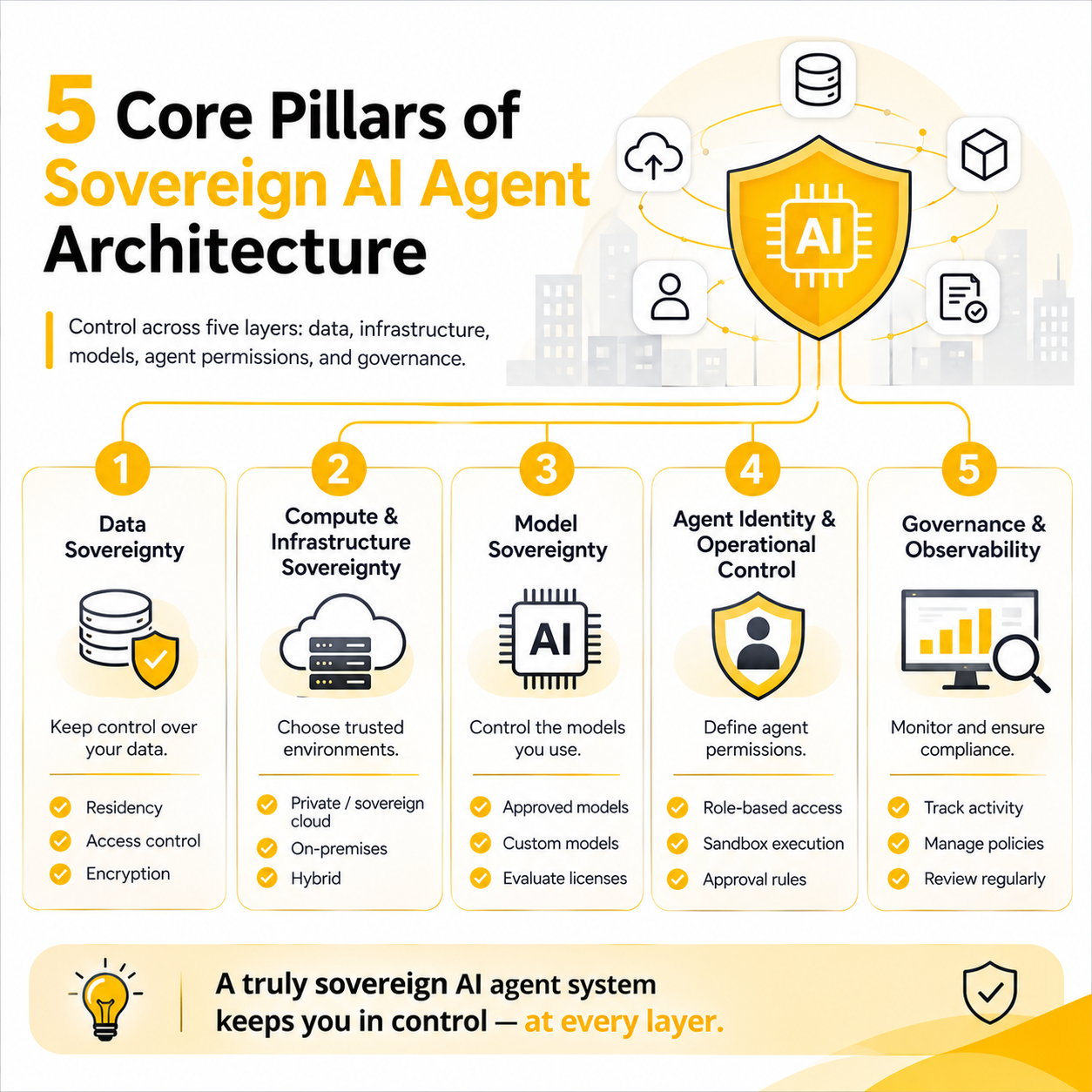
A sovereign AI agent architecture needs control across five interconnected layers: data, infrastructure, models, agent permissions, and governance. Controlling only one layer, such as hosting a model locally, does not guarantee that the complete system operates within organizational requirements.
1. Data Sovereignty
Data sovereignty determines where information is stored, processed, accessed, and transferred.
A sovereign agent should retrieve information from approved sources and follow defined data-handling policies. This may involve private databases, internal knowledge repositories, encrypted storage, and restricted retrieval pipelines.
Important controls include:
- Data residency and processing-location requirements.
- Role-based access to sensitive information.
- Encryption during storage and transmission.
- Data masking and minimization.
- Data provenance and access logging.
For example, a healthcare agent may retrieve patient records from an approved internal system without transferring the underlying records to an unauthorized external service.
2. Compute and Infrastructure Sovereignty
Infrastructure sovereignty concerns control over the environments used to run AI models and agents.
Depending on operational and regulatory requirements, organizations may choose:
- Private cloud infrastructure.
- Region-specific or sovereign cloud environments.
- On-premises servers.
- Hybrid infrastructure combining internal and external resources.
- Edge computing for applications requiring local processing.
The choice involves trade-offs. On-premises deployment can provide greater infrastructure control but requires hardware investment, maintenance, and specialized operational skills. A suitable sovereign cloud may offer more flexibility, provided its ownership, jurisdiction, access policies, and service dependencies meet the organization’s requirements.
3. Model Sovereignty
Model sovereignty refers to the ability to control which AI models are used, where inference takes place, and how models are customized or replaced.
Organizations may use self-hosted open-weight models, internally fine-tuned models, or approved commercial models under controlled deployment arrangements.
Model selection should consider performance, licensing, hardware requirements, data-handling policies, and portability.
Importantly, open-weight models do not automatically guarantee sovereignty. Their licenses, external dependencies, update mechanisms, and hosting environment still need to be evaluated.
4. Agent Identity and Operational Control
An autonomous agent needs an identity and clearly defined permissions, just like a human user or service account.
For example, an internal finance agent may be allowed to retrieve transaction records and prepare reports but not approve payments independently.
A strong architecture should include:
- Unique identities for individual agents.
- Role-based and least-privilege access.
- Restricted API and tool permissions.
- Sandboxed execution environments.
- Approval requirements for sensitive actions.
- Mechanisms to suspend or revoke agent access.
These controls prevent an agent from gaining unrestricted access simply because it can interact with multiple enterprise systems.
5. Governance and Observability
Sovereignty also requires visibility into how agents operate and whether their actions comply with organizational policies.
Monitoring should cover model usage, tool calls, data access, execution history, errors, and approval records. Governance mechanisms should also support agent evaluation, policy updates, rollback, and periodic permission reviews.
This layer is particularly important when multiple agents collaborate. A single workflow may involve several models, databases, and external services, making centralized visibility essential for identifying failures and investigating unexpected behavior.
How Sovereign AI Agents Work
Sovereign AI agents follow a controlled execution workflow in which requests, data retrieval, model reasoning, tool access, and final actions remain subject to organizational policies.
Consider a financial institution using an internal AI agent to investigate potentially suspicious transactions.
1. Receive Tasks Within Defined Policies
The agent receives a task and identifies the applicable business rules, user permissions, and data-access restrictions.
Before processing a request, the system verifies whether the requesting user or connected application is authorized to initiate that workflow.
2. Retrieve Data From Controlled Sources
The agent accesses approved internal databases, transaction records, and compliance documentation.
A retrieval-augmented generation (RAG) component may provide relevant context to the model without requiring the organization to transfer its entire internal knowledge base to an external provider.
3. Reason and Select Approved Tools
The AI model evaluates the available information and determines the next steps.
For example, it may compare transaction records against predefined compliance rules, request additional information, or select an approved analytical tool.
The orchestration layer ensures that the agent can only use permitted tools and operations.
4. Execute and Validate Actions
The agent performs authorized tasks and checks whether the results satisfy the original request.
It might prepare a suspicious-transaction summary or create an internal review record. More consequential actions, such as freezing an account or rejecting a transaction, should remain subject to the organization’s authorization requirements.
5. Record and Monitor Execution
The platform records relevant inputs, model activity, tool calls, outputs, and human approvals.
These records support auditing, troubleshooting, and continuous improvement. They also allow administrators to investigate whether an agent accessed unauthorized information or performed an unexpected operation.
This controlled architecture allows organizations to use autonomous AI for operational tasks while retaining oversight of the information, systems, and decisions involved.
Enterprise Use Cases of Sovereign AI Agents
Sovereign AI agents are particularly relevant to organizations that need autonomous workflows while maintaining control over sensitive information, infrastructure, and operational decisions.
Financial Services and Compliance
Financial institutions can use agents to review transaction records, retrieve regulatory documentation, identify potential discrepancies, and prepare compliance reports.
A sovereign deployment can keep sensitive financial information within approved environments while restricting agents to authorized systems. Decisions with financial or regulatory consequences should still require appropriate human approval.
Healthcare and Medical Administration
Healthcare organizations can use AI agents to support patient intake, organize clinical documentation, retrieve internal medical information, and coordinate administrative workflows.
These applications require strict controls over patient information, user permissions, and data processing. Agents should support healthcare professionals rather than independently make clinical decisions.
Government and Public Services
Government agencies may deploy sovereign agents to process documents, assist with citizen inquiries, retrieve public-service information, and support internal administrative workflows.
Control over data residency, identity, and infrastructure is particularly important when systems handle government records or operate under national security and regulatory requirements.
Manufacturing and Industrial Operations
Manufacturers can use agents to retrieve equipment information, coordinate maintenance workflows, analyze operational data, and support quality investigations.
For facilities with sensitive production environments, edge or private infrastructure may allow selected AI workloads to operate without transferring operational data to external services.
Enterprise IT and Software Operations
Internal IT teams can deploy sovereign agents to investigate incidents, retrieve technical documentation, summarize logs, and support system maintenance.
Keeping agents within controlled environments can help organizations limit access to internal infrastructure and proprietary technical information while maintaining auditability.
Sovereign AI Deployment Models: Cloud, Hybrid, or On-Premises?
Sovereign AI agents can run across several deployment models, and the appropriate choice depends on data sensitivity, jurisdictional requirements, infrastructure capacity, and operational constraints.
Sovereign Cloud
Sovereign cloud environments provide infrastructure within defined jurisdictions and governance arrangements. Depending on the provider, organizations may have greater control over data location, encryption, access management, and operational responsibilities.
However, businesses should evaluate the provider’s ownership, administrative access, subcontractors, and applicable legal jurisdiction rather than assuming that regional hosting automatically guarantees sovereignty.
Hybrid Cloud
Hybrid deployment combines private or on-premises infrastructure with selected external services.
For example, an organization may keep sensitive customer records and agent execution within its controlled environment while using an approved external model for less-sensitive tasks. This approach offers flexibility, provided data-transfer and model-access policies are enforced.
On-Premises and Air-Gapped Deployment
On-premises deployment gives organizations direct control over hardware, networking, storage, and model execution. Air-gapped environments go further by restricting or eliminating external network connectivity.
These approaches may suit highly sensitive workloads, but they require substantial infrastructure, hardware capacity, security maintenance, and specialized engineering resources.
Not every AI workload needs the highest level of isolation. The goal is to match deployment restrictions to actual business risks and regulatory requirements rather than introduce unnecessary infrastructure complexity.
FAQs
What is the difference between sovereign AI and sovereign cloud?
Sovereign cloud focuses primarily on controlling cloud infrastructure, data location, and jurisdictional requirements. Sovereign AI extends this control to models, data processing, agent operations, and governance.
Do sovereign AI agents need to run on-premises?
No. They can operate on-premises, in private or sovereign cloud environments, or through hybrid architectures. The right choice depends on data sensitivity, regulatory requirements, and infrastructure capabilities.
Can sovereign AI agents use open-source models?
Yes. Open-weight models can be hosted and customized within controlled environments. However, organizations should also assess model licensing, dependencies, security, and hardware requirements.
Are sovereign AI agents more secure?
Not automatically. Security depends on infrastructure configuration, data protection, agent permissions, API security, monitoring, and governance. A poorly managed private deployment can still expose sensitive information.
Can businesses build sovereign AI agents without training their own models?
Yes. Businesses can use existing commercial or open-weight models while maintaining control over deployment, data access, orchestration, and agent execution. Training a foundation model from scratch is not a requirement for AI sovereignty.
Conclusion
Sovereign AI agents allow businesses to adopt autonomous workflows while maintaining greater control over their data, models, infrastructure, and operations. However, sovereignty requires more than choosing a private hosting environment. It must be built into the entire architecture, from data access and agent permissions to monitoring and ongoing governance.
For organizations exploring controlled AI deployments, AMELA Technology can help design and develop custom agent architectures, enterprise integrations, and AI-powered workflows. Explore our AI development services to discuss an approach aligned with your infrastructure, security, and business requirements.