
 Jun 9, 2026
Table of Contents
A working prototype proves that your software concept solves a real problem. However, an interactive mockup or a quick proof of concept (PoC) is designed to test assumptions, not to withstand real-world operational stress. To successfully turn prototype into production app environments, businesses must shift their focus from rapid feature validation to disciplined engineering, system reliability, and long-term security.
Key Takeaways
- Expect a Rebuild: Up to 70–80% of early-stage prototype code must be refactored or completely rewritten to ensure security, data integrity, and system performance.
- Budgeting Realistically: Transitioning to a production-ready application typically requires a budget ranging from $40,000 to over $150,000, heavily influenced by geographical engineering rates and backend infrastructure complexity.
- Timeline Benchmarks: A standard migration takes between 4 to 6 months, divided across architectural audits, core engineering, and quality assurance automation.
- Team Composition: Moving past a prototype requires specialized technical roles beyond basic front-end developers, including system architects, DevOps experts, and QA engineers.
What is the Core Difference Between a Software Prototype and a Production-Ready App?
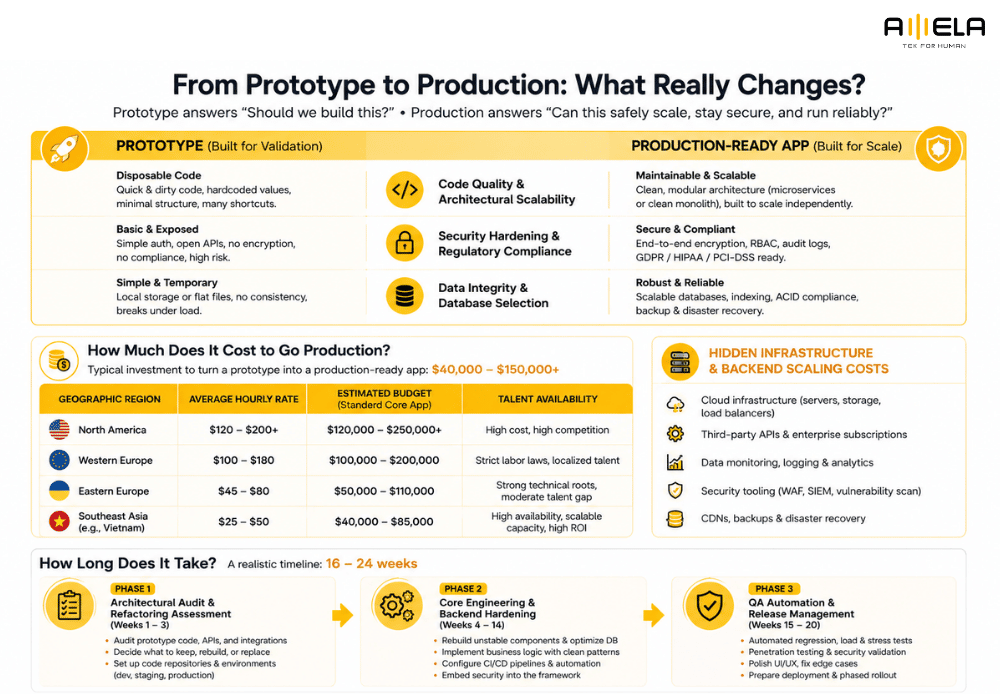
A software prototype is built to answer the question, “Should we build this?” while a production-ready application is engineered to answer, “Can this safely support thousands of concurrent users, handle sensitive data, and maintain 99.9% uptime?” Prototypes prioritize speed and visibility; production applications prioritize stability, fault tolerance, and security.
Code Quality and Architectural Scalability
Prototype code is fundamentally disposable, whereas production code is built as a highly maintainable, scalable foundation. During early validation phases, developers routinely cut corners—omitting error handling, hardcoding variables, and ignoring edge cases—to get a visual product in front of stakeholders quickly.
When moving to a production-ready system, this temporary code creates massive technical debt. Production apps require a decoupled architecture (often utilizing microservices or clean monolithic patterns) that allows individual components to scale independently when traffic spikes.
Security Hardening and Regulatory Compliance
Production applications require comprehensive security protocols, strict access controls, and data encryption that prototypes completely lack. A prototype often uses basic, shared authentication mechanisms and leaves APIs exposed to speed up initial testing.
According to the 2025 IBM Cost of a Data Breach Report, the financial and reputational fallout from an early security failure can be catastrophic for a growing enterprise. Elevating an app to production means deploying end-to-end encryption (TLS/SSL for data in transit and AES-256 for data at rest), implementing role-based access control (RBAC), and ensuring compliance with industry standards like GDPR, HIPAA, or PCI-DSS.
Data Integrity and Database Selection
Production systems require robust database architectures that ensure data consistency, rapid indexing, and automated recovery. Prototypes often rely on local storage or basic, unstructured flat files that break down under concurrent read/write operations.
Choosing the right database depends heavily on your data structure, query complexity, and transaction patterns. For a deeper look at aligning your data needs with the right infrastructure, read our engineering guide on selecting the best database for mobile apps.
How Much Does It Cost to Turn a Prototype Into a Production App?
Transitioning a prototype into a commercial, production-ready application typically costs between $40,000 and $150,000+, depending entirely on the complexity of your system architecture, integrations, and the geographical location of your engineering team.
Hidden Infrastructure and Backend Scaling Costs
Moving to production introduces recurring operational costs for cloud infrastructure, third-party APIs, data monitoring, and security tooling that prototypes never incur. While a prototype can run on free-tier cloud environments or cheap shared hosting, a production-grade deployment requires redundant server setups, content delivery networks (CDNs) to reduce global latency, and automated backup pipelines. Additionally, enterprise-tier API subscriptions, managed database clustering, and security monitoring tools (like SIEM systems) significantly influence the final budget.
Production Cost Breakdown by Geographic Region
Leveraging global custom software development services allows companies to optimize their engineering spend while maintaining strict production standards. Software development outsourcing rates vary dramatically by region. While local engineering talent in North America or Western Europe ensures tight timezone alignment, it comes with a massive premium that can quickly exhaust an early-stage company’s runway.
The table below breaks down the typical financial landscape of scaling a prototype based on geographic region:
| Geographic Region | Average Hourly Rate | Estimated Budget (Standard Core App) | Talent Availability |
| North America | $120 – $200+ | $120,000 – $250,000+ | High cost, high competition |
| Western Europe | $100 – $180 | $100,000 – $200,000 | Strict labor laws, localized talent |
| Eastern Europe | $45 – $80 | $50,000 – $110,000 | Strong technical roots, moderate talent gap |
| Southeast Asia (e.g., Vietnam) | $25 – $50 | $40,000 – $85,000 | High availability, scalable capacity, high ROI |
For an exhaustive, data-driven analysis of global engineering rates, check out our deep dive on app development cost a detailed comparison by region.
What is a Realistic Timeline for Moving from Prototype to Production?
A standard timeline to turn a prototype into a production app ranges from 16 to 24 weeks, assuming a disciplined approach to architecture, automated testing, and milestone-based release management.
Phase 1: Architectural Audit and Refactoring Assessment (Weeks 1–3)
The initial three weeks must be dedicated to analyzing the existing prototype to determine what can be kept and what must be built from scratch. This audit evaluates the code quality, API designs, and third-party integrations. If your prototype was built using low-code tools to save time, this is the phase where you map the migration from a no-code MVP to custom app environments, establishing clean code repositories and setting up development, staging, and production environments.
Phase 2: Core Engineering and Backend Hardening (Weeks 4–14)
The bulk of the timeline is spent rewriting unstable components, optimizing database queries, and embedding security protocols directly into the application framework. Developers implement the primary business logic using clean architectural patterns while DevOps engineers configure Continuous Integration and Continuous Delivery (CI/CD) pipelines. This phase ensures that every new code commit is automatically built, tested, and prepped for deployment without manual human intervention.
Phase 3: QA Automation and Release Management (Weeks 15–20)
The final month focuses entirely on breaking the application under simulated stress to guarantee real-world stability. QA automation engineers build test scripts to run continuous regression, stress, and load tests. At the same time, the team conducts penetration testing to expose security holes, polishes UI/UX edge cases, and prepares the deployment scripts for a controlled, phased rollout to production users.
How Should You Structure Your Engineering Team for Production Scaling?
Structuring a production engineering team requires shifting from cross-functional generalists who build features rapidly to highly specialized technical roles focused on systems stability, automated testing, and secure infrastructure. Attempting to scale an application using only front-end or full-stack feature developers leads to severe architectural bottlenecks, unvetted code vulnerabilities, and fragile deployment pipelines.
The Essential Roles Needed Beyond Front-End Developers
A production-grade launch requires specialized engineering roles dedicated entirely to system resilience, security infrastructure, and deployment health. While a prototype can be built by one or two full-stack developers, a commercially viable product relies on distinct competencies to prevent operational failures.
- Principal Software Architect: Focuses on designing decoupled systems (such as modular monoliths or microservices), selecting optimal data layers, and creating predictable APIs that do not degrade under high concurrent traffic.
- DevOps Engineer: Focuses on setting up infrastructure as code (IaC), managing automated Continuous Integration and Continuous Delivery (CI/CD) pipelines, configuring server monitoring, and optimizing cloud container hosting.
- QA Automation Engineer: Focuses on writing automated test suites that run continuous regression, unit, and end-to-end integration tests, preventing manual quality assurance bottlenecks before every release.
- SecOps / Security Engineer: Focuses on setting up role-based access control (RBAC), auditing dependency vulnerabilities, managing secrets, and ensuring compliance with industry standards like GDPR or HIPAA.
In-House Hiring vs. Partnering with a Dedicated Development Team
Partnering with an external engineering vendor via an Offshore Development Center (ODC) or a dedicated technical team allows companies to bypass recruitment bottlenecks and deploy complete, specialized engineering squads instantly. For many growing companies, sourcing and vetting highly specialized roles like DevOps and security engineers locally is financially prohibitive and takes months.
Choosing the right delivery model depends entirely on your internal management capacity, your project funding structure, and how quickly you need to hit the market.
| Delivery Model | Onboarding Speed | Core Structural Focus | Long-Term ROI | Operational Overhead |
| In-House Engineering | Very Slow (2–4 months per specialized hire) | Long-term internal knowledge retention and cultural alignment. | Low initial ROI due to competitive hiring costs, equipment expenses, and local benefits. | High; requires full internal HR, management, and training infrastructure. |
| Staff Augmentation | Fast (1–2 weeks) | Rapidly injecting temporary, specific engineering skills into an existing, well-managed team. | High for short-term fixes, but efficiency decreases if internal leadership is weak. | Medium; requires your internal tech leads to manage daily tasks. |
| Dedicated Team / ODC | Very Fast (2–4 weeks) | Deploying a fully functional, self-managed software delivery team with pre-arranged roles (PM, Dev, QA, DevOps). | Highest for scaling a prototype, balancing lower regional costs with structured engineering. | Low; the external vendor handles daily operations, HR, and project management. |
Persona-Specific Guides: The CTO Decision Framework vs. Founder’s Execution Guide
When preparing to scale a prototype, technical leaders and business founders look at the transition through entirely different lenses. A CTO focuses heavily on mitigating architectural risk and eliminating structural technical debt, while a non-technical founder focuses on protecting the company’s financial runway, keeping stakeholders aligned, and meeting time-to-market milestones.
The CTO Checklist: Architectural and Infrastructure Readiness
Before allowing developers to write new commercial features, a technical leader must validate that the underlying architecture can withstand real-world production stress.
- [ ] Decouple the Core Codebase: Ensure business logic is separated from presentation layers to prevent single-point-of-failure code crashes.
- [ ] Audit Third-Party Dependencies: Scan all open-source libraries and integrations to find outdated or unmaintained dependencies that introduce security risks.
- [ ] Enforce Database Indexing: Review query patterns and index keys to stop database locks when data volume expands.
- [ ] Establish Centralized Logging: Set up structured logging and observability platforms (such as Prometheus or Datadog) to catch errors before users report them.
- [ ] Configure the CI/CD Net: Ensure that no developer can push code directly to main production environments without clearing automated linting, security scans, and unit tests.
The Non-Technical Founder’s Guide: Managing Delivery Risks
For business owners, moving a prototype to market means treating software development as a structured, risk-aware business process rather than a guessing game.
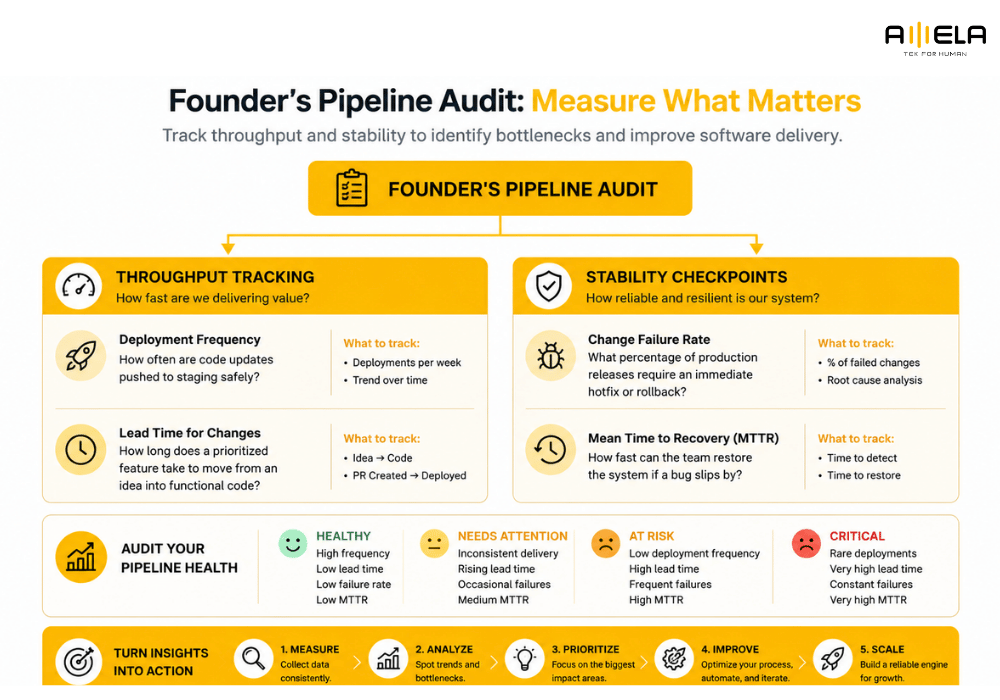
The biggest mistake a founder can make is assuming that a working prototype is “almost done.” To avoid running out of capital mid-development, look closely at how your engineering team manages delivery output.
According to the 2025 DORA Report by Google Cloud, high-performing engineering organizations do not just write code faster; they use structured, small-batch delivery pipelines supported by continuous quality control to keep their software stable. As a founder, evaluate your engineering progress using objective delivery benchmarks rather than emotional estimates:
What Are the Risks When Scaling a Prototype and How to Mitigate Them?
Failing to properly manage the transition from an early-stage concept to a commercial launch often leads to severe infrastructure crashes, leaking sensitive user data, or accumulating unmanageable technical debt that freezes future feature development.
Risk 1: Building on Top of Unscalable Prototype Code (The Technical Debt Trap)
- The Threat: Treating prototype code as a permanent production foundation causes the app to break under load, slowing down new feature development as engineers spend all their time patching recurring bugs.
- The Mitigation: Run a mandatory, objective technical audit at the start of the project. Clearly separate reusable UI elements from disposable backend logic, and dedicate the first few sprints entirely to refactoring underlying structural issues.
Risk 2: Overlooking Critical Security Flaws
- The Threat: Leaving APIs completely unprotected, using weak authentication, or hardcoding system keys leads to costly data breaches. The IBM Cost of a Data Breach Report notes that data breaches across global organizations carry a staggering average cost of $4.44 million, driven by regulatory fines, loss of customer trust, and operational disruption.
- The Mitigation: Implement a “Secure by Design” development pipeline. Use managed secrets managers to store sensitive credentials, encrypt data at rest and in transit, and run automated static application security testing (SAST) tools inside your deployment environment. If your app relies on advanced machine learning components, be sure to audit your systems for emerging vulnerabilities by checking our guide on modern security risks with AI apps.
Actionable Checklist: The Production-Ready Launch Sign-Off
Before moving your application into a live environment for public users, the technical delivery lead and product owner should verify that every item on this operational sign-off checklist is met:
- Security & Identity: Identity providers use strong multi-factor authentication (MFA); API endpoints are fully throttled to block brute-force or DDoS attacks.
- Infrastructure & DevOps: Cloud hosting scaling rules are properly configured to add computing resources when CPU usage spikes; production databases use isolated, encrypted credentials.
- Data Integrity & Recovery: Automated, point-in-time database backups are active and have been successfully tested for restoration health.
- Monitoring & Alerts: On-call engineers receive immediate automated alerts via Slack or PagerDuty when system response errors surpass 1%.
Frequently Asked Questions About Transforming Prototypes Into Commercial Apps
Can you ever launch prototype code directly to production users?
Almost never. Prototype code is intentionally built quickly to validate ideas and show workflows to stakeholders, meaning it leaves out essential backend scaling, error handling, and data security infrastructure. Launching it directly to the public often leads to major performance crashes, data leaks, and a poor initial user experience.
How do you handle stakeholder feature requests during the scaling phase?
Use a strict product backlog prioritization framework like MoSCoW (Must have, Should have, Could have, Won’t have). Freeze the core scope required for your production release, and place any non-essential feature requests into a secondary product backlog for future engineering sprints.
What percentage of the budget should be allocated to QA and testing?
For a production-grade application, budget around 20–25% of your total engineering resources for quality assurance and automated testing. Skimping on testing during development simply shifts the costs to production, where resolving live system bugs is significantly more expensive.
Conclusion
Successfully deciding to turn prototype into production app standards requires moving past rapid experimentation and committing to disciplined engineering, clean architecture, and tight data security. While building a quick proof of concept proves your ideas work, creating an enterprise-grade system demands a focused team structure, a realistic development timeline, and a clear view of hidden operational costs.
Whether you choose to build an internal engineering team or scale up using a trusted dedicated development team, the key to a smooth launch is addressing your technical debt early, keeping your development iterations small, and using automated quality assurance to protect your product long after release.
Ready to take your prototype beyond validation? AMELA Technology can help you build a secure, scalable, production-ready app with the right team, process, and engineering foundation.


