 Jun 4, 2026
Table of Contents
Building a quick Minimum Viable Product (MVP) with no-code tools is a great way to launch fast and prove your business model. It keeps upfront costs low and gets your product in front of real users in weeks instead of months.
But as your user base grows, you might notice that your app is becoming harder to scale, customize, secure, or maintain. Recognizing the right time to transition from a no-code MVP to custom app architecture is essential to keeping your business moving forward without losing your momentum.
Key Takeaways
- The Cost Crossover Point: Consider rebuilding when expanding usage-based platform fees begin to outpace the projected baseline cost of custom cloud hosting.
- The Architectural Ceiling: Rebuild when intricate application logic, granular multi-tenant security layers, or real-time computation hit platform boundaries.
- The Asset Value Multiplier: Securing full proprietary software ownership eliminates technical friction during venture capital (VC) or enterprise due diligence.
Why do successful no-code MVPs hit a scaling wall?
Moving from a no-code MVP to a custom app architecture becomes necessary when visual development limitations degrade application performance, increase operational risk, and cause your monthly hosting subscription fees to scale exponentially.
What are the main no-code app limitations?
Rigid visual programming logic eventually creates substantial technical debt, making complex product iterations slow, fragile, and difficult to manage.
As your product grows and feature sets expand, these structural ceilings manifest in several distinct ways:
- The Visual Spaghetti Problem: Complex nested conditional operations and heavy database filters turn visual workflows into tangled paths that are difficult for engineering teams to audit or debug.
- Absence of Standard CI/CD Pipelines: Most visual platforms lack mature Continuous Integration and Continuous Delivery (CI/CD) environments, preventing automated code testing, linting, or structured deployment stages.
- Fragile Version Control: Merging concurrent updates from multiple developers into a single visual canvas often overwrites logic, breaking live components.
How do no-code MVP scaling issues impact your ROI?
Unpredictable, usage-based platform pricing models act as a direct growth tax that degrades your application’s long-term Return on Investment (ROI) as transactions multiply.
While initial development using no-code/low-code solutions keeps initial validation costs minimal, the financial dynamics shift heavily at scale:
- The Workload Metric Trap: Platforms penalize scaling apps by charging steep overage premiums for server processing units, payload data transfers, or database record sizes.
- Shared-Server Latency Spikes: Executing heavy database operations inside shared, multi-tenant hosting infrastructures introduces severe app latency during concurrent traffic spikes.
- Expensive Integration Workarounds: Overcoming native tool boundaries often requires building complex external intermediate webhooks, which adds points of failure and increases recurring upkeep costs.
Why does missing code ownership stall VC funding?
Institutional investors frequently halt or markdown startup funding rounds during technical due diligence if the company owns zero proprietary code assets.
Operating entirely within a closed visual ecosystem introduces key business governance risks:
- Zero Intellectual Property Valuation: Because your software is tied directly to a vendor’s private runtime environment, you do not own deployable code equity, reducing total business asset value.
- Compliance and Data Residency Gaps: Achieving critical enterprise security milestones—like SOC 2 Type II, HIPAA, or strict GDPR data isolation—is exceptionally hard on shared platform architectures.
- System Provider Lock-In: If the platform vendor increases prices unexpectedly, changes its terms of service, or suffers major infrastructure outages, your business has no immediate migration fallback path.
When should you switch from no-code MVP to a custom app?
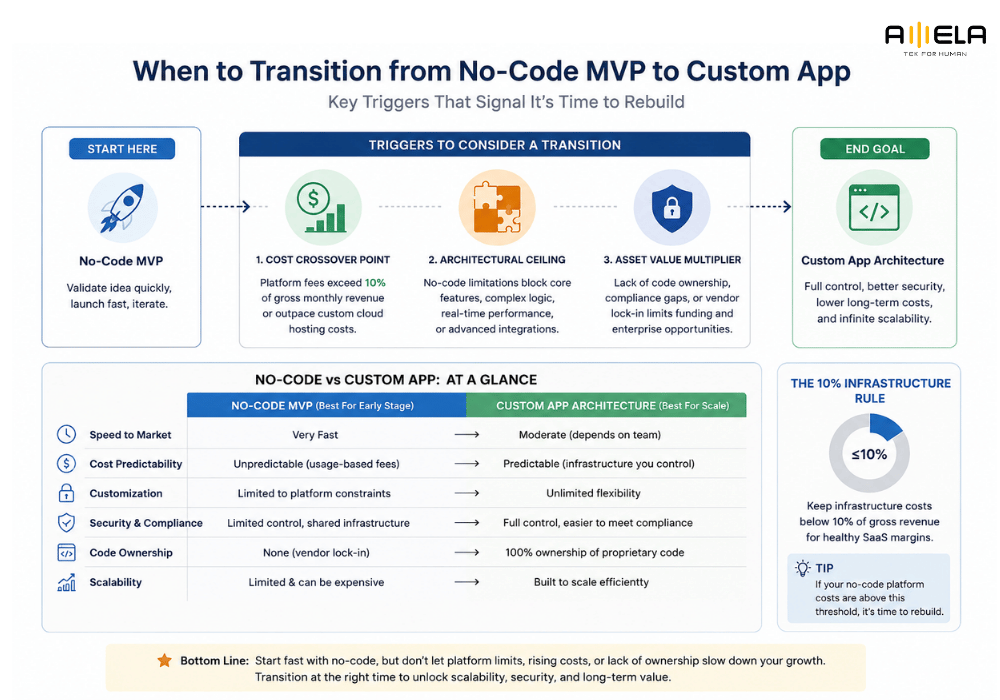
You should transition to a custom application when platform hosting fees exceed 10% of your gross monthly revenue, or when rigid feature limitations prevent you from delivering core product features required by your scaling user base.
When does the “10% infrastructure rule” apply?
The 10% infrastructure rule applies when the variable usage fees of your visual platform begin to outpace the predictable, fixed cost of dedicated cloud hosting.
- The Overage Inflection Point: Early-stage software setups consume minimal database lines. However, once your app scales to thousands of concurrent users, platform premiums for data operations can spike unpredictably.
- Predictable Cost Modeling: Shifting your data layers to an infrastructure framework like Amazon Web Services (AWS) or Google Cloud Platform (GCP) provides highly predictable cost structures tied directly to compute time and flat storage space.
- Margin Optimization: According to broader industry studies on software operations, keeping cloud infrastructure costs below 10% of gross software-as-a-service (SaaS) margins is standard for healthy business operations; if your visual stack pushes past this threshold, it is time to rebuild no-code app logic.
What technical triggers require an immediate rebuild?
An immediate technical rebuild is required when your product roadmap demands native device optimization, custom machine learning integrations, or complex real-time computational performance.
You have reached the absolute technical limits of your visual builder when your development roadmap encounters these three specific requirements:
- Advanced Automation & AI pipelines: Visual tools struggle to support complex asynchronous data jobs, deep vector database indexing, or custom Large Language Model (LLM) fine-tuning pipelines.
- Offline-First Synchronization: If your software requires complex local storage data synchronization that updates instantly when a user reconnects to the internet, visual environments introduce severe data corruption risks.
- Deep Hardware Integration: Building advanced background tracking, bluetooth communication, or highly responsive camera processing requires dedicated mobile app development pipelines that visual wrappers simply cannot support natively.
Founder vs. CTO: When to rebuild MVP setups?
While a Founder focuses on capital efficiency and market valuation, a CTO prioritizes system maintainability, security compliance, and long-term delivery speed.
The decision regarding when to rebuild MVP software configurations differs based on your specific organizational role:
The Founder’s Strategic Perspective
- Valuation Milestones: Preparing for a Series A funding round or enterprise pilot acquisition requires a clean asset portfolio with explicit ownership of the software’s source code.
- Churn Prevention: Customer retention drops rapidly if users experience interface lag or unexpected runtime errors caused by underlying platform performance caps.
The CTO’s Engineering Perspective
- Eliminating Structural Debt: Research indicates that engineering teams spend up to 40% of their development time managing legacy technical debt. Transitioning to a custom codebase allows your team to design modular microservices that drastically improve future feature velocity.
- Security Visibility: Custom infrastructure allows you to deploy deep web application firewalls (WAF), precise penetration testing protocols, and granular role-based access controls (RBAC).
Structural Comparison: Visual Infrastructure vs. Custom Architecture
| Metric | Visual Development Stack | Custom Code Architecture |
| Cost Predictability | Variable; scales sharply with data payloads and user workflows. | Stable; tied directly to flat cloud compute resources and storage space. |
| Feature Flexibility | Limited to vendor plugin marketplaces and visual canvas logic. | Limitless; open to any modern open-source framework or library. |
| Data Ownership | Vendor-locked database structures; complex schema extraction. | Complete; full control over relational database management systems. |
| Scalability Cap | Tied to shared multi-tenant server performance limits. | Highly elastic; horizontal auto-scaling based on user volume. |
| Security Control | Relies on vendor patch cycles and platform-wide configurations. | Granular; allows full compliance audits (SOC 2, ISO 27001). |
Rebuild vs. hybrid: Which path is right for your MVP?
The optimal migration path depends entirely on your immediate runway, available engineering resources, and whether your frontend user interface requires a complete visual overhaul alongside the backend infrastructure.
Option A: When is a clean custom rebuild best?
A clean custom rebuild is best when your no-code UI is deeply intertwined with a messy database schema, making partial extraction more expensive than a fresh architectural start.
- Framework Modernization: A complete rebuild allows your team to move to highly responsive, modern development frameworks using structured cross-platform app development solutions like Flutter or React Native.
- Long-Term ROI: While a full rewrite requires an upfront capital investment, it completely eliminates future platform subscription fees and vendor dependencies, resulting in a significantly lower total cost of ownership (TCO) over a 3-to-5-year lifecycle.
- Strategic Resource Allocation: If your internal team must remain focused on immediate customer acquisition and day-to-day business operations, partnering with a professional IT outsourcing vendor ensures the next-generation application is built to modern engineering standards without disrupting your current market traction.
Option B: How does a hybrid architecture save time?
A hybrid architecture saves time by preserving your validated visual frontend while seamlessly offloading heavy database processing and business logic to an external custom backend.
- The API Abstraction Strategy: Instead of executing a full system rewrite simultaneously, you can retain your visual app layout as a presentation layer and connect it to a custom PostgreSQL or MySQL database via secure RESTful APIs.
- Phased Risk Mitigation: This intermediate model allows you to migrate from Bubble to custom app components gradually, moving individual complex modules (like payment matching or data analytics engines) one at a time.
- Short-Term Speed: Choosing a hybrid model helps startups maintain fast frontend delivery speeds while giving a dedicated development team the isolated environment needed to refactor core enterprise databases systematically.
How to execute a zero-downtime migration from MVP to Custom Application?
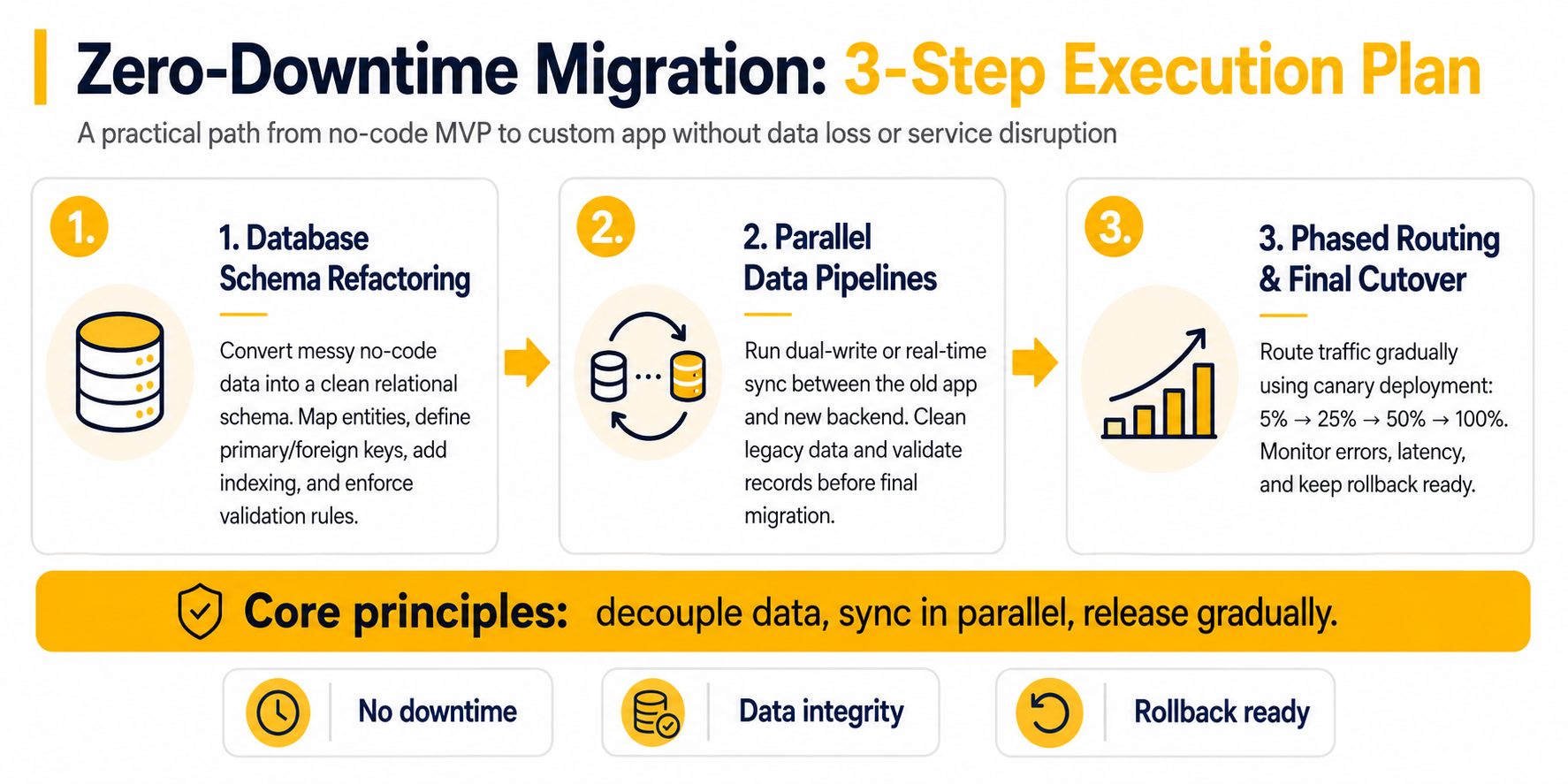
Executing a zero-downtime migration from a no-code MVP to a custom app requires decoupling your data layer, building a real-time synchronization pipeline, and running parallel environments before a final DNS cutover.
Step 1: Database schema refactoring
Migrating off a visual builder requires refactoring messy, flat data structures into a highly optimized, normalized relational database.
No-code platforms often store data in monolithic JSON-like blocks or unindexed tables to accommodate visual drag-and-drop workflows. When moving to an enterprise production database like PostgreSQL or MySQL, your engineering team must systematically map out these legacy relations. Our architectural experience reveals that failing to cleanly decouple these entities early results in severe query performance bottlenecks later. You must design clean primary and foreign key relationships, set up precise indexing strategies, and ensure that data validation rules are strictly enforced at the database level rather than the application interface level.
Step 2: Setting up parallel data pipelines
To prevent operational data loss during the development cycle, you must implement a dual-write architecture or a real-time Change Data Capture pipeline.
- The Dual-Write Pattern: Your live no-code application and your new custom backend must write transactional data to both databases simultaneously during the testing phase.
- Continuous Replication: For high-volume applications, you should utilize automated data streaming tools to synchronize changes instantly. Following industry-standard AWS Database Migration Service best practices, this ensures that your target custom database remains an exact, real-time mirror of your live production environment.
- Data Cleansing: Use this synchronization phase to run automated validation scripts that clean legacy formatting errors, null values, and orphaned records before they reach the new custom storage architecture.
Step 3: Phased user routing and final cutover
Minimizing transition risk requires routing user traffic to your custom application gradually using canary deployments rather than executing a single “big bang” switch.
Do not attempt to shift 100% of your user base to the new custom application instantly. Instead, use reverse proxies or feature flags to route a small subset of non-critical traffic (such as 5% of daily active users) to the new codebase. Monitor application latency, error rates, and server logs using application performance monitoring (APM) systems. Once the custom stack proves stable under minor loads, scale the traffic routing incrementally—from 25%, to 50%, and finally to 100%—before safely decommissioning the old visual platform.
Checklist: The Product Manager’s Blueprint for a Seamless Code Migration
- Audit Legacy API Dependencies: Document every third-party webhook, external integration, and plugin utilized by the no-code setup.
- Establish Data Integrity Baselines: Run row-count and cryptographic checksum checks on the legacy database to verify historical record accuracy.
- Map Data Schemas: Build an Entity-Relationship Diagram (ERD) that translates visual database fields into standardized SQL data types.
- Deploy a Sync Layer: Configure an intermediate worker or middleware solution to mirror live transactional updates across both environments.
- Run Stress and Load Testing: Simulate peak concurrent user traffic on the new custom infrastructure before routing live clients.
- Execute Phased Canary Routing: Shift traffic in micro-batches while monitoring server health and API response metrics.
What are the risks of a code rewrite?
The primary risks of a software rewrite include severe scope creep that delays product delivery, unpredicted database corruption during data cutover, and an operational slowdown within your internal product team.
Risk 1: Scope creep (Second-System Syndrome)
The tendency to add unvalidated product features during a rewrite frequently leads to extended development delays and missed launch deadlines.
When engineering teams transition from a visual stack to custom programming languages, there is a strong temptation to fix every past design flaw and add new features simultaneously. This phenomenon—historically documented as “Second-System Syndrome” in classic software engineering studies—can derail your project budget. According to historical Standish Group Chaos Report metrics, over 50% of software project features are rarely or never used. To mitigate this risk, you must freeze your current validated product scope entirely. Your custom application engineering objective must strictly be feature parity with the working no-code MVP; optimize your core architecture first, and defer new features until the custom application is live.
Risk 2: Production downtime and data loss
Flawed data migration mechanics can break existing customer workflows, leading to immediate operational downtime and customer churn.
- The Cost of Outages: System downtime directly impacts your bottom line. Industry infrastructure benchmarks from the Uptime Institute show that substantial infrastructure outages cost businesses significant revenue and reputational damage.
- API Breakage: If your enterprise clients rely on specific webhook structures exposed by your visual platform, changing your backend architecture without providing an API abstraction layer will break their automated workflows.
- Mitigation Strategy: Always maintain a comprehensive roll-back plan. If a critical bug appears during the database cutover phase, your engineering team must be capable of routing user traffic back to the visual platform within minutes without losing any transactional data generated during the migration attempt.
Risk 3: Drop in team feature velocity
Allocating your core internal developers to a full application rewrite stops the delivery of new product features, allowing competitors to capture market share.
If your internal product developers are completely occupied with rebuilding legacy features in a new code stack, your public-facing product roadmap will freeze for months. To maintain market momentum, many scaling companies follow a structured custom software development guide framework and partner with an external dedicated development team. By leveraging an experienced engineering collaborator to handle the underlying architectural rewrite, your internal product managers can remain focused on immediate client acquisition, strategic feature design, and day-to-day market operations.
FAQs
Migrating from a no-code MVP to a custom application resolves critical scaling, security, and cost barriers, ensuring your software architecture can support long-term business growth.
Can I export raw, deployable source code directly from Bubble?
No, dominant visual platforms like Bubble do not allow you to export clean, deployable application source code because their systems run on a proprietary interpreter.
While some modern low-code tools like FlutterFlow allow frontend source code downloads, the underlying architecture often requires significant manual refactoring to match enterprise standards.
- Data Portability: You can easily export raw user data tables via CSV or JSON formats.
- Logic Loss: Visual workflows, API connectors, and internal conditional branches cannot be translated directly into clean JavaScript, Python, or Go code.
- The Reality: Transitioning to a custom architecture always involves writing your core application logic from scratch to ensure a clean codebase.
How long does it typically take to migrate from Bubble to custom app frameworks?
A production-ready transition from a validated no-code MVP to a custom software stack typically spans between 12 to 24 weeks.
The exact engineering timeline depends entirely on data complexity, active user volume, and your integration ecosystem:
- 12 Weeks (Simple Migration): Covers basic CRUD (Create, Read, Update, Delete) applications with a single data relational layer and standard external APIs.
- 16–20 Weeks (Mid-Tier App): Required for platforms with multi-tenant user access controls, real-time messaging layers, or local offline caching.
- 24+ Weeks (Complex Enterprise System): Necessary when migrating heavy data pipelines, advanced AI workflows, or processing thousands of legacy user subscriptions.
Will moving to a custom codebase permanently slow down our product release cycles?
While custom engineering introduces structured code reviews and deployment controls, it increases long-term feature velocity by removing visual design limitations.
Early-stage development on visual tools is fast, but that velocity drops dramatically as your visual tree grows overly complex. Custom architectures change this dynamic:
- Fewer Regression Errors: Automated testing frameworks catch logic bugs before they hit your live production environment.
- Component Reusability: Modular backend microservices and clean UI libraries mean your team can build complex enterprise features without breaking existing system workflows.
- Parallel Engineering: Multiple developers can work on isolated code branches simultaneously without overwriting each other’s visual canvases.
Do venture capital firms completely reject startups running on no-code infrastructure?
Venture capitalists do not reject seed-stage companies for using visual tools, but they expect a clear technical rebuild roadmap prior to institutional scaling rounds.
During Pre-Seed and Seed rounds, investors look primarily at problem-solution fit and early user growth. However, the expectations change during Series A due diligence:
- IP Asset Checks: Institutional firms require proof that the business owns its underlying software equity rather than renting it from a single visual website provider.
- Risk Assessment: Operating entirely inside a closed platform ecosystem introduces substantial single-point-of-failure risks that lower total startup valuation.
- Scale Validation: Showing a clear, structured blueprint for transitioning to a proprietary codebase demonstrates operational maturity to incoming investment boards.
Conclusion
Moving from a no-code MVP to a custom application is not just a technical upgrade. It is a sign that your product has moved beyond validation and now needs better scalability, security, performance, and long-term flexibility.
When no-code tools start limiting features, increasing costs, or slowing down user experience, custom development becomes the stronger path forward. With the right migration plan, businesses can protect existing data, reduce operational risks, and build a more stable product foundation for future growth.