 Jun 22, 2026
Table of Contents
For a growing company, treating cybersecurity as an administrative item on a checklist is an operational hazard. Digital threats have evolved past manual, targeted attacks toward automated scanning engines that don’t care about the size of your business—they look exclusively for unpatched software, exposed databases, and fragile workflows.
Establishing a modern baseline for IT Security for SMBs is not about buying complex enterprise software packages that overwhelm your team. Instead, it requires structuring a clean, defensive architecture that keeps your core assets protected while your engineering team maintains product delivery speed.
Key Takeaways
- Automated Threat Profile: Growing companies are prime targets for modern automated attacks; they face high volumes of scanning engines looking for basic configuration oversights.
- Architecture Over Software: Effective protection relies on clean system design, strict access controls, and shifting security checkpoints early into the development pipeline.
- Contract Acceleration: A vetted security architecture acts as a business enabler, allowing mid-market firms to clear complex enterprise vendor reviews.
- Operational Resource Mix: Partnering with an external engineering team for system management bridges critical security personnel deficits without halting core feature development.
Why is IT security for SMBs no longer optional?
Effective cybersecurity transforms from an operational expense into a growth driver by preserving capital, preventing devastating operational downtime, and unlocking vendor compliance requirements necessary to secure enterprise-level B2B contracts.
The actual financial reality of contemporary mid-market data breaches
A single security incident can fundamentally disrupt corporate cash flow, as the operational downtime alone can create severe financial liabilities alongside recovery expenses.
Many founders operate under the assumption that they are flying safely under the radar of global threat groups. However, modern telemetry indicators show a completely different picture on the ground.
- According to the Verizon Data Breach Investigations Report (DBIR) 2025, ransomware is present in 88% of breaches affecting small and medium-sized businesses (SMBs). This is 2.3 times higher than the rate found in large-scale enterprises, where ransomware features in only 39% of incidents.
- The Hiscox Cyber Readiness Report 2025 highlights that 59% of small and medium-sized enterprises globally experienced at least one cyberattack over a 12-month window.
- Industry data compiled by VikingCloud reveals that the operational downtime caused by a successful breach generates an average liability of $53,000 per hour for a mid-market organization.
When an attack lands, the immediate cleanup cost is only a small piece of the problem. The larger blow comes from missed delivery deadlines, broken customer trust, potential regulatory non-compliance fines, and a complete freeze on core software feature shipping. For an expanding technology platform, these cumulative bottlenecks can easily derail an entire year of strategic market growth.
Why automated scanning profiles target small-scale architecture over enterprise networks
Threat actors actively target small and medium-sized infrastructure because they function as accessible entry points into larger enterprise supply chains while lacking dedicated, around-the-clock defensive teams.
Modern cybercriminals do not browse corporate directories looking for businesses by name. Instead, they use automated scanning setups to constantly look across the public internet for vulnerable infrastructure assets.
Large enterprises possess the resources to maintain segmented networks, automated intrusion detection software, and dedicated security monitoring pools. Growing companies, by contrast, frequently suffer from a structural resource gap:
- They often operate with smaller IT teams that must split their focus between infrastructure maintenance, general technical support, and product feature deployment.
- They frequently deploy internal utilities, testing environments, and application programming interfaces (APIs) that lack multi-factor authentication (MFA) or proper access restrictions.
- Their reliance on third-party integrations and custom code packages creates wider attack pathways. The 2025 Verizon DBIR found that third-party and supply chain compromises doubled within a single year, climbing to 30% of all recorded breaches.
This makes mid-market companies highly attractive targets for modern digital extortion. Attackers understand that an organization without a dedicated engineering backup pool is far more likely to face severe operational paralysis during an incident.
Building a resilient defensive posture allows an expanding business to protect its assets naturally while positioning itself as a secure, enterprise-grade B2B vendor.
What are the foundational layers of a practical SMB security framework?
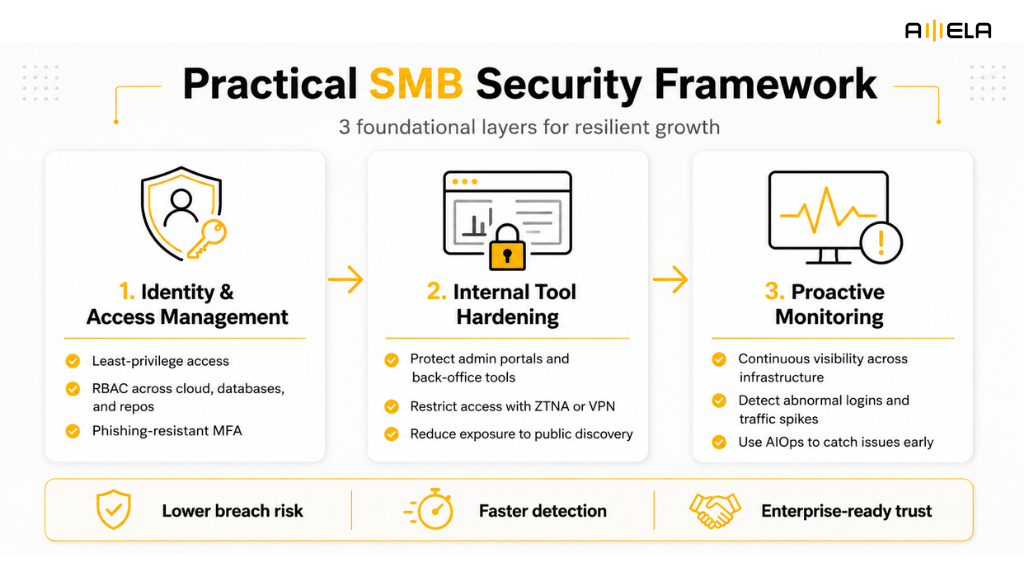
A practical small to medium business security framework establishes deep defense by enforcing strict identity access rules, hardening internal company tools, and shifting from manual firefighting to automated, continuous infrastructure monitoring.
Identity and Access Management (IAM): Restricting structural boundaries
Limiting user access rights to the bare minimum required for their roles prevents a single compromised credential from granting attackers keys to your entire network.
Implementing Identity and Access Management (IAM) built on the principle of least privilege ensures that an individual team member only accesses data strictly necessary for their daily tasks. For a growing platform, this means configuring Role-Based Access Control (RBAC) across cloud consoles, database environments, and code repositories.
According to data from the Center for Internet Security (CIS) Controls v8.1 guidance for 2026, implementing essential cyber hygiene—starting with multi-factor authentication (MFA) and structured account management—neutralizes the vast majority of low-sophistication, automated cyber threats. Enforcing phishing-resistant MFA across all corporate access points drastically reduces the blast radius if an employee inadvertently clicks a malicious link.
Hardening internal enterprise applications and internal corporate portals
Internal company utilities and administrative dashboards often bypass rigorous code reviews, making them highly vulnerable if exposed directly to the public web.
When engineering teams focus heavily on securing consumer-facing applications, back-office tools like customer relationship databases, content management tools, and internal employee directories can become overlooked security risks. Hackers actively look for these unmapped entrance paths because they frequently lack modern session timeouts, brute-force protection, or web application firewalls.
Securing these tools requires moving away from open internet exposure and placing admin interfaces behind a Zero-Trust Network Access (ZTNA) protocol or an authenticated corporate virtual private network. Prioritizing structured internal website security allows your business to shield proprietary databases and operational software from public discovery engines entirely.
Implementing proactive monitoring over reactive infrastructure fixes
Transitioning from reactive firefighting to automated system observation reduces the time that architectural vulnerabilities or cloud configuration drifts sit uncovered.
Waiting for an explicit system failure or a user complaint to identify an ongoing security incident is an operational liability. Modern infrastructure changes quickly as developers deploy updates, which can unintentionally alter security group rules or expose database ports.
By integrating intelligent operations platform models, such as AIOps for SMBs (Artificial Intelligence for IT Operations), growing companies can automatically flag abnormal data transfer spikes, strange login origins, and structural resource errors. This automated layer provides lean IT departments with the visibility needed to contain anomalous behaviors long before they develop into severe production incidents.
How should engineering teams implement security within custom software development?
Engineering teams must treat security as an integrated step in the development process by automating vulnerability scanning directly inside code pipelines and writing clear software safety rules before building features.
Shifting security left across the modern deployment pipeline
Catching software vulnerabilities during early code construction costs up to thirty times less than trying to patch an open security flaw within a live production environment.
The phrase “shifting left” means introducing automated security evaluations at the earliest phases of the Secure Software Development Lifecycle (SSDLC). Instead of performing an isolated security review right before a major product release, engineering teams embed Static Application Security Testing (SAST) and software composition analysis utilities directly into their Continuous Integration and Continuous Delivery (CI/CD) pipelines.
Every time a developer pushes code, automated scripts inspect the changes for hardcoded API keys, SQL injection risks, and outdated open-source library packages. This automated inspection keeps security a daily engineering standard, preserving development speed while stopping high-risk code from reaching production servers.
Establishing explicit baseline safety requirements for production code
A software engineering team must have a standardized list of security rules to ensure that authentication, encryption, and third-party data handlers are verified before shipping any feature.
When software development teams run on tight feature delivery deadlines, security considerations can be missed without an explicit, structural checklist. Relying on developers to remember every edge-case protection rule manually creates avoidable human error risks.
Before writing the first line of code for a new product module, tech leads should establish explicit, clear software safety requirements regarding data handling, secure encryption standards at rest, and input validation bounds. Hardening the application architecture at the design stage prevents common software bugs from turning into security exploits down the road, ensuring the final application is structurally resilient by design.
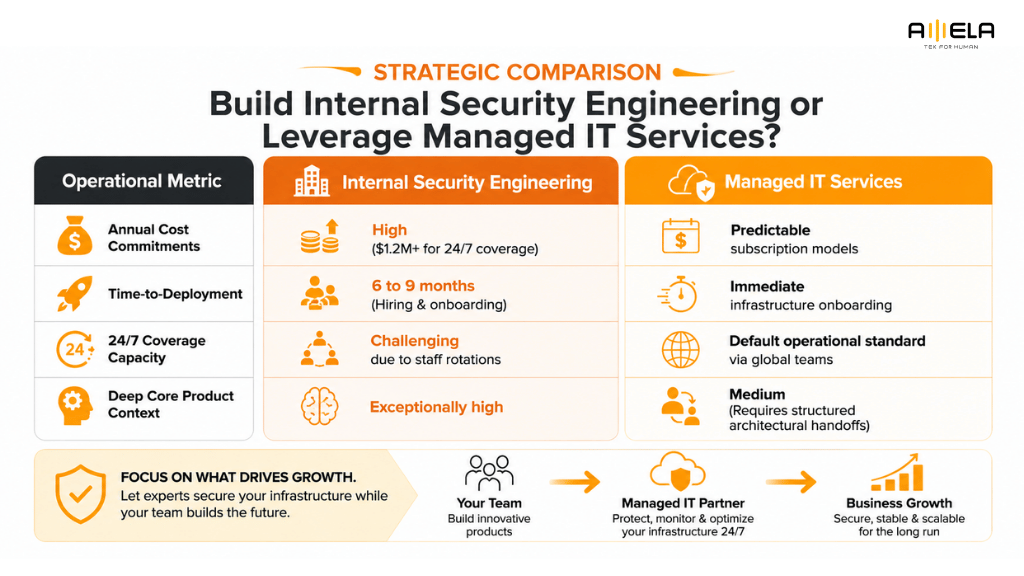
Strategic Comparison: Internal security engineering vs managed IT services
Choosing between internal security engineering and managed IT services comes down to organizational scale: managed services provide expanding platforms with 24/7 infrastructure defense and predictable budgets, whereas internal setups offer extreme customization but incur massive talent acquisition overhead.
Analyzing technical velocity, personnel depth, and resource efficiency
Building an in-house security operations facility requires an annual capital commitment that often exceeds the entire technology budget of a growing business.
Attempting to recruit, train, and retain a fully internal cybersecurity squad creates a difficult resource challenge in the modern talent market. According to specialized salary datasets, a single mid-level security engineer requires a base salary between $136,000 and $168,000 before accounting for corporate benefits, payroll taxes, and advanced security software licensing costs. Because true 24/7 infrastructure monitoring requires a minimum headcount rotation of five full-time analysts to account for weekend shifts and employee burnout, maintaining an internal threat monitoring operation can easily cross $1.2 million annually.
For mid-market organizations, shifting toward external engineering support bridges this operational personnel gap immediately. Instead of managing complex hiring pipelines, businesses utilize shared infrastructure expertise to gain complete operational defense on a predictable subscription framework.
| Operational Metric | Internal Security Engineering | Managed IT Services |
| Annual Cost Commitments | High ($1.2M+ for 24/7 coverage) | Predictable subscription models |
| Time-to-Deployment | 6 to 9 months (Hiring & onboarding) | Immediate infrastructure onboarding |
| 24/7 Coverage Capacity | Challenging due to staff rotations | Default operational standard via global teams |
| Deep Core Product Context | Exceptionally high | Medium (Requires structured architectural handoffs) |
Offloading system protection to an external engineering partner safely
Partnering with a specialized technology provider allows your core development group to remain focused on deploying consumer-facing software features rather than managing configuration maintenance.
When internal software engineers spend their valuable delivery hours troubleshooting network firewall notifications, reviewing cloud access logs, or patching base operating system images, product development speeds drop significantly. A hybrid management approach solves this bottleneck cleanly by drawing a clear boundary between software creation and daily infrastructure safeguarding.
By transferring underlying environment protection to AMELA’s structured managed IT services, an expanding company gains a dedicated infrastructure management wing that watches over server setups, automated backups, and access validation around the clock. This collaborative arrangement ensures that your custom cloud application environments remain strictly aligned with modern architectural defense rules, while your internal engineering team keeps its full focus on building software features that win corporate market share.
What are the most common IT security risks for SMBs, and how to avoid?
Small businesses frequently struggle with weak system access points caused by cloud configuration errors, untracked secondary applications, and fragmented infrastructure monitoring logs that hide digital intrusions from tech managers.
Threat 1: Misconfigured cloud environments and public-facing APIs
Leaving cloud storage buckets open to the public or deploying application programming interfaces (APIs) without authorization endpoints creates immediate entrance paths for automated scanning tools.
According to Data Stack Hub, misconfiguration remains one of the biggest cloud security risks, with 67% of cloud breaches caused by misconfiguration and 43% of organizations reporting public cloud storage exposure. IBM’s 2025 Cost of a Data Breach Report also found that breaches involving data stored in public cloud environments cost organizations an average of $4.68 million.
Fixing this systemic risk requires removing manual infrastructure adjustments entirely. By utilizing automated Infrastructure as Code (IaC) verification templates, your technical team can test environment settings inside a sandbox before code changes are pushed to live production servers.
Threat 2: Unmonitored shadow tools and unauthorized third-party scripts
Allowing team members to connect unvetted software utilities or third-party code packages to your repository compromises your corporate security posture.
The Verizon 2025 Data Breach Investigations Report emphasizes that software supply chain and third-party vendor vulnerabilities doubled within a single year, making up 30% of all confirmed corporate compromises. When remote employees integrate unverified browser extensions or productivity plugins into central communication channels or code repositories without formal IT authorization, they create unmonitored pathways into sensitive database environments.
Mitigating this risk requires establishing an authorized vendor whitelist. Tech managers should configure repository access rules that block external software plug-ins from fetching internal data assets unless they clear a manual code security assessment.
Threat 3: Siloed visibility and delayed root cause isolation
Fragmented system records make it extremely difficult for engineering groups to connect independent server errors into a clear picture of an active network intrusion.
When server logs, error notifications, and application metrics are scattered across different platforms, identifying an active data breach takes an average of over 200 days. Threat actors exploit this visibility gap to slowly copy proprietary data or set up background persistence scripts without triggering separate network alerts.
By implementing clear systems for AI incident triage and root cause analysis, an expanding company can gather disconnected environment signals into a single dashboard. This structural unification gives tech leads the contextual visibility needed to spot, isolate, and remediate abnormal infrastructure actions within minutes rather than months.
Actionable Framework: The 30-Day Small Business System Hardening Checklist
Hardening your company infrastructure requires an organized 30-day strategy that prioritizes access control cleanups first, moves into software testing processes second, and finishes with automated system auditing.
Phase 1: Access control and asset auditing (Days 1–10)
Cleaning up employee access rights and enforcing mandatory multi-factor authentication locks out automated credential spray attacks immediately.
- Enforce phishing-resistant multi-factor authentication (MFA) across all email accounts, code repositories, and cloud management consoles.
- Audit corporate identity configuration databases and delete old developer access keys that are older than one year.
- Block public administrative access ports on all cloud database servers and hide backend tools behind an authenticated corporate network.
Phase 2: Application and infrastructure configuration (Days 11–20)
Hardening active application servers and checking third-party integrations removes easy entryways for scanning engines.
- Integrate standard static analysis utilities directly into your deployment pipelines to search for hardcoded API keys or insecure code blocks.
- Audit all external software integrations and revoke system permissions for outdated or unverified developer tools.
- Establish explicit, documented code safety requirements to make sure customer data is fully encrypted while stored on production disks.
Phase 3: Automated monitoring and validation setup (Days 21–30)
Setting up continuous observation mechanisms ensures your technical staff receives immediate alerts about infrastructure anomalies.
- Connect system logs from every isolated application module into a centralized logging platform for unified environment visibility.
- Activate automated configuration monitors to detect unauthorized adjustments to your cloud security group rules. (RSAC Conference)
- Arrange an independent review with an external engineering group to perform a mock breach test on your live infrastructure.
Conclusion
Investing in robust IT Security for SMBs is a strategic business decision that directly positions an expanding organization for market growth. Moving away from reactive patches toward secure software development workflows and automated monitoring allows your business to eliminate costly system downtime risks and build deeper trust with your user base.
When you demonstrate to enterprise clients that your custom software architectures and development pipelines match modern defense baselines, you remove a major roadblock in corporate purchasing processes. Whether you manage this environment using a focused internal team or work with a trusted external engineering partner to oversee your cloud systems, building security into your daily business operations turns protection into a scalable competitive edge.