 Jun 15, 2026
Table of Contents
For years, automated software delivery relied entirely on deterministic scripts. If a server exceeded a specific threshold, a monitoring tool triggered a static script to spin up another instance. However, modern microservice architectures spanning multiple public clouds have made these rigid rules brittle and complex to maintain.
To bridge this operational gap, engineering teams are transitioning away from static pipelines toward autonomous engineering systems. Implementing a dedicated AI Agent for DevOps allows organizations to move past basic “if-this-then-that” rules into a model where software systems understand context, analyze system telemetry, and actively troubleshoot production incidents.
Key Takeaways
- Shift from Execution to Reasoning: Traditional automation executes rigid, predefined paths, whereas AI agents continuously evaluate live environments, isolate anomalies, and recommend context-aware mitigations.
- Native Cloud Ecosystems: The 2026 cloud landscape features deep agentic options, notably the general availability of the AWS DevOps Agent and Microsoft’s specialized Azure SRE Agent frameworks.
- Cross-Cloud Consistency: Modern autonomous tools use the Model Context Protocol (MCP) to ingest data across heterogeneous infrastructure, breaking down operational silos between Amazon Web Services (AWS) and Microsoft Azure.
- Human-in-the-Loop Safeguards: Production systems require clear, bounded guardrails where agents analyze and diagnose issues while human engineers retain final approval for major code or infrastructure changes.
What is an AI agent for DevOps?
An AI agent for DevOps is an autonomous software system that leverages large language models (LLMs) to analyze infrastructure metrics, logs, and application code. Unlike static scripts, it observes system states, reasons through alternative configurations, and executes complex operational tasks with contextual awareness.
The technical shift from automated scripts to agentic workflows
Traditional automation executes predefined code blocks, whereas agentic DevOps systems analyze live telemetry to make contextual infrastructure choices. Standard continuous integration and continuous delivery (CI/CD) pipelines are excellent at running structured tasks like compiling code or executing unit tests. However, if a build fails due to an underlying transient network timeout or a subtle database dependency drift, standard automation simply halts and alerts an engineer.
An autonomous agent handles this by initiating a dynamic evaluation cycle (ResearchGate). It queries system logs, compares the current deployment delta against historical operational patterns, and isolates the specific variable causing the failure. This intelligence transforms automation from a passive task-runner into an active engineering collaborator, which is particularly beneficial when stabilizing a DevOps for startups ecosystem where infrastructure changes rapidly.
How an AI agent utilizes the OODA loop in cloud architecture?
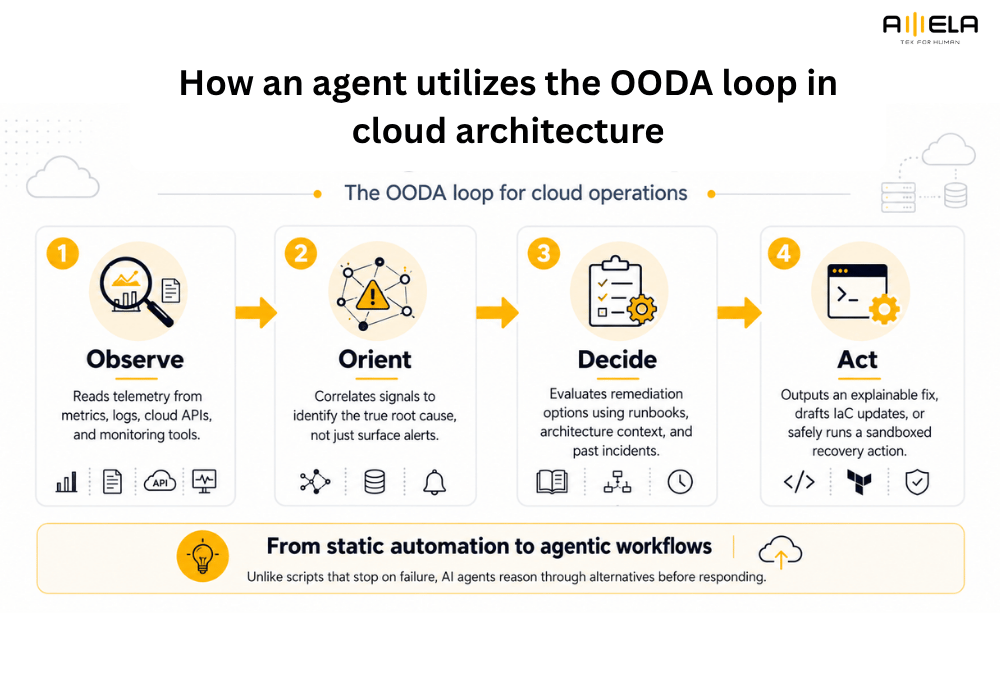
AI agents operate through a continuous feedback loop modeled on the Observe, Orient, Decide, and Act (OODA) framework. This architectural loop allows the agent to ingest raw infrastructure data and translate it into a structured operational response:
- Observe: The agent establishes read-only connections to monitoring tools, cloud provider Application Programming Interfaces (APIs), and log aggregators to scan for system anomalies.
- Orient: Instead of raising an alert for every minor CPU spike, the agent correlates logs, traces, and metrics to identify the true root cause of a degradation.
- Decide: The system references internal documentation, architectural topographies, and past incident logs to evaluate potential remediation strategies.
- Act: The agent outputs an explainable execution plan, writes the required infrastructure-as-code (IaC) updates, or safely executes a targeted recovery command within a sandboxed environment.
How do AI agents optimize AWS, Azure, and multi-cloud operations?
Autonomous agents optimize cloud environments by unifying telemetry analysis across diverse platforms. By interpreting cross-cloud dependencies via standardized protocols, they eliminate specialized management silos, accelerate root-cause analysis, and minimize cross-network operational errors.
Case 1: Managing heterogeneous environments across AWS and Azure
Using open integration standards like the Model Context Protocol, modern AI agents easily evaluate dependencies that span completely different cloud provider environments (Forbes). Operating a multi-cloud infrastructure usually requires separate engineering teams specialized in AWS CloudWatch and IAM policies on one side, and Azure Monitor and Entra ID on the other. This creates systemic knowledge boundaries that slow down incident response.
The latest cloud-native tooling directly addresses this problem. For instance, the generally available AWS DevOps Agent natively connects to Azure workloads using MCP servers. If an application tracking data across both clouds suffers a drop in throughput, a single agent can simultaneously audit an AWS Lambda function’s execution latency and verify an Azure SQL Database’s connection pool limits, generating a unified diagnostic journal that highlights where the cross-cloud handshake broke down.
Case 2: Autonomous incident response and site reliability engineering
By automating the initial triage and root-cause analysis phases, agents reduce the mean time to resolution from hours to minutes. When a production outage occurs at 2:00 AM, the primary bottleneck is human cognitive assembly—getting engineers out of bed, ensuring they have the right context, and manually digging through millions of log lines.
[System Alert Fired]
▼
│ AI Agent Observes Telemetry Drift │
▼
│ Orients: Correlates Logs & App Code │
▼
│ Decides: Builds Sandbox Repair Plan │
▼
│ Acts: Presents Fix to Human SRE │
An agentic site reliability engineering (SRE) workflow runs persistently in the background. The moment a service-level agreement (SLA) metric slips, the agent isolates the affected containerized resources, evaluates recent code commits in the repository, and reviews previous cluster states. Platforms like Azure Agentic DevOps and third-party tools like Resolve AI pull these disparate telemetry streams into an explainable root-cause summary. The human engineer on call avoids the tedious work of log parsing and can immediately focus on verifying and executing the agent’s recommended fix.
Case 3: Proactive FinOps and continuous cost optimization
AI agents continuously hunt for micro-inefficiencies, idle compute blocks, and misconfigured storage types that static cloud budgets miss. Traditional cloud cost optimization relies on retroactive monthly reporting or fixed threshold warnings that engineers frequently ignore due to competing product development priorities.
An autonomous agent approaches financial operations (FinOps) as an ongoing optimization task. It cross-references actual resource utilization patterns with cloud pricing metrics in real time. If an agent detects an over-provisioned elastic block storage volume on AWS or an under-utilized virtual machine scale set on Azure, it calculates the projected monthly savings, drafts the required Terraform or Bicep infrastructure changes, and flags the optimization for the development team’s approval during the next routine sprint planning window.
What are the top AI agents for DevOps in 2026?
The leading AI agents for DevOps include cloud-native tools like the AWS DevOps Agent and Microsoft Azure’s agentic core, alongside specialized third-party software like Sysdig Sage, Snyk Evo, and CodeRabbit.
Cloud-native autonomous platforms
Cloud providers now build native agentic capabilities directly into their cloud management consoles to resolve issues across accounts. The AWS DevOps Agent organizes its operations using logical containers called “Agent Spaces.” These spaces securely link code repositories, infrastructure-as-code files, and telemetry platforms. By automatically discovering connected services, the agent builds a dynamic topology map of your systems. When a performance issue arises, it traces the error graph across components—such as identifying a specific code update that occurred right before database throttling began.
Similarly, Microsoft’s Agentic DevOps ecosystem integrates GitHub Copilot directly with Azure infrastructure. This allows developers to assign multistep tasks, such as provisioning deployment pipelines or verifying cloud security configurations, directly from their primary development environments.
Third-party security and observability agents
Independent software tools focus deeply on targeted areas like container monitoring, security compliance, and code review verification. Rather than managing an entire cloud provider setup, these specialized agents connect directly to continuous delivery pipelines or live server environments. For instance, Sysdig Sage serves as an interactive security analyst that translates natural-language questions into complex infrastructure queries, quickly pinpointing container vulnerabilities during live production incidents.
Meanwhile, tools like Snyk Evo analyze infrastructure configuration files to catch security risks before code is ever deployed to the cloud.
| AI Agent | Primary Cloud Target | Core Operational Focus | Execution Context |
| AWS DevOps Agent | AWS & Multi-Cloud | Automated incident triage, SRE tasks, topology mapping | Production environments, Slack, Slack-integrated channels |
| Azure Agentic DevOps | Microsoft Azure | Continuous integration setups, pipeline creation, secure cloud delivery | Azure Dev Tools, GitHub Enterprise |
| Sysdig Sage | Multi-Cloud & Kubernetes | Container security analysis, active threat detection, compliance audits | Runtime monitoring environments |
| Snyk Evo AI-SPM | Cloud-agnostic | Infrastructure-as-code linting, cloud posture risk management | Deployment pipelines, code repositories |
CTO Decision Framework: How do you evaluate your organization’s agentic maturity?
Evaluating agentic maturity requires assessing your infrastructure readiness across four distinct levels, moving from basic manual scripts up to multi-agent production orchestration.
The four stages of cloud operational maturity
Transitioning toward autonomous operations requires a step-by-step evolution from static configuration files to platforms that safely suggest their own code fixes. Organizations cannot skip foundational automation steps; an agent is only as good as the underlying monitoring metrics it ingests. Before deploying advanced toolsets, executing a structured DevOps implementation plan can help you audit your baseline telemetry and clean up messy repository documentation.
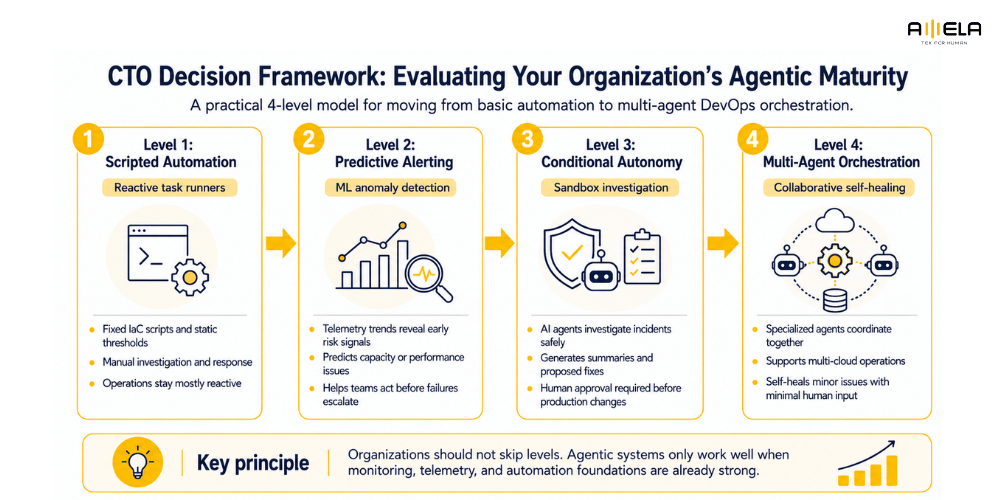
- Level 1: Scripted Automation: Your team uses traditional infrastructure-as-code tools and fixed monitoring thresholds. Operations remain entirely reactive and manual.
- Level 2: Predictive Alerting: Systems analyze telemetry trends using machine learning to predict capacity bottlenecks or code anomalies before an official failure occurs.
- Level 3: Conditional Autonomy: AI agents actively investigate alerts within isolated sandbox spaces, generating clear incident summaries and verified code patches for human approval.
- Level 4: Full Collaborative Orchestration: Multiple specialized agents coordinate with one another to manage multi-cloud platforms, continuously self-healing minor infrastructure failures with minimal human intervention.
What are the primary risks of AI agents in DevOps?
Deploying autonomous systems into production code environments introduces notable technical risks around configuration errors, hidden processing costs, and system security drift.
Managing configuration drift and data exposure
Without strict access boundaries, an autonomous agent can accidentally open public cloud storage blocks or leak internal system variables within its outbound training tokens. Large language models operate on probabilistic reasoning rather than absolute rules. If an agent attempts to resolve a network outage without firm operational boundaries, it might modify access security groups in a way that exposes backend servers to the open internet.
Furthermore, if an agent continuously loops while trying to fix an unresolved software bug, it can quickly generate thousands of unneeded cloud instances, causing massive infrastructure cost inflation overnight.
Designing strict human-in-the-loop policies
Operational security relies on setting strict read-only access limits for discovery and requiring multi-factor human confirmation before altering live cloud code. To minimize risks, engineering teams should restrict AI agents to read-only roles when gathering telemetry data.
When an agent proposes a fix—such as updating a cloud configuration file or restarting a database cluster—the action should be routed to a communication tool like Slack or Jira. The system must wait for an engineer to authenticate and click “Approve” before any changes are written to production.
When should your business build, buy, or outsource its AI-Ops capabilities?
Organizations must carefully balance the high development costs of custom tool creation against the faster execution speed of working with experienced external infrastructure teams.
The cost and talent overhead of in-house AI development
Building custom AI orchestration layers requires a specialized group of developers who understand vector databases, model training, and complex multi-cloud structures. For mid-sized organizations, trying to scale and maintain this niche technical capacity internally can strain operating budgets. This dynamic makes adopting curated AIOps for SMBs a much more practical strategy for achieving automated infrastructure efficiency.
Operational Reality: Senior platform engineers specialized in AI orchestration represent a high talent premium. Most growing businesses find greater long-term value by keeping their in-house teams focused on core product features.
Instead of dedicating months of internal development time to building custom infrastructure frameworks from scratch, partnering with an established external DevOps team allows you to deploy clean cloud baselines and automated guardrails in a fraction of the time.
Frequently Asked Questions (FAQ)
Will implementing an AI agent for DevOps replace my entire operations team?
No. These agents operate as specialized assistants that handle repetitive tasks like log analysis, initial incident investigation, and cost tracking. This clears away operational noise, allowing your senior engineers to focus on system architecture, security policies, and product development.
How do autonomous agents guarantee cloud compliance and data privacy?
Modern enterprise agents use secure design methodologies like isolated Agent Spaces and the Model Context Protocol. These configurations ensure your operational metadata is kept private, processing system info locally without allowing sensitive customer information to be mixed into public model training datasets.
Can AI agents operate successfully across hybrid or legacy environments?
Yes, provided the legacy components export standard telemetry data like syslog or OpenTelemetry data streams. Once these data channels are established, the agent reads old infrastructure logs just as easily as modern cloud configurations, helping bridge visibility gaps across mixed corporate setups.
Conclusion
Transitioning to an autonomous AI Agent for DevOps represents a major shift in how modern engineering teams achieve long-term stability across AWS and Azure environments. Moving from rigid script-based execution to flexible, reasoning-based platforms helps companies drastically lower their incident resolution times, identify hidden infrastructure waste, and minimize manual code bottlenecks.
However, achieving these results requires a clear understanding of your team’s operational maturity and the implementation of strict human-in-the-loop guardrails. At AMELA Technology, we build these protective boundaries directly into our managed IT services. By combining advanced automated tracking with experienced human oversight, we ensure your multi-cloud infrastructure stays resilient and scales safely.