 Aug 25, 2026
Table of Contents
Property managers handle sensitive tenant information, financial records, access systems, security footage, and compliance documents across increasingly connected properties. Managing all of this manually can make it difficult to identify risks early and keep compliance processes consistent.
AI solutions for security and compliance in property management can help teams detect threats, monitor requirements, review documents, and respond to incidents more efficiently. But AI also introduces risks around data privacy, system access, bias, and accountability.
This guide covers 10 practical AI use cases for property management, along with the security controls and implementation practices organizations should consider before deploying them.
Why Security and Compliance Matter in AI-Powered Property Management
AI can strengthen property security and compliance, but only when it is integrated with appropriate access controls, data governance, and human oversight.
Modern property management often connects property management systems (PMS), access control, surveillance cameras, payment platforms, tenant portals, IoT devices, and document repositories. AI can analyze information from these systems to identify anomalies, automate compliance checks, or prioritize risks.
However, each integration also creates another point where sensitive data must be protected.
Security goes beyond physical properties
Traditional property security focuses on cameras, alarms, locks, and access controls. AI-powered systems add digital considerations such as API permissions, user authentication, data retention, and audit logging.
For example, an AI system analyzing access events may need information from an access-control platform. A document-processing system may need access to leases or insurance records. Organizations should therefore apply least-privilege access, strong authentication, encryption, and clear audit trails.
NIST’s AI Risk Management Framework emphasizes managing AI risks throughout the system lifecycle, including cybersecurity, privacy, accountability, transparency, and fairness.
Compliance needs continuous monitoring
Property managers may need to track inspections, permits, insurance certificates, contractual requirements, and other property-specific obligations. When these processes depend entirely on spreadsheets and manual reminders, missed deadlines or incomplete records become easier.
AI can help monitor these requirements continuously by identifying missing documents, upcoming deadlines, expired certificates, or potential exceptions.
However, AI should support compliance workflows rather than replace professional judgment. Regulations can vary by jurisdiction and change over time, so AI-generated interpretations should be validated against authoritative requirements.
Data governance is essential
AI systems may process tenant identities, payment information, lease records, access logs, or video footage. Property managers therefore need to know what data an AI system can access, where it is stored, how long it is retained, and who can use it.
The objective is not simply to automate more processes. It is to build AI workflows that improve security and compliance without creating unnecessary data exposure or uncontrolled decision-making.
10 AI Solutions for Security and Compliance in Property Management
The most practical AI solutions focus on specific security and compliance workflows, from threat detection and access control to document review and incident management.
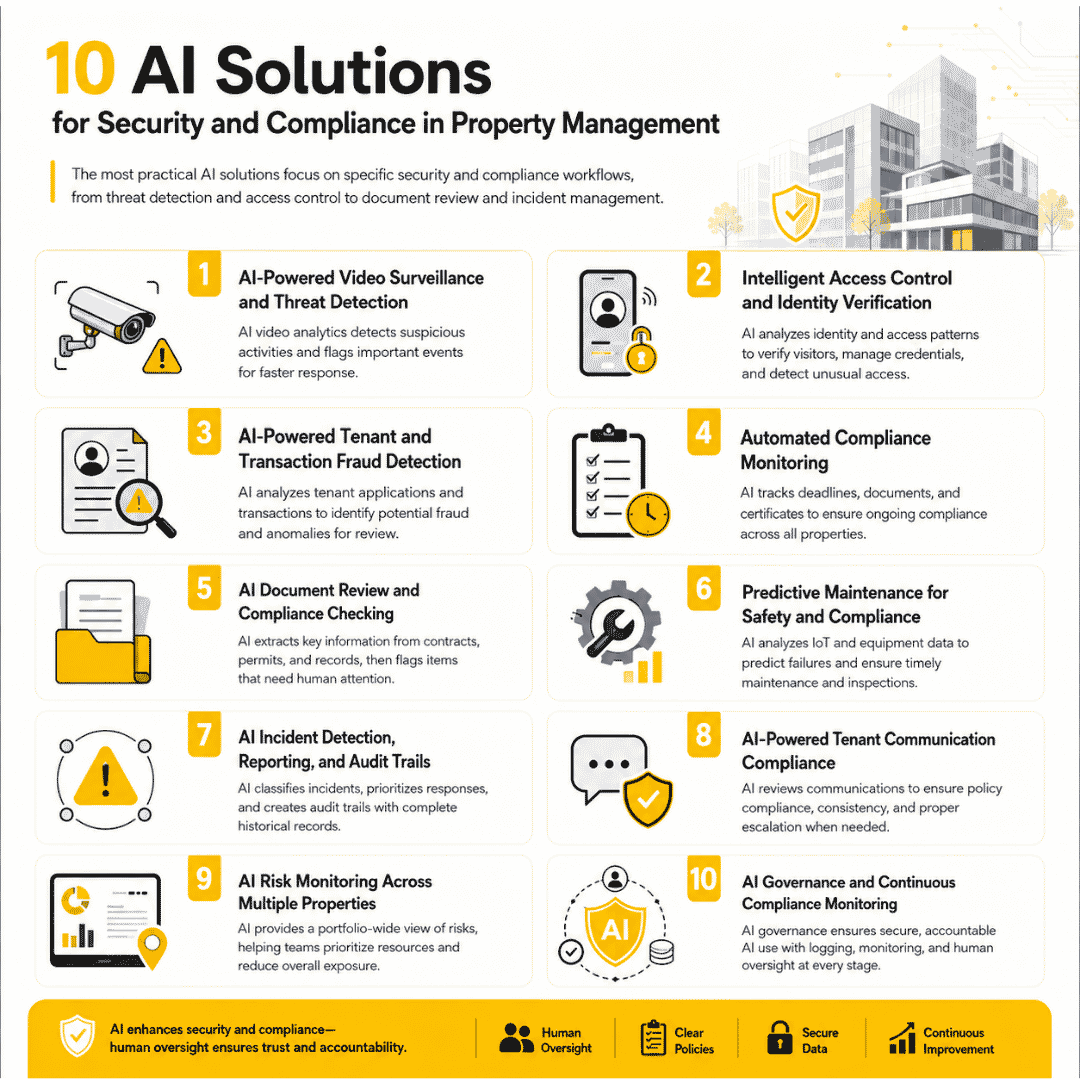
1. AI-Powered Video Surveillance and Threat Detection
AI-powered video analytics can identify events that require attention, reducing the need for staff to continuously monitor camera feeds.
Common applications include:
- Unauthorized entry
- Restricted-area activity
- Loitering
- Unusual behavior
- Potential safety incidents
Instead of replacing security personnel, AI can flag relevant footage for human review. This can help teams respond faster while reducing manual monitoring.
Privacy controls are equally important. Organizations should define who can access footage, how long recordings are retained, and how AI-generated alerts are reviewed.
2. Intelligent Access Control and Identity Verification
AI can make access systems more responsive by analyzing identity, authorization, and access patterns.
Use cases include:
- Visitor verification
- Digital credentials
- Temporary contractor access
- Unusual access detection
- Automatic expiration of temporary permissions
For example, an AI system could flag a contractor entering a restricted area outside an approved maintenance period.
AI should not automatically receive unrestricted control over physical security systems. Role-based access, API authorization, and human approval for high-impact actions can limit the consequences of incorrect AI decisions.
3. AI-Powered Tenant and Transaction Fraud Detection
AI can analyze applications, payments, and transaction patterns to identify cases that may require further investigation.
It can flag:
- Inconsistent application information
- Duplicate records
- Unusual payment patterns
- Potentially manipulated documents
- Anomalous activity
The important distinction is that AI should identify potential risk rather than automatically make consequential tenant decisions. Human review remains important, particularly for tenant screening and other processes where biased automated decisions could create legal or fairness concerns.
4. Automated Compliance Monitoring
AI can help property managers continuously track recurring compliance requirements instead of relying entirely on manual spreadsheets and reminders.
Potential applications include:
- Monitoring inspection deadlines
- Identifying missing documentation
- Flagging expired certificates
- Tracking property-specific requirements
- Prioritizing unresolved compliance issues
AI works particularly well when combined with rules-based controls. Explicit requirements, such as whether a required document exists or has expired, can often be handled through deterministic rules, while AI can help interpret documents and identify less structured exceptions.
5. AI Document Review and Compliance Checking
Property managers deal with leases, vendor contracts, insurance certificates, permits, inspection records, and other documents that require regular review.
AI-powered document processing can extract information such as:
- Expiration dates
- Contract parties
- Property details
- Required clauses
- Insurance information
- Missing fields
The system can then flag documents that need human attention.
For compliance purposes, organizations should retain an audit trail showing the original document, information extracted by AI, and the final human decision. This makes the AI workflow easier to verify when something goes wrong.
6. Predictive Maintenance for Safety and Compliance
AI can analyze equipment and sensor data to identify maintenance risks before they become safety or compliance problems.
Property teams can apply predictive analytics to HVAC systems, elevators, electrical equipment, water systems, and other building infrastructure. AI can identify abnormal patterns and prioritize inspections or maintenance instead of waiting for equipment to fail.
A 2025 systematic review published in Property Management identifies predictive maintenance using IoT data as one of the key applications of AI in property management, while also highlighting data security and ethical governance as adoption challenges.
The compliance benefit comes from connecting these predictions with maintenance records and inspection requirements. For example, an abnormal sensor reading could trigger a maintenance task while automatically recording the inspection or repair.
7. AI Incident Detection, Reporting, and Audit Trails
AI can help property teams detect, classify, and document incidents faster while creating a consistent record of what happened.
An AI incident workflow can:
- Classify incoming incidents
- Prioritize urgent cases
- Summarize relevant information
- Route incidents to the appropriate team
- Track response times
- Maintain an audit trail
For example, a security alert could be combined with access logs and camera events to give a manager a concise incident summary instead of requiring them to check several systems manually.
For more complex environments, organizations can also use AI-powered incident triage and root cause analysis to move from simply recording an incident toward understanding why it occurred.
The underlying evidence should always be preserved, with AI-generated analysis clearly separated from verified facts.
8. AI-Powered Tenant Communication Compliance
AI can review routine tenant communications and help property teams maintain consistent policies and escalation procedures.
Potential applications include:
- Checking automated messages against predefined policies
- Identifying missing information
- Maintaining communication records
- Routing sensitive requests to staff
- Standardizing responses to common questions
This can be useful for high-volume communication, but AI should not independently handle issues requiring legal interpretation or sensitive judgment. Human escalation remains important for disputes, financial decisions, access restrictions, and tenant-rights issues.
9. AI Risk Monitoring Across Multiple Properties
AI can provide a portfolio-wide view of security and compliance risks instead of requiring teams to review each property separately.
A centralized AI layer can compare signals across properties and identify:
- Repeated security incidents
- Unusual access patterns
- Recurring maintenance problems
- Missing compliance records
- Properties with unusually high risk levels
This allows managers to prioritize resources based on risk rather than treating every property equally.
Research published in Property Management also identifies the combination of AI with IoT and other digital technologies as an emerging opportunity, while emphasizing data security, ethical governance, and human-AI collaboration as important adoption considerations.
10. AI Governance and Continuous Compliance Monitoring
AI governance ensures that the AI itself remains secure, monitored, and accountable throughout its lifecycle.
Governance should define:
- What data the AI can access
- Which users can operate it
- Which actions require approval
- How AI decisions are logged
- How long information is retained
- How model performance is monitored
- What happens when the AI produces an incorrect result
NIST’s AI Risk Management Framework recommends managing AI risks throughout the design, development, deployment, use, and evaluation of AI systems. Its Generative AI Profile also highlights governance, pre-deployment testing, incident disclosure, and content provenance as areas organizations should consider.
For property-management organizations, this means AI governance should be part of the system architecture rather than a policy added after deployment.
How AI Improves Property Management Security and Compliance
The main value of AI is not simply automation; it is the ability to continuously identify risks and prioritize the work that requires human attention.
Faster threat detection and response
AI can continuously analyze security events and alert teams when predefined risk patterns appear. This can help reduce the time between detection and investigation, particularly across large property portfolios.
Less manual compliance work
Automated document analysis, deadline monitoring, and exception detection can reduce repetitive administrative work. Staff can focus on resolving exceptions rather than checking every record manually.
Better audit readiness
AI workflows can maintain timestamps, decisions, supporting documents, and incident records automatically. A consistent audit trail makes it easier to determine what happened and who reviewed the outcome.
More consistent portfolio management
For organizations managing multiple properties, centralized risk monitoring can reveal recurring problems that may be difficult to identify when each property is managed independently.
However, AI should augment rather than replace existing controls and expertise. The systematic review of AI adoption in property management highlights data privacy, legal and ethical challenges, security vulnerabilities, and algorithmic bias among the barriers organizations need to address.
Security and Compliance Risks of Using AI in Property Management
AI can reduce operational risk, but poorly designed AI systems can introduce new privacy, cybersecurity, compliance, and decision-making risks.
Tenant and financial data exposure
AI systems may process tenant identities, lease information, payment records, access logs, or surveillance footage. Sending this information to third-party AI services without clear controls can create unnecessary exposure.
Property managers should define what data an AI application can access, where it is processed, how long it is retained, and whether vendors can use it for model training.
Organizations should also review the security risks of AI applications before integrating AI into sensitive property-management workflows.
Excessive system permissions
An AI tool does not necessarily need access to every system it connects to. Giving an AI agent broad permissions across a PMS, tenant database, or access-control system increases the potential impact of an error or compromised account.
Use least-privilege access, separate read and write permissions, secure APIs, and strong authentication. High-impact actions should require additional authorization where appropriate.
Algorithmic bias and discriminatory decisions
AI used for tenant screening, risk scoring, or other decisions affecting individuals can produce unfair outcomes if the training data or decision logic contains bias.
Property managers should test models against relevant groups, monitor outcomes over time, and maintain human review for consequential decisions. NIST’s AI Risk Management Framework specifically includes fairness, privacy, transparency, accountability, and security among the characteristics organizations should consider when managing AI risks.
Incorrect AI-generated information
AI can produce inaccurate classifications, summaries, or compliance recommendations. This becomes particularly risky when staff assume that an AI-generated answer is automatically authoritative.
For compliance-related workflows, AI outputs should be checked against approved policies, regulations, or other authoritative sources. High-impact decisions should have a defined human review process.
Third-party and vendor risk
Property managers also need to evaluate the security practices of external AI providers. Important questions include:
- Where is property and tenant data processed?
- How is customer data isolated?
- Is data used to train models?
- What subprocessors are involved?
- How are data deletion and retention handled?
- What happens when the AI provider experiences a security incident?
NIST notes that AI security and privacy risks overlap with broader software and infrastructure risks, meaning AI governance should be integrated into existing cybersecurity and privacy programs rather than handled separately.
Security Controls to Look for in an AI Property Management Solution
A secure AI property-management solution should combine AI capabilities with conventional cybersecurity controls, clear permissions, auditability, and human oversight.
| Security control | Why it matters |
| Encryption | Protects sensitive data in transit and at rest |
| Role-based access control | Limits users and AI services to necessary data |
| MFA/SSO | Reduces the risk of compromised accounts |
| API authorization | Controls how AI connects to PMS and other systems |
| Audit logging | Records AI and user actions for investigation |
| Data retention controls | Prevents unnecessary storage of sensitive information |
| Human approval workflows | Adds oversight to high-impact AI actions |
| Model monitoring | Helps identify performance or behavior changes |
| Incident response | Defines how AI-related security events are handled |
| Vendor security assessment | Identifies risks from external AI providers |
These controls should be considered during system design rather than after deployment. NIST’s AI RMF recommends incorporating trustworthiness considerations across the design, development, deployment, use, and evaluation of AI systems.
For smaller property-management organizations without large security teams, these principles can also be applied through practical IT security best practices for SMBs, such as strong identity management, controlled permissions, secure backups, monitoring, and incident-response procedures.
How to Implement AI for Security and Compliance in Property Management
Successful AI implementation starts with a specific risk or workflow, then adds the right data, integrations, controls, and human oversight around it.
Step 1: Map sensitive data and workflows
Start by identifying what information the AI will process and where it currently resides. This may include tenant records, access logs, surveillance footage, leases, payment data, maintenance records, and compliance documents.
Then map how that information moves between the PMS, security systems, document platforms, IoT devices, and AI services. This makes it easier to identify unnecessary data access before development begins.
Step 2: Prioritize measurable use cases
Avoid trying to automate the entire property-management operation at once. Start with a workflow where the business problem and expected outcome can be measured.
For example:
- Reduce manual document reviews
- Detect access anomalies faster
- Reduce missed compliance deadlines
- Prioritize maintenance risks
- Shorten incident-response time
The 2025 systematic review in Property Management similarly identifies predictive maintenance, tenant screening, fraud detection, and AI-powered communication as important AI applications while emphasizing the need for ethical governance and data security.
Step 3: Integrate AI with existing systems
AI rarely works effectively as a standalone tool. A typical architecture may look like:
PMS → API/integration layer → AI service → policy/rules engine → human approval → PMS or security system
The integration layer should control what information reaches the AI and what actions can return to operational systems.
Step 4: Establish governance before deployment
Define:
- Who can access the AI
- What data it can process
- What actions it can perform
- Which decisions require human approval
- How AI actions are logged
- How data is retained or deleted
- How model performance is evaluated
NIST’s AI RMF organizes AI risk management around Govern, Map, Measure, and Manage, with governance treated as a continuous function throughout the AI lifecycle.
Step 5: Monitor performance after launch
Deployment is not the end of AI governance. Teams should monitor false positives, false negatives, unusual outputs, human overrides, security incidents, and changes in model performance.
A useful principle is simple: if the organization cannot explain what an AI system accessed, decided, and changed, it is not ready for a high-impact production workflow.
AI vs. Traditional Security and Compliance in Property Management
AI does not replace traditional security and compliance controls; it adds automation and continuous analysis to processes that previously depended more heavily on manual work.
| Area | Traditional approach | AI-enabled approach |
| Video monitoring | Staff review footage | AI flags relevant events |
| Compliance | Periodic manual checks | Continuous monitoring |
| Document review | Manual inspection | AI extraction and exception detection |
| Incident management | Manual classification | Automated triage and prioritization |
| Maintenance | Reactive or scheduled | Predictive risk detection |
| Portfolio monitoring | Property-by-property | Centralized risk analysis |
| Audit preparation | Manual evidence collection | Continuous records and logs |
The important distinction is that AI can increase the speed and scale of monitoring, but the underlying policies, security controls, and accountability mechanisms still need to exist.
For example, an AI system can flag an unusual access event, but the organization still needs an access policy, authorized personnel, logging, and an escalation procedure. Likewise, AI can identify a potentially missing compliance document, but someone still needs to determine whether the document is actually required and whether the issue has been resolved.
This approach aligns with NIST’s guidance that trustworthy AI considerations should be incorporated across the design, development, deployment, use, and evaluation of AI systems rather than treated as a one-time activity.
FAQs
How is AI used for security in property management?
AI can analyze video, access logs, IoT data, and other security signals to detect unusual activity and prioritize incidents. It can help security teams respond faster, but high-impact actions should remain subject to appropriate human oversight.
How can AI help property managers stay compliant?
AI can monitor deadlines, review documents, identify missing records, and flag potential compliance exceptions. It can reduce manual checking, while compliance decisions should still be validated against applicable requirements.
Is AI safe for tenant data?
AI can be used safely when organizations apply appropriate security controls, including encryption, access restrictions, data minimization, retention policies, and vendor assessments. The level of protection should match the sensitivity of the information being processed.
Can AI replace security or compliance teams?
No. AI is better positioned as an augmentation layer. It can monitor more information and automate repetitive tasks, while people remain responsible for judgment, exception handling, and high-impact decisions.
What security controls should an AI property management platform have?
At minimum, organizations should consider role-based access control, strong authentication, encryption, API authorization, audit logging, data-retention controls, monitoring, and human approval workflows for sensitive actions.
What are the biggest risks of AI in property management?
The main risks include sensitive data exposure, excessive system permissions, inaccurate AI outputs, algorithmic bias, weak third-party controls, and insufficient monitoring. NIST recommends treating AI risk management as an ongoing process across the AI lifecycle rather than a one-time assessment.
How should companies implement AI without creating compliance risks?
Start with a specific, measurable use case. Map the data and integrations involved, establish permissions and governance, test the system before production, keep humans involved in consequential decisions, and continuously monitor performance and security.
Conclusion
AI solutions for security and compliance in property management can help organizations detect risks earlier, automate repetitive controls, and manage growing property portfolios more consistently.
The strongest implementations are not built around AI alone. They combine AI with secure integrations, well-defined policies, access controls, audit trails, and human oversight.
For property managers, a practical starting point is to identify one workflow where AI can deliver a measurable improvement—such as compliance document review, incident triage, predictive maintenance, or security monitoring—then expand once the technology and governance model have been validated.
NIST’s AI Risk Management Framework similarly treats AI risk management as a continuous process spanning governance, mapping, measurement, and management.
If you are evaluating how AI could be integrated into your property-management workflows, our AI development services can help design and build AI solutions around your existing systems, data, and business requirements.