 Oct 5, 2026
Table of Contents
AI condition assessment tools use computer vision and return data to evaluate product condition, identify inconsistencies, and flag potentially fraudulent returns for review.
For retailers, the challenge is not simply identifying whether an item is damaged. A return may involve a product swap, missing accessories, unexpected wear, or a damage claim that does not match the returned item’s condition.
AI can turn product images, return information, and historical records into structured evidence for the returns team. Recent Riskified research found that nearly half of surveyed consumers across seven countries had used generative AI to assist with return or refund claims, highlighting why retailers increasingly need stronger verification workflows.
The key is to use AI as an evidence and assessment layer, rather than automatically labeling a customer as fraudulent.
What Is AI Condition Assessment for Returns?
AI condition assessment uses computer vision and related AI models to evaluate the physical state and identity of a returned product against expected conditions and available records.
The system can analyze images or video to identify characteristics such as:
- Scratches and dents
- Tears, stains, or other visible damage
- Signs of use or wear
- Missing components
- Packaging differences
- Product labels or serial numbers
- Differences between the returned item and reference images
However, condition assessment is not the same as fraud detection.
Condition assessment asks:
What condition is this product actually in?
Fraud detection asks:
Does the available evidence conflict with the return claim or expected product state?
For example, AI may detect substantial wear on a product submitted under a “new and unused” return reason. That does not by itself prove intentional fraud. It creates a discrepancy that can be combined with other evidence and, where necessary, reviewed by a human.
This distinction is important for building a fair return process while still identifying suspicious patterns.
How AI Condition Assessment Detects Suspicious Returns
AI condition assessment can compare return evidence with product records and the customer’s claim to identify inconsistencies before a refund is finalized.
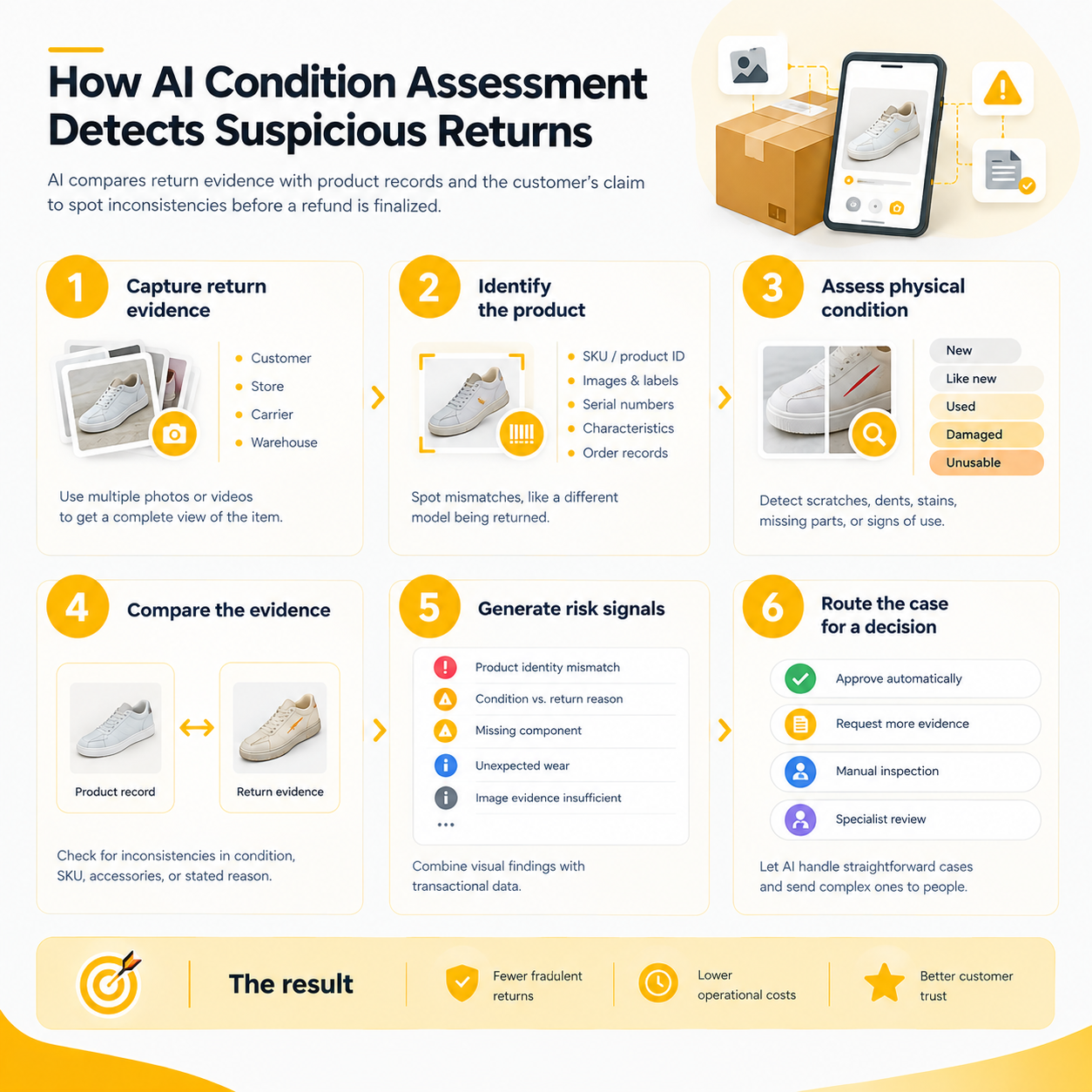
A practical workflow can look like this:
1. Capture return evidence
The process starts with photos or video of the returned item. Depending on the retailer’s workflow, evidence may come from the customer, a store, a carrier, or a warehouse inspection station.
The system can evaluate multiple images rather than relying on a single photo, which helps provide a more complete view of the item’s condition.
2. Identify the product
The system then determines whether the returned item matches the expected product.
Relevant evidence can include:
- SKU or product ID
- Product images
- Labels and packaging
- Serial numbers where available
- Product characteristics
- Order and shipment records
This can help identify a product substitution, such as a different model being returned under the original order.
3. Assess physical condition
Computer vision models can examine visible characteristics such as scratches, dents, stains, tears, missing parts, or signs of use.
For some product categories, condition can also be classified into predefined grades, for example:
New → Like new → Used → Damaged → Unusable
The categories should reflect the retailer’s actual return policy rather than relying on generic labels.
4. Compare the evidence
The system can compare the returned item’s condition with information associated with the original transaction.
For example:
- The customer reports a manufacturing defect, but the visible damage appears consistent with external impact.
- The item was sold as new, but the returned product shows significant wear.
- The returned product does not match the original SKU or visual characteristics.
- Accessories shown in the original product package are missing.
The AI does not necessarily determine why the discrepancy occurred. It identifies the difference that needs attention.
5. Generate risk signals
These observations can then become structured signals for the returns system.
A case might receive signals such as:
- Product identity mismatch
- Condition inconsistent with return reason
- Missing component
- Unexpected wear
- Image evidence insufficient
- Repeated similar return pattern
These signals can be combined with transactional information rather than making a decision from visual evidence alone.
6. Route the case for a decision
Based on the retailer’s rules, the return can be:
- Approved automatically
- Sent back for additional evidence
- Routed to manual inspection
- Held for a specialist review
This approach allows AI to handle straightforward assessments while reserving ambiguous or higher-risk cases for people.
What AI Condition Assessment Tools Can Detect
The strongest use cases are situations where the physical condition or identity of the returned item can be compared against a clear reference.
Product swaps
AI can compare the returned item against product images, labels, or other identifying characteristics to flag potential mismatches.
This is particularly useful for products with visually distinguishable models, colors, configurations, or components.
Used-as-new returns
Visible wear can provide evidence that an item has been used even when the original return reason does not indicate use.
The system can flag indicators such as:
- Scratches
- Creasing
- Wear marks
- Damaged packaging
- Signs of installation or handling
False or inconsistent damage claims
AI can compare the reported problem with the visible condition.
For example, a customer may report a damaged screen while the submitted images show no visible screen damage but significant external impact elsewhere.
The system should flag this discrepancy rather than automatically conclude that the claim is fraudulent.
Missing components
For products sold with accessories or multiple components, computer vision can help identify whether expected items are present.
This can be useful for electronics, appliances, tools, and other products with standardized packaging.
Condition degradation
For retailers that capture product condition before shipment or during previous inspections, new return images can be compared against earlier records.
This creates a more objective basis for determining whether damage existed previously or appeared later in the product lifecycle.
What Data Should an AI Condition Assessment System Use?
AI condition assessment works best when visual evidence is combined with product, order, and return data rather than relying on a single customer-submitted image.
Useful inputs can include:
- Return photos or video: Evidence of the item’s current condition.
- Product catalog images: Reference images for comparing appearance and components.
- SKU and product specifications: Helps distinguish similar models or configurations.
- Shipment records: Information about which product was originally sent.
- Previous inspection records: Useful when the item’s condition was documented before shipment or during an earlier return.
- Return reason: Provides context for evaluating whether the observed condition matches the claim.
- Order and return history: Can provide additional risk signals when combined with the condition assessment.
- Warehouse inspection data: Human inspection results can provide valuable ground truth for evaluating and improving the system.
This creates a multimodal evidence layer.
For example, an image showing a scratched product is only one observation. When combined with the original SKU, shipment record, stated return reason, and previous condition record, the retailer has a much stronger basis for deciding whether the case needs further review.
How to Design the Human-in-the-Loop Decision Process
AI should flag inconsistencies and provide evidence for review, while people or clearly defined business rules handle ambiguous and high-impact return decisions.
A practical workflow can separate returns into different levels.
Low-risk returns
If the product matches the expected item, the condition is consistent with the return reason, and the evidence is sufficient, the return can continue through the normal process.
Uncertain cases
If the images are unclear or the model has insufficient confidence, the system can request additional photos or send the item for manual inspection.
This is preferable to forcing an automated decision from weak evidence.
High-risk inconsistencies
Cases involving major product mismatches, significant unexplained condition differences, or other strong signals can be held for trained reviewers.
The reviewer can then examine the AI’s findings alongside the original claim and transaction data.
Use human decisions as feedback
Reviewer outcomes can also improve the system over time.
For example, if human inspectors repeatedly determine that certain visual patterns are normal for a particular product category, those cases can inform future model evaluation and business rules.
The important principle is to separate detection from accusation. An AI system can identify that a returned item differs from the expected condition; it should not automatically interpret every discrepancy as intentional customer fraud.
Security and Privacy Considerations
Return photos and videos can contain customer information, product identifiers, or other sensitive data, so AI condition assessment needs appropriate controls around collection, storage, access, and processing.
Key considerations include:
- Limiting who can access uploaded images
- Encrypting data in transit and at rest
- Defining image-retention periods
- Removing unnecessary metadata
- Controlling access to AI models and third-party providers
- Logging sensitive data access
- Separating customer information from model-training datasets where appropriate
Retailers should also understand how external AI providers process submitted images before sending customer or product information to them.
For a broader review of risks that can arise when AI is integrated into applications, see security risks with AI apps.
Moving AI Condition Assessment From Prototype to Production
A production AI condition assessment system needs more than a computer vision model; it also needs reliable data, business rules, integrations, monitoring, and a process for handling uncertain cases.
Start with one product category
Begin with products where condition differences are relatively observable and return volume is high enough to generate useful data.
For example, a retailer might start with electronics, footwear, or appliances before expanding to categories with more subjective condition standards.
Define clear condition labels
The model needs consistent definitions for what counts as:
- New
- Like new
- Used
- Damaged
- Missing components
- Unacceptable for resale
These definitions should match the retailer’s actual refund and resale policies.
Build a representative image dataset
Training and evaluation data should cover different lighting conditions, camera angles, product variations, packaging states, and legitimate types of wear.
The dataset should also include legitimate returns. Otherwise, the system may learn to treat normal product variation as suspicious.
Establish human-reviewed ground truth
Warehouse or returns specialists can label sample cases and provide the reference against which model performance is evaluated.
This helps answer practical questions such as:
- Which damage types can the model identify reliably?
- Which products require manual inspection?
- How often does the system confuse normal wear with damage?
- Which cases need additional images?
Integrate with the returns workflow
The model becomes useful when its output reaches the systems already used by the business.
It may need to connect with:
- Return authorization systems
- Order management systems
- Warehouse management systems
- Product catalogs
- Customer support platforms
- Fraud/risk engines
If a proof of concept already works, the next challenge is making it reliable within these production workflows. A structured approach to turning a prototype into a production app can help address the infrastructure, integration, testing, and deployment work around the AI component.
Monitor performance after launch
Product catalogs change, new return patterns appear, and image quality can vary over time. Teams should therefore monitor model performance rather than assuming the initial evaluation remains representative.
How to Measure AI Return Fraud Detection
The right metrics measure both fraud-detection effectiveness and the operational cost of incorrect decisions.
Useful metrics include:
| Metric | What it measures |
| Detection precision | How many flagged cases are actually problematic |
| False-positive rate | How often legitimate returns are incorrectly flagged |
| Manual review rate | How much work remains for human teams |
| Refund decision time | Whether assessment speeds up return processing |
| Recovery value | Value protected from confirmed fraudulent or invalid returns |
| Customer dispute rate | Whether automated decisions create additional disputes |
| Reviewer agreement | How closely AI assessments align with human decisions |
A higher number of flagged returns does not necessarily mean the system is performing better.
For example, an AI model that flags 30% of returns may identify more suspicious cases but also create a large manual-review burden if many of those cases are legitimate.
The better objective is to find an operating point where the system catches meaningful inconsistencies while keeping false positives and unnecessary reviews manageable.
Where Managed Services Fit Into AI Return Assessment
Once deployed, AI condition assessment requires ongoing monitoring, integration maintenance, security management, and operational support—not just an initial model deployment.
Production teams may need to maintain:
- AI and application infrastructure
- Data pipelines
- API integrations
- Model monitoring
- Security controls
- Performance monitoring
- System updates
- Incident response
This becomes particularly important when the assessment system is connected to returns, warehouse, payment, or customer-facing workflows.
For businesses that do not want to build and operate every layer internally, managed services can support the ongoing infrastructure and operational side of the solution while internal teams focus on product and business decisions.
Conclusion
AI condition assessment tools can help retailers reduce fraudulent returns by turning product images and return data into consistent evidence for faster, more informed decisions.
The strongest approach is not to let AI make an automatic fraud accusation. Instead, use it to compare product condition, identify inconsistencies, prioritize cases, and support human reviewers.
For retailers, the practical workflow is: Capture evidence → assess condition → compare with records → identify inconsistencies → review → decide
As return volumes and fraud tactics evolve, this approach can help returns teams protect margins without treating every unusual return as fraudulent.
FAQs
How do AI condition assessment tools detect fraudulent returns?
They analyze product images or video and compare the observed condition with the return claim, product records, previous inspection data, and other relevant signals. Suspicious inconsistencies can then be routed for review.
Can AI assess product condition from photos?
Yes. Computer vision can identify visible characteristics such as scratches, dents, stains, missing components, packaging differences, and signs of wear. Accuracy depends on image quality, product category, and the quality of the assessment data.
What types of return fraud can computer vision detect?
Potential use cases include product swaps, used-as-new returns, inconsistent damage claims, missing accessories, and differences between the returned product and its expected condition.
Can AI automatically reject fraudulent returns?
It can support automated return decisions in clearly defined, low-risk scenarios, but automatically rejecting ambiguous cases can create false positives. Human review is more appropriate when evidence is incomplete or the financial or customer impact is significant.
What data does AI need for return condition assessment?
Useful inputs include return photos or video, product images, SKU information, product specifications, shipment records, previous inspection results, return reasons, and relevant transaction history.
How accurate are AI condition assessment tools?
There is no single accuracy rate that applies across retailers or product categories. Performance depends on the model, training data, image quality, product complexity, condition definitions, and how the retailer evaluates false positives and false negatives.