 Oct 13, 2026
Table of Contents
Warehouses handle high-value inventory, frequent deliveries, contractor access, and activity across multiple shifts. Traditional CCTV records much of this activity, but identifying a suspicious event across hours of footage can be difficult. AI anomaly detection for warehouse security helps flag unusual activity in real time, giving security teams a better chance to investigate before a minor incident escalates.
The need for better visibility is real. The 2025 Global Cargo Theft Report, published by BSI and TT Club in April 2026, found that insiders were involved in 22% of recorded cargo theft cases worldwide. This figure covers cargo theft broadly, not warehouse incidents alone, but it highlights the importance of monitoring both facility access and internal activity.
AI does not replace cameras, physical security, or trained personnel. Its value lies in connecting unusual events with operational context, prioritizing alerts, and helping teams investigate potential threats more efficiently.
What Is AI Anomaly Detection for Warehouse Security?
AI anomaly detection identifies activity that differs from expected patterns or predefined security rules, helping warehouse teams investigate potential risks sooner.
Unlike basic motion detection, which triggers when movement occurs within a camera’s view, AI-based systems can analyze what is moving, where it is going, and whether the activity fits the situation.
For example, motion detection might alert a guard whenever someone passes a storage aisle. An AI system could instead flag a person entering a restricted zone outside authorized hours, then compare the event with access-control records.
Depending on the system, anomaly detection can use video analytics, access logs, inventory transactions, RFID data, and other operational signals. Combining these sources can make alerts more meaningful than relying on camera footage alone.
The distinction between an anomaly and a confirmed threat is important. A worker entering a restricted area might be responding to an emergency or completing approved maintenance. AI identifies a situation worth checking; it should not automatically classify the person as suspicious or conclude that theft has occurred.
For warehouses, the goal is to detect relevant deviations, provide enough context for verification, and direct the alert to someone who can take appropriate action.
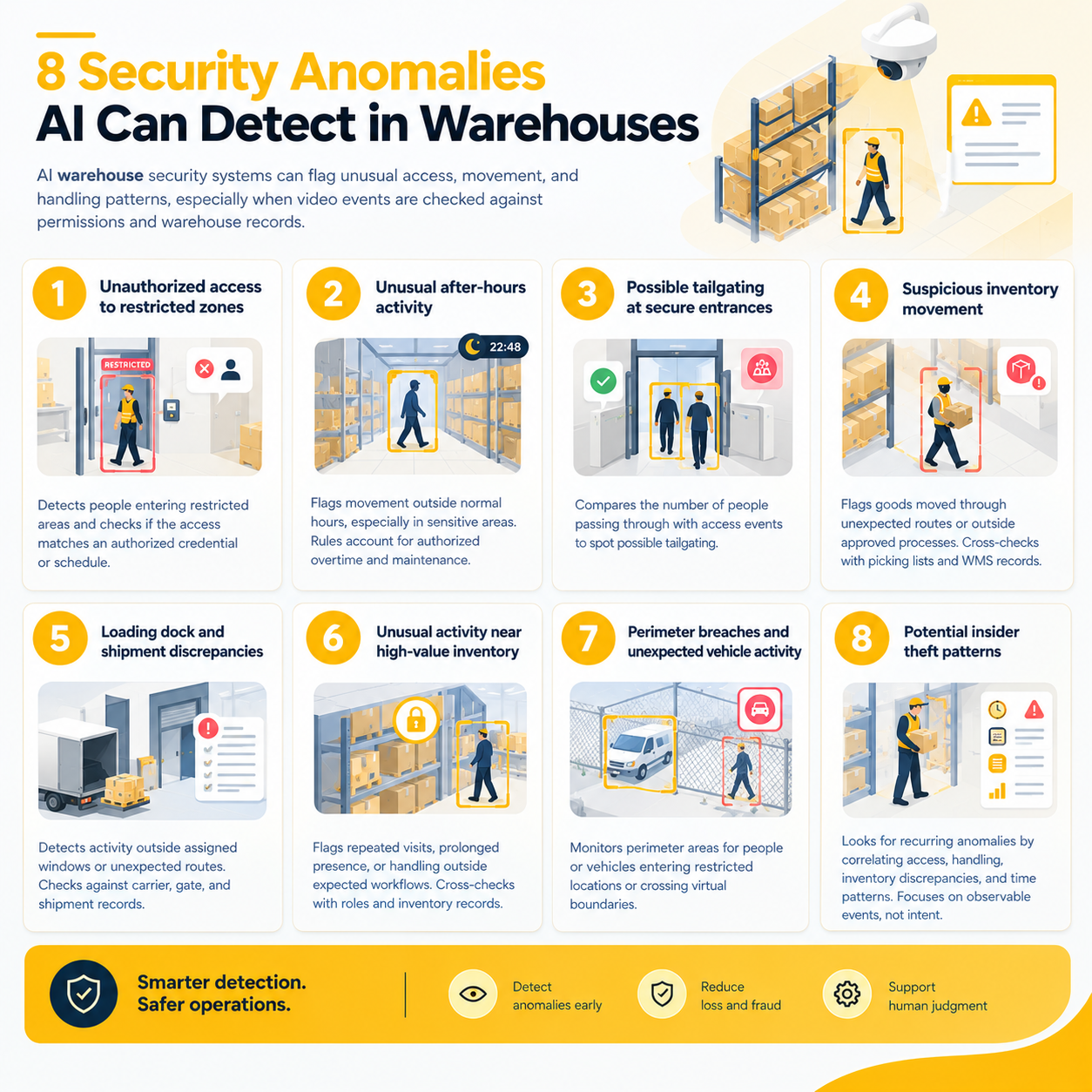
8 Security Anomalies AI Can Detect in Warehouses
AI warehouse security systems can flag unusual access, movement, and handling patterns, especially when video events are checked against permissions and warehouse records.
1. Unauthorized access to restricted zones
Computer vision can detect people entering designated areas, such as high-value storage rooms, pharmaceutical inventory zones, or equipment cages. When integrated with access control, the system can check whether an entry corresponds to an authorized credential or approved schedule.
A person entering without a matching authorization event can trigger an alert for security staff to verify.
2. Unusual after-hours activity
Activity outside normal operating hours may deserve closer inspection, particularly around loading docks, storage areas, and inventory cages.
AI can flag movement during closed periods or identify activity that conflicts with scheduled operations. Rules should account for authorized overtime, cleaning, maintenance, and emergency work to avoid unnecessary alarms.
3. Possible tailgating at secure entrances
Tailgating occurs when someone follows an authorized person through a controlled entrance without independently authenticating.
With suitable camera positioning and access-control integration, a system can compare the number of people passing through an entrance with recorded access events. A mismatch may indicate a possible security breach, although camera occlusion and closely spaced entries can affect detection reliability.
4. Suspicious inventory movement
AI can flag goods being carried through unexpected routes, removed from designated storage areas, or handled outside approved processes.
However, video alone rarely confirms whether inventory movement is legitimate. Comparing the event with picking lists, transfer orders, and warehouse management system (WMS) transactions provides stronger context.
For example, removing an item from a high-value storage area without a corresponding authorized movement record could trigger an investigation.
5. Loading dock and shipment discrepancies
Loading docks involve frequent vehicle movements, multiple handoffs, and time-sensitive operations. AI can flag events such as activity outside an assigned loading window or goods being moved through an unexpected route.
Where shipment and gate records are available, these events can be checked against the scheduled carrier, pickup authorization, and shipment status. The aim is to identify discrepancies for verification—not to assume every deviation indicates theft.
6. Unusual activity near high-value inventory
Repeated visits to a sensitive area, prolonged presence near secured goods, or handling outside an expected workflow may warrant attention when the circumstances justify it.
These signals must be interpreted carefully. Time spent in an area or repeated movement alone is not evidence of wrongdoing. Role-based permissions, assigned tasks, and actual inventory discrepancies should inform the assessment.
7. Perimeter breaches and unexpected vehicle activity
AI video analytics can monitor visible perimeter areas for people or vehicles entering restricted locations, approaching unauthorized gates, or crossing defined virtual boundaries.
This can supplement physical barriers, lighting, and intrusion sensors. Camera coverage, weather, shadows, and obstructions affect reliability, so critical perimeter zones may require multiple detection methods.
8. Potential insider theft patterns
Some inventory losses happen incrementally rather than through a single obvious incident. AI can help investigators identify recurring anomalies by correlating access events, unusual handling, inventory discrepancies, and relevant time patterns.
The system should focus on specific, observable events instead of attempting to determine someone’s intent from appearance or behavior. Any resulting concern should be reviewed against operational records and established investigation procedures.
This approach makes anomaly detection more useful as an early-warning and investigation tool while preserving human judgment for consequential security decisions.
How AI Anomaly Detection Works in a Warehouse
AI anomaly detection combines camera footage, behavioral patterns, security rules, and operational data to flag unusual events and send actionable alerts to security teams.
A typical system follows five steps.
Collect data from cameras and sensors
The system receives footage from existing CCTV cameras or dedicated security cameras. Depending on the use case, it can also access badge readers, door sensors, RFID systems, and WMS records.
Not every deployment needs all these inputs. A restricted-zone monitoring pilot may work with video and access logs, while investigating inventory discrepancies may require WMS integration.
Detect and track people, vehicles, and objects
Computer vision models identify relevant objects and track their movement through the camera’s field of view. The system can then evaluate events such as crossing a virtual boundary, entering a restricted area, or moving goods through an unexpected route.
Detection quality depends on camera placement, lighting, resolution, and visibility. Crowded aisles, stacked pallets, and obstructed views can make tracking less reliable.
Define normal activity and security rules
Anomaly detection needs context. That context may come from learned patterns, predefined rules, or a combination of both.
For example, a warehouse might define approved operating hours, restricted zones, designated vehicle routes, and permitted access roles. The system can flag activity that conflicts with those rules.
Learned behavior patterns can help identify deviations that are harder to describe in advance, but they require careful calibration as warehouse operations change.
Correlate events and assess risk
A camera may detect someone entering a high-value storage area, but the event becomes more informative when checked against access records.
If the person has valid authorization, the system may record the event without escalation. If authorization is missing or the entry conflicts with the operating schedule, it can raise an alert for review.
This is where integration adds value: the system can connect visible activity with records that explain whether it was expected.
Send alerts with useful evidence
An actionable alert should identify the event, time, location, relevant camera, and reason for escalation. A short video clip and related access or shipment records can help the security team verify what happened.
The workflow should also record the review outcome. Over time, confirmed incidents and false alarms help teams adjust detection rules, camera coverage, and alert thresholds.
AI Anomaly Detection vs. Traditional Warehouse Security
Traditional security tools record or flag events, while AI anomaly detection helps interpret activity and prioritize events that may require investigation. The two approaches work best together.
| Capability | Traditional approach | AI-supported approach |
| Video monitoring | Staff review live feeds or recordings | Analytics flags selected events for review |
| Motion alerts | Triggers when movement is detected | Can classify activity and apply contextual rules |
| Access monitoring | Logs badge use and door events | Can compare access records with observed activity |
| Inventory investigations | Staff reconcile footage and transactions | Can flag discrepancies for targeted investigation |
| Incident response | Depends on monitoring procedures | Can deliver timestamped alerts and supporting evidence |
AI does not automatically make every detection more accurate. A poorly positioned camera or an incorrectly configured rule can still generate missed events and false alarms. Basic motion detection may also be sufficient for simple requirements, such as detecting movement inside an empty room.
The strongest setup combines complementary controls. Cameras provide visual evidence, access control manages permissions, physical barriers restrict entry, and warehouse records help explain legitimate activity.
For warehouse operators, the decision should depend on the specific security gap. AI is most useful when the volume of activity makes manual review difficult or when events across several systems need to be correlated quickly.
How to Implement AI Anomaly Detection in a Warehouse
Start with one clearly defined security problem, test detection quality against real operating conditions, and expand only when the system proves useful.
1. Choose a specific use case
Avoid trying to detect every possible threat from day one. Start with a measurable problem, such as unauthorized entry into a restricted storage area or after-hours activity near loading docks.
Define what counts as an alert, which exceptions are legitimate, and who is responsible for investigating it.
2. Assess existing infrastructure
Review camera locations, lighting, image quality, network capacity, and blind spots. Check whether access-control logs or WMS records are available to provide context.
Existing cameras may be sufficient for a pilot, but not every camera supports reliable analytics. Areas with frequent obstructions or poor visibility may need repositioning or additional equipment.
3. Run a controlled pilot
Test the system against representative footage covering different shifts, lighting conditions, normal workflows, and known security events where available.
Initially, run alerts in shadow mode: the system records what it detects while existing security procedures remain unchanged. Compare its alerts with staff observations and confirmed incidents before relying on it operationally.
4. Integrate alerts with existing workflows
Connect validated alerts to the tools security staff already use, such as monitoring dashboards, incident-management systems, access control, or relevant WMS records.
The objective is to reduce the time spent finding evidence—not to create another dashboard that staff must monitor independently. For broader integration needs, AI and automation deployment for mid-market companies provides related implementation context.
5. Expand based on results
Once the pilot meets agreed performance targets, extend it to additional zones or detection scenarios. Review missed events and false alarms regularly, especially when warehouse layouts, shifts, or operating procedures change.
Facilities with specialized detection needs or multiple systems may benefit from custom AI development services that connect analytics to their existing infrastructure.
Challenges, False Alarms, and Security Risks
Reliable warehouse anomaly detection depends on controlling false alarms, protecting sensitive data, and keeping people responsible for security decisions.
Reduce false positives
A system may flag legitimate overtime, temporary storage changes, unusual but authorized movements, or activity obscured by forklifts and stacked pallets.
Tune rules around actual warehouse operations and measure false alarms by camera, shift, and event type. If a particular alert repeatedly produces no actionable finding, investigate whether the rule, camera position, or detection model needs adjustment.
Protect video and operational data
Video footage, employee access logs, and inventory records can reveal sensitive operational information.
FAQs
Can AI detect warehouse theft in real time?
AI can flag suspicious activity as it occurs, including unauthorized entry or unusual inventory movement. However, confirming theft requires reviewing the alert alongside relevant footage, access records, and inventory data.
Can AI work with existing warehouse cameras?
Often, yes. Compatibility depends on camera resolution, viewing angles, connectivity, and the analytics software’s requirements. A camera assessment helps determine whether existing equipment is sufficient or upgrades are necessary.
What is the difference between AI anomaly detection and motion detection?
Motion detection identifies movement, while AI anomaly detection can evaluate objects, locations, timing, and activity patterns to identify events that warrant closer inspection.
Can AI detect insider threats?
AI can flag potential warning signs by correlating access events, unusual inventory movements, and operational records. These indicators require investigation and should not be treated as proof of misconduct.
Does AI replace warehouse security staff?
No. AI helps prioritize monitoring and investigation, while security staff verify alerts, assess context, and coordinate appropriate responses.
Conclusion
AI anomaly detection for warehouse security helps teams move from reviewing footage after an incident to identifying potential risks as they emerge. Its effectiveness depends on more than the detection model: camera coverage, operational context, system integration, and human verification all matter.
Start with a specific security problem, test performance under real warehouse conditions, and expand when the results justify it. For businesses that need to connect AI analytics with existing security and operational systems, AMELA Technology provides AI development services to support tailored software solutions.