 Aug 10, 2026
Table of Contents
Customer relationship management (CRM) systems power sales, marketing, and customer service, but their value depends on one critical factor: data quality. As customer information flows in from websites, marketing platforms, support tools, and third-party applications, CRM databases quickly accumulate duplicate records, outdated contact details, and incomplete profiles. These issues reduce sales productivity, weaken customer insights, and limit the effectiveness of automation and analytics.
AI solutions for automated CRM data cleansing and enrichment help organizations address these challenges by continuously identifying data quality issues, standardizing records, and enriching customer profiles with minimal manual effort. Instead of relying on periodic cleanup projects or rigid rule-based workflows, AI enables businesses to maintain accurate, up-to-date CRM data at scale.
This article explains how AI transforms CRM data management, the core capabilities that drive business value, and the best practices for implementing an AI-powered solution that supports long-term growth.
Why CRM Data Quality Matters More Than Ever
Answer: High-quality CRM data is essential for reliable business decisions, efficient operations, and successful AI initiatives. As organizations manage larger volumes of customer data across multiple systems, maintaining data accuracy manually becomes increasingly difficult.
CRM has evolved beyond a sales tracking tool into the central source of customer information for many organizations. Sales, marketing, customer support, and leadership teams all rely on CRM data to understand customer behavior, forecast revenue, and plan strategic initiatives. When that data is inaccurate or incomplete, every downstream process is affected.
Common CRM Data Challenges
Poor CRM data quality rarely results from a single issue. Instead, it develops gradually as customer information is collected from multiple channels and updated by different teams.
Some of the most common challenges include:
- Duplicate records: The same customer appears multiple times under slightly different names or contact details, making it difficult to maintain a single source of truth.
- Incomplete customer profiles: Missing information such as industry, company size, or decision-maker roles limits segmentation and personalization.
- Outdated data: Job changes, new email addresses, or company mergers quickly make customer records obsolete if they are not updated regularly.
- Inconsistent formatting: Differences in naming conventions, addresses, or phone numbers reduce reporting accuracy and complicate system integrations.
- Data silos: Customer information spread across CRM, ERP, marketing automation, and support platforms creates fragmented customer views.
These challenges become more pronounced as businesses expand their digital channels and integrate additional enterprise applications.
The Business Impact of Poor CRM Data
Low-quality CRM data affects far more than operational efficiency—it influences revenue growth, customer experience, and strategic decision-making.
For sales teams, inaccurate records can lead to duplicate outreach, missed opportunities, and time spent verifying customer information instead of engaging prospects. Marketing teams may struggle with ineffective audience segmentation, while executives risk making decisions based on incomplete or misleading reports.
According to IBM, organizations lose an average of $12.9 million each year due to poor data quality, driven by operational inefficiencies, reduced productivity, and poor decision-making.
These issues also have long-term implications for AI adoption. Machine learning models, predictive analytics, and intelligent automation all depend on reliable, well-structured data. Without a trusted data foundation, even the most advanced AI initiatives are unlikely to deliver consistent business value.
Recognizing these challenges, many organizations are moving beyond manual data maintenance and adopting AI-powered approaches that continuously improve CRM data quality rather than treating it as a one-time cleanup project.
How AI Automates CRM Data Cleansing and Enrichment
AI automates CRM data cleansing and enrichment by continuously detecting inaccurate records, standardizing data, identifying duplicates, and enriching customer profiles. Unlike rule-based methods, AI learns from data patterns and adapts as customer information changes.
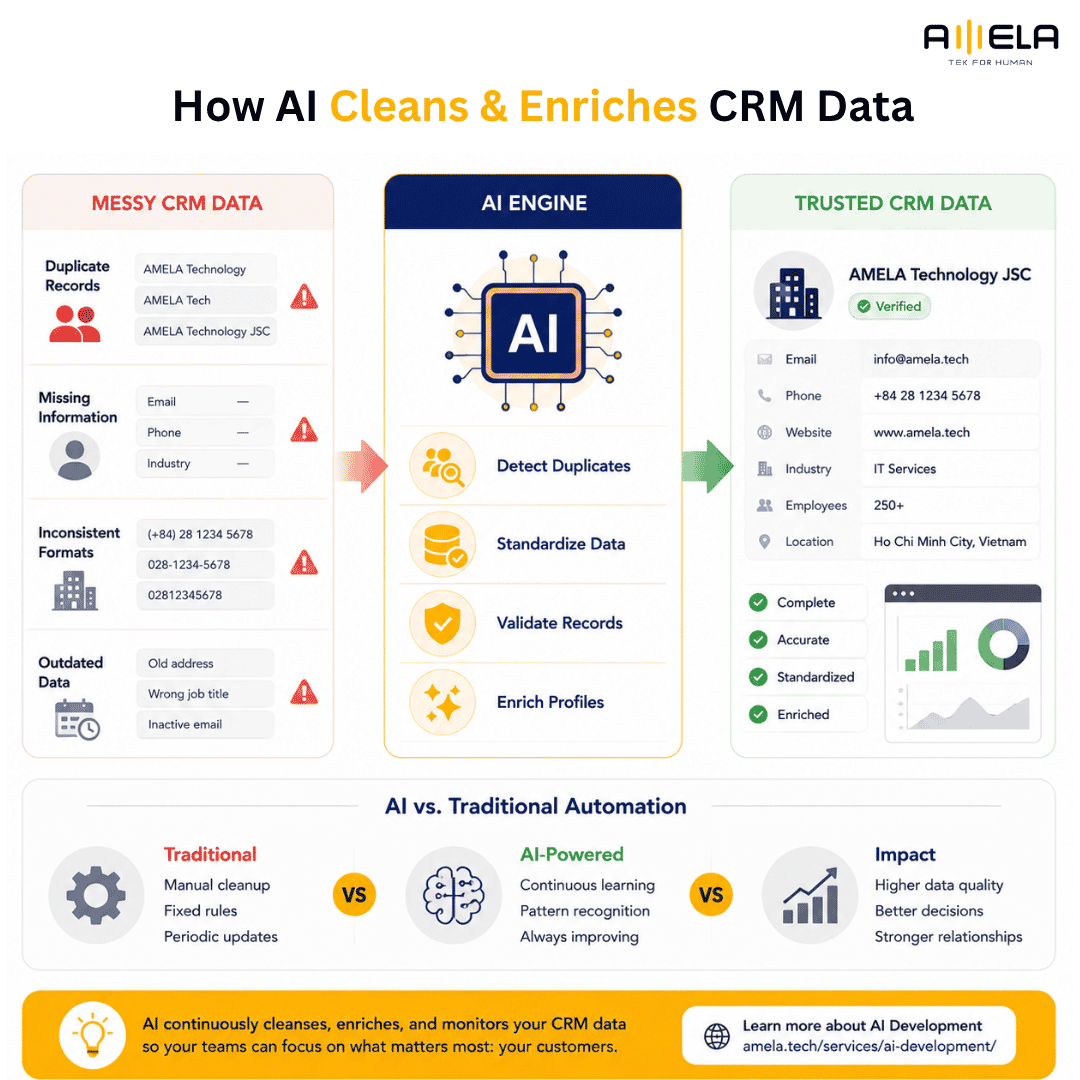
Traditional CRM data management often relies on scheduled cleanup projects or manually maintained rules. While these approaches can address basic formatting issues, they struggle to keep pace with today’s dynamic customer data. AI introduces a more intelligent, continuous approach by analyzing relationships between records, recognizing patterns, and automating repetitive data quality tasks.
AI-Powered Data Cleansing
AI-powered data cleansing focuses on improving the accuracy and consistency of existing CRM records. Rather than checking for exact matches alone, AI evaluates multiple data points to identify issues that conventional methods might miss.
Common AI-driven cleansing capabilities include:
- Duplicate detection: Identifies records that likely represent the same customer, even if names or contact details differ slightly.
- Data standardization: Normalizes fields such as company names, addresses, phone numbers, and job titles into a consistent format.
- Data validation: Flags incomplete, inconsistent, or suspicious records before they affect downstream processes.
- Error detection: Detects anomalies caused by manual entry mistakes, failed integrations, or outdated information.
For example, a rule-based system may only merge records with identical company names. An AI model can recognize that “AMELA Technology,” “AMELA Tech,” and “AMELA Technology JSC” likely refer to the same organization by considering additional signals such as email domains, websites, and addresses.
This broader understanding helps reduce duplicate records while minimizing false matches that could compromise customer data.
AI-Driven Data Enrichment
Data cleansing improves existing records, while data enrichment makes those records more complete and valuable.
AI can automatically enhance CRM data by:
- Filling missing customer attributes where sufficient context exists.
- Classifying companies by industry or business size.
- Identifying relationships between parent companies and subsidiaries.
- Updating customer information as business details change.
- Consolidating customer data from approved internal and external sources.
For sales and marketing teams, enriched customer profiles provide better context for lead qualification, account planning, and personalized engagement. Instead of working with only a company name and email address, teams gain a more complete view of each customer, helping them make faster and more informed decisions.
It’s important to note that enrichment should always align with organizational data governance policies and applicable privacy regulations. AI should enhance trusted data—not introduce unverified information into the CRM.
How AI Differs From Rule-Based Automation
Many CRM platforms already include automation features, but traditional automation follows predefined rules. AI takes a more adaptive approach by learning from historical data and recognizing patterns that fixed rules cannot easily capture.
| Rule-Based Automation | AI-Powered Automation |
| Uses predefined rules and conditions | Learns from historical data and evolving patterns |
| Best for predictable, repetitive tasks | Handles complex and inconsistent data scenarios |
| Requires frequent rule updates | Continuously improves as more data becomes available |
| Limited duplicate matching | Detects duplicates using multiple contextual signals |
| Reacts to known issues | Identifies emerging anomalies and data quality risks |
This distinction is particularly valuable for enterprise organizations managing large, constantly changing datasets. As customer information grows across CRM, ERP, marketing, and support platforms, maintaining data quality through static rules alone becomes increasingly difficult.
By combining intelligent cleansing, enrichment, and continuous monitoring, AI helps organizations maintain a trusted CRM that supports better reporting, stronger customer relationships, and more reliable business decisions.
For organizations with unique workflows or complex system integrations, a custom AI solution often provides greater flexibility than off-the-shelf tools. Tailored models can align with existing CRM processes, governance requirements, and business objectives while integrating seamlessly with enterprise applications.
Curious how AI enhances CRM data cleaning and enrichment for different types of companies? Learn more about AMELA’s AI Development Services.
AI Capabilities That Deliver Business Value
Answer: The most valuable AI capabilities don’t just improve CRM data quality—they help sales, marketing, and IT teams work more efficiently by keeping customer data accurate, complete, and actionable.
While AI can automate many data management tasks, organizations see the greatest return when these capabilities are aligned with specific business goals. The following five capabilities deliver the most significant impact across enterprise CRM environments.
1. Intelligent Record Matching and Deduplication
Duplicate records are one of the biggest obstacles to maintaining a reliable CRM. They can result in duplicate sales outreach, inaccurate pipeline reports, and fragmented customer histories.
AI addresses this by comparing multiple attributes—such as company names, email domains, phone numbers, and addresses—to determine whether two records represent the same customer. Unlike traditional matching rules, AI evaluates the overall context instead of relying on exact matches.
Business example: After integrating leads from a marketing platform and an event registration system, AI identifies duplicate company records before they enter the CRM, giving sales teams a single, complete customer profile.
2. Automated Data Standardization and Validation
Customer data often comes from multiple sources, each using different formats and naming conventions. AI automatically standardizes records and validates data quality as information enters the CRM.
This includes:
- Normalizing company names and addresses
- Standardizing phone numbers and country codes
- Detecting incomplete or inconsistent records
- Flagging invalid entries for review
By maintaining consistent data, organizations improve reporting accuracy and reduce errors during CRM integrations or migrations.
3. Customer Profile Enrichment
Complete customer profiles help teams make better decisions throughout the customer lifecycle. AI enriches CRM records by adding or updating relevant business information from trusted sources and existing organizational data.
For example, AI can help populate:
- Industry and business category
- Company size
- Geographic location
- Parent company relationships
- Customer engagement history
With richer customer profiles, sales teams can prioritize high-value accounts more effectively, while marketing teams can create more targeted campaigns without spending hours researching prospects.
4. Continuous Data Quality Monitoring
CRM data quality isn’t a one-time project. Customer information changes constantly, making continuous monitoring essential.
AI monitors CRM data in real time and alerts teams when it detects issues such as:
- An increase in duplicate records
- Missing required fields
- Unexpected formatting changes
- Synchronization errors between connected systems
Instead of waiting for quarterly cleanup efforts, organizations can resolve issues before they affect reporting, customer interactions, or downstream applications.
5. Workflow Automation Across CRM Systems
Many enterprises manage customer data across multiple platforms, including CRM, ERP, marketing automation, and customer support systems. AI helps orchestrate data quality workflows across these environments, reducing manual effort and improving consistency.
For example, an automated workflow can:
- Validate a new CRM record.
- Check for duplicate customers.
- Standardize formatting.
- Enrich missing information.
- Route low-confidence matches for human review.
- Synchronize approved updates across connected systems.
This approach enables IT teams to maintain consistent customer data while allowing business users to focus on higher-value activities instead of repetitive administrative work.
By combining these capabilities, organizations can build a more reliable CRM foundation that supports automation, analytics, and future AI initiatives.
Best Practices for Implementing AI CRM Data Solutions
Answer: Successful AI implementations depend as much on data governance and integration planning as they do on the AI technology itself. Organizations should establish clear processes before automating CRM data management.
Implementing AI without addressing underlying data management practices often leads to inconsistent results. The following best practices can help maximize long-term value while minimizing implementation risks.
Build a Strong Data Governance Foundation
AI performs best when it works with well-governed data. Before deploying AI, organizations should define:
- Data ownership and responsibilities
- Standard naming conventions
- Required data fields
- Data quality metrics
- Privacy and compliance requirements
Clear governance ensures AI improves data quality instead of reinforcing existing inconsistencies.
Integrate AI With Existing CRM Platforms
AI should complement existing business systems rather than replace them. Whether your organization uses Salesforce, Microsoft Dynamics 365, HubSpot, or a custom CRM, integration planning is critical.
Key considerations include:
- API compatibility
- Data synchronization frequency
- Security controls
- User access permissions
- Scalability for future business growth
A phased rollout—starting with a specific business unit or data domain—can help validate the solution before expanding across the organization.
Balance Automation With Human Oversight
Although AI can automate many decisions, not every recommendation should be applied automatically.
For sensitive tasks such as merging customer records or updating strategic accounts, human review remains valuable. Many organizations use confidence thresholds, allowing AI to automate routine updates while routing lower-confidence recommendations to administrators.
This hybrid approach improves efficiency while maintaining data accuracy and accountability.
Measure Business Outcomes, Not Just Data Quality
Success should be evaluated by business impact rather than the number of corrected records.
Useful KPIs include:
- Reduction in duplicate records
- Time saved on manual data maintenance
- Faster lead qualification
- Improved CRM user adoption
- Increased sales productivity
- More accurate reporting and forecasting
Organizations that connect AI initiatives to measurable business outcomes are better positioned to demonstrate ROI and guide future investments.
As AI adoption expands across enterprise operations, integrating CRM automation with broader operational intelligence can further improve system reliability and efficiency. Our guide to AIOps for SMBs explores how AI can help automate monitoring, streamline operations, and support scalable business growth.
Conclusion
AI solutions for automated CRM data cleansing and enrichment help businesses maintain accurate, reliable customer data while reducing manual effort.
As CRM data grows across multiple systems, manual data management becomes inefficient and error-prone. AI enables continuous data cleansing, duplicate detection, standardization, and enrichment, helping organizations improve sales performance, reporting accuracy, and customer insights.
If you’re evaluating how AI can improve your CRM or broader business operations, partnering with an experienced development team can help you design a solution that fits your existing systems, data governance requirements, and long-term goals. Learn more about AMELA Technology‘s AI solutions.