 Jun 26, 2026
Table of Contents
Scaling a development team quickly is not only about hiring more developers. It is about choosing the right hiring model for your delivery speed, product ownership, budget, and internal management capacity.
Many companies only realize this when delivery pressure is already high. The roadmap grows, customers expect faster releases, and internal engineers are pulled between product work, maintenance, security fixes, and technical debt. Hiring full-time developers sounds ideal, but it can take too long when the business needs capacity now.
The risk is not just delay. According to Robert Half’s 2026 technology hiring data, 71% of technology leaders say skills shortages have caused project delays in the past year, while 49% report that projects have been canceled entirely. For CTOs, product managers, and business owners, this turns hiring into a delivery strategy issue.
The best hiring models for scaling development teams quickly depend on what you need most: individual contributors, a stable product squad, full delivery ownership, or a long-term engineering structure. This guide compares the main models and shows when each one works best.
6 Best Hiring Models for Scaling Development Teams Quickly
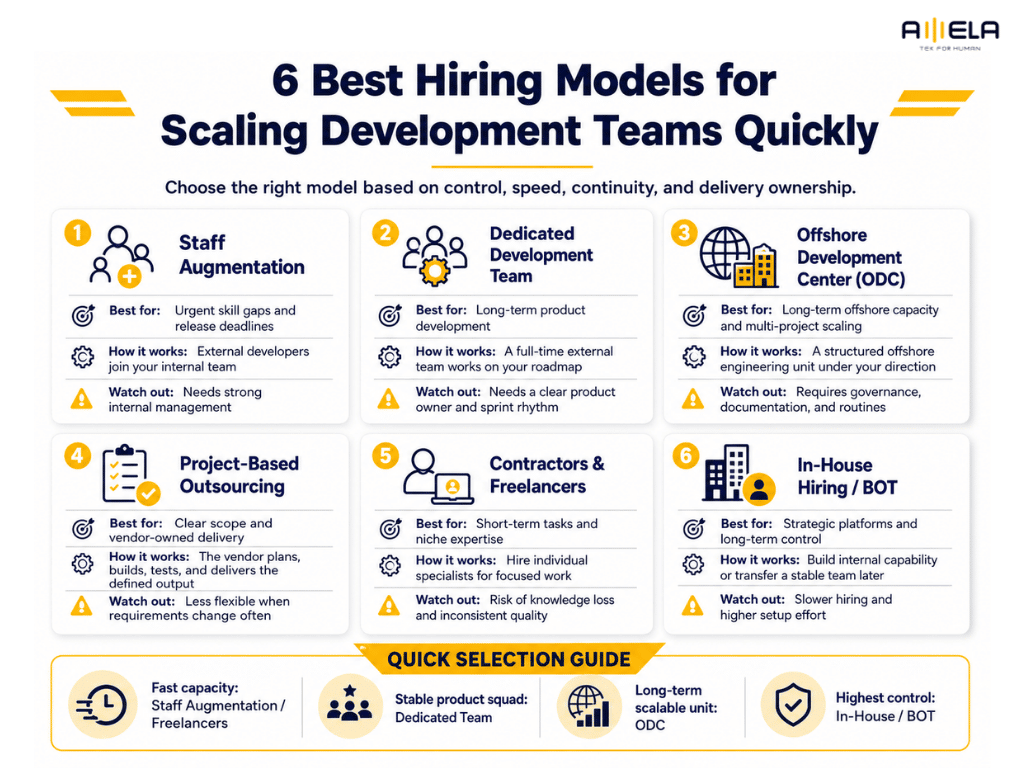
The best hiring models for scaling development teams quickly depend on whether you need extra people, a stable product squad, vendor-owned delivery, or long-term engineering control.
1. Staff Augmentation: Fast Capacity for Existing Teams
Staff augmentation helps companies add skilled developers to an existing team quickly while keeping product and delivery control in-house.
Best for:
- Filling urgent skill gaps
- Supporting an existing internal team
- Adding developers for a release deadline
- Scaling frontend, backend, QA, DevOps, cloud, or AI skills
How it works:
- External developers join your internal workflow.
- Your team manages backlog, sprint planning, code review, and delivery.
- The client keeps control over product direction and architecture.
For example, a SaaS company preparing for a major release may add only 2 backend developers and 1 QA engineer. This helps increase delivery capacity without changing the internal team structure.
Watch out:
Staff augmentation works only when your internal management is strong. If requirements are unclear, documentation is poor, or code review is slow, adding more developers can create more coordination problems.
2. Dedicated Development Team
A dedicated development team gives companies a full-time external team that works continuously on their product, roadmap, and technical environment.
Best for:
- Long-term product development
- SaaS platforms
- eCommerce systems
- Mobile apps
- Enterprise software
- Product modernization
How it works:
A dedicated team may include full roles: developers, QA, PM,…
Unlike short-term staff augmentation, this model focuses on continuity. The team builds product knowledge over time, including:
- Business logic
- Technical debt
- Release process
- Customer expectations
- Internal coding standards
This makes dedicated teams useful when the company needs more than temporary capacity.
Watch out:
A dedicated team still needs clear client-side ownership. Without a product owner, sprint rhythm, and quality standards, the team may stay busy but fail to create real delivery progress.
3. Offshore Development Center / ODC
An Offshore Development Center is a structured offshore engineering unit that helps companies scale development capacity over the long term while keeping strategic control.
Best for:
- Long-term offshore engineering capacity
- Multi-project roadmaps
- Product companies with continuous development needs
- Companies that want cost-efficient scaling without losing control
How it works:
An ODC can include different roles based on the client’s roadmap.
Compared with staff augmentation, an ODC is more structured. Compared with project outsourcing, it gives the client more control over roadmap, priorities, and technical direction.
For example, a company may build an offshore engineering unit with:
- One team for web development
- One team for mobile app development
- One team for cloud and DevOps improvement
This allows the business to scale several workstreams without hiring every role locally.
For companies that want to hire offshore development team without building everything from zero, AMELA Technology can support dedicated offshore teams across web, mobile, AI development, cloud/DevOps, and enterprise software solutions. The client keeps product ownership, while AMELA helps provide engineering capacity and team structure.
Watch out:
ODC requires strong governance. Before scaling, companies should define:
- Onboarding process
- Access control
- Documentation rules
- Reporting cadence
- Code review standards
- Communication routines across time zones
4. Project-Based Outsourcing or Managed Delivery: Best for Clear Outcomes
Project-based outsourcing is best when the company has a defined scope and wants the vendor to take responsibility for delivery execution.
Best for:
- MVP development
- Mobile app development
- Web platform development
- System integration
- Cloud migration
- Legacy modernization
- Fixed-scope modules
How it works:
The vendor is responsible for delivering a specific output. This may include:
- Project planning
- Resource allocation
- Development
- QA
- Delivery coordination
- Progress reporting
This model reduces management load because the client does not need to manage every sprint detail.
For example, a business may outsource a customer portal while its internal team focuses on core platform architecture and product strategy.
Watch out:
This model is less flexible when requirements change frequently. Scope changes can affect:
- Timeline
- Cost
- Delivery expectations
- Acceptance criteria
Before choosing this route, companies should understand common IT outsourcing models and match the contract structure to the project’s level of uncertainty.
5. Contractors and Freelancers
Contractors and freelancers can help companies start quickly, especially for short-term tasks or niche skills.
Best for:
- Prototypes
- Technical audits
- Short-term fixes
- UI support
- CI/CD configuration
- Small integrations
- Niche consulting
How it works:
Companies hire individual specialists for limited-scope work. This model is flexible and can be faster than forming a full team.
For example, a company may hire:
- A freelance UI developer for a prototype
- A DevOps contractor for CI/CD improvements
- A data engineer for a pipeline review
Watch out:
This model becomes risky when used for core product scaling. Common issues include:
- Limited availability
- Inconsistent quality
- Weak documentation
- Knowledge loss
- Security and IP concerns
Contractors work best for focused tasks, not as the foundation of a business-critical development team.
6. In-House Hiring and BOT
In-house hiring and Build-Operate-Transfer are better for companies that want long-term control over engineering knowledge, culture, and intellectual property.
Best for:
- Strategic platforms
- Core product ownership
- Long-term engineering capability
- Internal culture building
- Sensitive architecture or IP-heavy systems
How it works:
In-house hiring gives the highest level of control. Engineers are fully integrated into:
- Product vision
- Architecture decisions
- Internal culture
- Long-term roadmap
- Security and compliance processes
BOT works differently. A partner helps set up and operate an offshore team first. After the team becomes stable, operations can be transferred to the client.
Watch out:
Both models are slower than staff augmentation or dedicated teams. Recruiting, interviewing, onboarding, and retaining engineers takes time.
Before scaling internally, businesses should define a clear engineering department structure so new hires understand decision-making, ownership, and delivery responsibilities.
Hiring Model Comparison Table: Speed, Control, Cost & Use Case
Compare each model by ramp-up speed, control, predictability, management effort, and long-term fit before scaling your development team.
| Hiring model | Ramp-up speed | Control level | Cost predictability | Management effort | Best for | Main risk |
| Staff augmentation | High | High | Medium | High | Filling skill gaps inside an existing team | Client must manage delivery quality |
| Dedicated team | Medium–High | High | High | Medium | Long-term product development and roadmap scaling | Requires clear product ownership |
| ODC | Medium | High | High | Medium | Building a long-term offshore engineering extension | Needs strong governance and onboarding |
| Project-based outsourcing | Medium | Medium | High | Low–Medium | Defined scope, MVPs, modules, migrations | Less flexible if requirements change |
| Contractors / freelancers | Very High | Medium | Low–Medium | High | Short-term tasks, prototypes, niche expertise | Availability, quality, and knowledge retention |
| Build-Operate-Transfer (BOT) | Low–Medium | Medium, then High | Medium | Medium | Building a future internal offshore team | Slower setup and transfer complexity |
| In-house hiring | Low | Very High | Medium | High | Core product ownership and strategic capability | Slow hiring and high fixed cost |
For many growing companies, the strongest approach is hybrid. For example, you may keep product management and architecture in-house, use staff augmentation for urgent skill gaps, and build a dedicated offshore team for stable product development.
How to Choose the Right Hiring Model to Scale a Development Team
Choose the hiring model based on what you need to scale: people, a product squad, delivery ownership, or long-term engineering capability.
A common mistake is choosing a model based only on cost or speed. A better approach is to clarify the real scaling problem first.
Ask these questions:
- Do we need individual developers or a full team?
- Do we want to keep delivery ownership in-house?
- Is the scope clear or still changing?
- Do we have enough internal managers and tech leads?
- Is this a short-term capacity gap or a long-term roadmap?
- How much control do we need over architecture, security, and quality?
If You Need Developers in Days or Weeks
Choose staff augmentation or contractors when you already know exactly what roles are missing.
This works best when your team already has:
- Clear tasks
- Strong tech leads
- Fast onboarding
- Code review process
- Sprint management
- Defined engineering standards
It is useful for urgent releases, workload spikes, and temporary skill gaps.
If You Need a Full Product Squad
Choose a dedicated development team or ODC when you need more than individual developers.
This is usually better for: product companies, SaaS platforms, long-term roadmap delivery, continuous feature development, multi-role engineering capacity
A stable squad can include frontend, backend, QA, DevOps, and project coordination roles. Over time, this reduces repeated onboarding and improves product understanding.
If You Need Delivery Ownership
Choose project-based outsourcing or managed delivery when your internal team does not have enough time to manage the work directly.
This model fits projects with clear:
- Scope
- Timeline
- Acceptance criteria
- Technical requirements
- Delivery responsibilities
It works well for MVP development, app development, system migration, API integration, or cloud implementation.
If You Need Long-Term Control
Choose in-house hiring or BOT when the product is central to your business and you want to build permanent engineering capability.
This is not the fastest route, but it can be the right long-term decision when the company needs stronger control over:
- Culture
- Technical knowledge
- Security
- Architecture
- Product ownership
- Internal engineering standards
Companies can also combine this with an offshore dedicated team during the transition period to avoid slowing down delivery.
Common Risks in Fast Scaling Development Teams
Fast scaling fails when companies add people before fixing ownership, onboarding, communication, and quality control. The hiring model matters, but execution discipline matters more.
| Failure mode | Business impact | Practical mitigation |
| Hiring before defining ownership | Developers wait for decisions and delivery slows down | Assign product, technical, QA, and delivery ownership early |
| Weak onboarding | New engineers take too long to become productive | Prepare product docs, setup guides, architecture notes, and first tasks |
| No coding standards | Code quality becomes inconsistent | Define review rules, testing expectations, and definition of done |
| Poor communication rhythm | Teams work on different assumptions | Use sprint ceremonies, written updates, and decision logs |
| Knowledge silos | One person becomes the bottleneck | Require documentation, walkthroughs, and shared module ownership |
| Security gaps | Source code, credentials, or data may be exposed | Use access control, VPN, least privilege, and isolated environments |
| Measuring only headcount | More people do not improve delivery | Track cycle time, defect leakage, release frequency, and sprint reliability |
FAQs
What is the fastest hiring model for scaling a development team?
Staff augmentation and contractors are usually the fastest models when you need individual developers quickly.
They work well when your internal team already has:
- Clear backlog
- Strong tech leads
- Existing sprint process
- Defined coding standards
- Enough capacity to manage new people
Is outsourcing software development cheaper than hiring in-house?
Outsourcing can reduce recruitment effort, onboarding burden, and operational overhead, but it is not always “cheaper” in a simple hourly-rate comparison.
The better question is total cost. Companies should compare:
- Hiring time
- Recruitment cost
- Management effort
- Rework risk
- Quality control
- Knowledge retention
- Delay cost
- Long-term scalability
In-house hiring may be better for core product ownership. Outsourcing, dedicated teams, and ODCs may be better when the company needs faster capacity and more flexible scaling.
Which hiring model is best for startups?
For startups, staff augmentation or a dedicated development team often works best, depending on the internal team.
If the startup has a strong CTO or tech lead, staff augmentation can help move faster without giving up product control.
For an early MVP with fixed requirements, project-based outsourcing can also work. But if the product is expected to change quickly, a flexible dedicated team may be safer than a fixed-scope contract.
Which hiring model is best for enterprises?
Enterprise software development usually needs stronger governance, so dedicated teams, ODCs, BOT, or managed delivery models are often better than fragmented freelance hiring.
Conclusion
The best hiring models for scaling development teams quickly are not chosen by speed alone. A model that helps you add developers fast can still fail if ownership, onboarding, architecture standards, and communication are weak.
For short-term capacity gaps, staff augmentation or contractors may be enough. For long-term product delivery, dedicated teams and ODCs offer stronger continuity. For clearly defined outcomes, project-based outsourcing can reduce internal management pressure. For strategic platforms, in-house hiring or BOT may provide stronger long-term control.
The right decision depends on your roadmap, internal leadership, scope clarity, budget, and tolerance for delivery risk. Before choosing a model, evaluate not only how fast you can hire, but how well the team can deliver, retain knowledge, and scale without creating technical debt.
If you need a flexible offshore team to scale software development faster, AMELA Technology can help you build the right model at https://amela.tech/.