
 Mar 15, 2026
Table of Contents
How you structure an engineering department has a direct impact on delivery speed, code quality, and team scalability.
As companies grow, engineering teams often become larger and more specialized, making it important to organize roles, responsibilities, and reporting lines clearly. Some organizations scale internally, while others extend their teams through models like staff augmentation when they need additional engineering capacity.
In this guide, we’ll look at what an engineering department structure is, the key roles involved, common team models, and practical steps for structuring an engineering organization that supports long-term growth.
What Is an Engineering Department Structure?
An engineering department structure is how a company organizes its engineering roles, responsibilities, and reporting lines.
It defines how the team works, who owns what, and how engineering supports product delivery. In practice, this structure may include engineering managers, tech leads, developers, QA, and DevOps, depending on the company’s size and needs.
A clear structure helps the team scale more smoothly, reduce confusion, and maintain stronger execution as the business grows.
Main Components of an Engineering Department Organizational Structure
An engineering department structure typically includes leadership roles, technical leadership, and execution-focused engineering teams. Each role contributes differently to strategy, architecture, delivery, and operational stability.
Below is a common hierarchy, starting from the highest leadership level.
Chief Technology Officer (CTO)
The CTO leads the overall technology strategy of the company. This role focuses on long-term technical direction, major architecture decisions, technology investments, and alignment between engineering and business goals.
A CTO typically works closely with executives, product leadership, and stakeholders to ensure the company’s technology supports growth, scalability, and innovation.
VP of Engineering / Head of Engineering
The VP of Engineering manages the entire engineering organization and ensures teams deliver reliably. While the CTO focuses on technology vision, this role focuses more on execution and operational leadership.
Responsibilities often include team structure, engineering processes, hiring strategy, delivery performance, and cross-team coordination.
Engineering Manager
Engineering managers oversee specific teams or product areas. Their main role is to make sure engineers work effectively and projects move forward smoothly.
This includes coordinating development work, supporting team members, managing performance, and helping remove blockers that affect delivery.
Tech Lead / Technical Lead
A tech lead is responsible for guiding the technical direction of a team. They help define system architecture, review important design decisions, and ensure code quality across the project.
Unlike engineering managers, tech leads focus more on technical leadership rather than people management.
Software Engineers / Developers
Software engineers are the core builders of the product. They design, implement, and maintain the system’s features and services.
Depending on the company, developers may specialize in areas such as backend development, frontend development, mobile applications, or platform engineering.
QA Engineers / Test Engineers
QA engineers ensure the software works correctly and meets quality standards. They design test plans, run manual or automated tests, and help detect issues before software is released to users.
Their work is essential for maintaining product reliability and reducing production incidents.
DevOps / Platform Engineers
DevOps engineers focus on infrastructure, deployment pipelines, and system reliability. They manage environments, automate deployment processes, monitor system performance, and ensure applications run smoothly in production.
This role helps development teams release software faster while maintaining stability.
Supporting Roles (Optional in Some Organizations)
Some engineering departments also include supporting roles such as site reliability engineers (SRE), data engineers, security engineers, or system architects. These specialists help manage complex systems, maintain platform performance, and strengthen technical capabilities as the company scales.
>>> Related: How to Build a Mobile App Development Team
Types of Engineering Department Structure
Engineering teams can be organized in several ways depending on company size, product complexity, and delivery model. There is no universal structure that works for every organization. The right setup usually evolves as the product grows and the engineering team expands.
Below are some of the most common engineering department structures used in modern software organizations.
Functional Structure
In a functional structure, engineers are grouped by specialization. Backend developers, frontend developers, QA engineers, DevOps engineers, and other specialists work within their respective teams.
This model works well for companies that want strong technical depth and consistency across the organization. Specialists can focus on their domain, share knowledge more easily, and maintain higher standards within their field.
However, functional structures can slow down product delivery because work often moves across multiple teams. A single feature may require coordination between frontend, backend, QA, and infrastructure teams, which increases dependency management.
This structure is most suitable for larger organizations or companies building complex platforms where technical specialization is critical.
Potential downside: Product delivery may become slower due to cross-team dependencies and coordination overhead.
Cross-functional Product Teams
In this structure, engineers are organized around product features rather than technical specialties. Each team typically includes backend developers, frontend engineers, QA, and sometimes DevOps support.
The main advantage is speed. Because each team owns a product area, it can design, build, test, and release features with fewer dependencies on other teams.
From experience, this structure is particularly effective for product-driven companies that need fast iteration cycles and continuous delivery.
However, the trade-off is that technical standards may vary between teams if coordination is not strong. Knowledge sharing across teams can also become harder as the organization grows.
This model works best for product companies, SaaS platforms, and startups where rapid feature delivery is a priority.
Potential downside: Technical practices and architecture may diverge across teams without strong engineering governance.
Matrix Structure
A matrix structure combines functional specialization with product-based teams. Engineers typically belong to a functional group for technical guidance but are assigned to product teams for project execution.
For example, a backend engineer may report to a backend engineering manager while working daily with a product team building a specific feature.
This setup helps balance technical consistency with product delivery speed. Functional leads maintain standards, while product teams stay focused on delivering outcomes.
The matrix model is commonly used in mid-sized and large organizations that need both technical oversight and product-focused execution.
Potential downside: Dual reporting lines can sometimes create confusion about priorities or decision authority if responsibilities are not clearly defined.
Platform and Product Structure
In this model, the engineering organization is divided into two main groups: platform teams and product teams.
Platform teams build shared infrastructure, developer tools, and internal services that support multiple products. Product teams focus on user-facing features and business functionality.
This structure allows companies to scale engineering efficiently. Platform teams reduce duplication by providing reusable services, while product teams concentrate on customer-facing innovation.
It is particularly effective for companies running multiple products or complex systems that rely on shared infrastructure.
Potential downside: Platform teams may become disconnected from product needs if communication between groups is weak.
Flat Engineering Structure
A flat structure minimizes hierarchy. Engineers work with fewer management layers, and decision-making tends to be more collaborative.
This approach is common in early-stage startups where the engineering team is small and flexibility is important. Communication flows quickly, and engineers often take ownership of multiple responsibilities.
However, flat structures become harder to manage as the team grows. Without clear leadership roles, coordination and accountability can start to break down.
This structure works best for small teams or early-stage startup development team with fewer engineers and rapidly evolving products.
Potential downside: Scaling the team becomes difficult once the organization grows beyond a certain size.
How to Structure an Engineering Department for Your Company
The right engineering department structure should match your product goals, team size, delivery model, and growth stage.
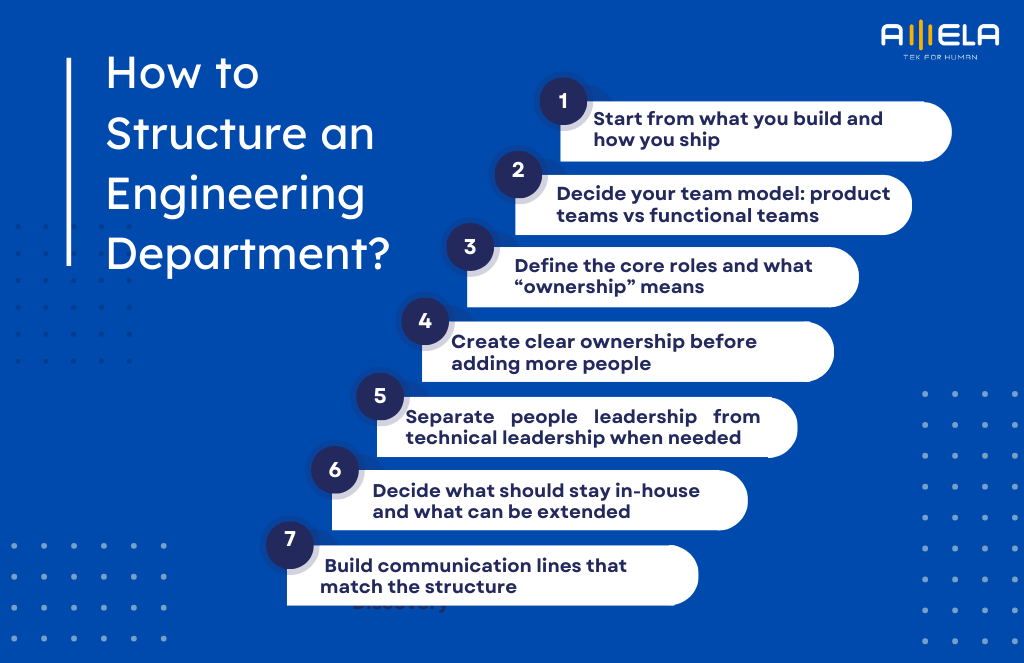
Start from what you build and how you ship
Before drawing an org chart, define the operating reality:
- How many products or domains you own
- Release frequency (weekly, biweekly, monthly)
- Quality expectations (uptime, security, compliance)
- Key bottlenecks today (speed, bugs, alignment, hiring)
This prevents the common mistake of copying another company’s structure that doesn’t match your delivery rhythm.
Decide your team model: product teams vs functional teams (or hybrid)
Most scalable orgs lean toward cross-functional product squads (PM + design + engineering + QA) because they own outcomes end to end. Functional teams (a big frontend team, a big backend team) can work early, but they often create handoff delays later.
A practical hybrid looks like:
- Product squads for features and customer value
- Platform/shared services team for tooling, CI/CD, security, core infrastructure
- Enablement functions (QA standards, architecture review) to keep quality consistent
3) Define the core roles and what “ownership” means
Unclear ownership creates slow decisions and repeated rework. Make responsibilities explicit:
- Product Manager / Product Owner: priority and outcomes
- Engineering Manager: people, delivery health, execution rhythm
- Tech Lead / Architect: technical direction, design quality, guardrails
- QA Lead: quality strategy and test discipline
- DevOps/SRE (as needed): reliability, deployments, observability
You don’t need all roles on day one, but you do need clarity on who decides what.
Step 4: Create clear ownership before adding more people
A larger team does not automatically solve delivery problems. In fact, unclear ownership gets worse as headcount increases.
Before scaling, define who owns each product area, system, or technical domain. That includes feature delivery, architecture decisions, quality standards, and operational health. When ownership is vague, teams spend too much time aligning, and not enough time building.
Step 5: Separate people leadership from technical leadership when needed
As engineering teams grow, management and technical direction often need different owners. One person may still handle both in a small team, but that becomes harder over time.
Engineering managers usually focus on team performance, planning, and execution. Tech leads focus more on architecture, code quality, and technical decisions. Splitting those responsibilities at the right time helps the team scale without overloading one role.
Step 6: Decide what should stay in-house and what can be extended
Not every company needs to build the entire engineering department internally. That is especially true when hiring is slow, budgets are tight, or product demand is increasing faster than the team can scale.
This is often where an offshore model becomes useful. For example, companies that want to extend delivery capacity without building a full local team can use an ODC in Vietnam to add dedicated engineering support while keeping clear ownership and delivery structure. When done well, this approach supports growth without forcing the company to overextend internal hiring too early.
Step 7: Build communication lines that match the structure
A structure only works if communication flows through it cleanly. Teams need to know how product decisions move, how technical issues escalate, and how priorities are shared across roles.
This becomes especially important in cross-functional or distributed teams. If reporting lines are clear but collaboration paths are not, delays start showing up fast. A good structure should make coordination easier, not heavier.
Step 8: Review the structure as the company grows
Engineering structures should evolve. What works at one stage often becomes a constraint at the next.
A team that once operated well with one lead and a few developers may later need product squads, platform ownership, or stronger engineering management. Reviewing the structure regularly helps the company adjust before delivery issues pile up.
In short, structuring an engineering department is not about copying a model from another company. It is about building a setup that supports your product, your people, and the way your business needs to scale.
Quick Examples: What Engineering Org Structures Look Like in Different Companies
Example 1: Early-stage startup (10–20 engineers)
This team setup usually wins by staying simple and shipping fast. You’ll often see 2–3 cross-functional squads (each owning a user journey like onboarding, core product, payments) with a small “platform” function handled by 1–2 senior engineers who rotate responsibilities. One engineering manager might cover multiple teams, and tech leads carry a lot of architecture decisions to keep coherence as speed increases.
Example 2: Scale-up SaaS (30–80 engineers)
At this stage, coordination overhead becomes the enemy, so teams typically organize by domains (billing, analytics, integrations, admin, customer portal). A dedicated platform team becomes non-negotiable—CI/CD, observability, security basics, and developer tooling can’t be “everyone’s side job” anymore. You’ll also start seeing enabling roles: QA leadership, architecture review, and a clearer incident ownership model so reliability doesn’t degrade as releases accelerate.
Example 3: Enterprise product company (100+ engineers, multiple products)
Enterprises usually need a structure that balances autonomy with governance. You’ll see product-aligned tribes (multiple squads per product line), plus centralized or federated groups for security, data, and platform. Release management becomes more formal, and compliance requirements often drive stronger process controls. The best enterprise orgs keep guardrails firm, but allow teams enough freedom to ship without waiting on approvals for every small change.
Example 4: Non-tech company building a digital platform (hybrid internal + ODC)
This is common in retail, logistics, finance, and manufacturing organizations that want product ownership internally but can’t hire fast enough. A practical model is: internal leads (PM, EM, tech lead) define roadmap and standards, while a dedicated offshore team executes delivery in stable pods. When done right, the ODC feels like an extension of your department—shared rituals, shared quality bar, shared roadmap—rather than a “throw work over the wall” vendor arrangement.
Conclusion
A strong engineering department structure comes from clear ownership, stable product teams, and shared standards that keep delivery predictable as headcount grows. Once that foundation is in place, scaling becomes a controlled process—add pods, expand domains, strengthen platform support—without turning the org into a coordination mess.
If you’re planning to grow the team quickly, AMELA can help you find and set up the right experts, plug skill gaps, and manage contracting end-to-end so you can scale capacity without slowing delivery.