
 Apr 8, 2026
Table of Contents
Hiring an offshore development team can help companies scale faster, access global talent, and deliver software more efficiently when done with the right setup.
In practice, offshore is not just about cost. It is about building a team that fits your product, workflow, and growth stage. When structured properly, an offshore team can operate as a seamless extension of your in-house team.
If you are exploring this model, our offshore development center services provide a structured approach to building dedicated teams that align with your long-term delivery goals.
What Is an Offshore Development Team?
An offshore development team is a software team located in another country that works remotely on your product or project.
In practice, it means your company collaborates with developers outside your local market, but they still follow your roadmap, tools, and workflow.
For example, a company in the US may work with a tech team in Vietnam to build a mobile app. The offshore team handles development and testing, while the local team manages product direction.
From what we’ve seen, the setup works when the offshore team is treated as part of the core team, not just an external vendor.
Benefits of Hiring an Offshore Development Team
The conversation around offshore development has shifted from “saving money” to “securing survival and scale.” While simple outsourcing is a transactional task-based model, building a strategic offshore development team functions as a seamless extension of your engineering DNA.
Lower development cost
Offshore development can reduce hiring cost, but the real advantage is better cost efficiency per delivered outcome.
In practice, the savings usually come from labor-market differences. U.S. software developers had a median annual wage of $133,080 in 2024, while Arc’s 2026 remote salary data shows much lower averages in offshore markets such as Vietnam ($45,848) and India ($48,918). That gap is why offshore hiring stays attractive for product teams under delivery pressure.
To keep the comparison practical, here is a simple salary-based estimate converted into rough hourly equivalents. These are market salary proxies, not agency billing rates, so actual project pricing will vary by seniority, team setup, and vendor model.
| Region / country | Annual cost benchmark | Approx. hourly equivalent |
| United States | $133,080 | ~$63.98/hour |
| Poland (CEE example) | $71,327 | ~$34.29/hour |
| Mexico (LatAm example) | $64,304 | ~$30.92/hour |
| India | $48,918 | ~$23.52/hour |
| Vietnam | $45,848 | ~$22.04/hour |
From what we have seen, this is where offshore teams make financial sense: not because they are simply cheaper, but because they let companies allocate budget across a fuller delivery setup. Instead of spending heavily on one or two local hires, a company may be able to fund a broader offshore team with development, QA, and delivery support built in.
>>> Related: Best Countries for Offshore Software Development
Faster scalability
Offshore teams make it easier to scale when local hiring is too slow or too competitive.
Speed matters here. Workable says the average global time to fill in Engineering is 62 days, and SHRM’s average time to fill across roles is 42 days.
That is the practical reason many companies go offshore. Building locally can take weeks just to close one role. If you need to add several engineers, a QA, and a team lead, the timeline stretches even more. An offshore partner can often scale faster because the recruiting pipeline, screening process, and delivery structure are already in place.
From our side, this is one of the biggest operational wins. When the roadmap expands or deadlines tighten, offshore teams give companies a quicker way to add capacity without rebuilding the hiring process from scratch.
Bridging the “Hyper-Specialized” Talent Gap
In 2026, the global talent shortage is no longer about general “coders,” but about specialized roles. According to the 2026 ManpowerGroup Talent Shortage Survey, 72% of employers globally report difficulty filling roles, with AI Model Development and Cybersecurity Automation now being the hardest skills to find.
A “local-only” hiring strategy in 2026 often results in months of vacant seats, which stalls innovation. Offshoring allows you to tap into “Centers of Excellence” (like Vietnam for AI/Fintech or Poland for high-end Backend Architecture) where the talent density for these specific niches is higher. You aren’t just “finding a developer”; you are accessing a global pipeline that is 6x larger than any single domestic market.
Institutionalized Engineering Discipline
Counter-intuitively, offshoring often improves a company’s internal documentation and processes. The 2026 State of DevOps Report found that high-performing distributed teams have 39% more automated audit trails and more standardized delivery models than centralized teams.
Because offshore teams require clear handoffs, companies are forced to move away from “tribal knowledge” and toward structured documentation, automated CI/CD pipelines, and rigorous “Definition of Done” standards. This forced discipline acts as a high-quality “Paved Road” (Platform Engineering) that benefits the entire organization, not just the offshore segment.
Risk Diversification and Operational Resilience
With 2026’s geopolitical and regional volatility, “Geographical Redundancy” has become a boardroom priority. 73% of business leaders now expect over half of their new hires to be based outside their home country to ensure business continuity.
Relying on a single talent hub (your home city) makes you vulnerable to local labor strikes, regional infrastructure failures, or localized economic downturns. An offshore team provides operational resilience; if one region faces a disruption, your development velocity doesn’t drop to zero. This “Distributed Risk” model is a hallmark of the most resilient enterprises.
How to Find and Hire an Offshore Development Team
Hiring the right offshore development team starts with clarity. Before comparing vendors, define what you need, how you want to work, and what level of support you expect.
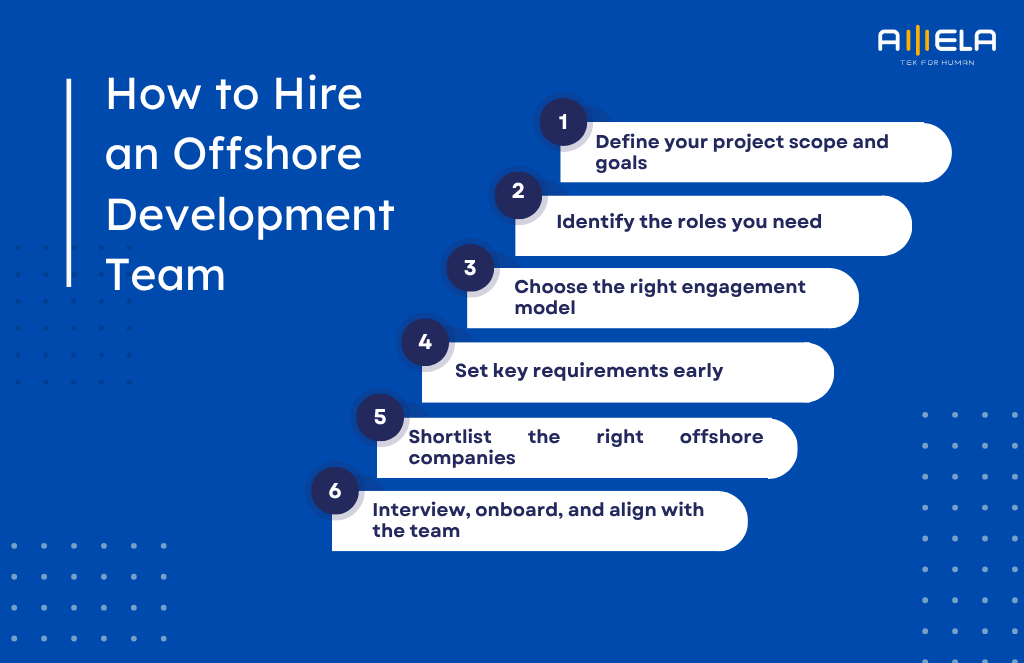
1. Define your project scope and goals
Start with the work. Not the vendor.
Be clear about what you want to build. It could be an MVP, a new module, a legacy upgrade, or ongoing product support.
I have seen offshore projects go off track early because the scope was still fuzzy. The team was capable, but the direction was not.
You do not need a perfect spec. You do need a clear brief.
At minimum, define the product goal, the team’s ownership, and the expected result in the first few months. That result could be faster releases, stronger QA, or more delivery capacity.
This step helps more than people think. It makes hiring easier. It also makes onboarding cleaner.
2. Identify the roles you need
Do not hire by headcount alone.
Hire based on how work moves through your process. Our clients tend to group roles into a few practical buckets.
- Core engineering roles: Frontend, backend, full-stack, mobile, and specialized engineers depending on the stack.
- Delivery support roles: QA, DevOps, business analysts, and project managers often sit here. These roles may not always be the first ones requested, but they have a major effect on delivery quality and speed.
- Leadership or architecture support: Tech lead, solution architect, or engineering manager depending on project complexity. Not every offshore team needs this from day one, but many growing projects eventually do.
Some companies ask for 3 developers. In reality, they need 2 developers and one QA. I have seen that mistake many times. More coders do not fix a broken workflow.
Look at where delivery gets stuck. If development is slow, add engineering capacity. If bugs keep slipping through, QA may be the real gap. If releases are unstable, you may need DevOps support. If coordination is messy, a lead or PM can help.
The goal is simple. Build the smallest team that can take work from requirement to release without constant friction.
>>> Related: How to Hire Offshore Software Developers?
3. Choose the right engagement model
The team can be good. The setup can still be wrong.
This step matters because the engagement model affects control, ownership, flexibility, and cost.
In practice, most offshore hiring cases fall into these models:
Best when you already have an internal team and just need extra capacity. You keep delivery control. The offshore side fills skill or headcount gaps.
- Dedicated team
A better fit when you need a stable group focused on your product over time. This usually works well for ongoing development, not just short-term tasks.
- Project-based model
Useful when the scope is clear and unlikely to change much. It can work for fixed deliverables, but it becomes harder when priorities shift often.
- ODC model
More suitable for long-term scaling. This model is often chosen when a company wants a more permanent offshore setup with stronger continuity.
A simple way to choose is to ask two things:
- How much delivery control do we want to keep?
- How much ownership should the offshore team take?
I have seen companies choose a project-based model when the product was still changing every week. That usually creates friction. I have also seen teams use staff augmentation when what they really needed was a more independent delivery unit.
The model should match the way you actually work, not just the way the proposal sounds.
4. Set key requirements early
This step saves a lot of back and forth later.
Before you start comparing vendors, define the requirements that will shape the collaboration. They do not need to be overly detailed, but they should be clear enough to filter out poor fits early.
Focus on the things that directly affect delivery:
- Budget range
- Preferred timeline
- Tech stack
- Time zone overlap
- Communication expectations
- Security or compliance needs
- Industry or domain experience
- Tooling preferences, if relevant
Some of these look simple on paper. In practice, they affect daily work a lot.
For example, two companies may offer similar technical quality. One may be far better aligned with your update rhythm, documentation style, or security process. That difference often matters more than a small pricing gap.
I have seen hiring slow down because key requirements were only raised late in the process. A vendor looked strong, then turned out to have limited overlap hours. Or the engineers were capable, but the team had no experience with the client’s cloud environment or delivery process.
A clear requirement list helps vendors respond more accurately. It also helps you compare them on things that actually matter once the project starts.
5. Shortlist the right offshore companies
Look beyond pricing.
A lower rate may help at first glance, but it does not say much about delivery quality. What matters more is whether the company has the right experience, a stable process, and a track record you can verify.
When shortlisting offshore partners, I would check a few things early:
- Technical fit
Do they actually work with your stack, product type, or architecture? - Delivery maturity
Can they explain clearly how they manage projects, structure teams, and handle risks? - Relevant proof
Do they have case studies, client examples, or references close to your situation?
This is also the stage where review platforms are useful.
I would recommend checking sites like Clutch, GoodFirms, and similar B2B review platforms. They are not perfect, but they help you spot patterns. You can often learn a lot from how clients describe communication, delivery consistency, flexibility, and problem-solving.
A few practical checks help here:
- recent client reviews
- ratings across multiple projects
- comments about communication and project management
- industries or project types they have handled
- whether the feedback feels detailed or too generic
Company websites usually show the best version of the story. Review sites give you a more grounded view.
You do not need a huge list. In fact, a shorter list is usually better. A few well-matched companies are easier to compare than ten vendors that all look similar on paper.
6. Interview, onboard, and align with the team
Choosing the company is not the finish line.
The next step is to make sure the actual team can work well with yours. That means validating the people, aligning on the workflow, and setting expectations early.
Start with the team itself. You do not need a long interview loop, but you should meet the key people involved. That may include developers, a team lead, a PM, or the delivery manager. I always find this part important because the company may look strong, but the real day-to-day experience depends on the assigned team.
Then move into alignment.
Keep the basics clear from the start:
- who owns what
- how communication will happen
- meeting rhythm
- tools and access
- reporting format
- escalation path
This is also the right time to define what a good first month looks like. It could be smooth onboarding, stable sprint participation, clean code review flow, or quick turnaround on the first tasks. Small, practical expectations work better than vague goals.
A good offshore company will handle much of the setup. Still, early alignment should not be skipped. In my experience, many delivery issues later on can be traced back to unclear onboarding and weak expectation-setting at the beginning.
How Much Does It Cost to Hire an Offshore Development Team?
Offshore software development cost usually depends on region, seniority, team mix, and engagement model. In most cases, Asia remains the lowest-cost option, while Eastern Europe and Latin America sit in the middle.
A practical way to estimate cost is to separate vendor billing rates from developer salary benchmarks. Billing rates help when you plan to work with an offshore company. Salary benchmarks are useful when you want to compare talent markets more broadly. Those two numbers are not the same, but together they give a more realistic view.
Estimated offshore team cost by region
| Region / market | Typical offshore company rate | Salary benchmark for remote developers | Notes |
| Vietnam | Part of Asia: $20–$50/hour | $45,848/year average | One of the most cost-efficient options for long-term offshore hiring. |
| India | Part of Asia: $20–$50/hour | $48,918/year average | Large talent pool and competitive cost, though quality can vary by vendor. |
| Eastern Europe | $30–$58/hour | Poland: $71,327/year average | Often chosen for strong technical depth and timezone fit for Europe. |
| Latin America | $25–$55/hour | — | Often preferred by North American companies for timezone overlap. |
| Global remote average | — | $70,877/year average | Useful as a broad benchmark when comparing hiring markets. |
If you are hiring through an offshore development company, a small team of 2–4 engineers in Asia will usually cost much less than building the same team locally in the US or Western Europe. The rate advantage becomes even more meaningful when the offshore setup already includes QA, PM, or delivery support. That is where offshore teams often become more cost-efficient than simply comparing hourly developer rates.
Best Practices for Hiring an Offshore Development Team
The best offshore hires happen when companies treat vendor selection like delivery design, not just recruitment. A strong team is not only skilled. It is also easy to manage, clear in ownership, and built to fit your workflow.
1. Hire for delivery flow, not just technical skill
A common mistake is focusing too much on coding ability and too little on how work will actually move.
A team may have strong engineers, but delivery can still feel slow if QA is weak, ownership is unclear, or nobody is managing dependencies properly. In practice, I would look at the full path from requirement to release.
Ask yourself:
- Who writes the code
- Who tests it
- Who reviews it
- Who handles blockers
- Who keeps delivery on track
If those pieces are fuzzy, the team is not really complete.
2. Test how the company thinks, not just what it claims
A polished proposal is easy to make. The harder part is showing good judgment.
During evaluation, pay attention to the questions the vendor asks. A strong offshore partner usually does a few things well. They challenge vague scope. They point out missing roles. They flag delivery risks early. They do not just say yes to everything.
That is often a better signal than a long capability deck.
3. Ask who stays with the project after onboarding
This part matters more than many clients expect.
Some companies put strong people into pre-sales and onboarding, then swap in a weaker delivery team later. I would clarify early:
- Who will be on the actual team
- Who manages the account after kickoff
- Whether the proposed lead stays involved
- How backup or replacement works if someone leaves
You are not hiring a promise. You are hiring the team that will still be there after the first month.
4. Check communication discipline, not just English level
Fluent English helps. Clear working communication matters more.
I have seen technically strong teams create friction because updates were vague, blockers were raised too late, or people waited too long to clarify assumptions. A good offshore team should be able to communicate in a way that keeps delivery moving.
Look for signs such as:
- Clear written updates
- Direct escalation of risks
- Specific questions, not generic ones
- Realistic estimates instead of easy promises
That is what makes remote collaboration workable day to day.
5. Start with real work, not endless interviews
Too many companies over-screen and still learn very little.
A short pilot, trial sprint, or limited workstream often tells you more than multiple interview rounds. You see how the team asks questions, handles feedback, writes code, joins your workflow, and responds under normal delivery pressure.
That gives you something much more useful than interview confidence. It gives you operating evidence.
6. Set rules for ownership early
Offshore delivery becomes frustrating when tasks are assigned but ownership is not.
Be very clear about what the team is expected to do beyond implementation. For example, should they only code from detailed tickets, or should they also raise edge cases, propose technical options, and flag requirement gaps?
This is one of the biggest differences between a team that feels like extra hands and a team that feels like a real delivery partner.
7. Look at retention and team stability before you scale
A vendor may hire fast and still create long-term problems if turnover is high.
Ask practical questions:
- What is the average tenure of engineers
- How often do people rotate off projects
- What happens if a key developer leaves
- How is knowledge transferred inside the team
A stable offshore team usually performs better over time because the product context stays inside the team. That continuity saves more time than most companies realize.
8. Do not optimize only for the lowest rate
The cheapest option often looks efficient in procurement and expensive in delivery.
If a low-cost team needs more supervision, produces more rework, or struggles with ownership, the hidden cost shows up quickly. I would compare partners based on total delivery value, not just hourly rate.
Sometimes paying a bit more for a stronger team leads to faster execution, fewer errors, and less internal management overhead. That is usually the better deal.
9. Build one operating rhythm and stick to it
Offshore teams work best when the collaboration feels routine, not improvised.
Once the team starts, lock in the basics:
- update format
- sprint rhythm
- review process
- overlap hours
- escalation route
- decision owners
This does not need to be heavy. It does need to be consistent. Remote teams lose momentum faster when working rules change every week.
10. Scale only after the first setup proves itself
A team that works well at small scale is worth expanding. A team that still feels shaky should not grow yet.
One of the more practical hiring habits is this: prove the model before you increase headcount. Add more people only after communication, code quality, and ownership are already stable.
That approach lowers risk and usually leads to a stronger offshore setup in the long run.
Case Study Snapshot: IMPT
Client context
IMPT is a Web3 platform focused on carbon credits. Users can buy, trade, and manage tokenized environmental assets, so the product needed both speed and trust from day one.
Why the offshore model fit
To support long-term product growth, IMPT chose an Offshore Development Center (ODC) model. The goal was not just to add developers. It was to build a stable team that could work like an extension of the internal product organization.
Team structure
The initial offshore team included:
- 1 Project Manager
- 1 Designer
- 1 Blockchain Developer
- 1 React Native Developer
- 2 Full-stack Developers
This gave IMPT a cross-functional setup from the start, without having to assemble each role separately in-house.
How the team worked
The offshore team was not treated as a task-only vendor. It was involved in core delivery activities such as:
- architecture design
- backlog refinement
- technical decision-making
That made a big difference. It reduced handover risk, kept product knowledge inside the team, and helped delivery stay consistent as the platform evolved.
Quality and risk management
Because IMPT operates in a trust-sensitive space, quality controls were built into the delivery process.
The team added:
- blockchain state validation and retry logic for reliable transactions
- automated CI/CD for testing and deployment consistency
- architecture documentation to keep knowledge from depending on individual team members
This approach helped the product move fast without sacrificing control.
Architecture and technology foundation
The platform was built with a scalable stack:
- Frontend: ReactJS, React Native (Expo)
- Blockchain: Hyperledger
- Infrastructure: Kubernetes, KEDA
- Data and messaging: PostgreSQL, Amazon SQS
- Delivery pipeline: Automated CI/CD
Outcomes
Since May 2024, IMPT has been live on both web and mobile.
The offshore model helped the company achieve:
- transparent, verifiable carbon credit transactions
- stable delivery with a dedicated long-term team
- faster iteration without resetting architecture or team knowledge
- stronger Web3 and ESG domain continuity over time
Why this case matters
IMPT is a good example of offshore development done properly. The value did not come from lower cost alone. It came from building a team with the right structure, the right ownership, and the ability to grow with the product.
Offshore Development Team Case Study Snapshot
IMPT is a Web3 platform focused on carbon credits. Users can buy, trade, and manage tokenized environmental assets, so the product needed both speed and trust from day one.
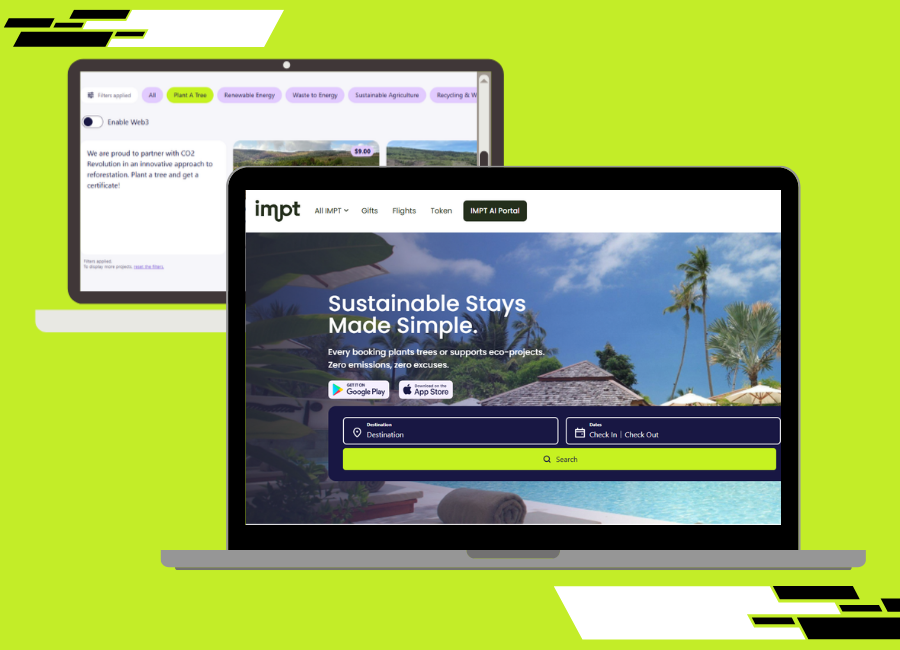
To support long-term product growth, IMPT chose an Offshore Development Center (ODC) model. The goal was not just to add developers. It was to build a stable team that could work like an extension of the internal product organization.
Offshore Team structure
The initial offshore team included:
- 1 Project Manager
- 1 Designer
- 1 Blockchain Developer
- 1 React Native Developer
- 2 Fullstack Developers
This gave IMPT a cross-functional setup from the start, without having to assemble each role separately in-house.
How the team worked
The offshore team was not treated as a task-only vendor. It was involved in core delivery activities such as:
- architecture design
- backlog refinement
- technical decision-making
That made a big difference. It reduced handover risk, kept product knowledge inside the team, and helped delivery stay consistent as the platform evolved.
Architecture and technology foundation
The platform was built with a scalable stack:
- Frontend: ReactJS, React Native (Expo)
- Blockchain: Hyperledger
- Infrastructure: Kubernetes, KEDA
- Data and messaging: PostgreSQL, Amazon SQS
- Delivery pipeline: Automated CI/CD
Outcomes
Since May 2024, IMPT has been live on both web and mobile.
The offshore model helped the company achieve:
- Transparent, verifiable carbon credit transactions
- Stable delivery with a dedicated long-term team
- Faster iteration without resetting architecture or team knowledge
- Stronger Web3 and ESG domain continuity over time
IMPT is a good example of offshore development done properly. The value did not come from lower cost alone. It came from building a team with the right structure, the right ownership, and the ability to grow with the product.
Conclusion
Hiring an offshore development team works best when it is treated as a long-term delivery strategy, not a short-term cost decision.
From what we have seen, the strongest results come from teams that are stable, well-structured, and aligned with real product needs. That is where offshore moves from “extra capacity” to a real competitive advantage.
Vietnam has become a strong destination for offshore development thanks to its growing talent pool, competitive cost, and strong engineering capabilities.
At AMELA, we support companies as a top IT outsourcing partner in Vietnam, helping you build dedicated offshore teams, scale engineering capacity, and deliver products with confidence.