 May 27, 2026
Table of Contents
Software engineering is experiencing a profound paradigm shift. Coined by AI pioneer Andrej Karpathy, “vibe coding” describes a new way of building software: instead of manually typing lines of syntax, developers and non-technical founders use natural language to guide autonomous AI agents that write, debug, test, and deploy entire codebases.
While the concept promises rapid execution, navigating the market for a vibe coding app requires an objective strategy. For founders aiming to validate a market or CTOs looking to manage technical debt, picking the wrong platform can result in broken code architectures, security vulnerabilities, and vendor lock-in.
Key Takeaways
- Vibe coding outputs production code: Unlike traditional no-code platforms, modern intent-driven tools generate standard, multi-file codebases (e.g., React, Node, Python) that can be modified, version-controlled, and exported.
- The ecosystem caters to two distinct personas: Tools are explicitly split between browser-based engines for non-technical founders and deep local IDE extensions for experienced engineers.
- The “Technical Wall” limits independent scaling: Natural-language platforms excel at building a Minimum Viable Product (MVP) but face context window degradation and recursive bug loops as system complexity grows.
- Strategic engineering partnerships preserve velocity: Transitioning from a “vibe-coded” prototype to a scalable commercial product often requires an external engineering partner to refactor the architecture, secure data pipelines, and manage cloud infrastructure.
What is a Vibe Coding App and How is it Transforming Software Development?
A vibe coding app is a development environment driven by agentic AI that translates natural language instructions into functional, multi-file software applications by automating code generation, system routing, debugging, and deployment workflows simultaneously.
The Shift from Syntax to Intent
Vibe coding abstracts away syntax mechanics, shifting the developer’s role from writing line-by-line code to directing application behavior through natural language. Historically, building a software product required deep mastery of programming languages, memory allocation, and environment configurations. In 2026, generative AI models have evolved from simple autocomplete extensions into autonomous agents. Instead of manually writing boilerplate functions, users provide high-level functional intents. The underlying AI agent analyzes the existing workspace, determines necessary file changes, writes the required logic, and runs internal tests to verify the execution.
How Natural Language App Builders Handle the Heavy Lifting
Modern agentic platforms operate as end-to-end software delivery pipelines rather than isolated text editors. When an operator issues a command—such as integrating a third-party payment gateway—the AI agent does not merely output a code snippet. It provisions environment variables, creates secure backend webhook routes, updates database schemas, and builds corresponding frontend UI components.
By handling compiling, error handling, and deployment containerization autonomously, these tools allow a single individual to iterate on software architectures at a speed that previously required a complete engineering team. To understand how these automated workflows fit into broader industry trends, it is helpful to look at the complete advantages and disadvantages impact of AI on software development.
Top Vibe Coding Tools: An Expert Technical Review
The vibe coding ecosystem is fundamentally divided between browser-based abstraction layers and local, repository-aware developer environments. Understanding the structural mechanics of these top-performing platforms allows teams to deploy them where they provide the highest architectural return on investment (ROI).
Lovable.dev
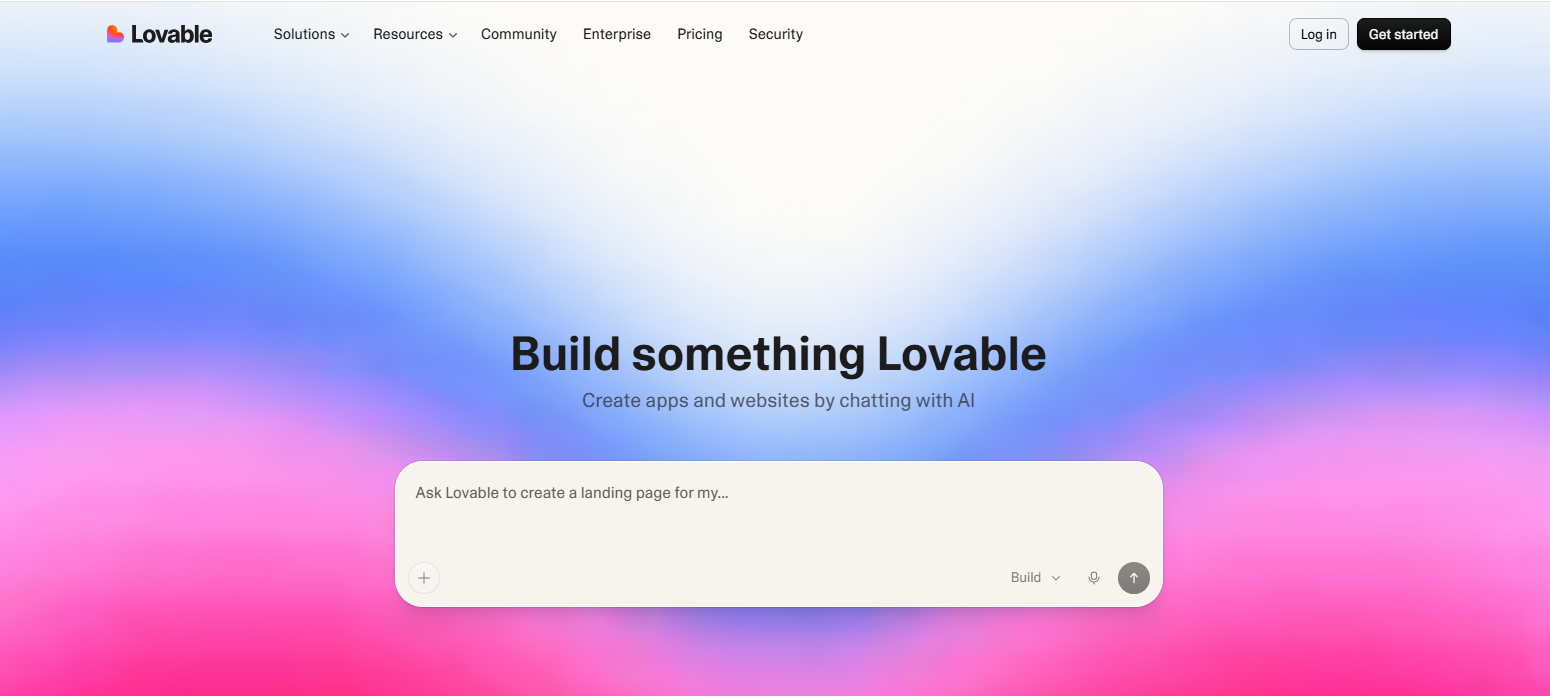
Lovable converts plain-English intent into highly styled full-stack applications with an emphasis on production-grade design fidelity. It leverages modern, modular UI components like shadcn/ui and Tailwind CSS to construct pristine web layouts. It is architected for rapid visual iterations, allowing users to click a rendered component in the preview window and prompt the AI to modify its specific logic or presentation.
[ User Text Prompt / Figma Import ] ──> [ Lovable AI Engine ] ──> [ Automatic Supabase Auth / Database ] ──> [ 2-Way GitHub Sync ]
- Best For: Non-technical founders and product managers building client-ready software prototypes and fast MVPs with real database dependencies.
- Pros: Two-way GitHub synchronization guarantees true code ownership; flawless Figma design transformations; out-of-the-box, zero-config Supabase schema and user authentication provisioning.
- Cons: Deep backend asynchronous worker processes or custom WebRTC-level networking configurations require manual code intervention outside the visual workspace.
- Pricing: Free tier with 10 design edits/month; Standard Plan at $20/month (100 credits); Pro Plan at $200/month (750 credits and priority processing agents).
Bolt.new (by StackBlitz)
Bolt.new executes an entire full-stack Node.js development container directly inside a single browser tab. Powered by StackBlitz’s WebContainers technology, it generates and compiles multi-file directories (supporting React, Next.js, and Remix) in an isolated virtual browser machine. When errors occur during building, Bolt’s autonomous loop runs internal logs through the model to correct its own syntax before prompting a user review.
- Best For: Technical or hybrid product leads who require lightning-fast, multi-file full-stack web prototypes with an open terminal view.
- Pros: Runs a complete in-browser Node server, file structure, and terminal; ultra-fast deployment integrations with Vercel and Netlify; automated error self-healing loops.
- Cons: Complex code refactoring can consume token quotas rapidly; the local in-browser file environment can slow down if storage allocations grow unusually large.
- Pricing: Generous free testing tier; Pro Plan starting at $25/month for expanded model tokens and extended project lifetimes.
Replit Agent
Replit Agent provides an all-in-one cloud workspace that autonomous software agents use to provision databases, execute terminal scripts, and host applications. Unlike tools that focus purely on frontend code, Replit’s agent plans an enterprise development checklist, builds the Python/Express backend, handles object-relational mapping (ORM) with PostgreSQL, and manages containerized deployment within Replit’s native production infrastructure.
- Best For: Citizen developers, operations leads, and startup builders who need internal operational dashboards, CRUD applications, and persistently hosted web platforms.
- Pros: Completely self-contained ecosystem providing coding, PostgreSQL databases, user authentication, and persistent cloud hosting under one tab; versatile multi-language support (50+ programming ecosystems).
- Cons: Moving an advanced application off Replit’s infrastructure can introduce vendor lock-in challenges due to its deeply integrated hosting abstractions.
- Pricing: Core workspace free access; Core Membership at $25/month; Agent usage operates on consumption-based “Effort/Compute” credits that scale depending on project runtime size.
Rocket.new
Rocket.new is an integrated browser-first platform built around a strict four-step loop—describe, build, refine, ship—capable of target-compiling cross-platform mobile apps. While competitors focus on web environments, Rocket’s engine is built to scaffold native mobile experiences using Flutter, allowing non-developers to configure device-level features like push notification routing and camera access modules entirely through natural language text.
- Best For: Entrepreneurs and small business teams needing a unified canvas to ship simultaneous web and native iOS/Android mobile applications.
- Pros: Deploys directly to the Apple App Store and Google Play; supports visual drag-and-drop editing alongside text prompts; features 29+ pre-built integrations for Stripe and marketing tools.
- Cons: App layout flexibility is bound to structured layout design systems; highly customized animation states can sometimes require manual Flutter adjustment.
- Pricing: Starter Plan at $14/month; Professional Plan at $49/month including automated app store submission tooling.
v0 by Vercel
v0 acts as an expert frontend engineer that generates clean, accessible React, Tailwind CSS, and TypeScript interface elements from screenshots or descriptions. Developed by Vercel, it uses specialized layout models to output highly optimized code compatible with modern design systems. It includes an interactive “Design Mode” where users select individual page assets to apply styling alterations seamlessly.
- Best For: UX/UI designers and frontend engineers who want to accelerate UI layout scaffolding, design system prototyping, and interactive page composition.
- Pros: Outputs beautifully written, production-ready React code; includes strict accessibility (a11y) defaults; connects smoothly into Vercel’s deployment pipeline.
- Cons: Lacks a persistent native backend layer; data handling must be manually wired to external APIs or custom server systems.
- Pricing: Free tier with baseline credits; Premium Plan at $20/month for advanced model speeds and unrestricted code exports.
Base44
Base44 focuses on the security-first assembly of business automation tools and cloud workflow configurations via structured, intent-driven nodes. It isolates internal applications from the public web by default, using an agentic approach to connect third-party databases, webhooks, and secure corporate API directories together without writing brittle custom integration scripts.
- Best For: Corporate IT teams, compliance managers, and enterprise analysts building scalable internal productivity portals.
- Pros: Strong emphasis on workspace data isolation and enterprise authorization; built-in team collaboration tools; clean data-mapping interfaces.
- Cons: Closed, highly opinionated runtime system can make porting the raw logic out to a customized, bare-metal server infrastructure difficult.
- Pricing: Team Plan starts at $20/user/month; Custom pricing options available for enterprise compliance requirements.
Cursor
Cursor is an AI-native fork of VS Code that provides deep repository indexing and multi-file contextual generation directly on a developer’s machine. Rather than hiding code behind a chat window, it expands the developer’s capability via advanced codebase indexation (@Codebase). Features like Composer allow developers to edit across multiple files simultaneously, refactor architectural frameworks, and review terminal errors in real time.
- Best For: Technical co-founders, software engineers, and teams looking to accelerate complex feature delivery by 3x without sacrificing repository control.
- Pros: Seamless replacement for VS Code; handles massive, enterprise-scale directories; model agnostic (allows toggling between Claude 3.5 Sonnet, GPT-4o, and Gemini models).
- Cons: Requires clear understanding of software engineering patterns; if prompts lack structural guidelines, the editor can generate subtle logic errors across large repositories.
- Pricing: Free tier; Pro Plan at $20/month for unlimited basic completions and 500 premium fast-agent queries.
Windsurf
Windsurf is an AI-first integrated development environment built around an agentic execution core called Cascade, ensuring absolute continuity between developer and AI. Unlike text editors that wait for a user to trigger an autocomplete suggestion, Windsurf’s AI agent continuously tracks file dependencies, project terminal behaviors, and active code transformations, anticipating complex structural shifts across thousands of lines of code.
- Best For: Full-stack developers who require a highly fluid and deeply automated agentic pairing experience for large-scale enterprise refactoring.
- Pros: Incredible awareness of deep system mechanics and cross-file side effects; highly cohesive user interface; fixed monthly fee avoids sudden token API billing spikes.
- Cons: The standalone IDE interface requires setting up keyboard shortcuts and workspace extension configurations if migrating away from VS Code.
- Pricing: Free evaluation tier; Pro Plan fixed at $15/month for continuous agentic access.
Claude Code (by Anthropic)
Claude Code is a terminal-first, command-line AI developer agent that directly reads, edits, runs tests, and executes multi-file scripts within your local repository. Launched by Anthropic, this tool brings deep agentic reasoning directly into the command-line interface (CLI). By executing tasks inside a secure shell session, it runs automated test beds, identifies breaking changes, handles merge tasks, and commits code straight to Git branches using natural language requests.
[ Terminal Command: ‘claude dev’ ] ──> [ Scans Local Files / Tests ] ──> [ Fixes Regressions ] ──> [ Safe Local Git Commit ]
- Best For: Senior DevOps engineers, backend architects, and system administrators working directly inside terminal-heavy code environments.
- Pros: Deep, context-aware repository reasoning; automates tedious command-line tasks; writes tests and fixes regressions directly inside your terminal workflow.
- Cons: Lacks a graphic visual layout editor; steep technical learning curve for non-technical or purely frontend-focused operators.
- Pricing: Charged directly against Anthropic API token consumption metrics or included with premium commercial Claude accounts.
Gemini CLI
Gemini CLI is Google’s open-source terminal agent built to handle massive codebases by utilizing large-context model capabilities. Running on the Gemini model family, it features a native context window capable of ingestion for hundreds of code files, documentation trees, and cloud architecture logs simultaneously, providing complete cross-system analysis inside the terminal.
- Best For: Engineers deeply embedded in the Google Cloud ecosystem who need large-context repository audits and automated documentation updates.
- Pros: Large context window easily maps massive legacy projects; generous free-access tiers; excellent integration with modern microservices architecture.
- Cons: As a terminal-native tool, it lacks real-time interactive visual rendering panels for fast frontend design validation.
- Pricing: Free access tier up to specific quota limits; standard Pay-As-You-Go API pricing model applies for high-throughput enterprise tasks.
How to Choose the Right AI Tool for Vibe Coding
Choosing an AI development platform is no longer about comparing programming syntax; it is about matching your technical literacy, project scope, and system complexity with the right AI interaction model.
5-Step Process for to Choose a Vibe Coding Tool
Evaluating a platform requires an objective framework that scales from initial user interface testing to full-stack code exportability.
1. Determine Your Interface Entry Point
Assess the technical baseline of your operator. If the user cannot navigate a terminal or manage environment variables, choose browser-first sandbox environments like Lovable.dev or Bolt.new. If the user is an experienced engineer or product manager with basic coding literacy, opt for IDE-forks like Cursor or terminal agents like Claude Code to maintain granular control over the source code.
2. Evaluate Database and Backend Complexity:
Define the data architecture your application requires. For static landing pages, simple user forms, or isolated UI component prototyping, frontend-centric builders like v0 by Vercel or Tempo are optimal. If your application demands persistent data storage, relational logic, and session authentication, select tools with native backend orchestration and external database connectors (such as Supabase or PostgreSQL integrations found in Bolt and Replit).
3. Verify Code Exportability and Portability:
Audit the platform’s code handoff capabilities before writing the first prompt. Ensure the tool supports native GitHub integration or allows direct source code zip downloads. Platforms must generate standardized, framework-compliant code (such as clean React, Next.js, or TypeScript configurations) so that the codebase can be smoothly transitioned to a dedicated development team if the AI environment reaches its operational limits.
4. Audit Built-in Security and Compliance Controls.
Review how the platform handles data isolation and code vulnerabilities. For commercial applications, prioritize tools that incorporate automated deployment pipelines with security checks—such as v0’s deployment scanning or enterprise-grade environments like OutSystems. Ensure the platform terms permit data opt-outs so that your proprietary business logic is not used to train public foundational models.
5. Test Token Economics and Context Optimization
Analyze the pricing structure and agentic memory behavior under load. Browser-based tools operate on message quotas or usage-based credit pools (e.g., Lovable Pro or Replit’s effort-based compute metrics). Run a multi-file test prompt to observe how the agent behaves during a debugging loop; if the agent experiences context compaction or recursive code rewriting, calculate the potential cost scaling or transition timelines to a local IDE.
The Vibe Coding Use-Case Allocation Matrix
Aligning your organizational objectives with the correct platform archetype prevents technical debt and reduces wasted development cycles. Using an enterprise-grade code assistant when you lack command-line experience leads to immediate operational bottlenecks. Conversely, forcing an enterprise application into a simplified browser sandbox restricts your data modeling and infrastructure flexibility.
The following table categorizes the leading vibe coding platforms by their primary use case, target audience, and engineering output:
| Use Case | Target User Persona | Objective | Recommended App |
| Rapid Prototyping | UX/UI Designers & Product Managers | Turning interactive user journeys into visual frontend designs instantly. | v0 by Vercel or Tempo |
| Minimum Viable Product (MVP) | Non-Technical Founders & Solopreneurs | Building functional full-stack web platforms to validate early market demand. | Bolt.new or Lovable.dev |
| Citizen Development | Internal Ops Leads & Business Analysts | Creating internal tooling, CRUD dashboards, and automated database interfaces. | Glide or Replit Agent |
| Scalable App Building | Technical Co-founders & Core Engineers | Supercharging complex engineering workflows with project-wide code generation. | Cursor or Claude Code |
The CTO Decision Framework: When to Vibe Code vs. When to Scale Team
While natural language app builders have democratized early-stage software creation, scaling a commercially viable product introduces complex engineering constraints that an AI agent cannot navigate autonomously.
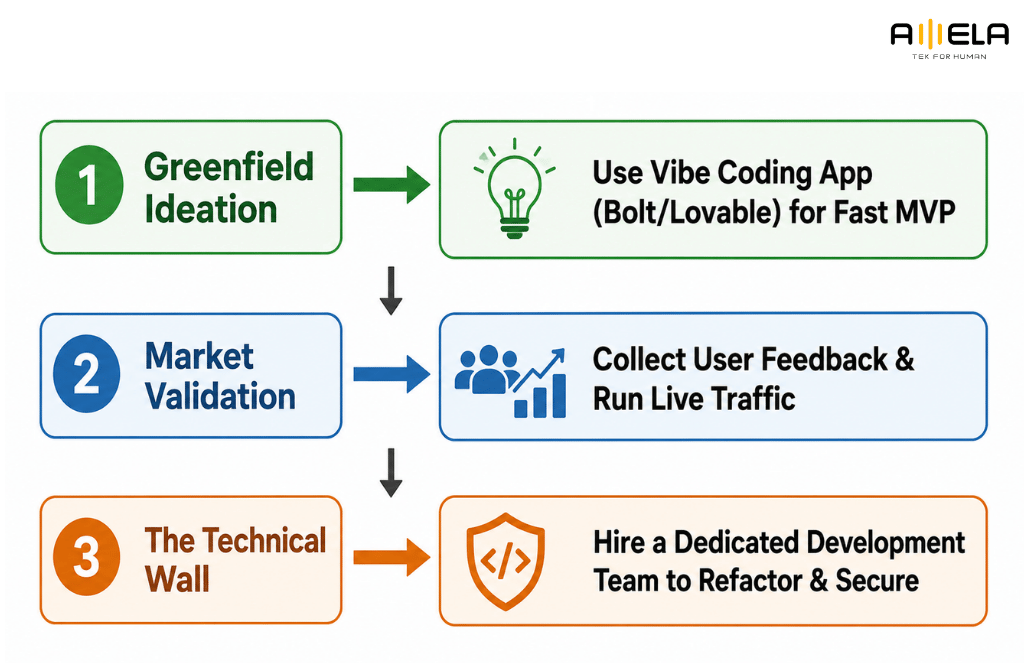
When Vibe Coding Apps Win: Velocity and Greenfield Prototyping
Vibe coding tools should be utilized primarily for initial prototyping, rapid wireframing, and early-stage seed validation where the cost of a bug is low. When validating an idea, median task completion times drop by 20% to 45% for greenfield features using intent-driven programming. Building an MVP through natural language allows a startup to ship a functional interface to early adopters or investors within days instead of months. For founders mapping out early product paths, studying successful startup app ideas can provide the target architecture parameters needed before writing the first prompt.
The Technical Wall: When Intent-Driven Programming Reaches its Limits
As a software product gains traction, AI agents begin to hit structural limitations known as the “Technical Wall,” where code quality and security dramatically decline. Recent 2026 code-quality analyses reveal that AI co-authored code contains 1.7x more major logic issues than human-written code, and nearly 45% of AI-generated samples contain standard OWASP vulnerabilities. (Hashnode)
The technical breakdown typically manifests across three distinct vector points:
- Context Window Overload: When an app reaches hundreds of complex files, the AI loses track of global states, resulting in code generation loops that repeatedly break existing features.
- Performance Optimization: Agents struggle with intricate database indexing, optimized query caching, and lowering memory footprints on high-traffic web applications.
- Security & Rigidity: AI tools follow linear programming patterns; they struggle to plan multi-tenant microservices or complex custom web infrastructure. If you are designing for long-term growth, understanding web development for startups will help you structure your project appropriately.
What are the Risks of Vibe Coding and How to Mitigate Them?
The primary risks of unmanaged vibe coding include unmonitored technical debt, structural architecture decay, and the exposure of sensitive user records to severe security vulnerabilities.
- Unseen Technical Debt and Architecture Decay
Because AI tools prioritize getting a feature to look functional quickly, they frequently take architectural shortcuts that degrade long-term code maintainability. AI agents frequently duplicate logic blocks across different directories, generate redundant styling classes, and introduce tightly coupled dependencies that make future updates difficult without breaking the system.
- Compliance and Security Blindspots
AI agents rarely implement rigorous enterprise security protocols out of the box, leading to exposed API keys and data leak vulnerabilities. Security benchmarking across major vibe coding tools reveals significant rates of injection vulnerabilities, insecure application defaults, and overly permissive access controls. Without human oversight, an agent may deploy an app that functions perfectly on the surface but fails baseline penetration tests or global data privacy compliance checks (such as GDPR or HIPAA).
Practical Mitigation Checklist for Project Owners
To minimize system exposure while leveraging the speed of natural language app builders, operators should implement the following engineering safeguards:
- [Enforce Private Version Control: Ensure your vibe coding app connects directly to a private GitHub repository, tracking every commit the AI agent executes.
- Mandatory Code Reviews: Establish a rule where no AI-suggested code is merged into the main production branch without human engineering validation.
- Run Automated Static Security Scanning (SAST): Integrate open-source tools like Semgrep into your repository pipeline to block merges with flagged security patterns.
- Audit Third-Party Dependencies: Periodically execute package audits (e.g., npm audit or pip-audit) to catch insecure packages pulled in by the AI agent.
- Onboard an Engineering Partner: Retain an experienced remote dev team to periodically review code structures and handle deep backend scaling before your public release.
How AMELA Stabilizes and Scales AI-Driven Codebases for Production?
At AMELA Technology, we view vibe coding not as a threat to traditional software engineering, but as a massive accelerator for the modern software delivery lifecycle.
How Our Teams Integrate AI-Assisted Code Environments
Our engineering squads actively leverage modern AI-assisted code environments within our workflows to reduce routine coding boilerplate cycles, passing those time and cost savings directly to our clients. By using professional-grade tools like Cursor and Claude Code under strict data-isolation agreements, our developers can accelerate standard feature scaffolding and unit test generation. This allows our teams to focus their human engineering expertise where it matters most: system architecture, advanced database design, and ironclad security protocols.
The Rebuild & Refactor Blueprint: Turning Your MVP Into an Enterprise Product
If you have built a successful MVP using a vibe coding app and find that your system is beginning to stall, crash, or fail user load requirements, AMELA provides custom software development services to stabilize your business. Our teams can:
- Take your AI-generated prototype, extract the core operational business logic, and eliminate the accumulated technical debt.
- Replatform your system onto highly optimized, cost-efficient cloud infrastructure with automated CI/CD deployment pipelines.
- Deploy an Offshore Development Center (ODC) in Vietnam or a dedicated engineering team to safely expand your features as your user base expands globally.
Frequently Asked Questions (FAQ)
When do you need a vibe coding app?
You need a vibe coding app when you want to quickly turn an idea into a clickable prototype, MVP, landing page, internal tool, or simple web app without starting from manual coding.
A vibe coding app is not enough when the product needs complex backend logic, secure authentication, payment flows, scalable infrastructure, custom integrations, or long-term maintainability.
Can a non-technical founder build a secure commercial app using only a vibe coding app?
While a non-technical founder can easily build a working proof-of-concept or alpha version to show early users, building a fully compliant, securely encrypted commercial app that handles sensitive financial or medical information requires human code review and engineering oversight. (Microsoft Source)
What happens to code ownership when using natural language app builders?
Most premier platforms specify that the code generated through their interfaces belongs entirely to the user. However, always review individual platform terms, as some tools require subscription tiers to freely export the complete repository for external hosting.
How do modern software development teams protect client data when using AI tools?
Enterprise development partners use secure, closed-loop LLM models and API data opt-outs. This prevents proprietary client source code from being processed, saved, or used to train public foundational AI models.