 Sep 6, 2026
Table of Contents
Building an AI capability requires more than hiring a few machine learning specialists. AI projects combine product strategy, software engineering, data, model development, infrastructure, security, and ongoing evaluation.
The need for this broader structure is becoming clearer as companies move from experimentation toward production.
This makes AI team structure an important consideration for companies that want to turn individual AI experiments into reliable products. The right structure does not mean hiring every possible AI specialist. It means assigning clear ownership to the capabilities your AI initiative actually requires.
Key Takeaways
- A strong AI team combines product, software engineering, AI/ML, data, infrastructure, and governance responsibilities.
- Small projects can combine several roles, while production systems usually require more specialized expertise.
- AI security and governance should have clear ownership from the beginning.
- Team structure should evolve as an AI project moves from prototype to production and scale.
- Companies without enough internal AI expertise can supplement their team through an external AI development partner.
What Is an AI Team Structure?
An AI team structure defines the roles, responsibilities, reporting relationships, and workflows needed to build, deploy, and manage AI systems.
Traditional software teams can often focus primarily on product requirements, application development, testing, and infrastructure. AI projects introduce additional responsibilities around data preparation, model evaluation, AI-specific testing, monitoring, and model or output governance.
For example, an AI-powered customer service application may require software engineers to build the application, AI engineers to integrate models, data specialists to manage information sources, and product managers to define how AI should improve the customer experience.
Centralized vs. embedded AI teams
Companies can organize these capabilities in several ways.
Centralized: A dedicated AI or center-of-excellence team supports multiple business units. This can make it easier to establish shared standards, platforms, and expertise.
Embedded: AI specialists work directly within individual product or business teams. This can improve domain knowledge and shorten the distance between AI development and business requirements.
Hybrid: A central group provides shared AI platforms, governance, or expertise while specialists are embedded in product teams.
There is no universal model. McKinsey’s 2025 research found that organizations tend to centralize risk, compliance, and AI data governance, while technical AI talent is more often managed through hybrid structures.
For companies designing an AI organization, the practical question is therefore not whether to centralize everything. It is which capabilities need common standards and which need to stay close to the product and business team.
Core Roles in an AI Team
An AI team does not need a separate specialist for every function; the right roles depend on the project’s complexity, data requirements, and production needs.
As AI moves from experimentation into production, organizations increasingly need a mix of technical and business capabilities. McKinsey’s 2025 research found that larger organizations are particularly likely to hire AI data scientists, machine learning engineers, and data engineers, while new roles around AI compliance and ethics are also emerging.
1. AI Product Manager
The AI product manager connects the AI capability to a specific business problem and measurable outcome.
Key responsibilities include:
- Defining AI use cases
- Setting product requirements
- Prioritizing the AI roadmap
- Defining success metrics
- Coordinating business and technical stakeholders
- Managing user feedback
This role is particularly important because an AI team can build technically impressive systems that have little business value if the use case is poorly defined.
2. AI/ML Engineer
AI/ML engineers turn models and AI capabilities into working features that can operate within a software product.
They typically handle:
- Model or LLM integration
- AI application development
- Inference workflows
- Model optimization
- APIs and service integration
- Evaluation and testing
For generative AI projects, this role may also cover prompt engineering, retrieval-augmented generation (RAG), agent workflows, and integration with foundation-model APIs.
3. Data Scientist
Data scientists use data to develop, test, and evaluate models while determining whether an AI approach can solve the target problem.
Their work may include:
- Exploratory data analysis
- Statistical modeling
- Feature engineering
- Model experimentation
- Evaluation
- Business insight generation
Not every AI application requires a dedicated data scientist. For example, an application built around an existing LLM may need stronger AI engineering and product skills than traditional predictive-modeling expertise.
4. Data Engineer
Data engineers make sure the AI team has reliable, accessible, and appropriately structured data.
They build and maintain:
- Data pipelines
- ETL/ELT workflows
- Data warehouses and lakes
- Data validation
- Data transformation
- Training and inference data flows
Without reliable data infrastructure, even a strong model can become difficult to deploy and maintain.
5. MLOps or AI Infrastructure Engineer
MLOps engineers connect AI development with reliable production infrastructure.
Their responsibilities can include:
- Model deployment
- CI/CD for AI systems
- Infrastructure automation
- Model and data monitoring
- Versioning
- Performance and cost optimization
- Scaling
This role becomes particularly important once an AI project moves beyond a prototype. For broader organizational context, companies can also consider how these responsibilities fit within their overall engineering department structure.
6. AI/ML Architect
An AI architect defines how the AI components, software, data, infrastructure, and external services fit together.
They may make decisions about:
- Model selection
- AI application architecture
- Data architecture
- Cloud infrastructure
- Integration patterns
- Scalability
- Security requirements
This role is more valuable as systems become complex. A small team may assign architecture responsibilities to a senior AI or software engineer instead.
7. AI UX or Conversation Designer
AI UX specialists design how users interact with AI and how the system behaves when it is uncertain or wrong.
This can include:
- Conversation flows
- Prompt and interaction design
- Feedback mechanisms
- Error handling
- AI-generated content presentation
- Human handoff
For customer-facing AI assistants and agents, this role helps ensure that technical capabilities translate into a usable product.
8. AI Security and Governance Specialist
AI security and governance specialists help ensure that AI systems are deployed with appropriate controls for data, access, risk, and compliance.
They may oversee:
- Data protection
- Access controls
- AI risk assessments
- Privacy requirements
- Output validation
- Auditability
- Governance policies
For smaller teams, these responsibilities can initially sit with existing security, legal, compliance, or engineering leaders rather than requiring a dedicated hire.
How to Structure an AI Team by Project Size
Team size should follow the AI system’s complexity, data requirements, and production workload—not a fixed list of job titles.
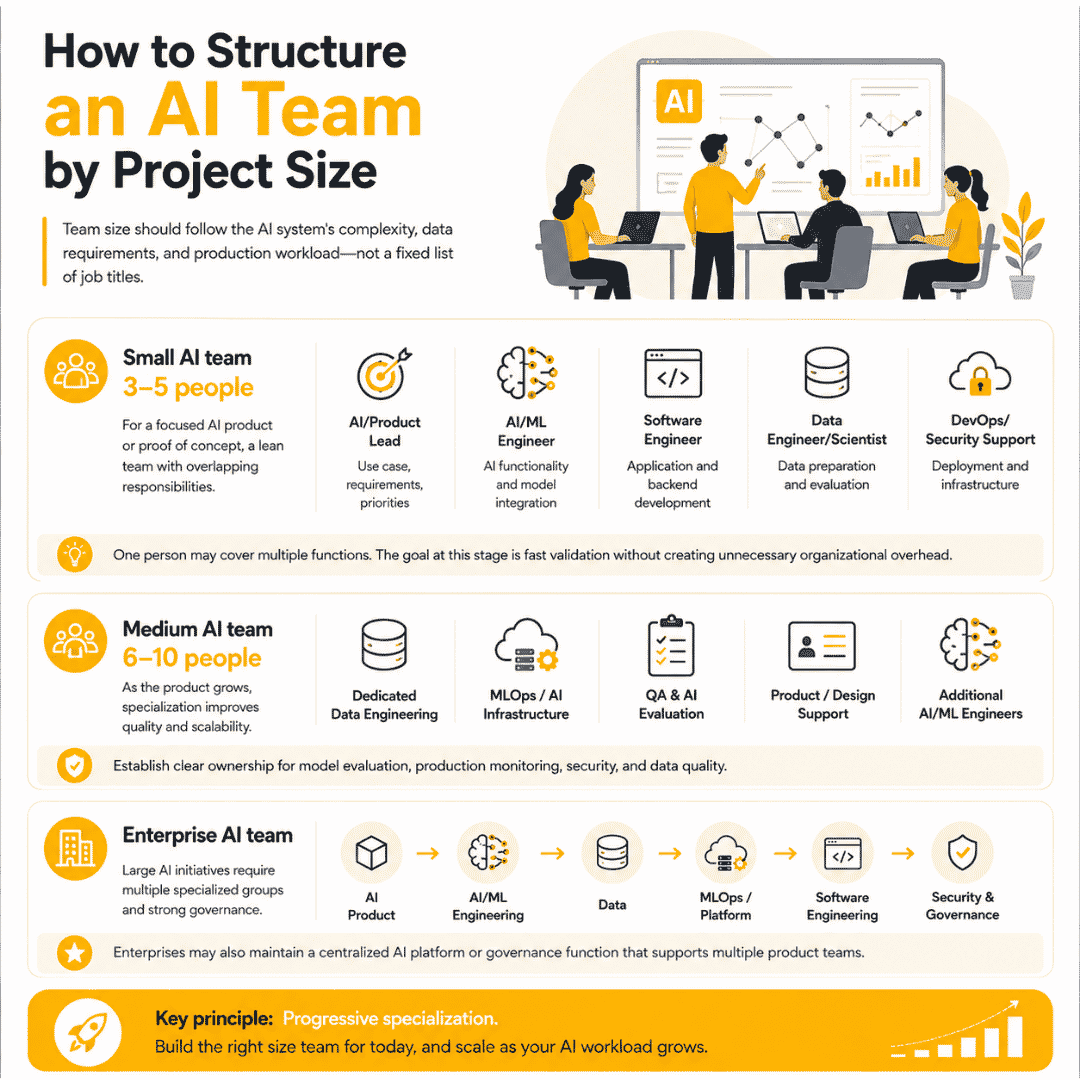
A small AI application may only need three or four people with overlapping responsibilities. As the system grows, dedicated specialists can be added where workload or risk justifies them.
Small AI team: 3–5 people
For a focused AI product or proof of concept, a lean team could include:
| Role | Primary responsibility |
| AI/Product Lead | Use case, requirements, priorities |
| AI/ML Engineer | AI functionality and model integration |
| Software Engineer | Application and backend development |
| Data Engineer/Scientist | Data preparation and evaluation |
| DevOps/Security support | Deployment and infrastructure |
One person may cover multiple functions. For example, a senior AI engineer could handle both AI architecture and model integration, while a software engineer manages some DevOps responsibilities.
The goal at this stage is fast validation without creating unnecessary organizational overhead.
Medium AI team: 6–10 people
Once an AI product has real users and more complex production requirements, specialization becomes more useful.
The team might add:
- Dedicated data engineering
- MLOps or AI infrastructure
- QA and AI evaluation
- Product/design support
- Additional AI/ML engineers
At this stage, teams should establish clearer ownership for model evaluation, production monitoring, security, and data quality.
Enterprise AI team
Large AI initiatives may require several specialized groups rather than one team.
A typical structure could include:
AI Product → AI/ML Engineering → Data → MLOps/Platform → Software Engineering → Security & Governance
An enterprise may also maintain a centralized AI platform or governance function that supports multiple product teams.
The important principle is progressive specialization. Companies should not build an enterprise-sized AI organization before they have enough AI workloads to justify it.
AI Team Structure for Production Systems
A production AI team must manage the entire lifecycle from business problem and data to deployment, monitoring, evaluation, and continuous improvement.
A practical workflow looks like this:
Business problem → Data → AI development → Application integration → Deployment → Monitoring → Evaluation → Improvement
Each stage creates different ownership requirements.
Development
AI/ML engineers, data scientists, data engineers, and software engineers work together to build the AI capability and integrate it into the product.
Deployment
MLOps, DevOps, and infrastructure engineers make the system reliable enough for production. They manage deployment pipelines, infrastructure, observability, scaling, and operational costs.
AI can also support these workflows directly. For example, AI agents for DevOps can assist with monitoring, troubleshooting, incident handling, and repetitive operational tasks.
Monitoring and evaluation
Production AI needs more than conventional application monitoring. Teams may need to track:
- Model or agent performance
- Response quality
- Latency
- Cost per request
- Failure rates
- Data drift
- User feedback
- Safety issues
Product and AI teams should define what constitutes a successful output and establish a process for investigating poor results.
Continuous improvement
AI systems often require ongoing iteration rather than a one-time release. New data, user behavior, model updates, and changing business requirements can all affect performance.
This is why an effective AI team structure should include clear ownership after deployment, not stop at model development.
Where AI Security and Governance Fit in the Team
AI security and governance should be built into the AI development lifecycle, with clear ownership rather than treated as a final compliance check.
AI systems can introduce risks that traditional applications do not face in the same way, including prompt injection, sensitive-data exposure, unauthorized model access, and unreliable generated outputs.
Depending on the organization, security and governance responsibilities can sit with dedicated specialists or be shared across existing teams.
Key responsibilities include:
- Data protection: Define what data AI systems can access and process.
- Access control: Restrict models, tools, APIs, and sensitive information based on user and system permissions.
- AI risk assessment: Identify potential misuse, unreliable outputs, and security vulnerabilities before deployment.
- Testing and evaluation: Test models and agents against expected and adversarial scenarios.
- Compliance: Align AI workflows with applicable privacy, industry, and organizational requirements.
- Monitoring: Track security incidents, unusual behavior, and changes in system performance.
- Human oversight: Define when AI outputs require human review or approval.
For a practical overview of application-level threats, see security risks with AI apps.
Security responsibilities should also be proportional to the project. A small internal AI assistant may only require existing security and engineering oversight, while an AI system processing financial, healthcare, or customer data may require dedicated governance.
How AI Team Roles Work Together
The most effective AI team structure connects business, data, engineering, infrastructure, and governance instead of treating them as isolated functions.
A typical workflow can look like this:
AI Product Manager
Defines the business problem, users, requirements, and success metrics.
↓
Data Scientist / Data Engineer
Prepares data, validates its quality, and determines whether the available data can support the use case.
↓
AI/ML Engineer
Builds or integrates the AI capability and evaluates its performance.
↓
Software Engineer
Connects the AI functionality to the application, APIs, databases, and user experience.
↓
MLOps / DevOps
Deploys the system and manages infrastructure, monitoring, reliability, and scaling.
↓
Security / Governance
Reviews data access, security controls, compliance requirements, and AI-specific risks.
↓
Product + Engineering
Measure real-world outcomes and use the results to improve the system.
This structure does not mean every project needs six or seven separate teams. In a smaller organization, one engineer may cover AI development and MLOps, while a product manager may also coordinate governance requirements.
What matters is that each responsibility has an owner. Unclear ownership can lead to problems such as models reaching production without adequate evaluation, security reviews happening too late, or AI features being developed without measurable business objectives.
For a broader view of how engineering responsibilities can be organized, see engineering department structure.
Build vs. Hire an AI Team
Companies should build an internal AI team when AI is a long-term strategic capability, while external development teams can provide faster access to specialized skills and capacity.
Build internally when:
- AI is central to your long-term product strategy.
- You need deep institutional and domain knowledge.
- You expect continuous AI development over several years.
- You already have strong engineering and data capabilities.
- You want direct control over hiring and technical standards.
An internal team can accumulate product knowledge and establish reusable AI capabilities across the organization. The trade-off is the time and cost required to recruit and retain specialized talent.
Hire an external AI development team when:
- You need to launch an AI initiative quickly.
- Your existing engineers lack specific AI expertise.
- You need temporary or specialized capacity.
- You want to validate an AI use case before building a permanent team.
- Hiring multiple AI specialists internally would be difficult to justify.
An external team can provide AI engineers, software developers, data specialists, and other expertise as a coordinated unit rather than requiring the company to recruit each role independently.
Companies considering this approach can learn more about hiring an offshore development team and how external engineering capacity can support AI initiatives.
Best Practices for Building an AI Team
A good AI team structure starts with the work the system must perform, then assigns people to the capabilities required to deliver and operate it.
1. Start with the use case, not job titles
Define the business problem, users, data, technical requirements, and expected outcome first. Then determine which skills are actually needed.
A simple internal AI assistant may not need a dedicated data scientist, for example, while a predictive analytics platform may require substantial data science expertise.
2. Define ownership early
Every critical responsibility should have a clear owner, including:
- Product outcomes
- Data quality
- AI performance
- Application development
- Infrastructure
- Security
- Compliance
This prevents gaps when an AI system moves from experimentation to production.
3. Avoid unnecessary specialization
Small teams should combine responsibilities where practical. A senior AI engineer may cover architecture and AI development, while a software engineer may handle some infrastructure work.
Specialize only when the workload becomes large or complex enough to justify another role.
4. Build governance into development
Security, privacy, evaluation, and access controls should be considered during design rather than after deployment. This is especially important when AI systems process sensitive business or customer data.
5. Measure business outcomes
Developer activity or model performance alone does not tell you whether an AI initiative is successful.
Teams should define metrics such as:
- Time saved
- Cost reduction
- Conversion or revenue impact
- Accuracy or task success
- User satisfaction
- Error and escalation rates
6. Plan for production from the beginning
A prototype can work with minimal infrastructure. A production AI system needs monitoring, reliability, security, cost controls, and a process for continuous improvement.
Designing for these requirements early can prevent expensive rework later.
FAQs
What roles are needed for an AI team?
Most AI teams need some combination of product management, AI/ML engineering, software engineering, data, infrastructure, and security/governance. Smaller teams can combine several responsibilities into fewer roles.
How many people should an AI team have?
There is no universal number. A focused AI project may start with 3–5 people, while a production platform or enterprise AI program may require multiple specialized teams.
Does every AI team need a data scientist?
No. An AI application using an existing foundation model may need more AI engineering and software development expertise than traditional data science. Data scientists become more important when the project involves statistical modeling, experimentation, forecasting, or custom machine learning.
What is the difference between an AI engineer and an ML engineer?
The roles often overlap. An AI engineer typically focuses on integrating AI capabilities into applications, including modern generative AI and AI agents. An ML engineer traditionally focuses more on developing, deploying, and maintaining machine learning models and pipelines.
In practice, companies should define responsibilities based on the project rather than relying too heavily on job-title distinctions.
Who is responsible for AI security?
Responsibility should be shared. Engineering and AI teams handle technical controls, while security, legal, compliance, or governance teams provide oversight depending on the organization’s size and risk profile.
Should AI teams be centralized or embedded?
Both approaches can work. Centralized teams are useful for shared platforms, standards, and governance. Embedded teams can stay closer to individual products and business requirements. A hybrid structure often combines the two.
Should companies build or hire an AI team?
Build internally when AI is a strategic, long-term capability. Hiring an external AI development team can make more sense when the company needs specialized expertise or wants to launch and validate an AI initiative quickly.
Conclusion: Build an AI Team Around the Work
The best AI team structure is not the one with the most specialists; it is the one with clear ownership of the capabilities your AI system actually needs.
Start with the use case and determine the required product, engineering, data, infrastructure, and governance responsibilities. As the system moves from prototype to production, add specialization where complexity and workload justify it.
For companies without all of these capabilities internally, an external partner can provide the missing expertise without requiring a full AI organization from day one. Our AI development services can support AI solution development, AI developer hiring, and dedicated AI team setup.