 Aug 23, 2026
Table of Contents
Engineering leaders are under increasing pressure to deliver software faster while balancing limited resources, changing priorities, and growing product complexity. Yet many teams still rely on spreadsheets, manual reports, or disconnected dashboards to plan capacity and track engineering performance. Without timely, reliable insights, it’s difficult to forecast delivery, identify bottlenecks, or make informed staffing decisions.
AI analytics software for engineering team planning helps organizations turn engineering data into actionable insights. By analyzing information from project management, version control, and DevOps tools, AI can improve resource planning, delivery forecasting, and workload visibility. However, not every platform offers the same capabilities, and choosing the wrong solution can lead to poor adoption and limited business value.
This guide explains the key factors to consider when evaluating AI analytics software, helping engineering leaders select a solution that supports both current needs and long-term growth.
Why Engineering Teams Need AI Analytics for Better Planning
AI analytics helps engineering teams make more informed planning decisions by providing real-time visibility into team capacity, delivery progress, and potential risks. Instead of relying on intuition or historical averages, leaders can use data to improve planning accuracy and resource allocation.
As engineering organizations grow, planning becomes more complex. Teams often work across multiple products, distributed locations, and specialized roles while using different tools to manage development. Information is scattered across platforms such as Jira, GitHub, GitLab, Azure DevOps, and CI/CD pipelines, making it difficult to build a complete picture of engineering performance.
Common Planning Challenges
Many engineering teams face similar obstacles when planning projects and allocating resources:
- Limited visibility into team capacity: Managers struggle to understand who has available bandwidth and where additional support is needed.
- Unpredictable delivery timelines: Changes in priorities, technical debt, and unforeseen blockers make sprint and release planning less reliable.
- Fragmented engineering data: Metrics are spread across multiple tools, requiring manual effort to consolidate reports.
- Reactive decision-making: Teams often identify risks only after deadlines begin to slip or workloads become unbalanced.
These challenges don’t necessarily reflect poor engineering practices—they’re often the result of growing complexity and disconnected data.
How AI Improves Engineering Visibility
AI analytics software connects data from engineering tools to provide a more comprehensive view of team performance and project health. Rather than simply displaying historical metrics, modern platforms identify trends, detect risks, and generate insights that support better planning decisions.
For example, AI can help engineering leaders:
- Forecast team capacity based on historical delivery patterns.
- Identify projects at risk of missing deadlines.
- Detect workload imbalances across teams.
- Monitor engineering trends without manually compiling reports.
- Highlight bottlenecks that may affect future releases.
The goal isn’t to replace engineering judgment but to give leaders better information for making planning decisions. When teams have consistent visibility into capacity, delivery, and productivity, they can allocate resources more effectively and respond to changing priorities with greater confidence.
For organizations managing multiple development teams, these insights are even more valuable when combined with strong engineering practices. Establishing clear roles, responsibilities, and communication processes remains essential to effective planning, making engineering analytics a complement—not a replacement—for good team management.
>>> Read more: AI Agents for DevOps
What to Look for in AI Analytics Software
The best AI analytics software should do more than visualize engineering metrics. It should help leaders make better planning decisions by combining reliable data, predictive insights, and seamless integration with existing development workflows.
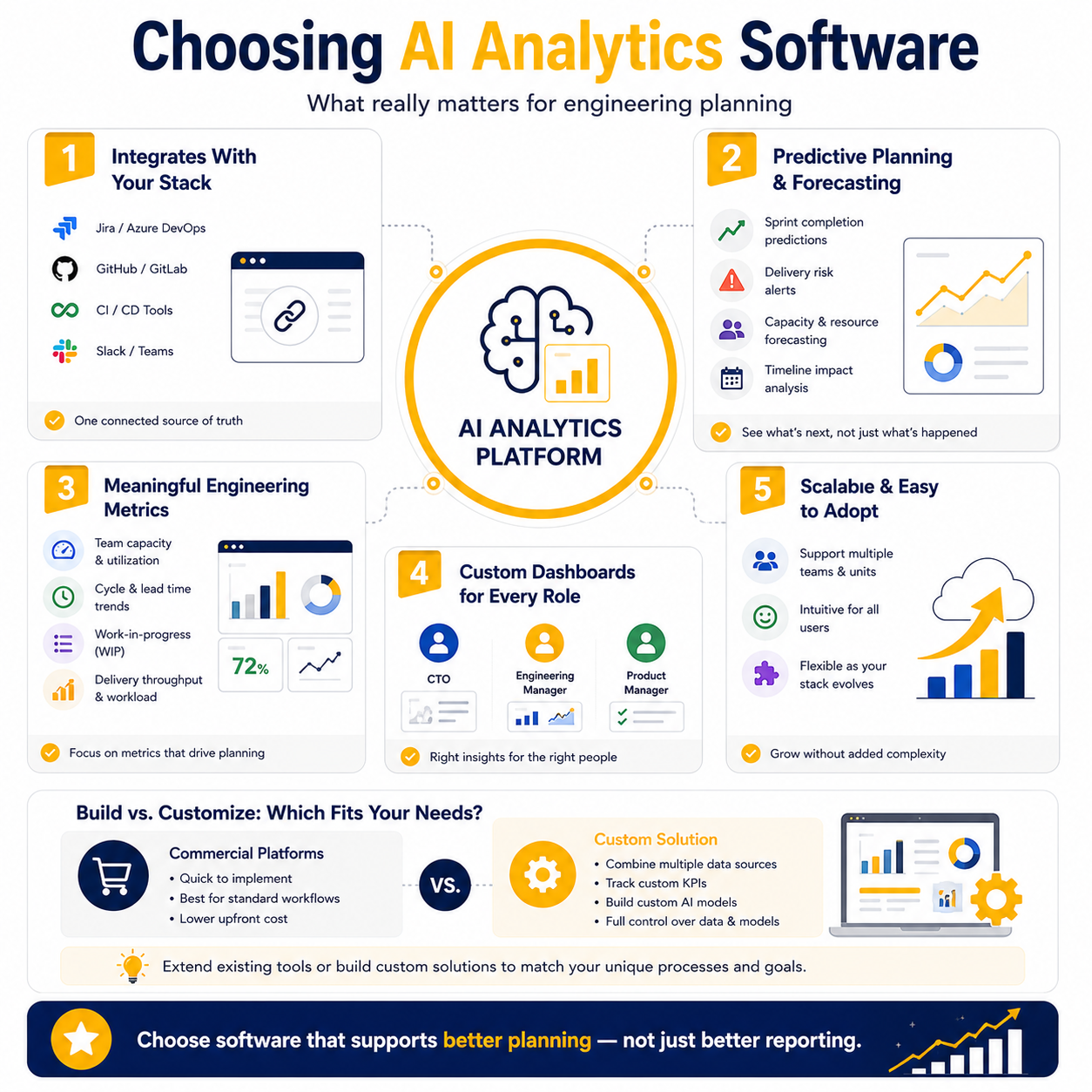
With a growing number of engineering analytics platforms on the market, it’s easy to be distracted by feature lists or AI-powered claims. Instead, focus on whether the software solves your team’s planning challenges and fits naturally into your engineering ecosystem.
Integration With Your Existing Engineering Stack
An AI analytics platform is only as valuable as the data it can access. Before selecting a solution, evaluate how well it integrates with the tools your teams already use.
Look for native or API-based integrations with platforms such as:
- Jira or Azure DevOps for project management
- GitHub or GitLab for source control
- CI/CD tools for deployment data
- Communication platforms such as Slack or Microsoft Teams
The goal is to reduce manual reporting and create a single source of truth for engineering planning.
Predictive Planning and Forecasting
Historical dashboards explain what happened. AI analytics should also help predict what is likely to happen next.
Useful forecasting capabilities include:
- Sprint completion predictions
- Delivery risk alerts
- Capacity forecasting
- Resource allocation recommendations
- Timeline impact analysis when priorities change
These insights allow engineering managers to address risks earlier instead of reacting after schedules slip.
Meaningful Engineering Metrics
More metrics don’t necessarily lead to better decisions. The right platform should surface the indicators that support planning rather than overwhelm teams with data.
Consider whether the software can measure:
- Team capacity and utilization
- Sprint predictability
- Cycle and lead time trends
- Work-in-progress (WIP)
- Delivery throughput
- Engineering workload across teams
Frameworks such as DORA and SPACE can provide a useful foundation, but the most valuable metrics are those aligned with your organization’s delivery goals and planning processes.
Custom Dashboards and Reporting
Different stakeholders require different views of engineering performance.
For example:
- Engineering managers need sprint health and workload visibility.
- CTOs focus on delivery trends, resource planning, and organizational capacity.
- Product managers need roadmap progress and delivery confidence.
Choose software that allows dashboards and reports to be customized for each audience rather than relying on one-size-fits-all reporting.
Scalability and Ease of Adoption
A platform should support your engineering organization as it grows—not create additional administrative work.
When evaluating solutions, consider:
- Can it support multiple teams or business units?
- Is the interface intuitive for both technical and non-technical users?
- How much training is required?
- Can new data sources be added as your toolchain evolves?
Software that is difficult to adopt often becomes another reporting tool instead of an integral part of engineering planning.
Strong planning also depends on effective collaboration and management practices. As engineering teams scale, combining analytics with proven approaches to managing software teams helps leaders make better decisions and maintain alignment across projects. Learn more in our guide to Managing Software Teams.
Build vs. Customize: Which Fits Your Needs?
Many commercial AI analytics platforms provide strong capabilities for standardized engineering workflows. However, organizations with unique planning processes or proprietary performance metrics may find these solutions limiting.
A custom platform may be worth considering if you need to:
- Combine data from multiple internal systems.
- Track organization-specific engineering KPIs.
- Build custom forecasting models.
- Integrate analytics into existing management workflows.
- Maintain greater control over data and AI models.
Rather than replacing commercial tools, some organizations choose to extend them with custom applications or AI features tailored to their engineering operations. This approach provides flexibility while preserving existing investments.
Common Mistakes When Choosing AI Analytics Software for Engineering Team Planning
Answer: Many organizations focus on AI features instead of planning outcomes. Choosing software based on dashboards or automation alone can lead to poor adoption and limited business value.
Selecting the right platform isn’t just about comparing feature lists—it’s about ensuring the software supports how your engineering teams actually plan, collaborate, and deliver software.
Prioritizing Features Over Business Goals
A platform may offer advanced AI capabilities, but they won’t deliver value if they don’t address your team’s biggest planning challenges.
Before evaluating vendors, define what success looks like. For example:
- Improve delivery predictability.
- Balance workloads across teams.
- Increase planning accuracy.
- Reduce time spent creating manual reports.
Clear objectives make it easier to distinguish essential capabilities from features that are rarely used.
Ignoring Integration Requirements
Engineering analytics depends on complete and reliable data. If the software cannot integrate smoothly with your existing development tools, teams may continue relying on manual reporting or incomplete dashboards.
When evaluating a solution, verify that it supports your current engineering ecosystem and can accommodate future tools as your organization grows.
Measuring Too Many Metrics
Tracking dozens of engineering metrics doesn’t necessarily improve decision-making. In fact, too many dashboards can make it harder to identify meaningful trends.
Instead, focus on a small set of metrics that directly support planning, such as:
- Team capacity
- Delivery predictability
- Workload distribution
- Sprint progress
- Delivery risks
The goal is to help leaders make better decisions—not generate more reports.
Overlooking Team Adoption
Even the most advanced AI analytics software won’t deliver value if engineering teams don’t use it.
Look for a platform that fits naturally into existing workflows, presents insights in a clear and actionable way, and requires minimal manual effort. Successful adoption depends as much on usability and change management as it does on technical capabilities.
As engineering organizations expand, software should also support evolving team structures and planning responsibilities. Establishing a clear engineering department structure makes it easier to define ownership, interpret analytics consistently, and scale planning processes across multiple teams. Learn more in our guide to Engineering Department Structure.
FAQs
What is AI analytics software for engineering team planning?
AI analytics software analyzes engineering data from tools such as Jira, GitHub, GitLab, and Azure DevOps to provide insights into team capacity, delivery progress, resource allocation, and project risks. It helps engineering leaders make more informed planning decisions using data rather than intuition.
How is AI analytics different from traditional engineering dashboards?
Traditional dashboards primarily report historical metrics, while AI analytics identifies trends, predicts delivery risks, forecasts team capacity, and recommends actions to improve planning and resource utilization.
What features should I prioritize when choosing AI analytics software?
Look for software that offers seamless integrations with your engineering tools, predictive planning capabilities, customizable dashboards, engineering performance metrics, and scalability. The best platform should solve your team’s planning challenges instead of simply providing more reports.
Should we buy an AI analytics platform or build a custom solution?
Off-the-shelf platforms are often suitable for teams with standard planning processes and common engineering workflows. A custom solution may be a better choice if you need proprietary metrics, specialized integrations, unique planning workflows, or greater control over your data and AI models.
Can AI analytics improve engineering team productivity?
Yes. By automating data collection, identifying bottlenecks, forecasting delivery risks, and improving resource planning, AI analytics helps engineering teams spend less time creating reports and more time delivering software efficiently.
Conclusion
Choosing AI analytics software for engineering team planning isn’t about finding the platform with the most features—it’s about selecting one that helps your team make better planning decisions.
The right solution should integrate with your existing engineering tools, provide actionable insights into capacity and delivery, and scale as your organization grows. Whether you choose a commercial platform or a custom-built solution, the goal is the same: improve planning accuracy, optimize resource allocation, and give engineering leaders greater confidence in delivery forecasts.
By following the evaluation criteria in this guide, you’ll be better equipped to choose AI analytics software that aligns with your team’s workflows, business goals, and long-term engineering strategy.
If your organization requires tailored analytics, custom integrations, or additional engineering expertise, explore how AMELA Technology helps businesses build custom software solutions and scale engineering teams.