 Feb 27, 2026
Table of Contents
Outsourcing software development pros and cons depend less on location and more on execution—done right, outsourcing accelerates delivery and unlocks scarce skills; done poorly, it creates rework, misalignment, and hidden coordination costs.
Many teams outsource to move faster than hiring allows, scale engineering capacity on demand, or access specialists in cloud, QA automation, mobile, and security. If you’re exploring a build or modernization project, you can also review our software development services to understand common delivery models and engagement setups—then use this guide to weigh the trade-offs with a clear, practical lens.
Overview of Outsourcing Software Development
Outsourcing software development is growing fast because companies need speed and scarce skills—but results swing from “huge win” to “painful rework” depending on governance and delivery control.
Outsourcing software development means hiring an external team (often offshore/nearshore) to build, test, maintain, or modernize software under models like staff augmentation, dedicated teams, or project delivery. In practice, it’s an execution strategy: you trade some direct control for faster capacity and broader expertise.
Growth signals are strong. One market estimate values software development outsourcing at ~$564B in 2025 and ~$618B in 2026, with continued growth projected after that. At the same time, 80% of executives in Deloitte’s Global Outsourcing Survey say they plan to maintain or increase investment in third-party outsourcing—so this isn’t a temporary “cost-cutting trend.”
The impact can be great—or not. When outsourcing works, teams ship faster, tap specialized skills, and scale up or down without long hiring cycles. When it fails, the root cause is usually not “bad developers,” but weak vendor governance: Deloitte reports 70% of executives say their Vendor Management Office (VMO) is not fully mature, which often leads to unclear ownership, scope creep, and quality inconsistency.
Bottom line: outsourcing can be a no-brainer for speed and capability, but it only stays “good” when the client-side operating model (requirements, acceptance criteria, communication, and accountability) is built as carefully as the code.
Pros of Outsourcing Software Development
Outsourcing wins when you need speed, scarce skills, or scalable delivery—without waiting months to hire, train, and rebuild processes internally.
1) Faster access to scarce engineering talent and niche expertise
Outsourcing is often the quickest way to get the exact mix of skills a product needs (backend + frontend + QA + DevOps + cloud) without doing a long hiring marathon. That matters because hiring has become a genuine bottleneck in many markets: 74% of employers worldwide reported difficulty finding skilled talent in 2025.
What changes in practice is not just “more developers.” Teams can spin up a balanced delivery squad from day one—especially for skills that are hard to hire locally (cloud modernization, test automation, data engineering, security hardening). When the internal team is already stretched, this talent access is the difference between “we’ll start next quarter” and “we can start this sprint.”
2) Faster time-to-market through elastic capacity and parallel execution
The speed advantage usually shows up before coding even begins. With a ready team, you can run workstreams in parallel—feature build, QA automation, CI/CD setup, and performance tuning—rather than stacking them sequentially behind a small internal team.
Example (typical scenario): a product team wants to launch an MVP for a partner portal in 10–12 weeks. Hiring locally for two senior engineers and a QA takes 8–12 weeks on its own, then onboarding begins. With outsourcing, the team starts in ~1–2 weeks, sets sprint rituals immediately, and delivers incrementally while the internal tech lead focuses on architecture decisions. The output is not magic—it’s simply fewer “dead weeks” and fewer dependencies waiting on one person.
3) Stronger delivery discipline and “done means done” execution
A less-talked-about benefit: good outsourcing partners bring process maturity that many teams only build after painful lessons—clear Definition of Done, test strategy, code review standards, CI/CD hygiene, and release controls. That structure reduces rework and makes delivery more predictable, especially when requirements evolve.
This is also why many companies are moving toward outcome-based delivery (measurable results instead of “hours consumed”). It changes the relationship from “staff rental” to “delivery accountability,” which tends to improve transparency, reporting, and quality gates when managed properly.
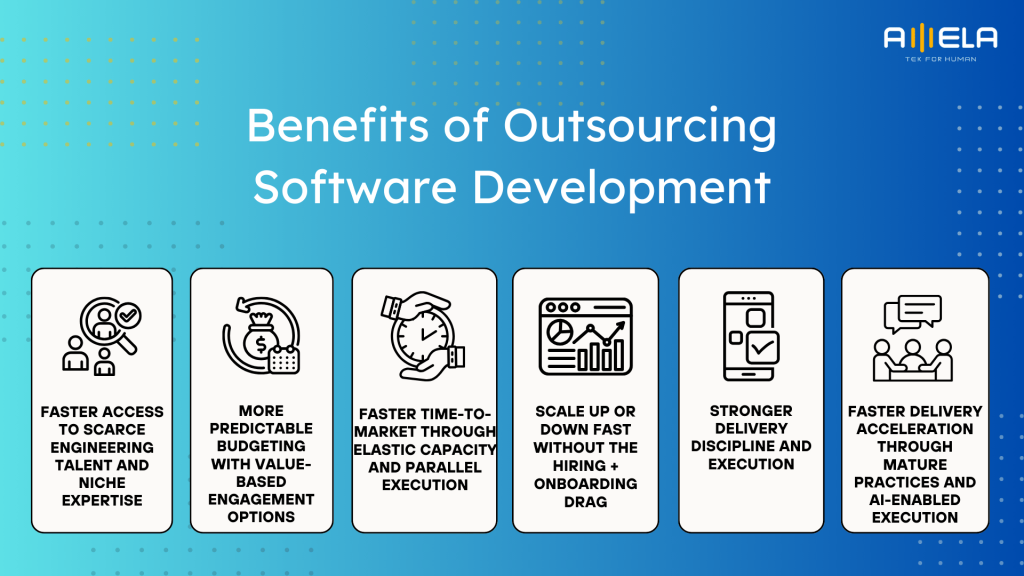
4) More predictable budgeting with value-based engagement options
Outsourcing isn’t only about cheaper rates. The bigger win is often commercial flexibility: dedicated team monthly retainers, milestone pricing, or outcome-based delivery. Deloitte notes that outsourcing delivery models are maturing with a growing emphasis on results-driven (outcome-based) relationships, not just time-and-materials staffing.
In real projects, this helps when leadership asks, “What will it cost to ship X by Y?” A vendor team can wrap delivery around a clear Definition of Done, acceptance criteria, and release plan—so budget conversations become less fuzzy. It’s especially useful for modernization work where internal teams are already booked with BAU.
5) Scale up or down fast without the hiring + onboarding drag
Outsourcing gives you elastic capacity: add QA for a release sprint, spin up a second squad for parallel features, or reduce burn after launch without layoffs and re-hiring cycles. That flexibility is one reason the outsourcing market keeps expanding.
A common “quiet” benefit: you can ramp specialists (DevOps, performance, security testing) for short windows. Those hires are painful to staff internally for only 6–10 weeks, but that’s exactly how long many projects need them.
6) Faster delivery acceleration through mature practices and AI-enabled execution
Strong vendors don’t just provide hands; they bring accelerators—CI/CD patterns, test automation playbooks, reusable components, and increasingly, AI-assisted workflows. Deloitte reports 83% of executives are leveraging AI as part of outsourced services (AI-powered outsourcing).
What that looks like on the ground: tighter feedback loops (PR reviews, automated tests, regression suites), cleaner release discipline, and fewer “we’ll fix it later” items turning into tech debt. It’s not magic—just a more standardized delivery engine that many companies don’t have time to build from scratch.
>>> Related: A Complete Guide to IT Outsourcing
Risks & Challenges in Outsourcing Software Development
Outsourcing risks usually come from weak alignment and control—unclear scope, shaky ownership, security gaps, and low visibility can turn “faster delivery” into rework and delays.
1) Misaligned requirements and scope creep
Outsourced teams move fast, which is great—until requirements are fuzzy. When “done” isn’t defined, teams ship something that technically works but misses the business intent. Then scope expands mid-sprint, timelines slip, and everyone feels the vendor is “slow,” even though the target kept moving.
What it looks like: stakeholders keep adding “small changes,” acceptance criteria are incomplete, and UAT becomes a negotiation instead of validation.
2) Communication gaps across time zones and culture
Even strong engineers can lose time when decisions depend on async messages. Time-zone differences can also create a “24-hour loop” for simple clarifications. Cultural gaps matter too: some teams hesitate to push back, so risks stay hidden until late.
A telltale sign: daily standups sound smooth, but surprises still pop up near release.
3) Quality inconsistency and accumulating technical debt
Outsourcing can deliver quickly, but quality varies if coding standards, test strategy, and Definition of Done aren’t enforced. The sneaky problem is tech debt that doesn’t show up in demos—until performance drops, bugs spike, and velocity dies.
Common triggers: weak code reviews, no automated regression suite, rushed handoffs between dev and QA.
4) Security, IP protection, and compliance exposure
Outsourcing expands your attack surface. Risks increase when vendors access production data, handle credentials loosely, or lack clear security controls. IP protection is also a real concern if contracts and access boundaries are not tight.
Practical pain points: shared accounts, unmanaged devices, unclear data handling rules, and over-broad repository access.
5) Vendor lock-in and poor knowledge transfer
If architecture decisions, infrastructure setup, and system understanding live mainly inside the vendor team, switching vendors—or bringing work back in-house—becomes expensive. Lock-in isn’t always intentional; it often happens because documentation and handover are treated as “nice to have.”
What it looks like: only 1–2 people truly understand the system, and every change requires asking them.
6) Limited visibility and weak delivery governance
Outsourcing fails most often when the client side doesn’t run a clear operating model. Without ownership, reporting, and escalation paths, the vendor may optimize for “activity” instead of outcomes.
Red flags: unclear product owner authority, no measurable deliverables per sprint, and progress reports that don’t map to business goals.
7) Team continuity risk (attrition and context loss)
Outsourced teams can change. When key engineers roll off, context drops and quality dips. If onboarding is slow or documentation is thin, new members repeat mistakes or hesitate to touch risky modules.
This hits hardest in long-running products where domain knowledge matters as much as coding skill.
In-House vs Outsourcing Development: Side-by-Side Comparison
In-house vs outsourcing software development pros and cons come down to control versus flexibility. Here’s the quick comparison table:
| Criteria | In-House Development | Outsourcing Development |
| Speed to start | Slower if hiring is needed; onboarding and team formation take time | Faster kickoff with an existing team; ramp-up can be quick |
| Access to talent | Limited to local hiring pool and compensation range | Wider access to global specialists (cloud, QA automation, mobile, data, security) |
| Cost structure | Higher fixed costs (salaries, benefits, equipment, overhead) | More flexible costs (monthly team, milestone, or project-based) |
| Budget predictability | Predictable monthly payroll, less predictable when hiring expands | Predictable if scope and governance are clear; can vary with change requests |
| Control over priorities | Direct control; easier to shift priorities quickly inside the org | Changes require alignment and process; priority shifts can add friction |
| Product/domain knowledge | Stronger long-term domain ownership inside the company | Depends on documentation and continuity; knowledge can concentrate in vendor team |
| Quality consistency | High if engineering standards are mature; varies by internal discipline | High with strong vendor + governance; inconsistent if standards are not enforced |
| Communication | Easier real-time collaboration; fewer time-zone delays | Can be smooth with cadence + tools; risk of async delays and misalignment |
| Security & compliance | Easier to control access and policies internally | Requires stronger controls (contracts, access management, audits, data handling) |
| Scalability | Scaling up/down is slow and costly (hiring/layoffs) | Elastic scaling; easier to add/remove capacity based on roadmap phases |
| Management effort | Requires strong internal leadership, hiring, performance management | Requires strong vendor governance (scope, acceptance criteria, escalation) |
| IP protection | IP stays fully internal by default | Needs legal + process safeguards; still manageable with proper controls |
| Risk of vendor lock-in | Low vendor dependency | Medium–high if architecture/knowledge stays with vendor; reduced by documentation and handover rules |
| Best fit scenarios | Core IP, long-term platform ownership, stable product teams | Fast delivery, skill gaps, short deadlines, modernization, variable workloads |
Best Practices in Outsourcing Development
Outsourcing works best when you manage it like an extension of your product team—clear ownership, measurable outcomes, tight feedback loops, and boring-but-solid governance.
1) Start with a small “proof sprint,” not a 6-month commitment
Even when the vendor looks perfect on paper, the real test is collaboration. A short proof sprint (1–2 weeks) forces alignment on requirements, working style, and quality expectations. You’ll learn quickly whether the team asks the right questions, flags risks early, and ships in a way you can actually maintain.
The goal is not to “get free work.” The goal is to validate delivery behavior before the scope gets big.
2) Write requirements that a developer can’t misinterpret
Outsourcing punishes vague specs. The safest approach is simple: define what success looks like and how it will be accepted. For each feature, make sure someone can answer:
- What user problem is being solved?
- What’s in scope and explicitly out of scope?
- What are the acceptance criteria and edge cases?
A great trick is to attach a few examples: expected inputs/outputs, permission rules, and “this should not happen” cases. That short detail prevents weeks of rework.
3) Assign one empowered product owner on your side
If three stakeholders can change priorities, the vendor will get mixed signals and delivery slows down. One person needs clear authority to prioritize, approve, and say “no.” The outsourced team can be excellent, but without a single decision lane, the project becomes a debate club.
4) Define “done” with quality gates, not optimism
The strongest outsourcing setups don’t rely on good intentions. They rely on a Definition of Done that includes quality gates such as code review, tests, and documentation. If “done” means “merged,” you will accumulate invisible debt. If “done” means “tested + deployable + documented,” delivery stays stable.
A practical approach: keep the gates light at the start, then raise them as the codebase grows.
5) Keep architecture ownership close, even if coding is outsourced
You don’t need to micromanage implementation, but you should own the big decisions: domain boundaries, core data models, security design, deployment approach, and integration patterns. When architecture becomes vendor-owned by accident, switching vendors—or even scaling the same vendor team—gets harder and riskier.
The healthiest model is shared: vendor proposes, you review, decisions are recorded.
6) Build a communication cadence that prevents “24-hour loops”
Time zones aren’t a deal-breaker, but you need a rhythm:
- One short daily sync for blockers and decisions
- One weekly planning/review where scope and risks are made explicit
- A fast escalation channel for urgent issues
If the team spends a full day waiting on clarifications, velocity dies quietly. The fix is not more meetings. The fix is faster decision routing and better written tickets.
7) Make progress measurable with outcomes, not activity
Outsourcing goes sideways when reporting focuses on hours, tickets, or “we’re working on it.” The most useful reporting ties to business outcomes: features completed, defects burned down, release readiness, and risk items.
A simple but effective habit: every week, ask the team to show what changed in the product, what’s next, and what could block delivery.
8) Protect security and IP with real operational controls
Contracts matter, but operations matter more. Keep access least-privileged, separate environments properly, and avoid sharing production data unless truly necessary. Use role-based access to repos, rotate credentials, and ensure code and infrastructure changes are traceable.
If security rules are fuzzy at the start, they rarely get tighter later.
9) Plan knowledge transfer from the first month
Documentation is not something you bolt on at the end. The most maintainable outsourced projects build living knowledge: architecture notes, runbooks, decision logs, and onboarding docs.
A practical rule: if a new engineer can’t onboard within a week using your docs, you’re creating future lock-in.
10) Structure the team for continuity, not just headcount
Outsourcing success depends heavily on stable ownership. Try to keep the same core people (tech lead, QA lead) across releases. If the vendor rotates key members too often, the project will feel like it restarts repeatedly.
Continuity is an underrated advantage; protect it like you protect your roadmap.
11) Treat testing as a delivery accelerator, not a cost
The quickest teams aren’t the ones who “test less.” They’re the ones who test earlier and automate what repeats. Push for a balanced test approach: unit tests for logic, integration tests for key flows, and automated regression for stable screens.
This reduces the end-of-sprint panic that kills trust and timeline predictability.
12) Set expectations for change requests before they happen
In outsourcing, changes are normal—what matters is the mechanism. Agree upfront how scope changes are handled: trade-offs, reprioritization rules, impact assessment, and who approves. That prevents the frustrating pattern where everything becomes “urgent” and nothing finishes cleanly.
Software Development Outsourcing Models: Onshore vs Nearshore vs Offshore
The best IT outsourcing model depends on one trade-off: how much you value time-zone proximity and cultural alignment versus cost efficiency and talent scale.
| Model | What it means | Pros | Cons | Best fit |
| Onshore outsourcing | Vendor team is in the same country as you | Strong real-time collaboration, easier legal/compliance alignment, fewer cultural gaps | Higher cost, smaller talent pool in some markets, slower scaling if local hiring is tight | Regulated products, heavy stakeholder alignment, complex discovery/strategy work |
| Nearshore outsourcing | Vendor team is in a nearby country / close time zone | Good overlap for meetings, often lower cost than onshore, easier travel and relationship building | Cost still higher than offshore, talent pool varies by region, some gaps still exist | Agile delivery needing frequent feedback, product teams that want “close enough” collaboration |
| Offshore outsourcing | Vendor team is in a distant country (different time zone) | Best cost-to-skill ratio, access to large talent pools, scalable delivery capacity | Time-zone delays if not managed, higher risk of misalignment without strong specs, governance and communication must be tighter | Long-running builds, clear backlogs, scaling engineering output, modernization + QA automation |
If your project requires constant live collaboration with business stakeholders, onshore or nearshore usually feels smoother. If you need to scale engineering capacity or access specialized skills at a more efficient cost, offshore often wins—provided you run a strong operating model (clear requirements, quality gates, and predictable communication).
Conclusion
Outsourcing software development pros and cons are real on both sides: outsourcing can help you ship faster, scale flexibly, and tap global expertise, but it also raises risks around alignment, quality consistency, security controls, and vendor dependency if governance is weak. The best outcomes usually come from choosing the right model (onshore/nearshore/offshore), setting crisp ownership and acceptance criteria, and running the partnership like an extension of your development team—not a ticket factory. If you want a second opinion on whether outsourcing fits your roadmap, AMELA’s team can help you assess scope, pick a delivery model, and build a plan that avoids the common pitfalls—learn more at amela.tech.
FAQs
What is outsourcing software development?
Outsourcing software development means hiring an external company or team to build, test, maintain, or modernize software for you. The vendor can deliver a full project, supply specific roles (developers, QA, DevOps), or operate as a long-term product squad working alongside your in-house team.
How do I select an outsourcing development company?
A strong selection process focuses on delivery proof, not promises. Look for:
- Evidence of similar projects (industry, scale, tech stack) with clear outcomes
- A transparent process for quality (testing, code review, CI/CD) and project management
- Communication capability (English/Japanese level, time-zone overlap, escalation path)
- Security practices (access control, NDA, code ownership, environment separation)
- Team stability and how they handle turnover
- A clear handover and documentation approach to avoid vendor lock-in
If a vendor cannot explain their delivery system in plain language, that’s a warning sign.
What should I ask before signing a contract with an outsourcing vendor?
Ask questions that reveal operational maturity:
- Who owns requirements and final decisions on my side and yours?
- How do you handle change requests and scope updates?
- What does “done” mean (tests, documentation, deployment readiness)?
- How do you report progress and risks weekly?
- What is your replacement process if a key member leaves?
- How do you protect IP and handle data access?
Good vendors answer these confidently without dodging.
Is outsourcing software development only about lowering cost?
Not really. Cost can be a factor, but the bigger drivers are usually speed-to-market, access to hard-to-hire skills, and the ability to scale capacity. Outsourcing becomes risky when teams chase the lowest rate and ignore governance and quality control.
How do I manage an outsourced development team effectively?
Treat the outsourced development team like part of your product organization. Assign an empowered product owner, define acceptance criteria, maintain a steady communication cadence, and make progress measurable by deliverables and outcomes. The biggest improvement usually comes from clearer ownership and faster decision-making, not more meetings.
When should I choose in-house development instead of outsourcing?
In-house is often better when you’re building core IP that must stay deeply internal, when your product requires constant rapid iteration with heavy domain nuance, or when security/compliance constraints make external access difficult. Outsourcing fits best when speed, scalability, or skill gaps are the bottleneck.